

Breaking into sustainable finance is competitive. Hiring managers at asset managers, banks, and consultancies are flooded with resumes from candidates who all claim to care about sustainability, but employers increasingly seek candidates with verifiable ESG credentials. A recognized certification signals that you have moved beyond good intentions and actually understand climate risk, ESG metrics, and sustainability reporting frameworks. This guide walks you through exactly how to choose, prepare for, and earn an ESG certification that will strengthen your resume and open doors in sustainable finance.
Table of Contents
-
How to earn top ESG certifications as a student: Step-by-step
-
Troubleshooting and tips: Common pitfalls in ESG certification
-
Verify success: Recognizing and leveraging your certification
-
The overlooked edge in ESG certification: Beyond credentials
-
Take the next step: Flexible ESG certification options for students
Key Takeaways
| Point | Details |
|---|---|
| ESG skills are in demand | Finance employers increasingly seek candidates with verifiable ESG and sustainability knowledge. |
| Flexible certification paths | Students can choose self-paced or structured ESG programs to fit their schedule and learning needs. |
| Prepare and plan ahead | Gather the right prerequisites, set a study schedule, and know certification requirements before starting. |
| Showcase credentials smartly | Highlight your ESG certifications on resumes and LinkedIn to maximize job opportunities in sustainable finance. |
| Real impact matters | Apply ESG knowledge in real-world settings for deeper career growth, not just on paper. |
Why ESG certification matters for students
The sustainable finance sector has grown from a niche interest into a core part of mainstream financial services. Regulatory pressure, investor demand, and corporate accountability are pushing firms to hire people who genuinely understand ESG analysis. For students, this is both a challenge and an opportunity.
A certification does three things for you. First, it demonstrates commitment. Anyone can write “passionate about sustainability” in a cover letter. A credential proves you invested real time and effort. Second, it gives you a competitive advantage. When two candidates have similar GPAs and internship experience, an ESG certification can be the deciding factor. Third, it signals hands-on knowledge of the frameworks that finance professionals actually use, including the Task Force on Climate-related Financial Disclosures (TCFD), the Global Reporting Initiative (GRI), and Sustainable Finance Disclosure Regulation (SFDR).
“A certification is not just a line on your resume. It is a signal to hiring managers that you understand the language of sustainable finance.”
Explore the full range of ESG course options available to students who want to build that signal strategically.
Key benefits of earning an ESG certification as a student:
-
Demonstrates credibility to recruiters in asset management, banking, and consulting
-
Provides structured knowledge of ESG frameworks, climate risk, and impact measurement
-
Builds vocabulary and analytical skills you can apply immediately in internships
-
Differentiates your profile in a crowded graduate job market
-
Lays the groundwork for advanced certifications later in your career
Now that you understand the value of ESG certification, let’s look at how to prepare before pursuing one.
Prepare: What you need before starting an ESG certification
Many students assume ESG certifications require years of work experience or advanced finance knowledge. That is not the case for most entry-level credentials. The ACCA Certificate in Sustainability for Finance is specifically designed for early-career professionals and students, which means the bar for entry is intentionally accessible.
That said, a little preparation goes a long way. Here is what you realistically need before you start:
Knowledge prerequisites:
-
Basic understanding of financial statements and accounting concepts
-
Familiarity with general business and economics terminology
-
No prior ESG experience required for most entry-level certifications
Practical requirements:
-
A computer or tablet with a reliable internet connection
-
A note-taking system (digital or paper) for tracking key concepts
-
Access to free resources like the GRI Standards or TCFD recommendations to supplement your learning
Time and scheduling:
-
Most student-level certifications require between 15 and 40 hours of total study time
-
Self-paced programs let you fit study sessions around your class schedule
-
Structured programs may require fixed weekly commitments
| Requirement | Details |
|---|---|
| Financial knowledge | Basic accounting and economics |
| Technology | Computer, stable internet |
| Time commitment | 15 to 40 hours depending on program |
| Prior ESG experience | Not required for entry-level certs |
| Cost | Varies; student discounts often available |
Pro Tip: Before enrolling, download the free syllabus or course outline for any certification you are considering. Match it against your current knowledge gaps so you know exactly what to review first.
Looking for flexible certifications that fit around a full course load? Platforms designed for students make it easier to balance studying with your existing academic commitments. You can also browse the full course catalog to compare what different programs cover before committing.
With the right preparation, you’re ready to choose and begin an ESG certification program.
How to earn top ESG certifications as a student: Step-by-step
The process of earning an ESG certification is more straightforward than most students expect. The key is choosing the right credential for your goals and following a clear path from enrollment to completion.
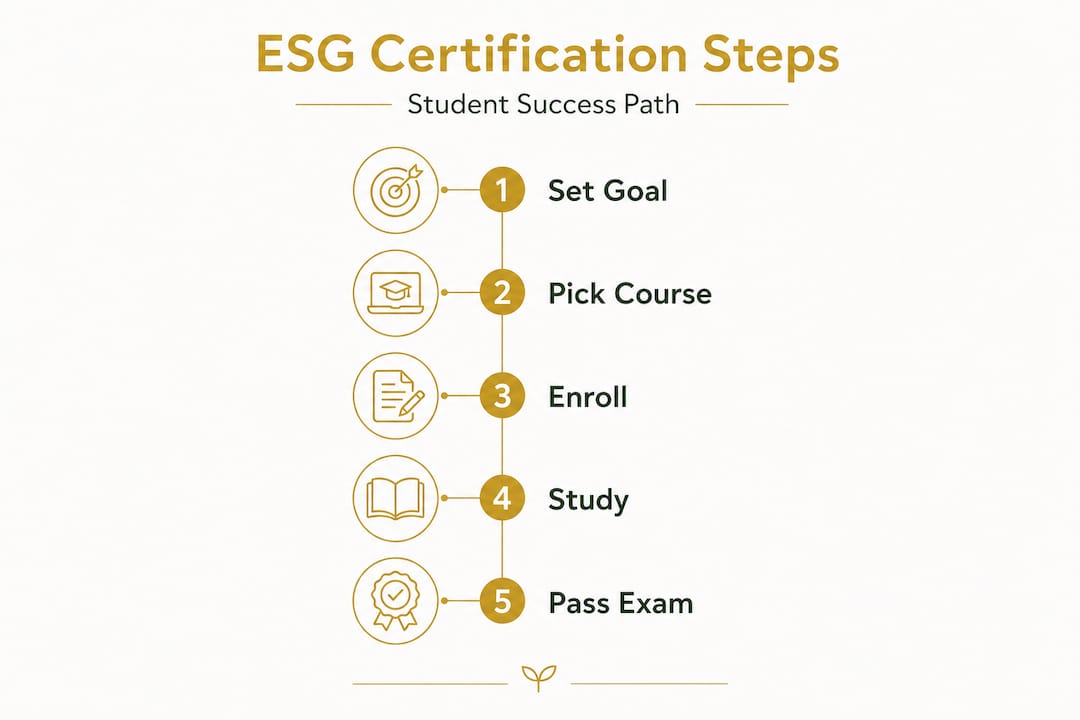
Step 1: Define your goal. Are you targeting a career in investment analysis, corporate sustainability reporting, or impact investing? Your answer shapes which certification makes the most sense. Analytical roles benefit from certifications heavy on ESG metrics and data. Reporting-focused roles benefit from credentials covering GRI, TCFD, and SFDR.
Step 2: Choose your certification. Compare the leading options based on cost, time commitment, and recognition. The two most accessible for students are ACCA’s Certificate in Sustainability for Finance and Harvard Extension School’s Sustainable Finance Microcertificate. The ACCA certificate covers five courses in climate risk, ESG metrics, and sustainability analytics, and is self-paced with a final assessment. The Harvard microcertificate requires two graduate-level courses completed within a year, each with a grade of B or higher.
Step 3: Enroll and set a study schedule. Once you have chosen your program, register and block out dedicated study time in your calendar. Treat it like a class. Consistency matters more than marathon sessions.
Step 4: Work through the coursework actively. Do not just read or watch videos passively. Take notes, summarize key frameworks in your own words, and connect concepts to real-world examples you find in financial news.
Step 5: Prepare for and complete the assessment. Review practice questions, revisit weak areas, and simulate exam conditions before your final attempt. Submit your work or sit your exam with confidence.
Step 6: Download and store your certificate. Once you pass, save your certificate in multiple formats and locations. You will need it for your resume, LinkedIn, and future job applications.
| Feature | ACCA Certificate in Sustainability for Finance | Harvard Sustainable Finance Microcertificate |
|---|---|---|
| Format | Self-paced online | Structured, instructor-led |
| Duration | Approx. 20 hours | Two courses within one year |
| Assessment | Final online exam | Graded coursework (B or higher) |
| Cost | Moderate, student pricing available | Higher cost, graduate-level tuition |
| Recognition | International | Academic and professional |
| Best for | Early-career students | Students seeking academic rigor |
Statistic to know: The ACCA certificate is designed to be completed in approximately 20 hours of self-paced study, making it one of the most time-efficient ESG credentials available for busy students.
Pro Tip: If cost is a barrier, look at affordable ESG courses before assuming top certifications are out of reach. Many platforms offer student pricing that makes professional-grade content genuinely accessible.
You can also stack certifications over time. Start with a self-paced credential to build your foundation, then pursue more rigorous programs as your knowledge grows. Browsing student-oriented ESG courses helps you map out that progression before you begin.
After completing your steps, it’s normal to encounter a few questions or bumps. Let’s tackle the most common ones.
Troubleshooting and tips: Common pitfalls in ESG certification
Even well-prepared students run into obstacles. Knowing the most common pitfalls in advance means you can sidestep them entirely.

Pitfall 1: Underestimating the time commitment. Students often enroll with good intentions and then let study sessions slide when assignments pile up. The fix is simple: schedule your ESG study time at the start of each week, not as an afterthought.
Pitfall 2: Treating certification as purely theoretical. ESG concepts like double materiality, scope 3 emissions, and portfolio carbon footprinting can feel abstract if you only read about them. Connect each concept to a real company or news story to make it stick.
Pitfall 3: Not using available assessment attempts. Most ESG certification programs allow multiple attempts on assessments and offer a flexible learning schedule. Students sometimes panic after a first attempt that does not go well, not realizing they have more chances. Read the assessment policy before you sit your first attempt.
Pitfall 4: Ignoring support resources. Most programs have forums, tutors, or community spaces where you can ask questions. Use them. Struggling alone with a concept you do not understand is one of the biggest time wasters in self-paced learning.
“The students who earn ESG certifications efficiently are not necessarily the smartest. They are the ones who plan their time, use their resources, and treat setbacks as information rather than failure.”
Practical tips for a smoother experience:
-
Break the syllabus into weekly chunks before you start
-
Use the Pomodoro technique (25 minutes focused study, 5 minute break) for dense material
-
Create a simple glossary of ESG terms as you go through each module
-
Connect with other students pursuing ESG credentials through LinkedIn or study groups
-
Review your progress against the learning objectives after each module, not just before the exam
Pro Tip: If you find a particular ESG concept confusing, search for how a major asset manager or bank explains it in their public sustainability report. Real-world language often makes technical definitions click faster than textbook definitions.
Find support for ESG students through platforms that offer structured learning paths, so you are never navigating complex material entirely on your own.
Once you’ve avoided these pitfalls, here’s how to confirm the value of your ESG certification and move forward.
Verify success: Recognizing and leveraging your certification
Earning your certification is step one. Leveraging it effectively is where many students leave value on the table.
How to verify successful completion:
-
Log into your certification platform and confirm your pass status and certificate issuance date.
-
Download your certificate in PDF format and save it to cloud storage and a local drive.
-
Check whether your certification body provides a digital badge (most do) and claim it immediately.
-
Verify that your name appears exactly as it does on your official ID, since discrepancies can cause problems during employer verification.
How to display your certification:
-
Add it to the Licenses and Certifications section of your LinkedIn profile with the issuing organization, date, and credential ID.
-
Include it in a dedicated Certifications section on your resume, listing the full credential name, issuing body, and year of completion.
-
Reference it specifically in cover letters when applying to roles that mention ESG, sustainability, or responsible investment.
-
Mention it in interviews when discussing your technical skills, and be ready to explain what you learned and how it applies to the role.
The ACCA certificate is recognized internationally and showcases ESG skills to employers in finance, which means it carries weight whether you are applying in London, Singapore, or New York.
| Action | Purpose | Timeline |
|---|---|---|
| Download certificate | Official record | Immediately after passing |
| Claim digital badge | LinkedIn and email signature | Within one week |
| Update LinkedIn | Employer visibility | Within one week |
| Update resume | Job applications | Before next application |
| Plan next credential | Career progression | Within three months |
Once you have your certification displayed and your profile updated, think about what comes next. Adding further ESG credentials over time builds a portfolio of expertise that signals genuine depth, not just a one-time effort.
Now that you know how to earn and showcase your ESG certification, let’s look at what most guides miss.
The overlooked edge in ESG certification: Beyond credentials
Here is an uncomfortable truth: a certificate alone will not get you hired. It will get you noticed. That is an important distinction.
Hiring managers in sustainable finance are becoming more sophisticated. They have seen enough resumes with ESG certifications to know that passing an online exam does not automatically mean someone can analyze a company’s transition risk or build a credible net-zero portfolio strategy. What separates candidates who get offers from those who do not is evidence of application.
The students who stand out are the ones who can point to a specific project, analysis, or piece of work where they applied ESG concepts to a real problem. That might be a university research paper on climate risk in a specific sector. It could be a volunteer project helping a local nonprofit measure its social impact. It might be a personal investment analysis you built using ESG data from public sources.
The certification gives you the vocabulary and the framework. What you do with it is what makes your story compelling. Seek out case competitions focused on sustainable finance. Look for internships or volunteer roles where ESG analysis is part of the work. Write about ESG topics on LinkedIn, even briefly. These actions demonstrate initiative in a way that a certificate alone cannot.
We also think students underestimate how much the learning community matters. Engaging with peers, discussing real cases, and debating ESG frameworks with others who are equally serious about the field accelerates your understanding faster than solo study ever will. Finding hands-on ESG programs that combine structured content with community and practical application is the smarter path, not just chasing credentials in isolation.
The credential opens the door. Your demonstrated ability to think and act on ESG principles is what keeps you in the room.
Take the next step: Flexible ESG certification options for students
You now have a clear picture of what ESG certification involves, how to prepare, and how to leverage it once you have it. The next move is yours.
Verdant Institute offers a student plan at $18 per month, giving you access to 16 courses and over 160 lessons covering everything from ESG foundations to advanced topics like transition finance and net-zero strategies. CPD tracking and certifications are built in, so you are building a verifiable record of expertise from day one. Check out student discounts and pricing to see exactly what you get at the student rate, and browse the full ESG course library to find the track that fits where you are right now.
Frequently asked questions
Which ESG certification is best for finance students?
The best choice depends on your learning style: ACCA’s certificate is self-paced and practical, while Harvard’s microcertificate offers a structured, academic approach with graded coursework.
How long do student ESG certifications take to complete?
The ACCA certificate takes approximately 20 hours of self-paced study, while the Harvard microcertificate requires two courses completed within one year.
What if I fail an ESG certification exam?
Most programs are designed with retakes in mind: ACCA allows three assessment attempts per registration, so one poor attempt does not end your path to certification.
Are ESG certifications recognized by employers?
Yes. Leading certifications are respected by employers in sustainable finance, with ACCA’s credential carrying international recognition across asset management, banking, and consulting sectors.