

Most finance professionals assume sustainability claims in capital markets are reasonably standardized. They are not. What is a sustainable finance framework, really? The answer depends on whether you are talking about an issuer-level bond framework, a regulatory disclosure regime, or a classification taxonomy — and these three things are fundamentally different, even though they are often discussed interchangeably. Getting them confused is not a minor error. It leads to failed audits, misaligned disclosures, and real reputational risk. This article breaks down each layer clearly, so you can apply them with precision.
Table of Contents
- What is a sustainable finance framework? Definition and core components
- The typical structure of green and social bond frameworks
- Regulatory and disclosure frameworks shaping sustainable finance worldwide
- Managing credibility: the role of external review and impact measurement
- Navigating multiple layers and common challenges in applying sustainable finance frameworks
- Why mastering sustainable finance frameworks is more crucial than ever for finance professionals
- Enhance your expertise with Verdant's sustainable finance training and resources
- Frequently asked questions
Key Takeaways
| Point | Details |
|---|---|
| Multilayered frameworks | Sustainable finance frameworks consist of jurisdictional rules, taxonomies, and issuer-level guidelines that interact but are distinct. |
| Core bond framework structure | Issuer frameworks typically follow use-of-proceeds, project evaluation, proceeds management, and reporting components. |
| Mandatory disclosures reduce greenwashing | Regulations like SFDR increase transparency and accountability, limiting misleading sustainability claims. |
| External review builds trust | Second-party opinions and impact verifications are essential for credibility and investor confidence. |
| Operational alignment crucial | Effective proceeds tracking and clear documentation help firms avoid compliance failures and strengthen disclosures. |
What is a sustainable finance framework? Definition and core components
The term "framework" gets used loosely in sustainable finance, which is exactly where the confusion starts. In practice, sustainable finance "typically refers to a structured set of criteria and rules that define what counts as sustainable activity and how capital is managed and reported." That definition is deceptively simple. The operational reality is more layered.
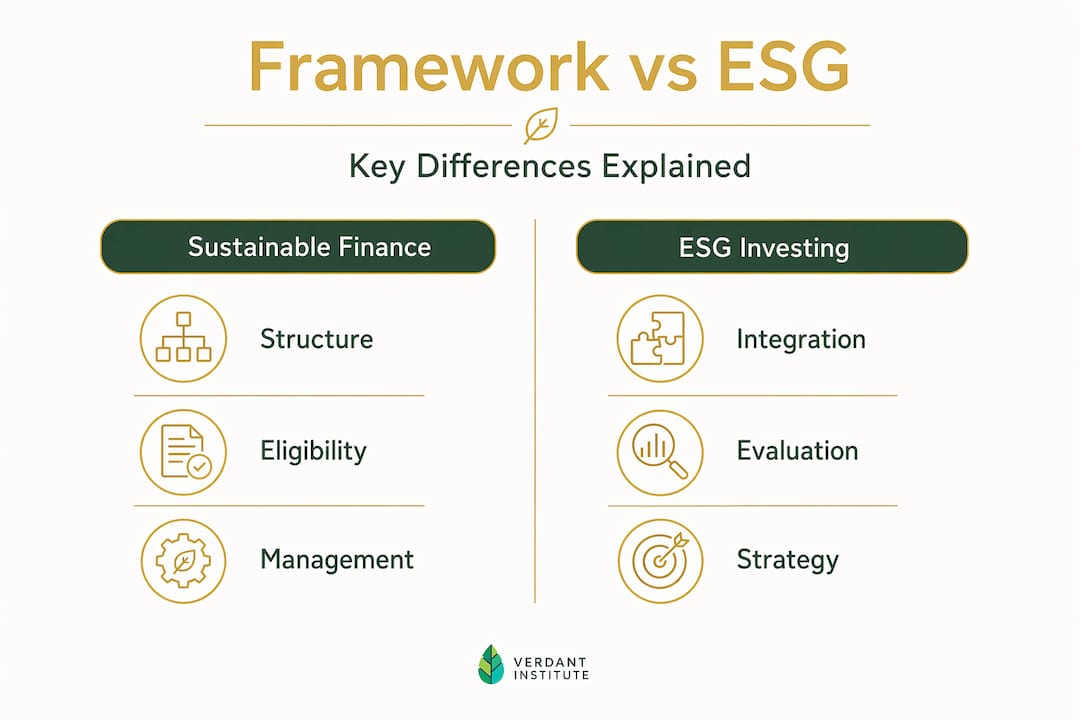
At its most basic, a sustainable finance framework serves three functions:
- Eligibility definition: It specifies which activities, assets, or projects qualify as sustainable under that framework's criteria.
- Capital management: It dictates how proceeds from labeled instruments (green bonds, social bonds, sustainability-linked loans) are tracked, allocated, and held pending disbursement.
- Disclosure and reporting: It requires issuers or fund managers to report on allocations, outcomes, and impact metrics on a recurring basis.
These frameworks sit at the center of the broader sustainable finance ecosystem, which includes ESG investing, responsible investment mandates, regulatory compliance, and impact measurement. Understanding sustainable business practices is foundational here, because frameworks translate those practices into financial product standards that investors and regulators can evaluate.
One important distinction: a sustainable finance framework is not the same as an ESG strategy. ESG investing integrates environmental, social, and governance factors into portfolio decisions. A framework, by contrast, governs specific financial instruments or institutional processes. Think of ESG as the investment philosophy and the framework as the operating manual that makes that philosophy auditable.
The typical structure of green and social bond frameworks
Bond and loan frameworks are the most common application of sustainable finance frameworks in capital markets. For green debt instruments, issuers follow a four-part structure aligned with ICMA-style guidelines: use of proceeds, project evaluation and selection, management of proceeds, and reporting. The City of Toronto's 2026 Sustainable Debenture Framework is a clear real-world example of this structure in action, with independent second-party opinions validating alignment.
Here is how each component works in practice:
- Use of proceeds: The issuer defines eligible project categories. For a green bond, these might include renewable energy, green buildings, clean transportation, or water management. Categories should align with recognized taxonomies or principles to ensure credibility.
- Project evaluation and selection: The issuer establishes a governance process, typically a sustainability committee, to review and approve projects against the defined eligibility criteria before proceeds are allocated.
- Management of proceeds: Net proceeds are tracked in a dedicated sub-account or through an internal ledger. Unallocated proceeds must be held in liquid, low-risk instruments. This is where many issuers stumble operationally.
- Reporting: Annual allocation reports disclose how proceeds were used. Impact reports quantify outcomes, such as tonnes of CO2 avoided or kilowatt-hours of renewable energy generated.
What is a sustainable bond framework without credible reporting? Essentially a marketing document. The reporting component is what separates genuine frameworks from greenwashing vehicles, and investors increasingly know the difference.
Pro Tip: Align your eligible project categories with at least one recognized external standard, such as the ICMA Green Bond Principles or the EU Taxonomy, from the start. Retrofitting alignment after the framework is drafted is time-consuming and often forces category revisions that delay issuance. Build framework reporting techniques into your internal processes before you go to market.
Regulatory and disclosure frameworks shaping sustainable finance worldwide
Issuer-level bond frameworks do not exist in a vacuum. They operate within a broader regulatory environment that is becoming more prescriptive by the year. The EU Sustainable Finance Disclosure Regulation (SFDR) mandates that financial market participants disclose sustainability risks and principal adverse impacts, and it works alongside classification systems like the EU Taxonomy to regulate sustainable finance products at the market level.
This is a critical distinction. SFDR is not an eligibility framework. It does not tell you which projects are green. It tells you how financial products and their managers must disclose their sustainability characteristics. The EU Taxonomy, by contrast, is a classification system that defines which economic activities are environmentally sustainable. These two instruments work together but serve different functions.
A few key concepts worth understanding here:
- Double materiality: Requires firms to disclose both how sustainability risks affect financial performance and how their activities affect the environment and society. This is the EU's approach.
- Financial materiality: Focuses only on sustainability factors that affect financial value. This is the approach taken by the ISSB (International Sustainability Standards Board) in its IFRS S1 and S2 standards.
- National-level rules: Jurisdictions like the UK, Singapore, and Jersey are developing their own disclosure regimes, often drawing from ISSB standards while adapting to local market conditions.
| Framework | Type | Scope | Key requirement |
|---|---|---|---|
| EU SFDR | Disclosure regulation | EU financial market participants | Disclose sustainability risks and adverse impacts |
| EU Taxonomy | Classification system | EU-regulated entities | Define environmentally sustainable economic activities |
| ISSB (IFRS S1/S2) | Reporting standard | Global, voluntary adoption | Financial materiality-based sustainability disclosures |
| National rules (UK, Singapore, etc.) | Jurisdictional regulation | Country-specific | Vary; often ISSB-aligned with local adaptations |
Understanding how these EU disclosure rules interact with issuer-level frameworks is essential for any finance professional working across borders or advising institutional clients.
Managing credibility: the role of external review and impact measurement
A framework document, however well-written, is only as credible as its verification. The market has converged on a clear standard: credible sustainable finance frameworks require external review, including Second-Party Opinions (SPOs) pre-issuance and independent post-issuance verification to confirm alignment and build investor confidence.
Here is what that process typically looks like:
- Pre-issuance SPO: A specialized research firm reviews the draft framework against recognized principles (ICMA, LMA, or relevant taxonomy) and issues an opinion on alignment. This typically takes four to six weeks.
- Post-issuance verification: After proceeds are allocated, an independent auditor or verifier confirms that funds went to eligible projects and that the reporting meets framework commitments.
- Annual impact reporting: Issuers publish impact data tied to funded projects, such as energy savings, emissions reductions, or social outcomes like affordable housing units created.
Beyond SPOs, impact-management frameworks like the Impact Principles move the market from one-off claims to ongoing impact measurement and annual independent disclosure. This is the direction the market is heading. Investors, particularly institutional allocators with their own ESG mandates, are demanding process evidence, not just outcome claims.
Pro Tip: Commission your SPO provider early, ideally before your framework is finalized. Experienced SPO providers will flag alignment gaps during the review process, which gives you time to revise eligibility categories before they become embedded in a published document. Starting late is the single most common reason green bond issuances miss their target launch windows.

Navigating multiple layers and common challenges in applying sustainable finance frameworks
Here is where many finance teams get into trouble. There are at least three distinct layers in sustainable finance: jurisdictional disclosure rules, eligibility taxonomies, and issuer-level frameworks. Mixing them up leads to failed audits and misaligned disclosures. Each layer has a different author, a different audience, and a different enforcement mechanism.
The three layers, clearly defined:
- Layer 1: Jurisdictional disclosure rules (e.g., SFDR, UK SDR). These are regulatory requirements. Non-compliance carries legal and supervisory risk. They govern how sustainability information is disclosed, not what qualifies as sustainable.
- Layer 2: Eligibility taxonomies (e.g., EU Taxonomy, Climate Bonds Standard). These define what qualifies as a sustainable activity or asset. They are often referenced in issuer frameworks but are not themselves issuer documents.
- Layer 3: Issuer-level frameworks (e.g., a corporate green bond framework). These are voluntary documents that describe how a specific issuer will use, manage, and report on proceeds from labeled instruments.
| Layer | Example | Who creates it | Enforcement |
|---|---|---|---|
| Jurisdictional disclosure | EU SFDR | Regulators | Legal/supervisory |
| Eligibility taxonomy | EU Taxonomy | Regulators/standards bodies | Regulatory alignment |
| Issuer framework | Corporate green bond framework | Issuer | Market/reputational |
Common operational pitfalls include poor proceeds tracking (especially when sub-accounts are not properly segregated), failure to document the project selection process, and inadequate reconciliation between internal accounting systems and framework commitments. Finance teams that invest in training on framework application before issuance consistently produce cleaner audit trails and stronger post-issuance reports.
Why mastering sustainable finance frameworks is more crucial than ever for finance professionals
Here is the perspective most articles skip: sustainable finance frameworks are not compliance boxes to check. They are governance tools that, when applied rigorously, fundamentally change how an institution manages capital and communicates with investors.
The finance professionals who treat frameworks as documentation exercises will always be playing catch-up. Regulators are tightening requirements. Investors are getting more sophisticated. And the reputational cost of a greenwashing allegation, even an unintentional one, is severe and lasting.
"SFDR should be understood as a disclosure-and-governance regime, not just a label, that helps reduce greenwashing through market and regulatory scrutiny."
That framing matters. Governance regime, not label. The distinction signals that sustainable finance frameworks are moving toward the same institutional seriousness as credit risk frameworks or liquidity management policies. They require dedicated ownership, documented processes, and recurring review cycles.
The professionals who will lead this space are not those who can recite the four components of a green bond framework. They are the ones who can design a framework that holds up under external scrutiny, integrate it into treasury operations, and communicate its integrity to a skeptical investor base. That requires layered sustainable finance expertise that goes well beyond reading a principles document.
The shift from one-off claims to institutional process is already underway. The Impact Principles, SFDR's entity-level disclosures, and the growing demand for post-issuance verification all point in the same direction. Professionals who build this capability now will be well-positioned as the regulatory environment continues to tighten through 2026 and beyond.
Enhance your expertise with Verdant's sustainable finance training and resources
Understanding sustainable finance frameworks at a conceptual level is one thing. Applying them correctly in a live transaction or regulatory filing is another. Verdant Institute bridges that gap with structured, practitioner-focused training designed specifically for finance professionals and students working in ESG and sustainable finance.

Verdant's sustainable finance courses cover everything from foundational concepts to advanced topics like transition finance, net-zero strategies, and disclosure practices under SFDR and ISSB standards. With over 160 lessons across 16 courses, CPD tracking, and recognized certifications, the platform is built for professionals who need more than surface-level knowledge. Flexible pricing options start at $18 per month for students and $58 per month for professionals. Visit Verdant Institute to explore learning tracks and find the right starting point for your career stage.
Frequently asked questions
What distinguishes a sustainable finance framework from ESG investing?
A sustainable finance framework is a structured set of criteria and rules governing the eligibility and management of sustainable financial products, while ESG investing specifically involves integrating environmental, social, and governance factors into investment decisions. The framework is the operating structure; ESG investing is the strategy applied within it.
Why are second-party opinions important in sustainable finance?
Second-party opinions provide independent verification that a framework or bond issuance meets recognized sustainability standards. Many frameworks require this external review to confirm alignment and build credibility with investors before and after issuance.
How do sustainable finance disclosure regulations help reduce greenwashing?
Disclosure regulations like SFDR require firms to publish comparable, standardized sustainability information, which means investors can compare how different firms integrate sustainability risks and hold them accountable for their claims.
What common mistakes should professionals avoid when implementing sustainable finance frameworks?
The most damaging mistakes are confusing the three framework layers (disclosure rules, taxonomies, and issuer frameworks), poor proceeds tracking, and inadequate documentation of the project selection process, all of which can result in audit failures or misleading disclosures.