

Somewhere between $3 trillion and $17 trillion. That is the range you will encounter when researching the global sustainable investment market size, and it is not a sign of sloppy reporting. It reflects something more fundamental: no single definition of "sustainable investment" exists, and the organizations counting it are not counting the same thing. For finance professionals building ESG strategies, pitching to clients, or conducting market analysis, this ambiguity is not just academic. It has direct consequences for how you frame opportunity, assess competition, and communicate with stakeholders. This guide cuts through the noise with evidence-backed figures and a clear analytical lens.
Table of Contents
- Defining sustainable investment market size
- The latest global sustainable investment market figures
- Why estimates vary: Source scope and methodology
- Implications for ESG strategy and market analysis
- The uncomfortable truth about sustainable investment metrics
- Explore next-level ESG analysis and training
- Frequently asked questions
Key Takeaways
| Point | Details |
|---|---|
| Definitions matter | Market size figures depend heavily on the scope and methodology used by each reporting entity. |
| Growth is strong | Global sustainable finance grew by 17% in 2024 with record highs reached in fund assets. |
| Source comparison | Comparing UNCTAD, GSIA, and Morningstar reveals major differences in what is counted. |
| Strategic application | Finance professionals must scrutinize how market data is constructed before using it in ESG strategies. |
| Continuous learning | Advanced ESG training and tools can help professionals stay updated and interpret market changes effectively. |
Defining sustainable investment market size
Understanding the numbers starts with understanding what is actually being measured. "Sustainable investment" and "sustainable finance" are not interchangeable, even though they are frequently used as if they were. Sustainable finance is the broader category. It covers all financial instruments and capital flows directed at environmental, social, or governance objectives, including green bonds, sustainability-linked loans, blended finance structures, and ESG-oriented funds. Sustainable investment, by contrast, tends to refer specifically to investment portfolios and funds that apply ESG criteria in some form.
This distinction matters enormously when you are comparing market size estimates across sources. The organizations producing these figures use different scopes and different counting rules:
- US SIF (US Forum for Sustainable and Responsible Investment): Reports total "sustainable marketed" or ESG-integrated assets under management across institutional and retail portfolios in the United States.
- Morningstar: Sizes the universe of funds that meet its own classification criteria for sustainability, based on publicly disclosed fund documentation and manager intent.
- GSIA (Global Sustainable Investment Alliance): Aggregates global responsible investment assets from regional member organization surveys, though data availability limits comparability across markets.
- UNCTAD (UN Conference on Trade and Development): Measures the broadest category of sustainable finance, including capital market products such as green bonds, sustainability bonds, and social bonds, alongside fund-level data.
As UNCTAD's WIR2025 Chapter 3 makes clear, market-size estimates differ sharply by methodology and scope, with trade-group AUM figures (like US SIF), fund-universe AUM figures (like Morningstar), and broader capital-market product totals (like UNCTAD) all producing meaningfully different results.
"The boundaries of what counts as 'sustainable' are not standardized across reporting bodies. A number that is accurate within one framework can be misleading when placed alongside a figure from a different one."
This is not a trivial point. When you explore the ESG investment courses at Verdant Institute, one of the first skills you build is learning how to interrogate a statistic at the source level rather than simply citing it. That skill starts here.
What gets included or excluded depends on a handful of key decisions each organization makes: whether to count only dedicated ESG funds or also integrated strategies, whether to use self-reported data or independently verified disclosures, and whether to include regional markets with limited public data. Each decision shifts the final figure by trillions of dollars.
The latest global sustainable investment market figures
With definitions clarified, let's examine the numbers that drive headline market size claims. The range of current estimates is genuinely wide, but each figure is defensible within its own framework. Finance professionals need to hold multiple figures in mind simultaneously, matching each to its context.
UNCTAD's broad sustainable finance measure
UNCTAD's most recent data shows that the global "sustainable finance" market grew to more than $8.2 trillion in 2024, representing 17% growth from 2023. This is UNCTAD's total estimate across capital market instruments, including green bonds, social bonds, sustainability bonds, and sustainability-linked bonds and loans. That 17% growth rate in a single year is significant. It suggests that even as regulatory scrutiny of ESG claims increased, capital flows into labelled sustainable instruments continued to accelerate.

UNCTAD also separately estimates that the sustainable fund market reached a record $3.2 trillion in 2024, focusing specifically on investment funds with stated sustainability mandates. That figure is more comparable to other fund-level estimates, though still uses UNCTAD's own classification logic.
Morningstar and Morgan Stanley's fund-level estimate
At the fund universe level, sustainable funds' AUM reached a record $4.13 trillion at end-December 2025, according to Morningstar and Morgan Stanley reporting. This figure uses Morningstar's classification methodology and represents the total assets held in funds that meet its ESG criteria globally. The gap between UNCTAD's $3.2 trillion and Morningstar's $4.13 trillion reflects both the time period difference and classification differences.
GSIA's broader responsible investment estimate
GSIA's Global Sustainable Investment Review 2024 places global sustainable and responsible investment fund assets at $16.7 trillion. This is the largest figure commonly cited and reflects GSIA's historically inclusive approach to counting ESG-integrated assets, including those where ESG factors are considered alongside but not necessarily prioritized over financial returns.
| Source | Scope | Figure | Year |
|---|---|---|---|
| UNCTAD | Broad sustainable finance (bonds, loans, funds) | $8.2 trillion | 2024 |
| UNCTAD | Sustainable funds only | $3.2 trillion | 2024 |
| Morningstar/Morgan Stanley | ESG-classified fund universe | $4.13 trillion | End-2025 |
| GSIA | Global responsible investment fund assets | $16.7 trillion | 2024 |
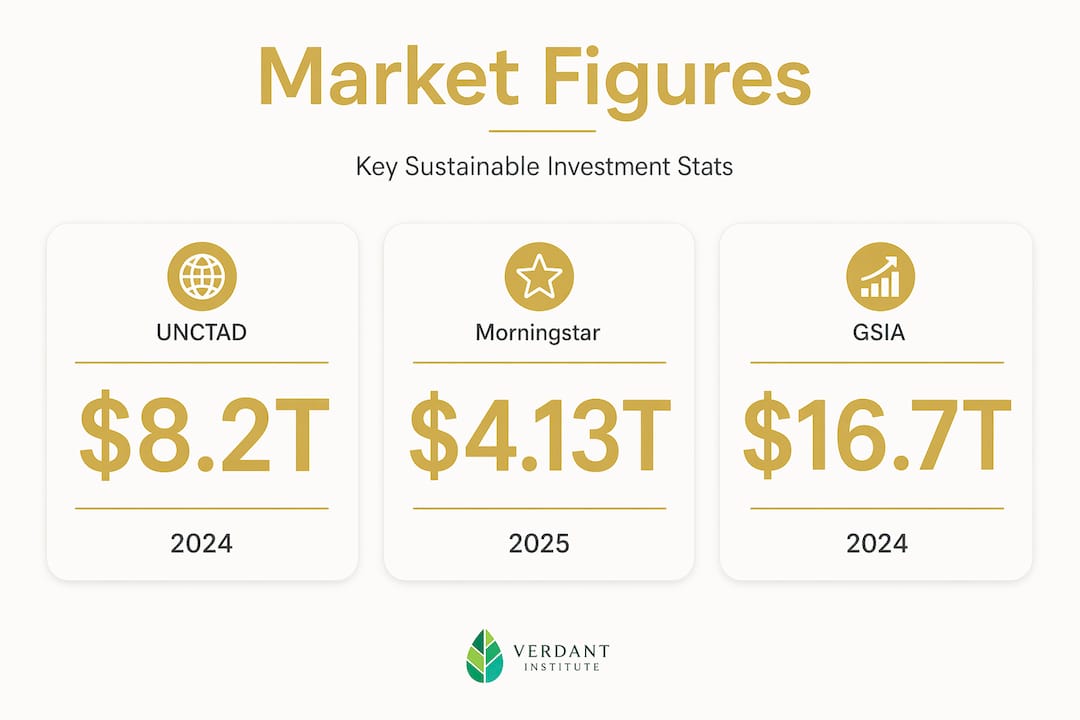
The table above illustrates why a single sustainable investment market size figure is impossible to pin down without first specifying what question you are trying to answer. Each number is accurate in its own context. Mismatching them creates analytical confusion and, in client-facing materials, potential credibility problems.
Key takeaways from the current data landscape:
- The sustainable fund market is growing consistently across all measurement frameworks
- Broad sustainable finance (including bonds and loans) significantly exceeds fund-only estimates
- Year-over-year growth at the UNCTAD level was 17% in 2024, a strong signal of continued capital momentum
- Record AUM figures at the fund level suggest sustained investor demand even amid regulatory pressure in some markets
Why estimates vary: Source scope and methodology
While market figures grab headlines, the "how" behind the numbers matters just as much. Three core factors drive divergence between sustainable investment market size estimates, and understanding them will make you a sharper analyst in any conversation about ESG market dynamics.
1. Scope of instruments included
UNCTAD's $8.2 trillion figure includes capital market instruments like green bonds and sustainability-linked loans, which do not appear in fund-level AUM counts. GSIA's $16.7 trillion historically included a very wide definition of ESG integration across institutional portfolios. Morningstar focuses on funds that meet its classification criteria based on disclosed documentation, which narrows the scope considerably but increases verifiability.
2. Data availability and survey methodology
As GSIA notes in its GSIR 2024 report, for this edition it could not rely on prior large-scale surveys for the US and Europe and therefore bridged the data gap using Morningstar data based on publicly disclosed fund documentation. This methodological shift substantially reduced scope compared to previous editions, and it explains the apparent decline in GSIA's estimates relative to historical reports. It is a reminder that seemingly lower figures do not always mean market contraction. Sometimes they mean the measurement got more rigorous.
3. Self-reported versus independently classified data
Some sources rely on asset managers self-reporting their ESG strategies, which creates obvious incentive problems. Funds may use broad ESG language to benefit from inclusion in sustainability-focused databases, a practice sometimes called "ESG labeling" rather than genuine integration. Sources that use independent classification, like Morningstar's methodology, tend to produce lower but more defensible figures.
| Source | Data method | US coverage | European coverage | Fund types included |
|---|---|---|---|---|
| UNCTAD | Capital market + fund data | Broad | Broad | Bonds, loans, funds |
| GSIA GSIR 2024 | Morningstar-bridged, public docs | Reduced scope | Reduced scope | Funds |
| Morningstar | Independent classification | Full | Full | Funds |
| US SIF | Member survey + institutional AUM | US-focused | Limited | Broad ESG strategies |
Pro Tip: Before citing any sustainable investment market size figure in a report or presentation, read the methodology section of the source. Confirm what instruments are included, whether the data is self-reported or independently verified, and whether the geographic scope matches your analysis. This single habit will prevent significant analytical errors.
Explore sustainable investment data solutions to understand how structured training can build these source-evaluation skills systematically.
Implications for ESG strategy and market analysis
Knowing why numbers differ is crucial, but how you apply them is where expertise gets sharpened. The practical implications of market size literacy extend across several core analyst functions.
Using market size figures strategically
Finance professionals use market size data in strategy development, client reporting, fund positioning, and regulatory commentary. Each use case demands a different level of precision. For a high-level market overview in a client pitch, UNCTAD's $8.2 trillion figure for total sustainable finance may be the most impressive and accurate representation of the opportunity. For a fund benchmark comparison, Morningstar's $4.13 trillion AUM figure is far more appropriate, because it measures the same universe you are competing within.
The GSIA's Global Sustainable Investment Review 2024 reporting of $16.7 trillion in global sustainable fund assets is best used in historical trend analysis, acknowledging that prior editions used broader survey data and that the current edition reflects a methodological shift toward more conservative, documentation-based classification.
Red flags to watch for
Not all sustainable investment statistics in circulation are being used in good faith. Watch for these patterns:
- A source citing a very large total without specifying whether it includes bonds, loans, or funds only
- Comparisons across different years from different sources without adjusting for methodology changes
- Claims of market decline or growth that do not account for reclassification effects
- Regional figures presented as global totals
Practical questions to ask when comparing market size data
- What instruments are included? (Funds only, or broader capital market products?)
- Is the data self-reported or independently classified?
- What geographic scope applies?
- Has the methodology changed between reporting periods?
- What is the base year and how does it align with the comparison figure?
Pro Tip: Supplement quantitative market size data with qualitative ESG metrics, including regulatory trend analysis, engagement activity, and stewardship reporting, to build a complete picture of where the market is actually heading. Numbers measure the past. Qualitative signals often predict what comes next.
Building these analytical layers is exactly what ESG analysis training at Verdant Institute is designed to develop, from foundational data literacy to advanced application in transition finance and net-zero strategy.
The uncomfortable truth about sustainable investment metrics
Here is what most market news sources will not say plainly: the biggest sustainable investment market size figures exist, in part, because they serve a purpose for those reporting them. Larger numbers attract more capital, validate industry growth narratives, and support regulatory arguments. That does not make them fabricated. It does mean that headline figures are never neutral.
The professional skill most undervalued in ESG analysis is skepticism about scope. Not cynicism, which leads to dismissing the market altogether, but precise, methodological skepticism that asks "compared to what, and measured how?" The difference between GSIA's $16.7 trillion and UNCTAD's $3.2 trillion sustainable fund estimate is not a contradiction. Both figures are internally consistent. The contradiction only appears when analysts pick numbers without reading the fine print.
Our view at Verdant Institute, built from working with finance professionals across institutional investment, asset management, and sustainable finance advisory, is that the best ESG analysts are fundamentally comfortable with ambiguity. They do not need one clean number. They understand why different frameworks produce different results and they use that understanding to communicate more credibly, not less.
The professionals who struggle with ESG market data are often those trained to seek a single authoritative source. Sustainable finance does not yet have one. The ISSB is working toward greater standardization of sustainability disclosures, and Morningstar, UNCTAD, and GSIA continue to refine their methodologies. But in the near term, multi-source triangulation, reading footnotes carefully, and asking the right questions remain the core competencies.
One practical approach: build a personal source matrix. Track which sources you use for which types of claims, note their methodology, and update your matrix when new editions are published. This turns methodological awareness from a vague principle into a repeatable professional practice.
Explore next-level ESG analysis and training
If this breakdown of sustainable investment market size has surfaced questions about how you are currently sourcing, interpreting, or applying ESG market data, that is exactly the right reaction.
Verdant Institute is built for finance professionals who want to move beyond headline statistics into the analytical depth that separates credible ESG practitioners from those simply citing big numbers. The ESG course library covers foundational market literacy, advanced ESG strategy, and applied transition finance across 16 structured courses and more than 160 lessons. Whether you are an analyst building source-evaluation skills or a senior professional pursuing CPD-tracked certification, the platform meets you where you are. Review the pricing for sustainable finance solutions and find the plan that fits your development goals, starting from $18 per month for students and $58 per month for professionals.
Frequently asked questions
What is the global sustainable investment market size in 2026?
The most recent published estimates place broad sustainable finance at $8.2 trillion for 2024, while sustainable fund AUM reached $4.13 trillion at end-December 2025, depending on which instruments and methodologies are included.
Why do sustainable investment market size estimates differ?
Market-size estimates differ sharply because of differences in scope (funds only versus broader capital market products), data methodology (survey-based versus independently classified), and geographic coverage across reporting organizations.
How should analysts interpret market size figures?
Always verify the definition and methodology behind any figure before applying it to strategy or reporting, since the same instrument can be counted or excluded depending on the source framework.
What is included in the sustainable investment market size?
The answer depends entirely on the source. UNCTAD includes green bonds, sustainability-linked loans, and funds; Morningstar counts fund universe AUM based on public disclosures; and GSIA historically aggregated a broader set of responsible investment strategies from regional surveys.