

More ESG data does not automatically mean better investment decisions. That assumption has led many analysts down a path of data overload, where volume replaces rigor and compliance theater substitutes for genuine insight. ESG (Environmental, Social, Governance) disclosure research exists precisely to cut through that noise, testing whether the information companies report actually moves markets, reduces risk, and supports capital allocation in meaningful ways. For finance professionals and students building careers in sustainable finance, understanding why disclosure research matters is as important as knowing what gets disclosed.
Table of Contents
-
Demystifying ESG disclosure: What is it and why does it matter?
-
The regulatory and economic case for ESG disclosure research
-
Market realities: Does ESG disclosure impact all markets equally?
-
Why materiality and methodology define disclosure’s usefulness
-
Common pitfalls and advanced takeaways for ESG disclosure research
-
Perspective: Why most ESG disclosure research misses the real test
Key Takeaways
| Point | Details |
|---|---|
| Quality matters more than quantity | Not all ESG disclosure is equally valuable; decision-relevant information is what drives real impact. |
| Market context drives results | Disclosure research shows effects depend heavily on market maturity and institutional interpretation. |
| Scoring and modeling require scrutiny | Always examine ESG score methodologies rather than relying solely on reported numbers. |
| Materiality is essential | Materiality filters ensure disclosed ESG data is useful for decision-making and not just compliance. |
Demystifying ESG disclosure: What is it and why does it matter?
ESG disclosure refers to the formal reporting of a company’s environmental impact, social practices, and governance structures to investors and other stakeholders. In an investment context, disclosure is not just a reporting exercise. It is a mechanism for reducing information asymmetry, the gap between what company management knows and what investors can observe. When that gap closes, capital markets can price risk more accurately.
But here is where many analysts stop short. They treat disclosure as a data-collection exercise, pulling numbers from sustainability reports and feeding them into models without asking whether those numbers actually matter. The more rigorous question is whether disclosure effects are real and structural, or whether they are simply the result of companies that already perform well also disclosing more. A Sustainability Journal study makes this precise point: ESG disclosure research matters because it helps test whether disclosure effects are structural (and thus worth mandating) rather than spurious co-movement.
That distinction is not academic. If better ESG disclosure causes improved financial outcomes, regulators have a strong case for mandating it. If the correlation is spurious, mandating disclosure imposes costs without delivering benefits. For you as an analyst or student, this means that every time you work with ESG data, you should be asking a prior question: Is this disclosure telling me something real, or am I just seeing a pattern that happens to look meaningful?
The primary stakeholders in ESG disclosure include investors seeking decision-relevant information, regulators designing rules that serve public interest, and companies managing the costs and reputational effects of what they report. Each group has different incentives, and those incentives shape what gets disclosed, how it gets framed, and how it gets used. Recognizing this dynamic is the first step toward using ESG data with genuine analytical discipline.
You can explore structured approaches to this kind of thinking through ESG analysis courses that build from foundational concepts to applied research skills.
“Not all disclosure is created equal. The structural question, whether disclosure changes behavior and outcomes or merely reflects them, is the one worth answering.”
The regulatory and economic case for ESG disclosure research
Regulations around ESG disclosure are expanding rapidly, from the European Union’s Corporate Sustainability Reporting Directive to the SEC’s climate disclosure rules in the United States. But regulation alone does not guarantee useful information. The net benefits of ESG disclosure depend on market frictions, investor demand, and the design of the disclosure framework itself.
Market frictions are the real-world barriers that prevent information from flowing freely between companies and investors. These include search costs (how hard it is to find relevant data), processing costs (how difficult it is to interpret what you find), and verification costs (how expensive it is to confirm that reported data is accurate). Good disclosure regulation reduces these frictions. Poor regulation adds to them by requiring companies to report data that investors cannot easily use.
The table below illustrates how disclosure quality and regulatory design interact:
| Scenario | Regulatory approach | Disclosure quality | Market outcome |
|---|---|---|---|
| High friction, weak rules | Voluntary, minimal guidance | Low, inconsistent | Poor price informativeness |
| High friction, strong rules | Mandatory, standardized | High, comparable | Improved capital allocation |
| Low friction, strong rules | Mandatory, principles-based | High, flexible | Efficient market response |
| Low friction, weak rules | Voluntary, market-driven | Variable | Depends on investor sophistication |
Research also links mandated ESG disclosure to measurable financial outcomes including cost of capital, earnings quality, and capital market functioning. Companies that disclose more material ESG information tend to face lower borrowing costs, partly because investors can assess risk more accurately and partly because disclosure itself signals a commitment to accountability.
The main trade-offs regulators face when designing ESG disclosure rules include:
-
Compliance costs versus information value. Requiring detailed disclosure is expensive for companies, especially smaller ones. The benefit must outweigh that cost.
-
Standardization versus flexibility. Standardized formats make comparison easier but may not capture what is most relevant for each sector or business model.
-
Mandatory versus voluntary approaches. Mandatory disclosure ensures coverage but risks low-quality, box-checking responses. Voluntary disclosure can be more genuine but creates gaps.
-
Timeliness versus accuracy. Faster disclosure may be less reliable; more careful reporting takes time.
Pro Tip: When evaluating any ESG disclosure framework, examine both the regulation itself and how actual market participants process the new information. A well-designed rule that investors ignore produces no benefit.
Verdant’s resources cover the regulatory landscape across major jurisdictions, helping you build a working knowledge of how rules translate into practice.
Market realities: Does ESG disclosure impact all markets equally?
The short answer is no, and this is one of the most underappreciated facts in ESG analysis. The effect of ESG disclosure on market behavior depends heavily on the institutional environment where it lands. Research comparing developed and emerging markets shows that ESG disclosure raises price informativeness more in developed markets than in EMDEs (Emerging Markets and Developing Economies).
Why the gap? In developed markets, you have sophisticated institutional investors, well-resourced rating agencies, active financial media, and regulatory infrastructure that collectively process disclosed information quickly and accurately. In EMDEs, those intermediaries are thinner on the ground. A company can disclose excellent ESG data, but if the local investment community lacks the tools or incentives to act on it, prices may not respond.

| Factor | Developed markets | EMDEs |
|---|---|---|
| Institutional investor base | Large, sophisticated | Smaller, less specialized |
| ESG rating agency coverage | Broad and competitive | Limited and inconsistent |
| Regulatory enforcement | Strong | Variable |
| Price informativeness from ESG | Higher | Lower |
| Disclosure uptake speed | Fast | Slower |
What makes ESG disclosure more effective in any context?
-
Strong institutional investors who have both the resources and the mandate to analyze ESG data
-
Active rating agencies and research providers that translate raw disclosures into actionable signals
-
Regulatory enforcement that ensures reported data is accurate and complete
-
Investor sophistication at the portfolio manager level, meaning the ability to distinguish material ESG risk from reporting noise
-
Comparable disclosure standards across companies in the same sector or index
“The interpreter of disclosure can be as important as the disclosed data itself. A sophisticated institutional investor in London and a retail investor in an emerging market may receive the same ESG report and reach completely different conclusions.”
This is a crucial insight for disclosure interpretation in practice. If you are analyzing ESG data from a company operating in a market with weak institutional infrastructure, you need to apply additional scrutiny rather than assuming the disclosed numbers carry the same weight they would in a well-developed market.
Why materiality and methodology define disclosure’s usefulness
Materiality is the principle that only decision-relevant information should be disclosed. In financial reporting, materiality has a long history. In ESG reporting, it is still being worked out, and that ambiguity creates real problems for analysts.
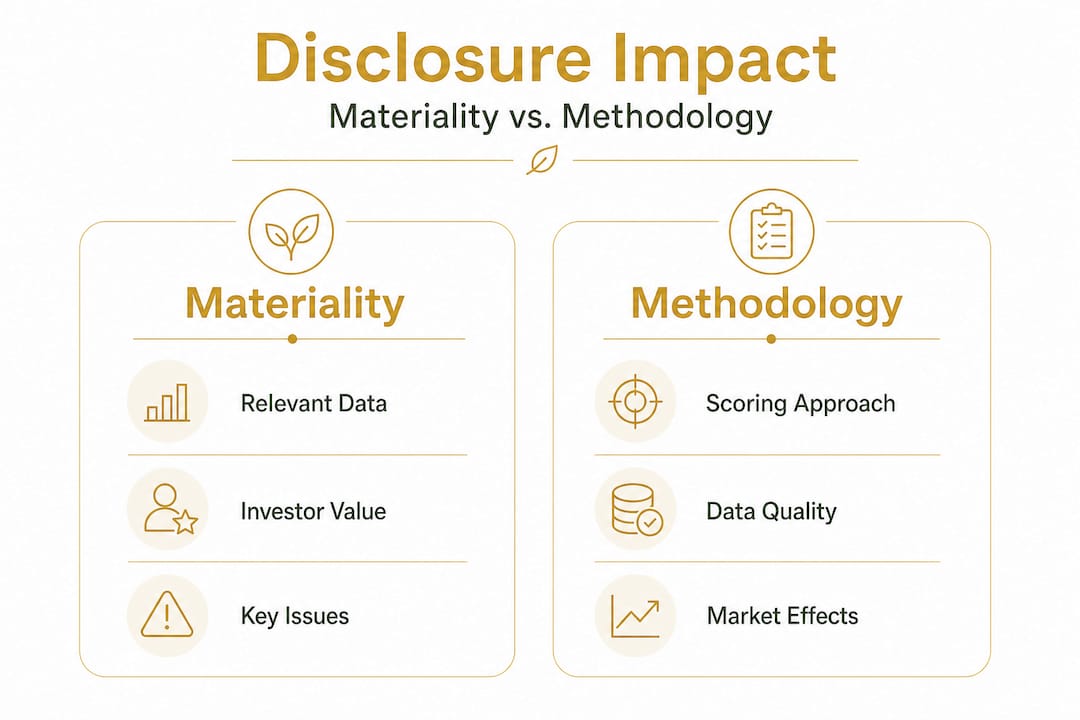
KPMG’s materiality guidance frames this clearly: what to disclose and how to disclose it determines whether disclosures are decision-useful rather than costly noise. A company reporting on 47 ESG metrics when only 8 are financially material to its business model is not being transparent. It is creating a data management problem for investors.
Disclosure research tests for this distinction. It asks whether specific disclosures move prices, affect analyst forecasts, change lending terms, or influence voting behavior. If a disclosure does none of those things, it is noise. If it does, it is signal.
The methodology behind ESG scores adds another layer of complexity. ESG scoring methodologies depend on disclosure availability and modeling choices. A score is not a disclosure. It is a derived product, built from disclosed data, weighted by a provider’s model, and filtered through assumptions about what matters. Two providers can look at the same company’s disclosures and produce very different scores, not because one is wrong, but because their models weight factors differently.
How to spot decision-useful versus non-informative ESG data:
-
Does it connect to financial performance? Material ESG data should have a plausible link to revenue, cost, or risk.
-
Is it specific and verifiable? Vague commitments (“we are committed to sustainability”) are not disclosures. Quantified targets with timelines are.
-
Is it consistent over time? One-off disclosures are less useful than data that allows trend analysis.
-
Does it vary across companies? If every company in a sector reports the same number, the data has no discriminatory power.
-
Is it comparable? Disclosures using different methodologies or boundaries cannot be meaningfully compared.
Pro Tip: Before relying on any ESG rating in your analysis, read the provider’s methodology documentation. Understand which disclosures drive the score, how missing data is handled, and whether the weighting reflects what is material for the specific sector you are analyzing.
Developing this kind of critical lens is exactly what structured ESG scoring courses are designed to build.
Common pitfalls and advanced takeaways for ESG disclosure research
Even experienced analysts fall into predictable traps when working with ESG disclosure data. Recognizing these patterns early saves significant time and protects against flawed conclusions.
The most common pitfalls include:
-
Overreliance on disclosure volume. More pages in a sustainability report do not mean better disclosure. Length can obscure as easily as it reveals.
-
Trusting scores without examining the underlying disclosures. A high ESG score can mask poor performance on specific material issues if those issues are underweighted in the scoring model.
-
Ignoring institutional context. Applying the same analytical framework to disclosures from a German industrial company and a Nigerian energy producer without adjusting for market context will produce misleading results.
-
Treating voluntary and mandatory disclosure as equivalent. Companies choose what to voluntarily disclose strategically. Mandatory disclosures, while imperfect, are harder to cherry-pick.
-
Conflating disclosure with performance. A company that discloses its carbon emissions is not necessarily reducing them. Disclosure and action are related but distinct.
Here is a practical framework for avoiding these pitfalls in your work:
-
Start with materiality. Identify which ESG issues are financially material for the specific sector and company before collecting data.
-
Trace scores back to disclosures. For any ESG score you use, identify the three to five disclosures that drive it most, and assess the quality of those underlying reports.
-
Adjust for institutional context. Note the regulatory environment, investor base, and rating agency coverage for each market you are analyzing.
-
Compare mandatory and voluntary disclosures separately. Do not blend them in the same analysis without flagging the difference.
-
Test for financial relevance. Ask whether the disclosed information has a plausible mechanism for affecting financial outcomes before including it in a model.
Research confirms that disclosure quality and who interprets it can drive whether ESG disclosure actually changes market behavior. The analyst who understands both sides of that equation, quality of the data and sophistication of the interpreter, is the one producing research that holds up under scrutiny.
“Advanced ESG analysis is not about collecting more data. It is about asking sharper questions of the data you already have.”
For professionals looking to build these skills systematically, advanced ESG analysis training provides the structured frameworks that make the difference between surface-level reporting and genuinely useful research.
Perspective: Why most ESG disclosure research misses the real test
Here is an uncomfortable observation: most ESG analysis in practice goes through the motions. Analysts gather data, apply a standard scoring framework, check the compliance boxes, and move on. The research looks thorough on paper. But it rarely asks the one question that separates useful analysis from expensive busywork: Does this disclosure actually tell us something that changes the investment case?
The real test of ESG disclosure research is not whether you have covered all the metrics. It is whether you can distinguish a genuine signal from a well-packaged noise. That requires going beyond the surface of what companies report and interrogating the context, the methodology, and the parties who translate raw data into market prices.
In our view, the analysts who consistently outperform in ESG-integrated strategies are not the ones with the most data subscriptions. They are the ones who understand which disclosures are material for a specific business model, which scoring methodologies are appropriate for a given sector, and which institutional environments allow disclosed information to actually reach prices.
The hard-won lesson here is that relying on disclosure volume or headline scores is a shortcut that costs you accuracy. The material nuance in a company’s climate transition plan, the governance structure behind a social commitment, or the verification methodology behind an emissions figure, these are where the real analytical edge lives. Building practical ESG research skills means training yourself to work at that level of depth, not just processing data faster.
Advance your ESG analysis skills with Verdant
If this article has sharpened your thinking about ESG disclosure research, the next step is building the structured skills to apply that thinking consistently in your work.

Verdant Institute offers a library of 16 courses and over 160 lessons designed specifically for finance professionals and students working in sustainable finance. From foundational ESG concepts to advanced topics like transition finance and net-zero strategy, Verdant’s ESG courses give you the analytical frameworks that go well beyond data collection. Whether you are just starting out or looking to sharpen your research methodology, flexible course pricing makes it accessible for both students and working professionals. Explore the full range of ESG learning resources and start building the skills that actually move the needle in sustainable investing.
Frequently asked questions
Why is ESG disclosure research important for finance professionals?
ESG disclosure research clarifies which disclosures matter for financial performance and informs better investment decisions by testing the real effects of ESG data. As a Sustainability Journal study notes, it helps determine whether disclosure effects are structural and worth mandating, rather than simply reflecting existing performance patterns.
How do regulations affect the usefulness of ESG disclosures?
Regulations shape what gets disclosed, but the net benefit depends on how well the rules reduce information gaps without creating costly compliance burdens. Research confirms that net benefits depend on market frictions, investor demand, and the specific design of the disclosure framework.
Does ESG disclosure affect developed and emerging markets the same way?
No. ESG disclosure raises price informativeness more in developed markets than in emerging ones, largely because institutional investors, rating agencies, and regulatory infrastructure are better equipped to process and act on disclosed information. Cross-market research supports this finding directly.
How do ESG scores relate to underlying disclosures?
ESG scores are derived products built from raw disclosures and weighted by a provider’s modeling choices, not direct reflections of company performance. Understanding the methodology behind any score is essential, as S&P Global’s ESG score methodology illustrates through its dependence on disclosure availability and analytical assumptions.