

Finding a sustainable finance training platform that offers both practical tools and recognized certification often feels inconsistent with market needs. Many platforms limit access to advanced modules, skip sector-specific templates, or hide pricing behind manual quotes and private demos. This side-by-side review lets readers choose the best sustainable finance training provider with clear price points, real certifications, and practical course features.
Table of contents
Verdant institute
At a glance
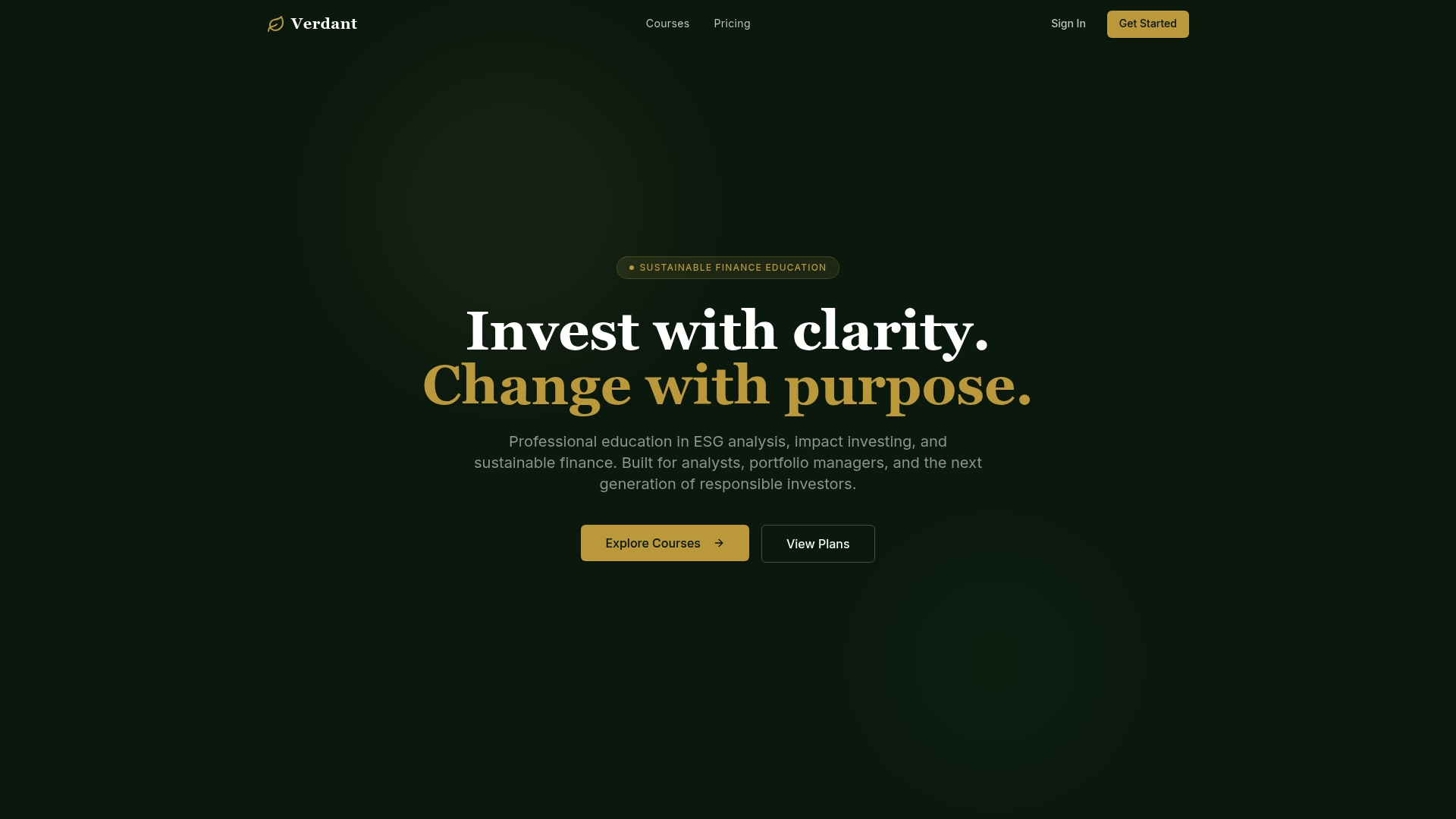
16 courses and 160+ lessons make up the platform's core library. The site groups content into four learning tracks: Academic Foundations, Foundations, Deep Dives, and Advanced Practice. That structure targets both classroom-style learning and on the job skill building for finance roles.
Core features
The course library includes modules on ESG frameworks, impact measurement, transition finance, and origins of sustainable finance. The platform provides CPD hours tracking and a formal ESG certification that maps to professional development requirements. Learning tracks separate beginner material from advanced practice, so candidates can follow a clear progression. Plans are subscription based and include student and professional pricing tiers.
Key differentiator
The platform's design centers on tiered learning tracks with built in CPD certification and applied tools for impact measurement. That alignment keeps coursework relevant to portfolio analysis and responsible investing workflows. The content mix moves from theory to practice so analysts can apply methods directly to risk and engagement work. This focus makes the curriculum practical for finance teams and classrooms.
Pros
-
The course catalog covers foundational to advanced topics in ESG and sustainable finance. This lets a trainee build a full topical map without jumping between vendors.
-
Tracked CPD hours and a certification pathway help professionals document continuing education for internal compliance or regulator reporting. This saves time compared with ad hoc course records.
-
The platform separates Academic Foundations from Advanced Practice, which helps instructors assign material by competency level. Teams can use tracks for onboarding and upskilling.
-
Pricing starts at a low entry point for learners, which lowers the barrier for students entering the field. That makes it easier for schools and early career professionals to adopt the program.
Cons
- The offering is limited to online courses and does not include in person training or mentorship programs, which some firms use for applied coaching and internships.
Who it's for
The product fits students entering sustainable finance and finance professionals seeking structured ESG skill upgrades. It matches junior analysts, portfolio managers, and responsible investors who need documented CPD hours and certification. It is less suitable for casual learners who want non technical introductions or for teams seeking in person coaching.
Unique value proposition
Student plan from $18/month and Professional plan from $58/month gives a clear entry price for career minded learners. Those price points let firms budget per seat for training and compliance without multi year contracts. For a finance team that needs repeatable training and CPD evidence, the subscription model keeps costs predictable while supporting staged skill development.
Real world use case
A junior analyst at an asset management firm completes the ESG integration track to improve portfolio risk analysis. The analyst records CPD hours from the platform and earns certification the firm accepts for internal training logs. Managers use the Advanced Practice modules to assign follow up work on transition finance.
Pricing
Student plan from $18/month. Professional plan from $58/month. Additional tiers extend up to $158/month for full access to all courses and advanced practice content.
Website: https://verdantinstitute.com
ESG academy
At a glance
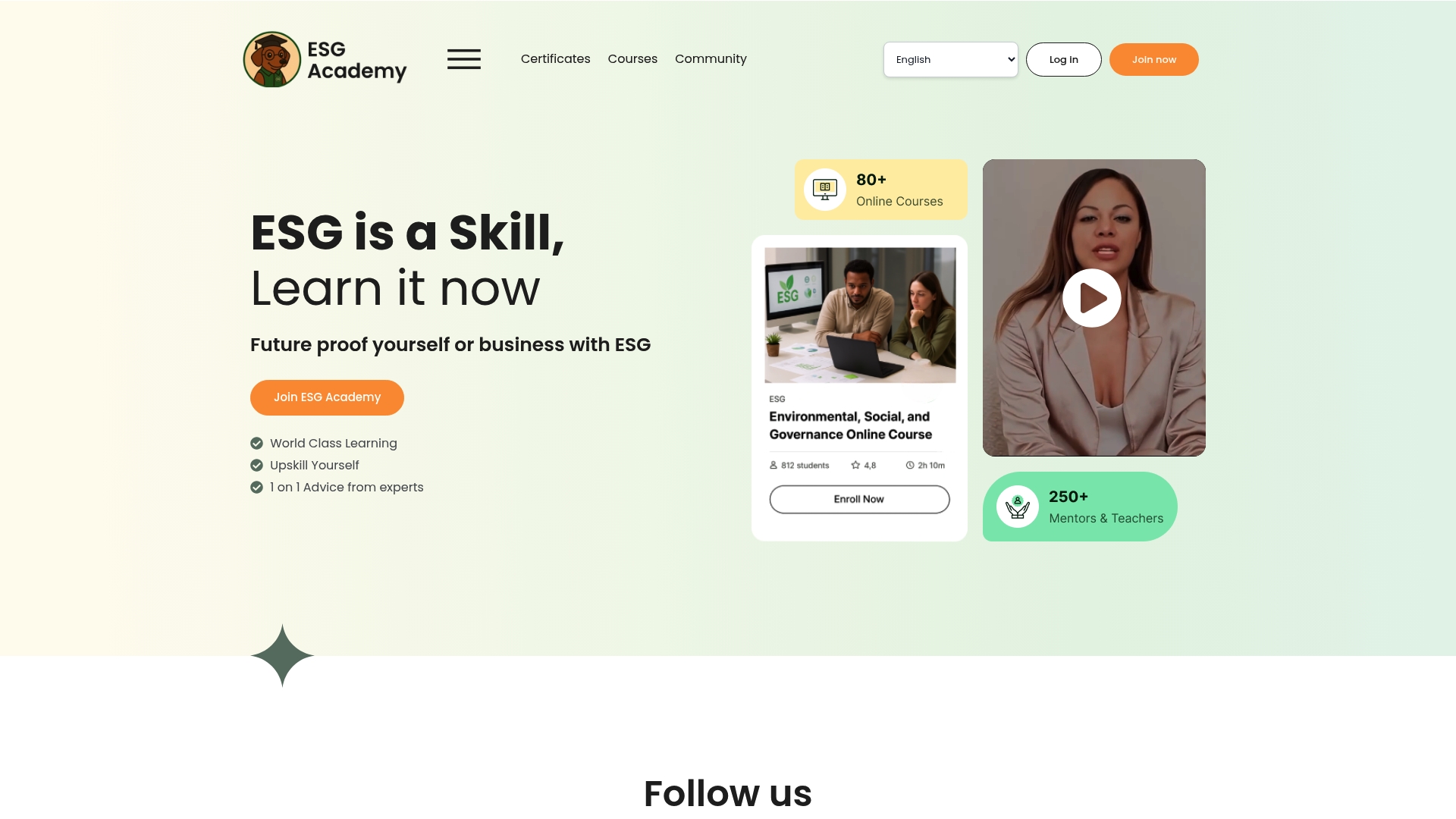
Free initial courses are available, and the vendor advertises certificates that employers and recruiters accept. The platform was founded by Francine Carron to widen access to ESG skills. Courses include sector specific modules, practical templates, and community support for learners worldwide.
Core features
- Structured ESG courses covering environmental, social, governance, and sector specific content for different industries.
- Certificates of completion that learners can use for career or internal recognition.
- Community forums for peer support, networking, and discussion around course material.
- Customizable training programs for businesses and small and medium sized enterprises.
- Practical tools and templates including checklists and downloadable resources to apply learned methods.
Key differentiator
ESG Academy focuses on sector specific and immediately usable training for learners across regions. The curriculum pairs foundational theory with ready to use templates and checklists. That approach makes it easier for a sustainability manager or analyst to apply course outputs directly to corporate policies.
Pros
- Accessible, practical training for both beginners and working professionals. Many courses aim to move learners from theory to workplace tasks.
- Global community and peer support help learners compare approaches across jurisdictions. Community feedback can speed practical problem solving.
- Certificates are positioned for employer recognition, which helps professionals document skill development. Employers and recruiters may accept these credentials according to the vendor.
- Multi language content and visual learning aids reduce barriers for non native English speakers. That widens practical uptake in international teams.
- Wide course range including sector specific, foundational, and corporate programs gives learners options for targeted study.
Cons
- There are no public user reviews or third party evaluations, so real world platform strengths and weaknesses remain unclear.
- Pricing information beyond free initial courses is not detailed. Organizations will need to request figures for bulk or enterprise programs.
- The product data lacks independent assessments of platform usability and technical performance. Buyers must judge UX from trial access.
When it may not fit
If your procurement process requires third party reviews or independent ratings, this offering may not meet that need. Large enterprises that need clear documented pricing for budgeting will need to request a formal quote. Teams needing verified LMS integrations should confirm technical compatibility directly with the vendor.
Who it's for
Individuals building ESG expertise and professionals moving into sustainability roles will get practical skills from these courses. Small and medium sized enterprises seeking tailored training for staff will find the customizable programs useful. Corporate sustainability teams that need templates and quick policy inputs will benefit most.
Real world use case
A sustainability manager at a manufacturing company completes sector specific modules to map regulatory requirements and to draft internal policy. The manager uses downloadable templates to create a compliance checklist and then issues certificates to staff who complete training. The training shortens the internal review cycle for reporting.
Pricing
Free access exists for initial courses. The vendor states subscription and premium programs likely exist, but no public pricing details are provided. Contact the vendor for enterprise or group pricing and formal quotes.
Website: https://esgacademy.education
E-learning ESG
At a glance
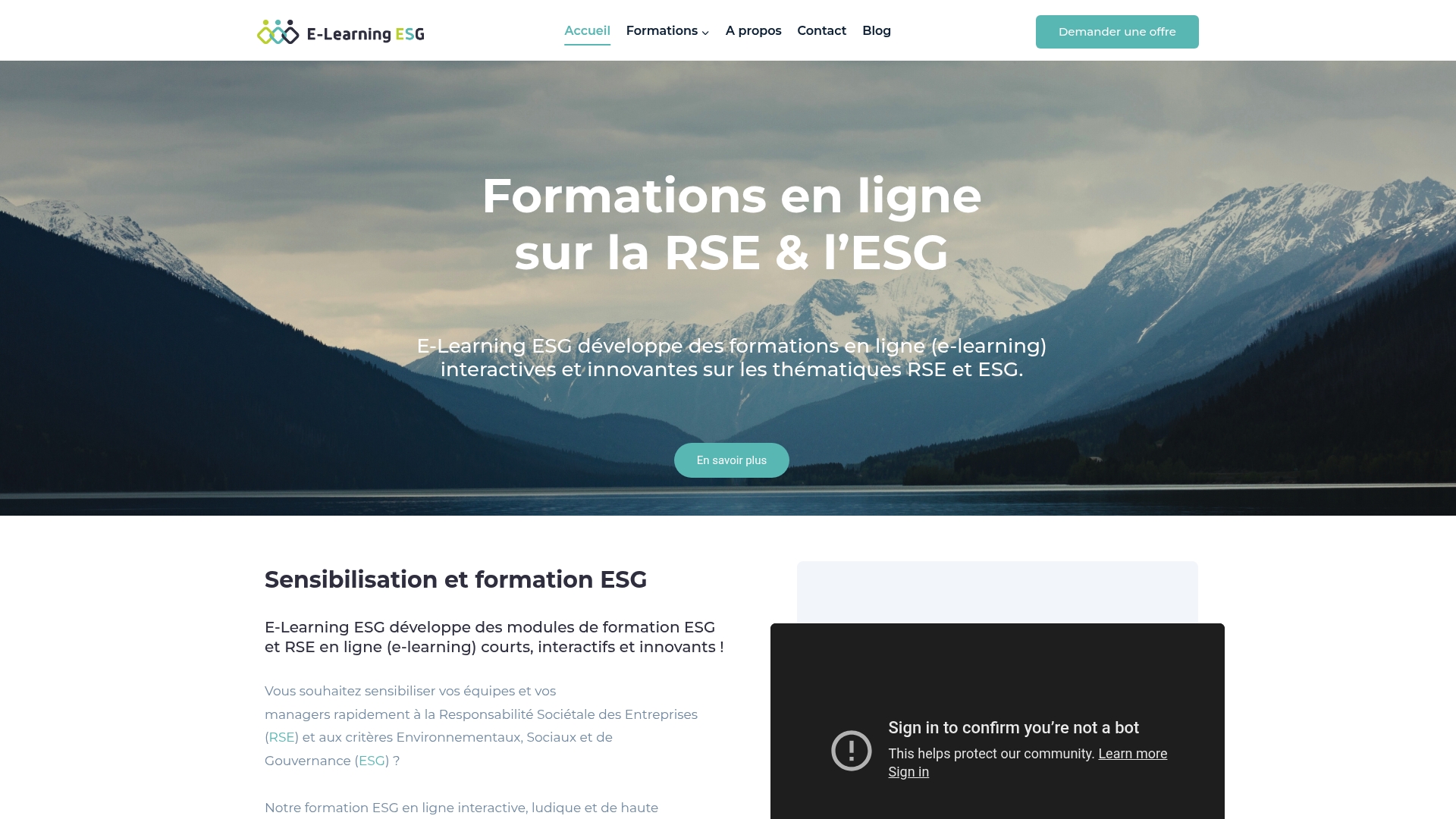
Content is regularly updated to reflect CSRD and the EU taxonomy requirements. That focus means modules map directly to European reporting and compliance topics. The product mixes ready-to-use courses with customizable training for company deployments.
Core features
E-Learning ESG bundles interactive course modules with customization tools for corporate learning programs.
- Interactive online modules covering ESG, corporate sustainability, CSRD, EU taxonomy, double materiality, and sustainability standards.
- Device compatibility across PC, Mac, tablets, and smartphones for employee access on the go.
- Customizable course development so organizations can tailor training to internal policies and workflows.
- Regular content updates to reflect the latest European regulations and reporting guidance.
Key differentiator
The product’s clear specialization is its alignment with European regulatory frameworks. Content centers on CSRD and EU taxonomy topics, not general ESG awareness. That narrow focus helps compliance teams and reporting leads get training that ties directly to regulatory language and disclosure expectations.
Pros
-
Offers training specifically aligned to European regulation, which reduces time lawyers and compliance teams spend translating requirements into learning objectives.
-
Provides both off-the-shelf modules and custom development, letting learning teams deploy quickly or build tailored programs for complex workflows.
-
Modules run on common devices, which lowers technical friction for wide employee rollouts across offices and remote workers.
-
The curriculum emphasizes compliance and reporting, which helps reporting teams prepare for CSRD timelines and disclosure formats.
-
Regular content updates keep courses current with regulatory changes, which reduces the internal maintenance burden for L&D teams.
Cons
-
No substantive third-party reviews are available, so independent evidence of training effectiveness is limited.
-
Course material can be complex and may require prior familiarity with ESG regulatory concepts to follow every module.
-
Pricing details are not published, making budget planning harder without a vendor conversation.
When it may not fit
If your organization needs basic ESG literacy rather than regulation-focused training, this product may feel overly technical. Teams seeking a global curriculum outside European rules will find the focus narrow. Small organizations without internal ESG expertise may need external support to translate course content into local practice.
Who it's for
Companies and organizations in Europe that must train employees on ESG standards and regulatory reporting will benefit most. Compliance officers, sustainability reporting leads, and learning managers running mandatory training programs should consider this for regulated reporting preparation.
Real world use case
A European multinational used the platform to prepare finance and sustainability teams for CSRD reporting. The company rolled out modules to reporting teams and managers, then used customized content to address company-specific disclosure items. The approach aligned learning with reporting deadlines and internal controls.
Pricing
Pricing is not explicitly specified. The vendor states pricing is likely customized based on corporate scope and deployment needs, so expect quotes to vary by license model and level of customization.
Website: https://e-learning-esg.com
Comparison of alternatives
Selecting the right ESG training platform involves balancing structured educational offerings, certification requirements, and flexible accessibility for learners. Here, we compare Verdant Institute, ESG Academy, and E-Learning ESG to highlight their respective strengths, allowing readers to select the training that best meets their goals.
Structuring educational progression
The Verdant Institute offers a structured, tiered approach to mastering ESG concepts, transitioning users from beginner to advanced levels while earning CPD certification. This pathway is ideal for training financial professionals who need to document education completions. Conversely, ESG Academy provides sector-specific modules facilitating immediate practical applications, and E-Learning ESG delivers training targeting European regulatory compliance.
Technical feature alignment
E-Learning ESG centers its content on European regulatory frameworks such as CSRD and EU taxonomy. For organizations preparing for these regulations, E-Learning ESG’s models and training are integral to meeting compliance standards efficiently. In contrast, ESG Academy’s community-driven approach supports networking, while Verdant Institute shines in developing detailed, structured learning conducive to long-term professional improvements.
Best fit
- Finance professionals requiring CPD certification: Verdant Institute provides tiered learning with CPD tracking, ideal for advancing knowledge systematically.
- Corporate teams needing sector-focused, applied training: ESG Academy’s customizable training programs deliver tools instantly applicable within specific industries.
- Enterprises aligning with European ESG regulations: E-Learning ESG specializes in modules tuned for regulatory compliance, simplifying mandatory training.
Our pick
Verdant Institute emerges as a versatile and strategically designed platform for ESG education, particularly for learners entering finance-focused roles. It provides a structured educational journey coupled with CPD certification tailored to professional needs. However, for organizations solely focused on immediately deploying regulatory-specific training, E-Learning ESG offers distinct advantages.
To compare platforms focusing on sustainable finance training, let's examine key offerings across several critical dimensions:
| Platform | Core Features | Target Audience | Pricing | Key Limitation |
|---|---|---|---|---|
| Verdantinstitute | 16 courses, CPD certification, structured learning paths | Students, finance professionals | From $18/month (Student), $58/month (Professional) | No physical, in-person training or mentorship |
| ESG Academy | Free initial courses, sector-specific modules, practical tools | Beginners and professionals seeking ESG roles | Not disclosed | Lacks third-party evaluations for platform usability |
| E-Learning ESG | Courses tailored to European CSRD and taxonomy requirements | Compliance teams, sustainability officers | Not disclosed | Focused narrowly on European regulations |
This overview highlights the product features, suitable users, and financial commitment needed to assist in selecting the appropriate platform.
Discover a practical alternative to decodeesg.com for ESG and sustainable finance training
Professionals looking for decodeesg.com alternatives often face challenges like fragmented course offerings, unclear CPD tracking, and high training costs. Verdantinstitute offers a streamlined solution focused exclusively on ESG and sustainable finance with clear learning tracks from foundational to advanced practice. With over 160 lessons and structured certification paths, it addresses these pain points by providing documented CPD hours, recognized certifications, and tailored plans for students and professionals.
Key benefits include:
- Organized learning tracks that build ESG expertise step-by-step
- Transparent subscription pricing starting at $18/month for students
- Practical skill-building tools relevant to portfolio analysis and impact measurement
Explore how Verdantinstitute’s subscription plans deliver targeted and affordable ESG training designed to fit your career or team’s needs. Visit Verdantinstitute now to view course details and take action by enrolling in a certification path that meets your compliance and professional development goals.
FAQ
What advantages does Verdantinstitute offer for sustainable finance training?
Verdantinstitute specializes in structured learning tracks that cater to different competency levels in ESG and sustainable finance. The platform features a course catalog covering foundational to advanced topics, allowing trainees to build a complete understanding without needing multiple vendors. To get started, consider enrolling in one of their affordable plans that begin at $18 per month.
How does Verdantinstitute compare to ESG academy for accessibility?
ESG Academy provides free initial courses, making it an accessible choice for beginners. Conversely, Verdantinstitute's pricing starts at a low entry point but does not offer free courses. This makes Verdantinstitute a better fit for those seeking structured learning alongside documented CPD hours and formal certification.
Which features make Verdantinstitute suitable for compliance training?
Verdantinstitute offers tracked CPD hours and a formal ESG certification that aligns with professional development requirements. This ensures that users can document their continuing education, which is essential for internal compliance or regulatory reporting. Taking advantage of these features will support your professional growth in sustainable finance roles.
Does Verdantinstitute provide customizable training options?
Verdantinstitute's offerings primarily consist of structured courses that do not include customizable training, unlike E-Learning ESG, which allows for tailored programs. If your organization requires specific adaptations for internal policies, consider reaching out to E-Learning ESG for customizable solutions, while Verdantinstitute remains a solid choice for standardized learning.
Can i earn certification through verdantinstitute's courses?
Yes, Verdantinstitute provides formal ESG certification upon completion of their courses. This certification not only adds value to your professional qualifications but also aids in fulfilling CPD requirements, making it a practical option for finance professionals looking to certify their skills in sustainable finance.