

An ESG engagement strategy is the deliberate, continuous integration of stakeholder perspectives into environmental, social, and governance decision-making processes that drives both regulatory compliance and long-term business value. Most sustainability officers understand the term, but far fewer have built the operational infrastructure that makes it work. Frameworks like CSRD/ESRS, GRI 2-29, and the UN PRI have moved ESG engagement from a voluntary best practice to a documented, auditable requirement. This article breaks down what a functioning ESG engagement strategy actually looks like, how it differs from exclusion or ratings-focused approaches, and how to implement one that holds up under assurance scrutiny.
What are the essential elements of an effective ESG engagement strategy?
An effective ESG engagement strategy is defined by four non-negotiable characteristics: it is continuous, inclusive, documented, and directly connected to decision-making. CSRD/ESRS expectations make this explicit. Treating engagement as an annual survey or a pre-reporting consultation misses the entire point and creates compliance exposure.
Stakeholder mapping beyond the obvious
Most organizations default to mapping investors and regulators. The more defensible and strategically valuable approach maps communities affected by operations, value-chain workers, suppliers, and civil society organizations alongside capital providers. Each group carries different salience, different information, and different risk signals. Prioritizing by impact and dependence, rather than by proximity to the boardroom, produces a materiality assessment that reflects actual business risk.

The methods you use must match the stakeholder group. Structured surveys work for large supplier populations. In-depth interviews surface nuance from community representatives. Focus groups are effective for employee cohorts. A materiality-driven approach uses sector frameworks and these stakeholder methods together to build a defensible materiality matrix, not a document assembled by the sustainability team alone.
Embedding outcomes into governance
Engagement outputs must feed directly into your sustainability roadmap and governance structures. This means recording which stakeholder inputs shifted topic thresholds, which were deprioritized and why, and how the final materiality decisions were reached. That documentation is not administrative overhead. It is the evidence base that defends your double materiality assessment during third-party assurance.
- Map stakeholders by impact, dependence, and influence, not just by relationship tier
- Select engagement methods appropriate to each group (surveys, interviews, focus groups, workshops)
- Record every input, including disagreements and deprioritized concerns
- Link engagement outcomes explicitly to material topic decisions in your sustainability report
- Communicate back to stakeholders how their input shaped decisions, closing the feedback loop
Pro Tip: Build a living stakeholder register that updates after each engagement cycle. Persistent records compound intelligence over time and prevent you from restarting the same conversation every reporting period.
How does ESG engagement strategy differ from exclusion or ratings-focused approaches?
ESG engagement strategy and exclusion strategies solve fundamentally different problems, and confusing them leads to misallocated resources. Exclusion is a static avoidance model: an investor or organization screens out sectors, companies, or activities that fail to meet defined criteria. Engagement is a continuous improvement model: it maintains or builds relationships with the goal of shifting behavior, governance, and disclosure over time.
The distinction matters operationally. Exclusion requires no ongoing relationship management. Engagement requires infrastructure, skilled practitioners, and persistent records. For corporate sustainability officers, the relevant parallel is supplier engagement versus supplier deselection. Deselecting a supplier with poor labor practices removes the risk from your Scope 3 inventory but does nothing to improve conditions in the industry. Engagement with corrective action tracking can do both.
ESG ratings present a separate but related trap. WBCSD guidance is direct: companies should treat ESG ratings as investor process inputs, not as proxies for a full ESG strategy. Rating methodologies diverge significantly across providers like MSCI, Sustainalytics, and ISS ESG, and data inconsistencies are common. Chasing a higher score from one provider often produces no improvement in actual ESG performance and can distort internal resource allocation.
| Approach | Focus | Relationship | Outcome |
|---|---|---|---|
| ESG engagement | Continuous improvement through dialogue | Active, ongoing | Behavior change, better disclosure, risk reduction |
| Exclusion strategy | Avoidance of non-compliant entities | None required | Portfolio or supply chain risk removal |
| Ratings optimization | Score improvement with specific providers | Transactional | Higher rating, not necessarily better ESG performance |
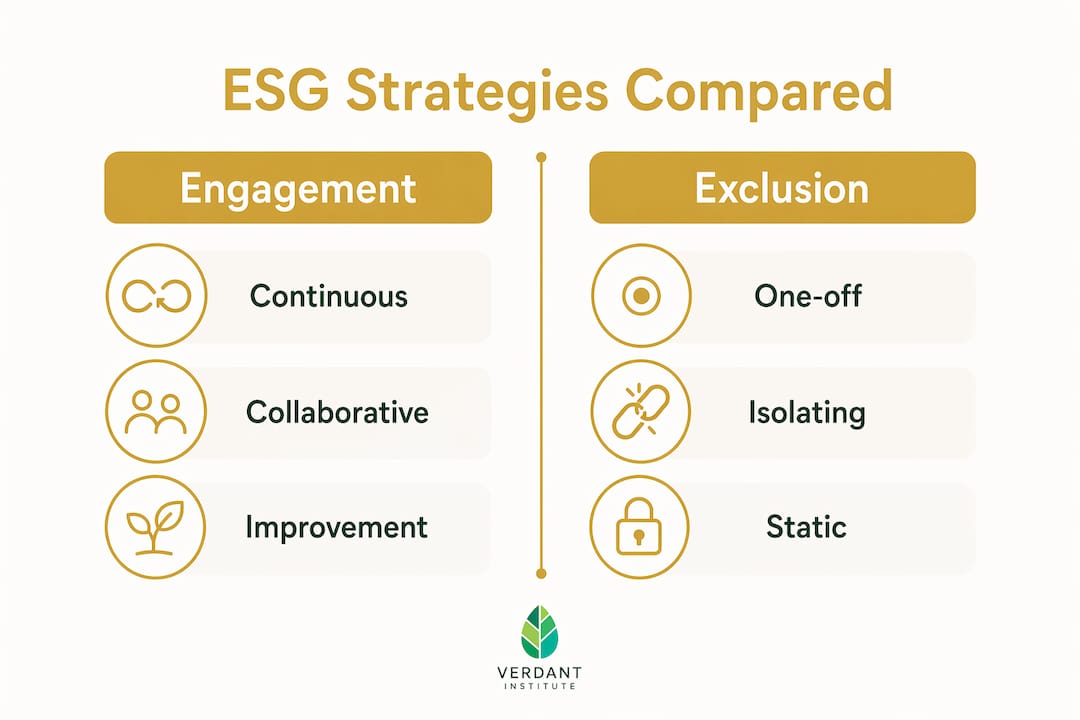
The most effective organizations use ESG ratings pragmatically, treating them as one signal among many rather than the destination. Internal resources go toward governance quality and standardized data, not toward reverse-engineering a rating methodology.
What practical steps and infrastructure enable operational ESG engagement?
Building an ESG engagement strategy that operates at scale requires infrastructure, not just policy. A policy document stating your commitment to stakeholder engagement is the starting point, not the deliverable. The operational layer is what separates organizations that can demonstrate progress from those that can only describe intentions.
Here is a practical sequence for building that infrastructure:
- Define your engagement scope. Identify which stakeholder groups are in scope for each material topic. Supplier engagement for Scope 3 emissions is a different program from community engagement for social impact topics.
- Build scorecards and assessment tools. EcoVadis guidance stresses continuous due diligence over single pass/fail outcomes. Supplier scorecards that track performance across environmental, labor, ethics, and procurement dimensions give you a baseline and a trajectory.
- Establish corrective action tracking. When a supplier or operational unit falls below threshold, the engagement program must include a corrective action plan with defined timelines, responsible parties, and closure criteria. Tracking closure rates is a core KPI.
- Integrate with procurement and supplier management. ESG engagement that sits only in the sustainability team will not scale. Embedding it into procurement workflows means every new supplier onboarding and contract renewal triggers an ESG assessment.
- Run continuous due diligence cycles. The cycle is: identify risk, assess severity, act through engagement or remediation, track progress, and communicate outcomes. This is not an annual process. High-risk suppliers or topics warrant quarterly touchpoints.
- Document for assurance readiness. Every engagement interaction, every corrective action, and every closure should be recorded in a system that produces an audit trail. Evidence traceability is the difference between a credible report and an undefendable one.
Pro Tip: Technology platforms like EcoVadis support scalable ESG data governance across large supplier populations. If you manage more than 50 active suppliers with material ESG risk, manual tracking in spreadsheets will break down before your next reporting cycle.
Integrating engagement into ESG investment decisions follows the same logic: the process must be embedded in existing workflows, not bolted on as a separate reporting exercise.
How to measure and report the impact of your ESG engagement strategy?
Measurement is where most ESG engagement programs reveal their weaknesses. Vague claims about "ongoing dialogue with stakeholders" do not satisfy GRI 2-29, CSRD/ESRS disclosure requirements, or a skeptical assurance provider. Focused KPIs aligned with material topics and business impact are the standard.
The metrics that matter most in practice include:
- Stakeholder coverage rate: What percentage of identified stakeholder groups were engaged during the reporting period, and through what methods?
- Corrective action closure rate: Of all corrective actions issued to suppliers or operational units, what percentage were closed within the defined timeline?
- Supplier risk assessment coverage: What share of your Scope 3 spend has been assessed for ESG risk in the current cycle?
- Feedback loop completion: Can you document, for each major stakeholder group, how their input was considered and what decision it influenced?
Reporting must go beyond listing activities. GRI 2-29 and CSRD require disclosure of your identification and involvement approaches, with feedback loops that stakeholders recall as authentic. That last phrase is significant. Stakeholders who participated in your engagement process should recognize their contribution in your published report.
| Metric | What it measures | Reporting use |
|---|---|---|
| Stakeholder coverage rate | Breadth of engagement across identified groups | GRI 2-29 disclosure |
| Corrective action closure rate | Effectiveness of remediation programs | Operational ESG performance |
| Scope 3 assessment coverage | Supply chain ESG risk visibility | CSRD value chain disclosure |
| Feedback loop completion | Quality of two-way engagement | Materiality assessment defense |
Treating engagement outputs as evidence artifacts means documenting how stakeholder input shifted materiality thresholds, including cases where input was considered but not acted upon and the reasoning behind that decision. This documentation is your defense during assurance.
What challenges do organizations face when implementing ESG engagement?
The most common failure mode is treating engagement as an event. A single annual survey sent to a curated list of investors does not constitute a stakeholder engagement program. Continuous engagement with persistent records is what regulatory frameworks require and what actually builds organizational intelligence over time.
Several other challenges appear consistently across organizations at different stages of ESG maturity:
- Narrow stakeholder scope: Focusing engagement on investors and large customers while ignoring affected communities, value-chain workers, and civil society organizations creates blind spots in your materiality assessment and exposes you to reputational and regulatory risk.
- Stakeholder fatigue from repeated consultation: When organizations fail to aggregate inputs and close feedback loops, stakeholders are asked the same questions cycle after cycle with no visible outcome. Participation rates drop and trust erodes.
- Over-reliance on ESG ratings as a proxy: Directing internal resources toward improving a specific provider's score rather than building genuine governance and data quality is a misallocation that becomes visible during assurance.
- Disconnected engagement and reporting teams: When the team conducting stakeholder engagement and the team writing the sustainability report operate independently, the link between input and decision is lost. The report cannot demonstrate how engagement shaped outcomes.
"Engagement fails when it is treated as a checkbox. Embedding it into double materiality workflows is what delivers strategic value beyond compliance." — CSRD Experts
The solution to most of these challenges is architectural. Build a system where stakeholder engagement records are persistent, searchable, and linked to specific material topics. Every engagement cycle adds to that record rather than replacing it.
Key takeaways
An effective ESG engagement strategy requires continuous, documented stakeholder dialogue that feeds directly into materiality assessments, operational governance, and sustainability reporting.
| Point | Details |
|---|---|
| Engagement must be continuous | One-off consultations fail regulatory and strategic tests; build persistent records across cycles. |
| Map stakeholders beyond investors | Communities, suppliers, and value-chain workers carry material risk signals that investors do not. |
| Engagement outperforms exclusion | Active dialogue drives behavior change and disclosure improvement; exclusion only removes exposure. |
| Metrics must be specific | Track corrective action closure rates, coverage rates, and feedback loop completion, not just activity counts. |
| Documentation is your defense | Engagement outputs mapped to ESRS topics and materiality decisions withstand assurance scrutiny. |
Why most ESG engagement programs stall before they scale
After working with sustainability professionals across multiple sectors, the pattern I see most often is not a lack of commitment. It is a lack of architecture. Organizations invest in writing a stakeholder engagement policy, conduct a well-intentioned materiality survey, and then move on. The next reporting cycle begins with the same blank page.
The organizations that get this right treat engagement as a data infrastructure problem as much as a relationship problem. They build systems that accumulate stakeholder intelligence over time, link that intelligence to specific governance decisions, and produce an audit trail that a third-party assurer can actually follow. That is not glamorous work, but it is what separates a credible sustainability report from a document that reads well but cannot be defended.
I also think the field underestimates the cross-functional dimension. Sustainability officers who try to own ESG engagement entirely within their team will hit a ceiling. The program needs procurement, legal, finance, and operations to function at scale. Building those internal relationships is as important as building external stakeholder relationships, and it requires the same deliberate, documented approach.
The UN PRI framework, which requires active ownership reporting on engagement activities quarterly, sets a useful benchmark even for corporate sustainability teams. If you cannot report on your engagement activities with that level of specificity, your program needs more structure, not more ambition.
— Charles
Build your ESG engagement skills with Verdant Institute
Verdant Institute offers structured ESG engagement strategy courses designed specifically for sustainability professionals and finance practitioners who need to move from policy to practice. The course library covers materiality assessment, stakeholder engagement frameworks, CSRD/ESRS compliance, and supplier ESG programs, with CPD tracking and certification included. Whether you are building a program from scratch or strengthening an existing one, the course library gives you the frameworks and tools used by practitioners in the field. Flexible plans start at $18 per month for students and $58 per month for professionals. Review the full pricing options to find the plan that fits your organization's development goals.
FAQ
What is an ESG engagement strategy?
An ESG engagement strategy is the structured, ongoing process of integrating stakeholder perspectives into ESG decision-making, materiality assessments, and sustainability reporting. It is defined by continuous dialogue, documented outcomes, and direct links to governance decisions.
How does ESG engagement differ from ESG exclusion?
ESG engagement maintains active relationships to drive improvement in behavior, governance, and disclosure over time. Exclusion removes exposure by screening out non-compliant entities without requiring ongoing relationship management or remediation.
What frameworks govern ESG stakeholder engagement?
CSRD/ESRS, GRI 2-29, and the UN PRI all require documented, continuous stakeholder engagement with systematic feedback loops. GRI 2-29 specifically requires disclosure of identification and involvement approaches.
What metrics should I track for ESG engagement effectiveness?
Track stakeholder coverage rate, corrective action closure rate, Scope 3 supplier assessment coverage, and feedback loop completion. These metrics demonstrate both the breadth and quality of your engagement program to assurance providers.
Why do ESG engagement programs fail?
Engagement fails most often because it is treated as a disconnected event rather than a continuous process. Failure to aggregate inputs, close feedback loops, and maintain persistent records leads to stakeholder fatigue and compliance gaps.