

Pressure to embed ESG in investment decisions has never been greater. Asset managers overseeing USD 120 trillion are now signed onto the PRI, and regulators across the EU and US are tightening disclosure requirements at a pace that makes ad hoc ESG practices a genuine liability. Yet most finance professionals still struggle with the same core problem: ESG data is inconsistent, materiality is poorly defined, and sustainability considerations get siloed from the financial models that actually drive decisions. This guide gives you a structured, model-first approach to fix that.
Table of Contents
- Key takeaways
- How to embed ESG in investment decisions: prerequisites first
- Embedding ESG into financial models step by step
- Common pitfalls in ESG integration and how to avoid them
- Measuring and monitoring embedded ESG factors
- My take on what actually works in ESG integration
- Take your ESG skills further with Verdantinstitute
- FAQ
Key takeaways
| Point | Details |
|---|---|
| Materiality drives integration | Focus on 5 to 10 sector-relevant ESG risks mapped to enterprise risk frameworks, not every available metric. |
| Triangulate your data | Use multiple ESG data providers alongside primary research to compensate for low inter-provider correlation. |
| Embed into financial models directly | Apply ESG variables in credit risk (PD/LGD) and cash-flow projections, not in a parallel reporting track. |
| Monitor with KRIs and dashboards | Establish ESG key risk indicators tied to your investment objectives and review them on the same cycle as financial KPIs. |
| Assurance is becoming mandatory | Third-party ESG data assurance is required from 2025 onward in multiple jurisdictions; build audit readiness now. |
How to embed ESG in investment decisions: prerequisites first
Before you touch a financial model, you need three things in place: a clear definition of materiality, reliable data sourcing, and a regulatory anchor.
Financial materiality vs. impact materiality
These two concepts are often confused, and conflating them leads to wasted effort. Financial materiality asks whether an ESG factor affects the company's cash flows, risk profile, or valuation. Impact materiality asks whether the company affects people and the planet. For investment analysis, you start with financial materiality. The ISSB's IFRS S1 and S2 standards, along with the EU's CSRD double-materiality framework, have formalized both concepts, so you need to know which disclosure regime applies to each issuer you analyze.
Materiality assessments work best when they prioritize 5 to 10 sector-relevant ESG risks mapped to enterprise risk management frameworks, giving boards direct visibility and keeping analysts from drowning in irrelevant data points.

Sourcing and triangulating ESG data
Here is a number that should change how you approach ESG data: ESG ratings across providers have an average inter-provider correlation of only 0.54. Credit ratings from major agencies correlate at 0.99. That gap means a single ESG data subscription will leave you with blind spots. The fix is triangulation: combine at least two rating providers, supplement with TCFD-aligned disclosures directly from company filings, and use AI-driven alternative data where available. AI analytics tools detected over 4,300 greenwashing instances in 2025 alone, so they earn their place in your sourcing stack.
- Cross-reference MSCI ESG Ratings with Sustainalytics or Moody's ESG Solutions for divergence flags
- Pull primary data from company TCFD and CSRD disclosures for physical and transition risk metrics
- Use sector-specific databases (e.g., GRESB for real estate, CDP for carbon) to supplement general ratings
- Apply ESG indexes as a benchmark reference for sector-level ESG performance norms
Pro Tip: Build a divergence log. When two providers rate the same issuer more than two quintiles apart, flag it for primary research before assigning a house view. This single habit will surface the most material data disputes early.
Embedding ESG into financial models step by step
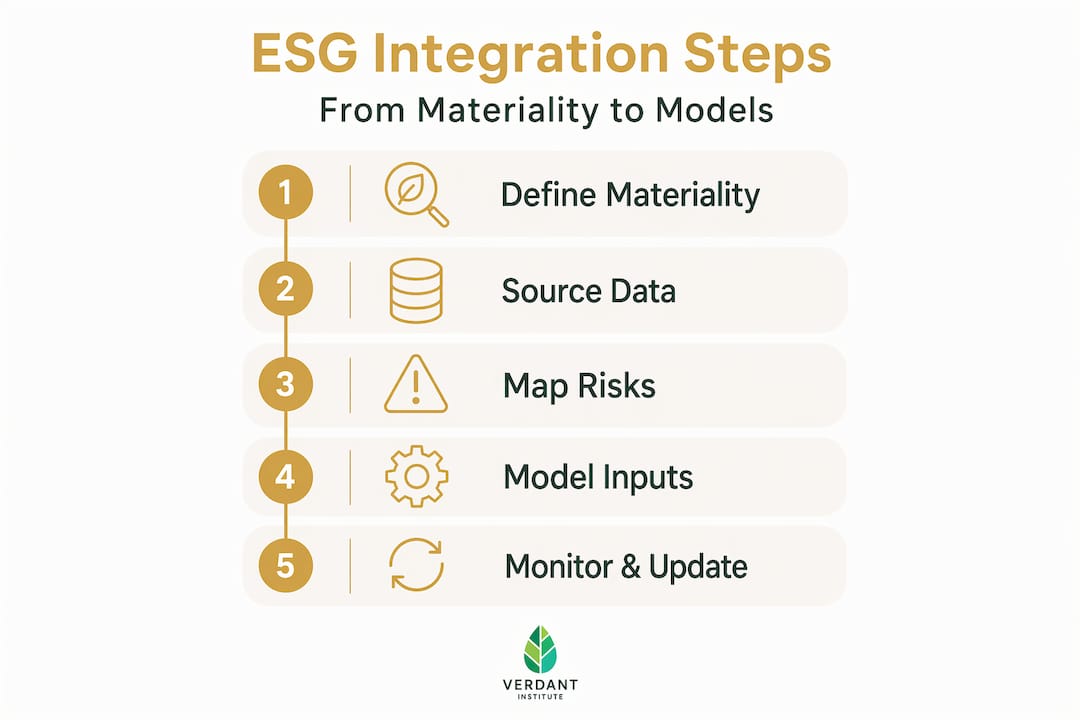
This is where responsible investing principles move from policy documents into actual numbers. The approach follows four steps.
-
Run a sector-specific materiality screen. Map ESG risks to the SASB Materiality Map for your sector. A utility company faces physical climate risk and water scarcity; a software company faces data privacy and talent retention. Starting here keeps the analysis financially grounded and avoids the trap of applying identical ESG frameworks across different industries.
-
Adjust probability of default and loss given default in credit models. Integrating climate transition risk into credit spreads reduced portfolio drawdowns by 18% during volatile 2024 energy prices. That is not an ESG outcome. That is a risk management outcome. For high-carbon issuers, apply transition cost assumptions directly to EBITDA projections and let that flow through to coverage ratios and PD estimates. For ESG in fixed income, this step is particularly material because credit impairment timelines often align with physical and regulatory risk horizons.
-
Run climate scenario analysis on equity valuations. Use NGFS scenarios (Orderly, Disorderly, Hot House World) to stress test DCF models. Assign carbon cost trajectories and physical damage assumptions to revenue and capex lines. For real estate specifically, 26.1% of US homes, representing USD 12.7 trillion in asset value, face severe climate risk. That exposure belongs inside your cap rate and terminal value assumptions, not in a footnote.
-
Pair quantitative integration with active ownership. Models capture the past and extrapolate trends. Engagement changes them. Active ownership commitments from firms engaging Shell, TotalEnergies, and HeidelbergCement produced binding net-zero transition plans and executive compensation linked to emissions targets. These outcomes are forward-looking financial catalysts. Build them into your investment thesis, not just your stewardship reports.
| ESG risk type | Model integration point | Key input metric |
|---|---|---|
| Climate transition | PD/LGD adjustment, EBITDA margins | Carbon price trajectory, stranded asset exposure |
| Physical climate risk | Terminal value, cap rate (real estate) | Flood/heat/wildfire hazard scores |
| Governance quality | Discount rate premium, cost of capital | Board independence, audit quality scores |
| Social (labor/supply chain) | Revenue risk, regulatory penalty assumptions | Injury rates, supplier audit scores |
Pro Tip: Do not create a separate "ESG model." Integrate ESG variables as additional inputs within your existing DCF or credit model. That way ESG assumptions are reviewed and challenged by the same governance processes as financial assumptions, not treated as optional add-ons.
Common pitfalls in ESG integration and how to avoid them
The most expensive mistake you can make is treating ESG as a reporting workstream rather than a modeling input. When sustainability teams produce ESG reports in parallel with investment analysis, the two processes rarely inform each other. Successful integration means ESG variables sit inside financial models with the same statistical rigor and internal controls as traditional financial data.
Here are the other pitfalls that consistently derail ESG integration efforts:
- Data overload. Pulling 200 ESG metrics per issuer without a materiality filter creates noise, not insight. Restrict your analysis to the 5 to 10 risks that are financially material for that sector.
- Single provider reliance. Given a correlation of 0.54 across rating providers, using one source as your sole ESG view is equivalent to relying on one analyst's model for a complex credit decision.
- Targets without controls. Setting ESG targets without mapped controls and credible action plans creates greenwashing exposure and reputational risk. Every stated target needs a clear ownership chain and a funding line.
- Governance disconnects. Lack of board-level ESG expertise is one of the most cited governance failures in ESG integration. If ESG risks do not appear in board risk appetite statements and credit committee packs, they will not be acted on.
"The shift toward financial materiality and away from purely reporting exercises is key for embedding ESG as a strategic driver." — Humanities and Social Sciences Communications
Pro Tip: Add ESG risk flags to your investment committee templates as standing agenda items, not attachments. When ESG considerations appear in the same document as financial metrics, analysts stop treating them as optional.
Measuring and monitoring embedded ESG factors
Getting ESG into your models is only half the job. The other half is maintaining it as a live input rather than a static checkbox.
Setting ESG KPIs and KRIs
Distinguish between KPIs (what you are trying to achieve) and KRIs (what signals risk is rising). A portfolio-level KPI might be "reduce weighted-average carbon intensity by 15% by 2028." The corresponding KRI would be "portfolio WACI deviation from glide path exceeds 5% in any quarter." When a KRI breaches, it triggers a defined review process, not just a note in the next board report.
Building integrated dashboards
Your ESG dashboard should pull from the same data infrastructure as your financial risk systems. Siloed ESG platforms that feed only reporting teams are a governance gap. Connect ESG KRIs to your enterprise risk management system so portfolio managers see ESG signals alongside credit, market, and liquidity metrics in one view.
| Dashboard element | Data source | Review frequency |
|---|---|---|
| Portfolio carbon intensity (WACI) | CDP, TCFD disclosures | Quarterly |
| Physical climate risk exposure | Climate hazard data providers | Semi-annually |
| ESG rating divergence flags | Multiple rating providers | Monthly |
| Active engagement progress | Internal stewardship logs | Quarterly |
| Third-party assurance status | External auditor reports | Annually |
Transparent ESG reporting backed by third-party assurance is now required from 2025 onward in multiple jurisdictions. Build audit readiness into your ESG data governance now, before a regulator or institutional client asks for it under time pressure.
Pro Tip: Align your ESG reporting cycle with TCFD's four-pillar structure: Governance, Strategy, Risk Management, and Metrics & Targets. This keeps your disclosures structured and positions you well ahead of ISSB-aligned regulatory requirements.
For portfolio-level thinking, the ESG portfolio construction framework offers a practical model for embedding these metrics at the construction stage, not just monitoring them after the fact.
My take on what actually works in ESG integration
I have sat in investment committee rooms where a 40-slide ESG report was presented after the financial analysis was already done. No one changed a single recommendation because of it. That experience taught me the single most important lesson in this space: ESG integration that does not live inside the financial model is decoration, not analysis.
What I have found actually works is uncomfortable for people who came up in sustainability roles: you need to be more of a financial modeler than a sustainability expert to do this job well. The practitioners getting the most traction are the ones who can articulate how a carbon price trajectory affects an energy company's EBITDA margin, not the ones who can recite the SDGs.
The second thing I have learned is that scores and ratings are starting points, not conclusions. I have seen portfolios with high ESG scores carry serious undisclosed physical risk because the rating methodology weighted governance heavily and barely touched climate exposure. That is why active engagement matters so much. You learn things from a direct conversation with a CFO about their Scope 3 data quality that no third-party rating will ever capture.
Finally, the teams that succeed treat ESG integration as a continuous improvement process. Regulatory frameworks, data quality, and climate science all evolve. The institutions that build adaptive processes, not static checklists, will still be getting this right five years from now.
— Charles
Take your ESG skills further with Verdantinstitute

If this guide has clarified how to embed ESG factors in investment decisions, the next step is building the technical depth to do it consistently across different asset classes and market conditions. Verdantinstitute's structured learning tracks take you from ESG foundations through to advanced ESG frameworks, transition finance, and net-zero strategies. With over 160 lessons, CPD tracking, and certifications designed for finance professionals, the platform is built for practitioners who need more than theory. Explore the professional plan options starting at $58 per month and see which learning track fits where you are right now.
FAQ
What does it mean to embed ESG in investment decisions?
It means incorporating ESG variables directly into financial models, including credit risk calculations and valuation projections, rather than treating ESG data as a separate reporting exercise. The goal is for ESG factors to influence the same outputs that drive investment recommendations.
Why do ESG ratings differ so much across providers?
ESG rating providers use different methodologies, data sources, and weighting schemes, resulting in an average inter-provider correlation of only 0.54. This is why finance professionals should triangulate data from multiple providers instead of relying on a single score.
How do I apply ESG criteria in a DCF model?
Apply material ESG risks as adjustments to revenue growth assumptions, operating cost projections, and discount rates. For climate-exposed companies, use NGFS scenario assumptions to stress test terminal values and capital expenditure requirements.
What is the role of active ownership in ESG integration?
Active ownership through shareholder engagement complements quantitative ESG integration by driving corporate behavior change that forward-looking models cannot fully capture. Engagements have produced binding net-zero commitments and executive pay linked to emissions targets at major energy and industrial companies.
When is third-party assurance required for ESG disclosures?
Third-party assurance over ESG data and disclosures is required from 2025 onward in several jurisdictions under frameworks including ISSB standards and the EU's CSRD. Finance professionals should treat audit readiness as a baseline governance requirement, not an optional enhancement.