

Most finance professionals assume ESG education means sifting through thousands of pages of disconnected standards, voluntary disclosures, and academic theory. That assumption keeps a lot of people from starting. The reality is that a well-structured ESG learning track explained properly removes that friction entirely. It organizes everything, from understanding ESG concepts at the foundation level to applying frameworks inside actual portfolios, into a sequence that builds real competency. This article breaks down exactly what an ESG learning track contains, why it matters for your career, and how to use it effectively.
Table of Contents
- Key takeaways
- What an ESG learning track actually covers
- Core ESG frameworks every learning track must include
- ESG certifications and learning modules worth your time
- Putting ESG knowledge to work in practice
- My honest take on ESG learning tracks
- Start your ESG education with Verdantinstitute
- FAQ
Key takeaways
| Point | Details |
|---|---|
| Structure beats self-study | A sequenced ESG education path moves you from fundamentals to application faster than random reading. |
| Frameworks are the backbone | GRI, SASB, TCFD, and ISSB each serve different audiences and reporting goals you need to understand separately. |
| Certification adds credibility | The CFA Sustainable Investing Certificate has an 81% pass rate and requires roughly 100 to 130 study hours. |
| Practice requires more than data | Effective ESG integration means embedding sustainability into investment decisions, not just collecting metrics. |
| Continuous learning is non-negotiable | ESG standards evolve annually, so CPD-accredited training keeps your skills current and defensible. |
What an ESG learning track actually covers
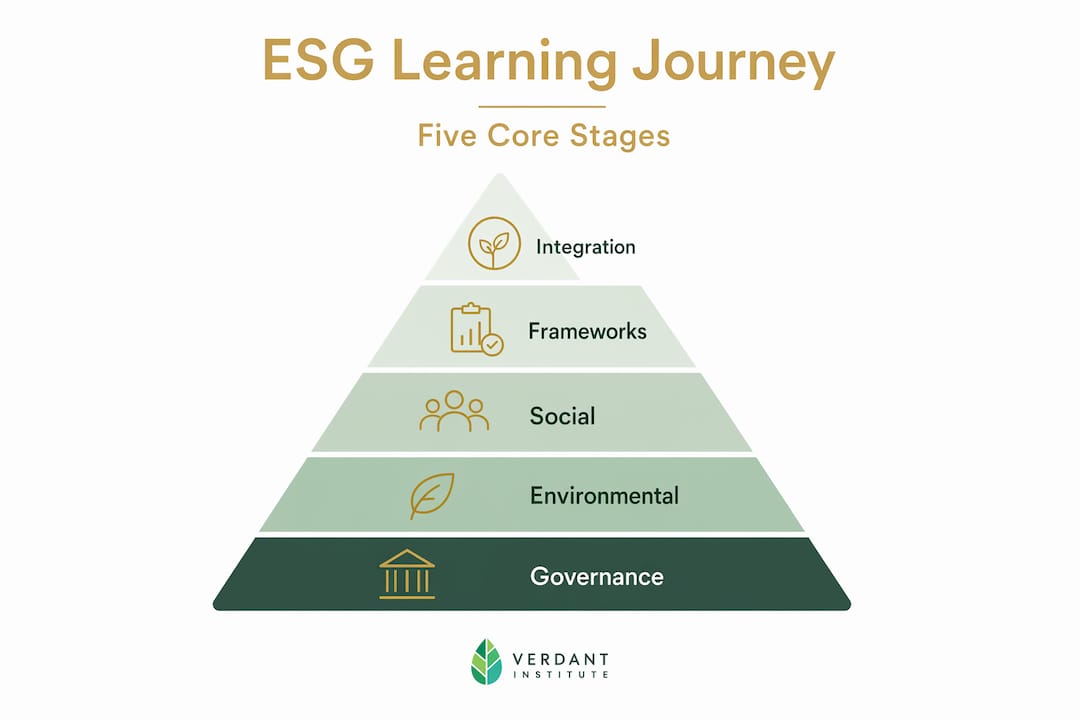
An ESG learning track is a structured education path that sequences your exposure to Environmental, Social, and Governance (ESG) concepts in a deliberate order. It is not a single course or a reading list. It is a curriculum designed to move you from definitional awareness to professional application, with each module building on the one before it.
For finance professionals, understanding ESG means more than knowing what the letters stand for. You need to know why ESG factors affect asset prices, how they show up in regulatory requirements, and what tools analysts use to measure and compare them across companies and sectors.
A typical ESG curriculum overview covers four broad areas:
- Environmental factors: Carbon emissions, energy use, water management, biodiversity exposure, and physical climate risk
- Social factors: Labor standards, supply chain practices, community relations, diversity and inclusion metrics, and product safety
- Governance factors: Board structure, executive compensation, shareholder rights, anti-corruption policies, and transparency
- Cross-cutting themes: Materiality, double materiality, ESG data sources, rating methodologies, and greenwashing risks
The sequencing matters. Jumping straight to portfolio integration without understanding why these factors connect to financial performance creates gaps that show up later, usually in client meetings or due diligence reviews.
Pro Tip: If you are new to ESG, spend time on the governance pillar first. It directly mirrors concepts you already know from financial analysis: accountability structures, incentive alignment, and information quality. It is the fastest on-ramp to the rest.
The career case for ESG knowledge among finance professionals is growing every year. Learning tracks that tie each ESG concept directly to an investment use case, rather than treating sustainability as a standalone topic, produce analysts who can apply their knowledge immediately.
Core ESG frameworks every learning track must include
ESG frameworks are the scaffolding that structured learning tracks are built around. They define what gets measured, who the audience is, and how disclosures connect to financial analysis. Different frameworks serve distinct purposes: GRI focuses on broad social and environmental impacts for stakeholders, SASB targets financially material issues by industry, TCFD addresses climate-related financial risks for investors, and ISSB provides a global baseline for investor-focused sustainability disclosure.
The table below captures the key distinctions you need to know before choosing which frameworks to prioritize in your own work.
| Framework | Primary focus | Primary audience | Geographic scope | Main use case |
|---|---|---|---|---|
| GRI | Broad environmental and social impacts | General stakeholders | Global | Sustainability reporting |
| SASB | Financially material ESG issues by industry | Investors | Primarily North America | Investment analysis |
| TCFD | Climate-related financial risks and opportunities | Investors, lenders | Global | Climate risk disclosure |
| ISSB (IFRS S1 and S2) | Integrated sustainability and financial disclosure | Investors | Global | Regulatory reporting baseline |
ISSB standards require governance, strategy, risk management, and metrics disclosures with explicit financial connectivity and climate scenario analysis. That financial connectivity piece is what separates ISSB from earlier frameworks. It is not enough to describe your climate risks. You have to show how they connect to your balance sheet.
One practical misunderstanding worth flagging: TCFD compliance does not equal ISSB compliance. ISSB adds industry-specific measures, financial linkage requirements, and more rigorous scenario analysis. Organizations that assume they are covered because they follow TCFD often discover significant gaps during transition.
Beginner learners typically start with GRI because its broad scope gives them context, then progress toward ISSB and TCFD as they focus on investor-facing applications. An effective ESG learning track mirrors that progression deliberately.
Pro Tip: Do not try to master all four frameworks simultaneously at the start. Pick the one most relevant to your current role, understand it deeply, then map the others relative to it. The differences become far clearer once you have one strong reference point.
ESG certifications and learning modules worth your time
Sustainable finance training has become a real market, which means there is significant variation in quality and relevance. The learning modules worth your time are the ones built around recognized frameworks and tied to either CPD credit or widely accepted certifications.

The CFA Sustainable Investing Certificate is one of the most recognized credentials in this space. It requires roughly 100 to 130 study hours, carries no formal prerequisites, and covers ESG integration, portfolio management, and sustainability analysis. The exam uses 100 multiple choice questions, and the pass rate sits at 81%. For finance professionals who already hold the CFA designation, it is a logical and efficient add-on.
Other modules commonly found in structured ESG learning tracks include:
- Foundations modules: Define ESG, explain its relevance to investment analysis, and introduce major frameworks. Suitable for analysts or students with no prior ESG background.
- Disclosure and reporting modules: Cover GRI, SASB, TCFD, and ISSB in depth, with practical exercises in reading and interpreting sustainability reports.
- ESG integration modules: Focus on materiality assessment, data sourcing, scoring methodologies, and how ESG factors enter portfolio construction.
- Advanced practice modules: Cover transition finance, net-zero portfolio alignment, impact investing, and regulatory compliance timelines.
- CPD-accredited modules: Platforms like Robeco offer updated professional CPD content accredited by CFA, including updated chapters on double materiality and the transition to a lower-carbon economy.
For students, the priority is building foundational fluency fast. For professionals, the value comes from modules that connect theory to tools you already use, like integrating ESG scores into DCF models or adjusting portfolio weights based on climate scenario outputs.
A step-by-step ESG certification guide for students can help you map the sequencing before you commit time and money to a specific credential.
Putting ESG knowledge to work in practice
Knowing the frameworks is only half the job. The real test of any ESG education path is whether it prepares you to apply ESG thinking inside actual investment workflows. Effective ESG integration moves beyond data collection and into embedding sustainability considerations directly into investment decision systems and processes.
Here is how a structured integration process typically works in practice:
- Materiality mapping. Identify which ESG issues are financially material for the specific industry or company you are analyzing. Not every ESG factor matters equally for every sector. Water risk is critical for food producers. It is largely irrelevant for software companies.
- Data collection and normalization. Gather ESG data from company disclosures, third-party data providers, and NGO databases. Normalize it across companies so comparisons are valid. This step is harder than it sounds.
- Scoring and weighting. Apply a scoring methodology, whether quantitative, qualitative, or a hybrid, that weights ESG factors according to their materiality. Many analysts use provider scores as a starting point, then adjust for sector-specific considerations.
- Portfolio construction. Incorporate ESG scores into the portfolio construction process. This might mean exclusions, tilts toward higher-scoring companies, or engagement targets for lower-scoring holdings.
- Impact measurement and reporting. Track portfolio-level ESG metrics over time and report against client mandates or regulatory requirements.
One of the trickiest parts of step two is emissions data. Scope 3 emissions reporting differences can cause reported carbon footprint variance by a factor of three or more depending on methodology. That kind of variance has real consequences when you are constructing a low-carbon portfolio or meeting a regulatory threshold.
Pro Tip: ESG rating disagreement across providers is not a bug in the system. It is a feature of how ESG is currently structured. Use multiple data sources and understand the methodology behind each score before relying on any single rating. Treat ratings as inputs, not conclusions.
Political and conceptual debates also shape this space. ESG metrics face ongoing criticism around greenwashing, vague definitions, and politicization, which makes it even more important that your training gives you the critical thinking skills to evaluate claims, not just apply them uncritically.
My honest take on ESG learning tracks
I have watched ESG go from a niche interest to a core finance competency in under a decade. What strikes me most is how many professionals still treat it as optional, as if understanding sustainability factors is something you add to your résumé rather than something that changes how you analyze companies.
The learning tracks I have seen work best are the ones that refuse to separate ESG from finance. The moment a curriculum starts treating ESG as a separate topic rather than a lens through which you do financial analysis, it produces analysts who can write sustainability reports but cannot defend a portfolio decision in front of a client. That distinction matters enormously.
The hardest part of getting started is not the content. It is accepting that ESG standards evolve constantly, which means any credential you earn today requires ongoing updates. The professionals I respect most in this field treat their ESG education as a continuous practice, not a box checked. They follow framework updates, revisit their methodologies when new data emerges, and stay intellectually honest about where the evidence is thin. That is the mindset a good ESG learning track should build, not just the technical knowledge.
— Charles
Start your ESG education with Verdantinstitute
If this article clarified what an ESG learning track looks like, the next step is finding one that fits your actual schedule and career stage.
Verdantinstitute offers a structured course library covering everything from Academic Foundations to Advanced Practice areas including transition finance and net-zero strategies. With 16 courses and over 160 lessons, it is built specifically for finance professionals and students who need depth, not just survey-level content. All courses support CPD tracking, and the platform issues certifications tied to recognized ESG competencies. Student plans start at $18 per month and professional plans at $58 per month. You can review everything at the Verdantinstitute pricing page and choose the track that matches where you are and where you want to go.
FAQ
What is an ESG learning track?
An ESG learning track is a sequenced curriculum that organizes ESG concepts, frameworks, and practical skills into a structured education path. It moves learners from foundational understanding to professional application in sustainable finance and responsible investing.
Which ESG frameworks should finance professionals learn first?
Most learners start with GRI for broad context, then progress to SASB, TCFD, and ISSB as they focus on investor-facing analysis. The right sequence depends on your current role and reporting obligations.
How long does it take to complete ESG certification?
The CFA Sustainable Investing Certificate takes roughly 100 to 130 study hours, with no formal prerequisites required. Other module-based programs vary from a few hours for introductory content to several months for advanced specializations.
Is ESG learning relevant for students without finance experience?
Yes. Most structured ESG learning tracks include beginner-level modules that introduce core concepts before moving into framework application and portfolio integration. Students can build foundational fluency before entering the workforce.
How often do ESG standards and curricula get updated?
ESG frameworks and training content update frequently. For example, Robeco's Sustainable Investing module was updated for 2026 with new chapters on double materiality and the low-carbon transition, reflecting how rapidly the field evolves.