

Most finance professionals who dismiss ESG study as an ethics exercise are making a career-limiting mistake. Understanding why study ESG for finance matters goes well beyond impact investing or corporate responsibility reports. ESG (Environmental, Social, and Governance) analysis is now woven into investment research, risk modeling, regulatory compliance, and fiduciary duty. With major EU regulations reshaping how financial institutions must operate, and empirical research confirming that ESG factors drive real market risk, the question is no longer whether to engage with ESG knowledge but how quickly you can build it.
Table of Contents
- Understanding ESG integration as core finance work
- Regulatory drivers behind ESG study for finance professionals
- Challenges in ESG measurement and ratings
- ESG's role in financial risk management and market interdependence
- Applying ESG knowledge: practical skills for finance careers
- Why mastering ESG study is a career imperative, not a trend
- Develop your ESG finance expertise with Verdant
- Frequently asked questions
Key Takeaways
| Point | Details |
|---|---|
| ESG integration defined | ESG is integrated financially, not just ethically, treating ESG factors as material investment inputs alongside traditional metrics. |
| Regulatory urgency | EU regulations effective in 2026 mandate ESG transparency, making ESG study essential for compliance and investor trust. |
| Data complexity | ESG measurement and ratings vary, requiring finance professionals to develop skills in critical evaluation and mapping of ESG data. |
| Risk management relevance | ESG risks are intertwined with market volatility, so mastering ESG enhances portfolio risk analysis and mitigation. |
| Career advantage | Mastering ESG knowledge and integration techniques positions finance professionals ahead in a competitive, evolving industry. |
Understanding ESG integration as core finance work
Many finance professionals encounter ESG for the first time through exclusionary screening, where funds simply avoid tobacco, weapons, or fossil fuel companies. That is the least sophisticated application of the concept. ESG integration is defined by the CFA Institute as the explicit and systematic inclusion of ESG factors in investment analysis and decisions alongside traditional financial metrics. It is not a values statement. It is an analytical layer.
The distinction matters enormously. Exclusionary screening removes certain companies from consideration. ESG integration keeps every company on the table but demands you account for governance risks, climate exposure, and labor practices when building your discounted cash flow models or assessing credit quality. A highly leveraged energy company with poor carbon transition planning carries a materially different risk profile than one with a credible net-zero strategy, even if both look similar on a price-to-earnings basis.

Here is where the concept of financial materiality becomes essential. Not every ESG factor is material to every sector. Water usage matters intensely for semiconductor manufacturing and agriculture. Board independence and executive pay structure matter most in financials and consumer staples, where governance failures translate directly into fraud risk or capital misallocation. Learning to identify which factors move the needle in a given industry is a core analytical skill, not a soft consideration.
ESG integration operates at multiple levels within an investment firm:
- Research level: Analysts incorporate ESG data into sector and company assessments alongside earnings forecasts and balance sheet analysis
- Modeling level: ESG risks appear in scenario analysis, stress testing, and valuation adjustments
- Portfolio level: Portfolio managers use ESG scores and raw data to manage concentration risk, sector tilts, and active ownership decisions
- Risk level: Risk teams monitor ESG-related exposures to regulatory, reputational, and transition risks
Explore sustainable investing frameworks to see how these integration approaches connect to broader investment strategies and performance outcomes.
Pro Tip: When you first study ESG integration, anchor every concept in a specific sector example. Ask: "What would a material governance failure look like for a bank versus a mining company?" Sector-specific thinking accelerates your understanding faster than memorizing frameworks in the abstract.
Regulatory drivers behind ESG study for finance professionals
Regulatory pressure has turned ESG expertise from a differentiator into a baseline requirement. Two major developments in 2025 and 2026 are reshaping what finance professionals must know.
The European Commission has proposed amendments to the Sustainable Finance Disclosure Regulation (SFDR). The goal is to simplify SFDR disclosures, reduce greenwashing risks, and make sustainable investing more accessible to retail investors. For finance professionals, this means product categorization, disclosure templates, and marketing language for investment products are all under review. If you manage or advise on funds distributed in the EU, these changes affect how you classify and communicate what your portfolio actually does.
On the ratings side, the EU ESG Ratings Regulation applies from 2 July 2026. It requires ESG rating providers to obtain authorization, publish methodology details, and meet governance standards. Any financial institution relying on third-party ESG ratings in its investment process will need to understand what those ratings actually measure and whether they meet the new transparency standards.
What this means practically for your work:
- Know your data providers. Under the new regulation, if your firm uses ESG ratings in investment decisions, you need to understand the methodology behind those ratings, not just the score.
- Understand product classification. SFDR categories affect how funds are marketed and sold. Misclassification carries regulatory and reputational consequences.
- Track disclosure obligations. Both regulations introduce new timelines and reporting templates. Finance teams need staff who understand the underlying ESG concepts to populate these correctly.
- Manage greenwashing risk. Regulators are scrutinizing the gap between ESG claims and actual portfolio positioning. The liability falls on the institution.
- Prepare for global spillover. The EU framework influences regulators in the UK, Asia, and the Americas. Understanding the EU baseline puts you ahead of emerging requirements elsewhere.
Research on ESG disclosure quality shows that better disclosure correlates with improved investor decision-making. The regulatory push is accelerating what good analysis already demands. You can also review how EU financial sector regulations are evolving to understand the broader compliance landscape.
Challenges in ESG measurement and ratings
Here is the uncomfortable reality about ESG data: it is inconsistent, often incomplete, and sometimes contradictory across providers. A 2026 systematic review identifying 50 peer-reviewed papers on ESG measurement frameworks found significant challenges in comparability and standardization. Two providers can score the same company differently by 40 to 50 points using legitimately defensible methodologies. This is not a data quality scandal. It reflects genuine disagreement about what ESG risk means and how to measure it.
Understanding these differences is now a core finance skill, not a technical footnote. The EU ESG Ratings Regulation specifically demands methodology transparency and frequent disclosure updates from rating providers to improve comparability. But until full standardization arrives, finance professionals need to do their own mapping.
The major reporting frameworks differ in important ways:
| Framework | Primary focus | Audience | Materiality approach |
|---|---|---|---|
| GRI (Global Reporting Initiative) | Stakeholder impact | Broad/public | Double materiality |
| SASB (Sustainability Accounting Standards Board) | Financial materiality | Investors | Sector-specific |
| TCFD (Task Force on Climate-related Financial Disclosures) | Climate risk | Investors/regulators | Financial materiality |
| ISSB (International Sustainability Standards Board) | Investor-focused disclosure | Investors/regulators | Financial materiality |
The practical implication for ESG portfolio construction is that you cannot simply plug a third-party score into your model and call it analysis. You need to understand which framework underpins the score, which topics it captures, and whether those topics are financially material in your target sector.
Pro Tip: Build a one-page mapping document for any sector you cover. List which ESG data sources you use, what they measure, their reporting lag, and known methodology gaps. This forces you to think critically about data quality before it enters your model.
ESG's role in financial risk management and market interdependence
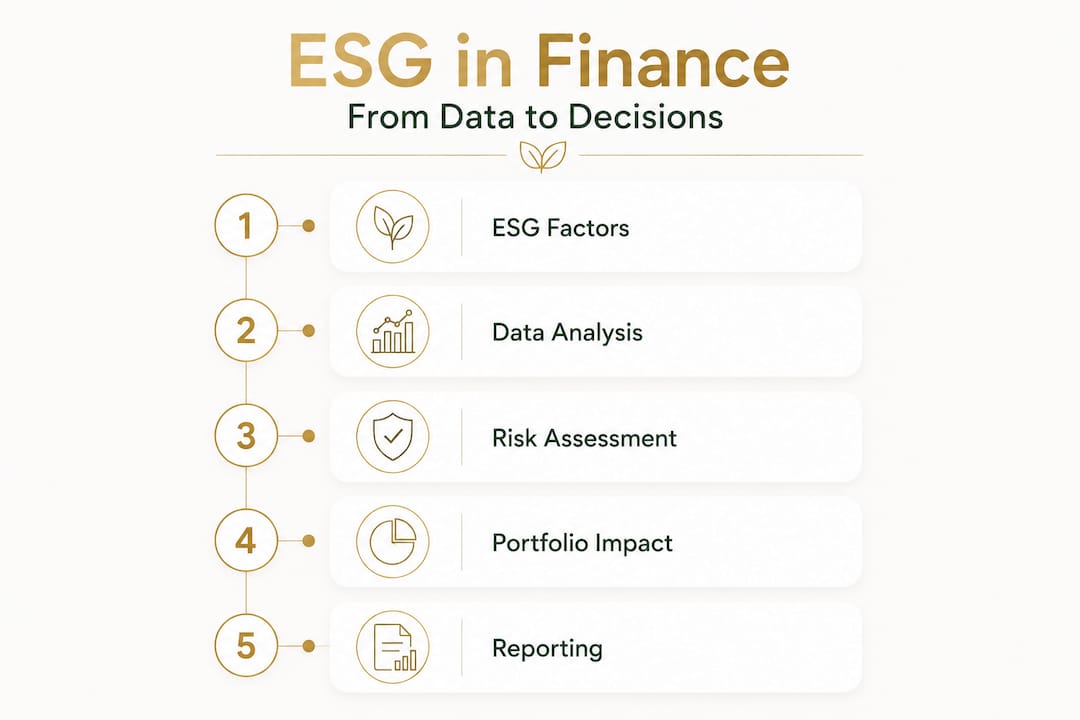
The strongest argument for studying ESG is not regulatory. It is empirical. Research shows that ESG factors are interdependent globally and that the VIX volatility index functions as a major channel through which ESG-related risk transmits across markets.
What this means is direct: ESG risks do not stay in the ESG column of your risk register. They ripple through market-wide volatility and affect portfolios that have no explicit ESG mandate. A governance failure at a large financial institution, a regulatory shock to a major emitter, or a social controversy triggering consumer boycotts can all feed into the VIX and transmit risk broadly.
"ESG factors are substantially interdependent in global markets, with the VIX index serving as a key transmission channel for ESG-related market risk — making ESG risk analysis inseparable from mainstream portfolio risk management."
Key implications for finance professionals:
- ESG risk analysis belongs in your core risk management process, not in a separate sustainability report
- Market timing and diversification strategies must account for ESG-driven volatility episodes
- Concentration in sectors with high ESG transition risk (fossil fuels, heavy industrials) can amplify VIX sensitivity in your portfolio
- ESG data gaps during high-volatility periods create blind spots that standard risk models miss
- Active ownership, specifically engaging with companies on ESG practices, can reduce the probability of governance or social risk events that feed market disruption
Understanding investment risk management in this context shows why ESG study is a natural extension of rigorous financial analysis. A structured market risk management approach supports these connections further.
Applying ESG knowledge: practical skills for finance careers
Knowing that ESG matters is not the same as knowing what to learn. Here is where to focus your development.
- Master ESG integration, not just screening. Understand how ESG factors enter financial models, not just which companies to exclude.
- Learn sector-specific material factors. Use resources like SASB's materiality maps to identify the ESG issues that actually move financial performance in your target sectors.
- Stay current on regulatory requirements. SFDR, the EU ESG Ratings Regulation, and ISSB standards are evolving. Finance professionals who track these changes in real time will stay ahead of compliance demands.
- Develop data evaluation skills. Learn to identify methodology gaps, scoring biases, and reporting lags in the ESG data sources you use.
- Understand active ownership. Proxy voting and direct company engagement are increasingly part of the investment process at major asset managers. Knowing how stewardship works adds depth to your investment analysis.
- Build scenario and transition analysis skills. Climate transition risk, in particular, requires stress testing portfolios against different policy and temperature pathways.
Practical skills to develop alongside these:
- Reading and interpreting sustainability reports critically
- Using TCFD-aligned frameworks for climate risk disclosure
- Performing double materiality assessments for EU-regulated funds
- Mapping ESG data across providers for a single issuer
- Evaluating engagement track records of asset managers
If you are ready to build these skills in a structured way, explore ESG courses and certification or read the ESG certification guide for students for a practical path forward.
Pro Tip: Start every ESG learning session by anchoring to a real portfolio decision, whether it is how to adjust a credit spread for climate risk or how to assess governance quality in an emerging market issuer. Applied context accelerates retention significantly.
Why mastering ESG study is a career imperative, not a trend
Here is the contrarian view that most ESG commentary avoids: the finance professionals who treat ESG as a values-based add-on are not just missing an opportunity. They are falling behind on basic fiduciary duty. Fiduciary responsibility now explicitly requires integrating financially material ESG factors into analysis. Ignoring this is not a values choice. It is a professional liability.
The typical newcomer mistake is focusing entirely on exclusion and impact, because those concepts are intuitive. Real ESG integration is harder and less satisfying. It requires you to assign financial weight to governance structures, quantify transition risk, and reconcile contradictory data from multiple providers. That analytical rigor is exactly what makes ESG expertise valuable and why it genuinely differentiates finance professionals in a competitive market.
Another underappreciated point: the regulatory changes are not going to plateau. EU frameworks set precedent globally. The professionals who build deep ESG knowledge now, particularly around disclosure standards and ratings methodology, will be the ones guiding compliance and investment strategy for the next decade. Those who wait will spend years playing catch-up on material they could learn systematically today.
The importance of ESG disclosure research in shaping better investment outcomes illustrates why this is worth serious attention. ESG is not an ethical lens added to finance. It is what good finance looks like when it accounts for the full range of material risks.
Develop your ESG finance expertise with Verdant
Building real ESG competence requires more than a quick read of frameworks. It takes structured learning, applied examples, and instruction from people who understand both the financial mechanics and the evolving regulatory context.

Verdant Institute offers exactly that. With 16 courses and over 160 lessons covering everything from ESG foundations to transition finance and net-zero strategies, you can build skills that apply directly to investment analysis, compliance, and stewardship roles. Students start at $18/month and professionals at $58/month, both with CPD tracking and certification. Whether you are just starting out or deepening advanced practice, the course library at Verdant is built for finance professionals who want practical, current ESG knowledge. Review the pricing and plan options to find the path that fits your career stage.
Frequently asked questions
What is ESG integration in finance?
ESG integration means including environmental, social, and governance factors explicitly and systematically in financial analysis and investment decisions alongside traditional financial metrics. It is distinct from exclusionary screening or purely values-based investing.
Why is ESG knowledge crucial for finance professionals in 2026?
The EU ESG Ratings Regulation applies from 2 July 2026, requiring authorization and transparency standards that directly affect financial institutions using ESG ratings. Finance professionals must understand ESG methodology to meet these compliance requirements and manage investment risk accurately.
How does studying ESG improve investment risk management?
ESG factors are substantially interdependent in global markets, with the VIX index acting as a key transmission channel for ESG-related risk. Understanding these dynamics helps finance professionals manage systemic and portfolio risk more accurately than traditional models alone.
What challenges exist in ESG data and ratings?
A 2026 systematic review highlights significant comparability and standardization challenges across ESG measurement frameworks. Finance professionals need to critically evaluate each data source's methodology and map multiple providers to form reliable assessments.
How can I start learning ESG for finance?
Begin with ESG integration fundamentals, focus on sector-specific material factors, stay current with SFDR and ratings regulation updates, and pursue a structured certification program tailored to finance professionals. Applied practice with real ESG data sources accelerates your skills faster than theory alone.