

Sustainable finance degree alternatives are structured programs, certifications, and short courses that equip finance professionals with ESG and sustainability skills without requiring a full academic degree. The market for these credentials has expanded sharply as regulatory frameworks like the EU Taxonomy, SFDR, and CSRD have created demand for technically fluent professionals that traditional finance degrees rarely address. Programs from the CFA Institute, Imperial College Executive Education, IUCN, and Harvard Business School Online now cover everything from ESG accounting to climate risk modeling. If you are considering a career in sustainable finance, the right alternative program can get you job-ready faster and more affordably than a two-year master's degree.
What are the best sustainable finance degree alternatives?
The market for sustainable finance degree alternatives divides into four distinct categories, each suited to different career stages and learning goals.
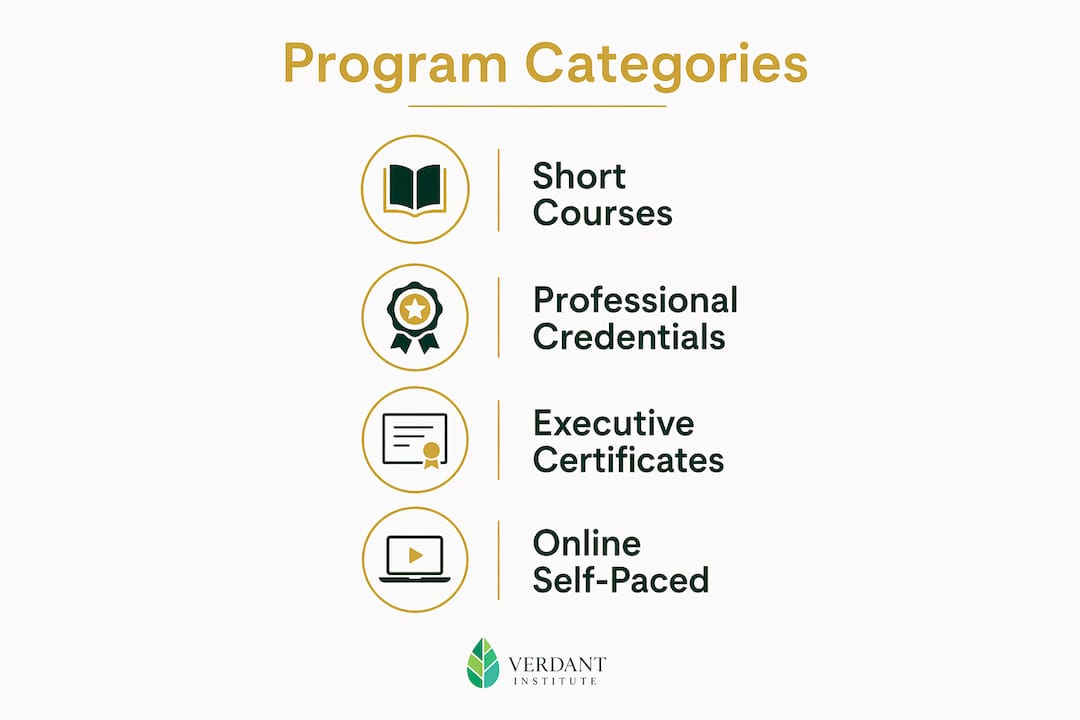
Short courses and certificate programs run from three weeks to three months and deliver focused technical training. The IUCN Professional Certificate on Finance for Nature is one concrete example, combining 12 hours of live sessions with individual projects on governance frameworks, biodiversity finance instruments, and data challenges. This format suits working professionals who cannot step away from their roles for a full semester.

Professional credentials represent the most employer-recognized tier. The CFA Institute's Certificate in ESG Investing is the most widely recognized credential in sustainable finance, particularly valued across European asset management firms. It covers ESG concepts, integration techniques, and responsible investment frameworks that hiring managers actively look for on resumes.
Executive education certificates target mid-career professionals moving into sustainability leadership roles. Imperial College's Executive Certificate in Sustainability Leadership and Finance teaches professionals how to convert sustainability ambition into measurable business value, including tools for risk assessment, opportunity identification, and credible action roadmaps.
Online self-paced programs offer the most scheduling flexibility. Harvard Business School Online's Sustainable Investing course focuses on integrating ESG factors into financial valuation with the same numerical rigor applied to traditional metrics. This is not a soft introduction to sustainability concepts. It is a quantitative program that expects prior knowledge of capital markets and investment management.
| Program type | Duration | Best suited for | Credential recognition |
|---|---|---|---|
| Short certificate (e.g., IUCN) | 3 weeks to 3 months | Early-career professionals | Specialist and NGO sectors |
| CFA ESG Certificate | Self-paced, typically 3-6 months | Investment professionals | Global asset management |
| Executive certificate (e.g., Imperial) | 3-6 months | Mid-career leaders | Corporate and financial services |
| Online course (e.g., HBS Online) | 6-8 weeks | Career switchers | Academic and employer recognition |
How do these alternatives build real ESG technical skills?
The most effective sustainable finance courses do not teach sustainability as a values exercise. They treat ESG data with numerical rigor, the same way a fixed income analyst treats credit spreads. That distinction separates programs worth your time from those that produce certificates without substance.
Regulatory fluency is the single most differentiating skill in the European sustainable finance market. Employers want candidates who can navigate Article 8 and Article 9 SFDR fund classifications, understand CSRD reporting obligations, and apply the EU Taxonomy's technical screening criteria to real portfolios. A general sustainability degree rarely covers these frameworks in the depth that a focused alternative program does.
The core technical areas covered by leading programs include:
- EU regulatory frameworks: EU Taxonomy alignment criteria, SFDR principal adverse impact indicators, and CSRD double materiality assessments
- ESG accounting and reporting: Sustainable reporting standards including GRI, ISSB, and TCFD disclosure frameworks
- Climate risk modeling: Physical and transition risk quantification integrated into portfolio stress testing
- Impact measurement: Outcome-based metrics for impact investing mandates, including SDG alignment mapping
- ESG integration in valuation: Adjusting DCF models and credit analysis to reflect material ESG factors
Programs like the IUCN certificate go further by including live sessions with leading experts and organizational change projects, which means you leave with a deliverable, not just a certificate. Understanding how to embed ESG in investment decisions is the practical output that employers actually test in interviews.
Pro Tip: Read primary regulatory documents for SFDR, EU Taxonomy, and CSRD rather than relying only on secondary commentary. Candidates who can cite specific articles and annexes in interviews stand out immediately from those who only know the headlines.
Why alternatives often beat traditional degrees for career switchers
Speed is the most obvious advantage. A traditional master's in sustainable finance runs 12 to 24 months and costs tens of thousands of dollars in tuition and lost income. A focused certificate program delivers the specific regulatory and technical knowledge employers want in a fraction of the time.
The advantages stack up across several dimensions:
- Faster time to competency. Programs spanning three weeks to three months cover ESG accounting, climate risk assessment, and regulatory frameworks without the general education requirements of a degree program.
- Cost efficiency. Executive certificates from providers like Imperial College cost significantly less than a full master's degree, and some programs offer partial academic credit that can count toward a degree later if you choose that path.
- Regulatory specificity. Mastering EU sustainability frameworks like the EU Taxonomy and SFDR is more differentiating than a general sustainability degree in European hiring markets. Employers are not looking for broad environmental awareness. They are looking for technical fluency in specific regulatory instruments.
- Practical application. The best programs include ESG research projects, case studies, and in some cases internship connections. Applications for ESG internships should be submitted 6 to 12 months in advance to stay competitive, so pairing a certificate with early internship applications is a proven career acceleration strategy.
- Flexibility for working professionals. Online and hybrid formats from providers like Verdantinstitute, HBS Online, and Imperial Executive Education allow you to study around existing job commitments, which a full-time degree program does not.
The one caveat worth stating clearly: top sustainable investing programs assume foundational finance knowledge. If you are missing baseline competency in investment management, capital markets, or asset classes, tackle that gap first before enrolling in an advanced ESG certificate.
How to choose the right program for your career goals
Choosing among alternative finance programs requires more than comparing price and duration. The curriculum content, provider credibility, and alignment with your target role all determine whether a certificate translates into career advancement.
Start with curriculum relevance. If your target role is in ESG fund management, prioritize programs that cover SFDR classifications, portfolio-level ESG integration, and sustainable investment strategies. If you are targeting corporate sustainability or investor relations, programs emphasizing CSRD reporting, double materiality, and stakeholder disclosure are more directly applicable. Review the types of ESG investment strategies relevant to your target sector before committing to a program.
Provider credibility matters because employers recognize names. The CFA Institute, Imperial College, IUCN, and Harvard Business School Online carry employer recognition that a lesser-known provider cannot replicate. That said, newer specialized platforms like Verdantinstitute offer structured learning tracks with CPD tracking and certifications that are gaining traction among finance professionals who want ongoing, modular learning rather than a single credential.
Pro Tip: Ask the program directly which employers have hired their graduates and whether they have relationships with ESG-focused asset managers or sustainability consultancies. A provider that cannot answer this question has not invested in career outcomes.
Consider these factors when evaluating any program:
- Does the curriculum cover EU regulatory frameworks in technical depth, not just conceptual overview?
- Is the provider recognized by employers in your target geography and sector?
- Does the format (live, self-paced, hybrid) match your schedule and learning style?
- Are there networking opportunities, alumni access, or career support included?
- What are the prerequisites, and do you meet them honestly?
Sustainability in finance is evolving fast enough that a program from three years ago may already be outdated on regulatory content. Check when the curriculum was last updated, particularly on CSRD and ISSB standards, which have changed significantly since 2023.
Key takeaways
Sustainable finance degree alternatives deliver faster, more targeted ESG expertise than traditional degrees when candidates choose programs with strong regulatory depth and credible provider recognition.
| Point | Details |
|---|---|
| Regulatory fluency is the priority skill | EU Taxonomy, SFDR, and CSRD mastery differentiates candidates more than a general sustainability degree. |
| CFA ESG Certificate leads on recognition | The CFA Institute credential is the most employer-recognized sustainable finance qualification globally. |
| Program duration ranges widely | Alternatives run from three weeks to six months, fitting working professionals without career interruption. |
| Prerequisites matter | Top programs like HBS Online assume baseline finance knowledge; fill that gap before enrolling. |
| Pair certificates with internships | Submitting ESG internship applications 6 to 12 months early maximizes the value of any credential. |
Why I think most people approach this decision backwards
Most people searching for sustainable finance degree alternatives start by asking which program is most prestigious. That is the wrong first question. After years of watching finance professionals navigate ESG career transitions, the pattern is clear: the candidates who advance fastest are not those with the most impressive certificate names. They are the ones who combined technical regulatory knowledge with hands-on ESG research experience, even if that experience came from a self-directed project or a short internship.
The uncomfortable reality is that sustainable finance leadership requires integrating sustainability with measurable value creation, not just compliance reporting. Programs centered only on reporting frameworks produce candidates who can fill out disclosure templates but cannot advise a portfolio manager on how ESG factors affect a company's cost of capital. That distinction shows up immediately in interviews.
My recommendation: treat your first certificate as a foundation, not a destination. Use it to build regulatory fluency, then layer in practical experience through ESG research projects, internship applications, or platforms like Verdantinstitute that offer modular deep dives into transition finance and net-zero strategies. If a full degree eventually makes sense for your goals, many certificate credits can count toward one. But most people in this field will advance further by staying current through ongoing learning than by spending two years in a classroom. The ESG career pathways that are growing fastest reward demonstrated technical skill over credential prestige.
— Charles
Start building your sustainable finance skills with Verdantinstitute
Verdantinstitute offers one of the most structured online sustainable finance training ecosystems available for finance professionals and students. With 16 courses and over 160 lessons organized into learning tracks covering ESG foundations, deep dives into specific topics, and advanced practice areas like transition finance and net-zero strategies, the platform is built for people who want to go beyond surface-level sustainability awareness.
Student plans start at $18 per month and professional plans at $58 per month, both with CPD tracking and certifications recognized by employers in financial services. Whether you are building your first ESG skill set or advancing into specialized areas like impact investing and responsible investing, explore Verdantinstitute's courses and pricing to find the track that fits your career goals.
FAQ
What are sustainable finance degree alternatives?
Sustainable finance degree alternatives are focused programs, certifications, and short courses that teach ESG investing, climate risk, and sustainability regulation without requiring a full academic degree. Examples include the CFA Certificate in ESG Investing, the IUCN Professional Certificate on Finance for Nature, and executive certificates from Imperial College.
How long do sustainable finance certificate programs take?
Most programs run between three weeks and six months depending on the format and depth. Short certificates like the IUCN Finance for Nature program combine 12 hours of live sessions with project work, while professional credentials like the CFA ESG Certificate are self-paced and typically completed in three to six months.
Is the CFA ESG Certificate worth it for a sustainable finance career?
The CFA Institute's Certificate in ESG Investing is the most widely recognized credential in sustainable finance and is particularly valued by European asset management employers. It is most effective when combined with practical ESG research experience or an internship.
Do I need a finance background to enroll in these programs?
Top programs like Harvard Business School Online's Sustainable Investing course assume prior knowledge of investment management, capital markets, and asset classes. Candidates without this foundation should build baseline finance competency before enrolling in advanced ESG certificate programs.
Can certificate credits count toward a full degree later?
Some programs offer partial academic credit that can be applied toward a full degree if you choose that path later. Check with the specific provider, as credit transfer policies vary significantly between institutions and programs.