

Asking what is a sustainable finance career gets you a simple answer fast: it's a finance role where ESG (Environmental, Social, and Governance) criteria actively shape how capital gets allocated. But that framing barely scratches the surface. Sustainable finance, the industry's standard term for what many also call green finance, is not about choosing between profit and purpose. It is about recognizing that long-term capital allocation that accounts for environmental risk, social impact, and governance quality creates better financial outcomes. This guide breaks down the roles, entry paths, and hard realities you need to know before committing to this career direction.
Table of Contents
- Key Takeaways
- What a sustainable finance career actually means
- Sustainable finance job titles explained
- How to enter the field
- The realities of the 2026 job market
- Practical steps to build your sustainable finance career
- My honest take on building this career
- Start your sustainable finance education with Verdantinstitute
- FAQ
Key Takeaways
| Point | Details |
|---|---|
| More than ethics | Sustainable finance careers center on value creation through ESG-integrated capital allocation, not just good intentions. |
| Diverse role types | Jobs span investment analysis, ESG risk, credit underwriting, and advisory, all resembling core finance functions. |
| Finance background matters | About 31% of impact professionals come from finance; investment roles generally require prior finance experience. |
| Competition is fierce | Early-career applicants often send 100 to 200 applications before landing interviews, so networking is critical. |
| Credentials open doors | ESG certifications and structured learning significantly improve your interview positioning and resume strength. |
What a sustainable finance career actually means
Sustainable finance is not a philosophy. It is a set of practices that integrate ESG criteria into financial analysis, product structuring, and investment decision-making. BNP Paribas describes it as focusing on long-term investments that benefit businesses, communities, and the planet simultaneously. That framing matters because it positions sustainability as a risk and opportunity lens, not a charitable exercise.
The UNDP frames sustainable finance as a $1 trillion mobilization challenge to fund the Sustainable Development Goals by 2030. That scale means the field needs practitioners who can build financial models, assess credit quality, and structure products with sustainability criteria baked in from the start.
Here is what separates sustainable finance from traditional finance at the conceptual level:
- ESG integration: Every investment or lending decision gets evaluated through environmental risk (climate exposure, resource use), social factors (labor practices, community impact), and governance quality (board structure, transparency).
- Long-term orientation: Sustainable finance explicitly deprioritizes short-term yield maximization in favor of durable capital performance.
- Positive impact measurement: Practitioners must quantify and report the real-world outcomes of capital deployment, not just financial returns.
- Regulatory alignment: The field operates within an expanding framework of disclosure requirements, green taxonomy rules, and climate-related financial risk standards.
Understanding these pillars tells you exactly what employers expect you to know. It also explains why sustainable finance frameworks form such a core part of professional development in this space.
Sustainable finance job titles explained
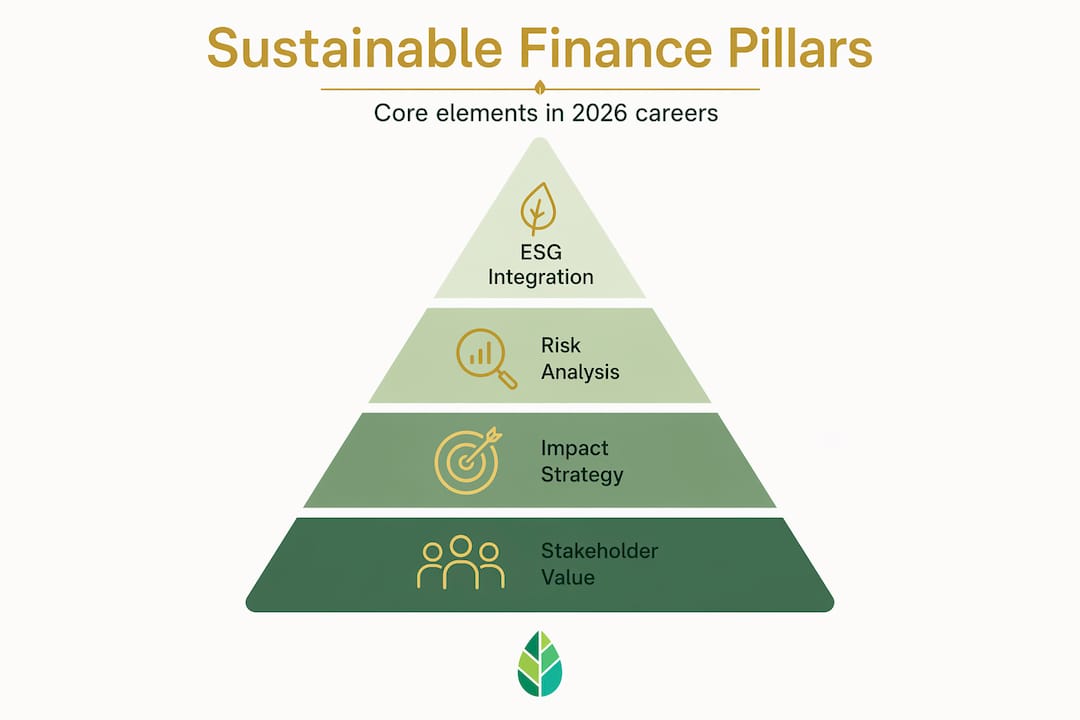
The range of careers in sustainable finance is wider than most people expect. These roles are not separate from mainstream finance. They are finance roles with a specific ESG or sustainability mandate layered on top.
| Role | Core function | Typical skills required |
|---|---|---|
| ESG Investment Analyst | Research and evaluate companies on ESG metrics for portfolio decisions | Financial modeling, ESG scoring, sector analysis |
| Sustainable Finance Advisor | Advise corporate clients on green bonds, sustainability-linked loans | Structuring, client management, regulatory knowledge |
| ESG Risk Analyst | Identify and quantify ESG-related risks in lending or investment portfolios | Risk frameworks, data analysis, scenario modeling |
| Renewable Energy Credit Analyst | Underwrite credit for clean energy infrastructure projects | Credit analysis, energy sector knowledge, cash flow modeling |
| Sustainability Portfolio Manager | Manage investment funds with ESG mandates | Asset allocation, ESG reporting, stakeholder communication |
Current job postings reflect real demand. Roles in GHG accounting, natural capital private equity, and renewable energy credit underwriting are active across major financial centers. Salary ranges vary significantly by seniority and function. A renewable energy credit analyst role in New York, for instance, typically pays between $70,000 and $125,000 for candidates with two or more years of experience.
Most sustainable finance job opportunities cluster geographically in cities like New York, London, Zurich, Singapore, and Amsterdam. Swiss Sustainable Finance maintains a dedicated job board with active roles, which reflects how specialized and organized the hiring ecosystem has become in European markets.

Pro Tip: When researching sustainable finance entry-level roles, look beyond job title keywords like "ESG analyst." Search for terms like "impact investing analyst," "green bond associate," or "climate risk associate" to find roles that may not use ESG terminology but are squarely within the field.
For a deeper breakdown of how these roles map to career progression, the ESG career pathways guide from Verdantinstitute walks through the specific competencies each level demands.
How to enter the field
The entry path depends heavily on your current background. That is the honest starting point for any sustainable finance entry-level career guide worth reading.
-
If you have a finance background: You are already positioned for investment-facing roles. Your priority is adding ESG-specific knowledge. Pursue an ESG certification, build familiarity with sustainability reporting standards like GRI or TCFD, and target firms with active ESG integration programs. About 31% of impact professionals come from prior finance careers, but investment officer and portfolio manager roles almost universally require that foundation.
-
If you are coming from a non-finance background: Your path requires more deliberate skill-building. Focus on financial modeling fundamentals, accounting basics, and ESG data analysis. Programs in environmental science, policy, or social work can be genuine assets, especially in impact measurement and stakeholder-facing roles. The majority of impact professionals actually come from non-finance sectors, so this path is well-worn.
-
Get certified: An ESG credential signals to hiring managers that your interest is professional, not just ideological. Verdantinstitute's step-by-step ESG certification guide walks you through the options and what each certification actually demonstrates to employers.
-
Build practical experience: Volunteer for sustainability reporting projects, take on freelance ESG research work, or seek internships at impact-focused funds or development finance institutions. Hiring managers want evidence of applied thinking, not just coursework.
-
Network with intention: Generic LinkedIn outreach rarely works. Attend industry events like PRI in Person, GIIN's annual conference, or local sustainable finance roundtables. Ask for informational interviews with analysts who are two to three years ahead of you in their careers.
Pro Tip: For sustainable finance resume building, do not list ESG as a soft skill. Show it through specifics: "Analyzed Scope 1 and 2 emissions data for 15 portfolio companies" or "Built a DCF model incorporating carbon price sensitivity scenarios."
The ESG study guide for finance professionals from Verdantinstitute is a good starting point for understanding what credential matters for which role type.
The realities of the 2026 job market
Anyone serious about sustainable finance career transition tips needs to understand the market without filters. The field is genuinely competitive and structurally more constrained than the volume of interest in it suggests.
A Harvard Business School study cited by ImpactAlpha found that only 1 in 400 MBA graduates from the United States work in impact investing roles, with those jobs concentrated in a handful of major geographic hubs. That ratio should recalibrate expectations for anyone assuming that passion alone opens doors.
"Show me the money. That is what sustainability has become." — Luanne Sieh, Chief Sustainability Officer, CIMB
That quote from CIMB's CSO captures the current hiring mindset precisely. Hiring managers now expect candidates to connect ESG work directly to business outcomes: reduced cost of capital, improved risk-adjusted returns, measurable impact on client portfolios. "I care about sustainability" is not a differentiated answer in 2026.
Here is what the application process actually looks like at the entry level:
- Early-career applicants frequently submit 100 to 200 applications before securing a meaningful number of interviews.
- Tailored applications that reference a firm's specific ESG strategy outperform generic applications significantly.
- Regulatory disruption continues to reshape roles. Positions tied to specific disclosure frameworks can shift as regulatory requirements evolve.
- Geographic flexibility substantially increases your odds. Being open to Zurich, Singapore, or Amsterdam, not just New York, matters.
Practical steps to build your sustainable finance career
You know what the field is. You know the roles. Now here is where to focus your energy.
Skills to prioritize first: Financial modeling with ESG scenario inputs, carbon accounting basics, ESG data sourcing and analysis, credit assessment for infrastructure projects, and sustainability reporting under frameworks like TCFD and SFDR. Job descriptions consistently list financial modeling, GHG accounting, investor relations, and fundraising as core requirements across seniority levels.
Where to learn: Verdantinstitute offers structured learning tracks specifically designed for sustainable finance practitioners, from foundational ESG knowledge through to advanced transition finance and net-zero strategies. The course library covers 16 courses and over 160 lessons, with CPD tracking built in. Student plans start at $18 per month, which makes consistent, structured learning genuinely accessible.
How to stay current: Subscribe to publications like Bloomberg Green Finance, Environmental Finance, and ImpactAlpha. Follow ISSB and GRI updates closely because regulatory change directly affects which skills become most valuable.
How to prepare for interviews: Practice explaining how you would incorporate climate risk into a credit decision or how you would respond if a client's ESG score was driving underperformance. Interview preparation in this field requires practical examples showing influence on capital allocation or risk assessment. Abstract answers about believing in sustainability will not get you hired.
Real-world exposure: Reading about sustainable finance projects with real examples helps you develop the vocabulary and analytical instincts that make interviews much more convincing.
My honest take on building this career
I have watched a lot of people approach sustainable finance with enormous enthusiasm and exit the job search frustrated. The pattern is almost always the same. They lead with values and follow with credentials. Hiring managers hear it a hundred times a week.
What actually moves the needle, in my experience, is reversing that order. Lead with your technical competency in finance. Then demonstrate how ESG frameworks sharpen that analysis rather than replace it. When I talk with practitioners who successfully made the transition, they almost uniformly say the same thing: the people who got hired were the ones who could explain how an ESG factor affected a financial output. Not how much they cared about the planet.
The other thing I would tell anyone starting out is to be strategic about where you learn. Scattered YouTube videos and LinkedIn posts will not build the fluency that a hiring manager can test in thirty minutes. Structured learning, with a real curriculum and certification you can point to, changes the conversation. It signals that you have put in the work systematically, not just collected scattered opinions.
Sustainable finance is genuinely one of the most interesting intersections in modern finance. The challenge is that the market for roles, while growing, has not kept pace with the interest. That gap rewards people who are prepared, not just motivated.
— Charles
Start your sustainable finance education with Verdantinstitute
If you are serious about pursuing a sustainable finance career, the gap between interest and employability comes down to structured knowledge and demonstrated skill.
Verdantinstitute is built specifically for finance professionals and students who want to develop real ESG and sustainable finance expertise, not surface-level familiarity. The platform offers 16 courses covering everything from ESG fundamentals to advanced topics like transition finance and net-zero investment strategies. CPD tracking and certifications give you tangible credentials to include on your resume. Student plans start at $18 per month, and professional plans at $58 per month, making it one of the most cost-effective ways to build serious credentials. Explore the course and pricing options to find the learning path that fits your current level and career goals.
FAQ
What does a sustainable finance career involve?
A sustainable finance career involves integrating ESG criteria into financial decision-making, including investment analysis, credit assessment, risk management, and advisory work. Roles closely resemble traditional finance functions but require knowledge of sustainability frameworks and reporting standards.
Do you need a finance degree to enter sustainable finance?
Not always, but investment-facing roles generally require prior finance experience or education. About 31% of impact professionals come from finance backgrounds, while the majority enter from other sectors with targeted upskilling in financial modeling and ESG analysis.
How competitive is the sustainable finance job market?
Very competitive. Early-career applicants often submit 100 to 200 applications before landing meaningful interviews, with jobs concentrated in cities like New York, London, Zurich, and Singapore. Strategic networking and tailored applications significantly improve outcomes.
What qualifications help most for sustainable finance roles?
ESG certifications, financial modeling proficiency, familiarity with disclosure frameworks like TCFD and SFDR, and carbon accounting knowledge are among the most valued qualifications. Hiring managers consistently prioritize demonstrated analytical skills over general sustainability interest.
What salary can you expect in sustainable finance?
Salaries vary widely by role and seniority. A renewable energy credit analyst role in New York, for example, typically pays between $70,000 and $125,000 for candidates with two or more years of experience, with senior roles and portfolio management positions commanding significantly more.