

For finance students, professionals, and academics deciding where to invest their learning time in 2026, the top sustainable finance academic platforms and programs are: Verdant Institute (best for CPD-focused upskilling), GRASFI (best for research networks and conferences), Oxford Sustainable Finance Group (best for research-backed short courses), Institut Louis Bachelier / PARC (best for literature mapping), Columbia Center for Sustainable Investment (best for policy-oriented research), MIT sustainability initiatives (best for quantitative and tech-forward methods), and NUS MSc in Sustainable and Green Finance (best formal degree). Here is the one-line test that cuts through the noise: do you need a credential your employer recognizes next quarter, or do you need deep research fluency over the next two years? That single question narrows the list faster than any ranking.
- Verdant Institute — Subscription-based, CPD-tracked courses across 16 modules; best for practitioners who need verifiable upskilling without a multi-year commitment.
- GRASFI — Annual conferences and member-university research networks; best for PhD candidates and academics building publication records.
- Oxford Sustainable Finance Group — Eight-week online course backed by Smith School faculty; best for professionals who want academic rigor without a full degree.
- Institut Louis Bachelier / PARC — Searchable sustainable finance research cartography for literature discovery; best for researchers mapping gaps.
- Columbia Center for Sustainable Investment (CCSI) — Policy-focused applied research; best for professionals at the investment-development interface.
- MIT sustainability initiatives — Quantitative and data-driven orientation; best for learners who want technical depth.
- NUS MSc in Sustainable and Green Finance — Full master's degree with green finance specialization; best for students who need a formal credential.
Key Takeaways
The strongest sustainable finance academic platforms in 2026 combine research credibility, format flexibility, and curriculum alignment with current regulatory and market demands, with Verdant Institute leading for CPD-focused practitioners.
| Point | Details |
|---|---|
| Match format to your goal | Degrees (NUS), short courses (Oxford), research networks (GRASFI), and CPD platforms (Verdant) serve different needs. |
| 2026 curriculum must-haves | Biodiversity finance, SFDR alignment, ESG data analytics, and agentic AI literacy are now baseline competencies. |
| Cost scales with credential type | Open-access tools are free; subscriptions run $18–$58/month; short courses and degrees carry higher tuition. |
| Research tools complement courses | Institut Louis Bachelier's cartography and GRASFI's paper collections are free resources that sharpen any learning plan. |
| Verdant Institute for CPD | Verdant Institute offers 16 courses, automated CPD tracking, and certificates starting at $18/month for students. |
Table of Contents
- How these 2026 picks were selected
- Which platforms and programs lead in 2026?
- What do leading programs actually teach?
- How to choose the right platform or program for your goals
- What trends are reshaping sustainable finance education in 2026?
- Verdant Institute: platform profile and credentials
- Which platform fits your specific goal?
- An editorial perspective on how to think about this list
- Verdant Institute: a practical CPD-first path
- Sources
How these 2026 picks were selected
Every platform and program on this list was evaluated against eight criteria, weighted toward what actually moves careers and research agendas in 2026.
- Research output and faculty credibility — Does the institution publish peer-reviewed work in sustainable finance? Are faculty active researchers, not just practitioners on retainer?
- Format and accessibility — Is the program available online, hybrid, or in-person only? Can a working professional complete it without a leave of absence?
- Cost model — Subscription, per-course fee, or full tuition? Is pricing transparent and proportionate to the credential offered?
- CPD accreditation or certificate value — Does the program issue certificates recognized by professional bodies, or does it offer trackable CPD hours?
- Career outcomes and employer links — Are alumni outcomes published? Do employers actively recruit from the program or recognize its credential?
- Unique features — Conferences, curated datasets, API access, monitoring tool integration, or research cartographies that go beyond a standard syllabus.
- 2026 curriculum relevance — Does the program address biodiversity finance, ESG data analytics, SFDR/MiFID II alignment, and agentic AI in due diligence? These are no longer elective topics.
- Accessibility for US-based learners — Programs or platforms with no meaningful online access for US learners were excluded.
Data sources included published program curricula, institutional research output records, platform feature documentation, and publicly available partnership and accreditation disclosures. Where CPD accreditation status was not publicly confirmed, it is noted as such rather than assumed.
One important distinction shapes the whole list: sustainable finance operating systems like emFi or Connect Earth are data and compliance infrastructure tools, not educational platforms. They matter for curriculum design (learners should understand what these systems do), but they are not substitutes for structured learning. Conflating the two is a common mistake, and this ranking does not make it.
Which platforms and programs lead in 2026?
| Platform / Program | Best for | Format | Accessibility | Cost model | Faculty / research credibility | Unique features | 2026 focus |
|---|---|---|---|---|---|---|---|
| Verdant Institute | Practitioner CPD, modular upskilling | Online courses, structured tracks | Fully online, open enrollment | $18/mo (students), $58/mo (professionals) | ESG and sustainable finance specialists; practitioner-aligned curriculum | CPD tracking, 16 courses, 160+ lessons, certificates | Transition finance, net-zero, ESG data analytics |
| GRASFI | Academic researchers, PhD candidates | Research alliance, annual conference | Open access publications; conference registration | Free access to publications; conference fees vary | Member universities globally; peer-reviewed research collections | Annual conference, member-university network, paper collections | Biodiversity finance, climate risk research |
| Oxford Sustainable Finance Group | Professionals seeking research-backed short courses | 8-week online short course | Online; paid enrollment | Tuition listed on program page | Oxford Smith School faculty; one of the largest academic sustainable finance centers | Research-to-teaching pipeline; faculty-led modules | Multidisciplinary climate and finance research |
| Institut Louis Bachelier / PARC | Researchers, literature reviewers | Research mapping tool | Open access | Free | Academic literature network; PARC research cartography | Searchable topic-linking map of academic papers | Research gap identification, topic clustering |
| Columbia Center for Sustainable Investment (CCSI) | Policy researchers, investment-development professionals | Research center, publications, events | Mostly open access | Free (publications); event fees vary | Columbia University faculty; policy-engaged applied research | Policy briefs, investment frameworks, development finance focus | Sustainable investment policy, SDG alignment |
| MIT sustainability initiatives | Quantitative learners, tech-forward researchers | Research programs, courses, events | Mixed (some open, some paid) | Varies by program | MIT faculty; strong technical and data science orientation | Intersection of finance, technology, and sustainability | Data analytics, climate modeling, innovation |
| NUS MSc in Sustainable and Green Finance | Students seeking a formal degree credential | Full master's degree | In-person / hybrid (Singapore) | Full tuition (contact NUS Business School) | NUS Business School faculty; regional green finance expertise | Degree credential, classroom and research components | Green finance, regional market exposure |
Verdant Institute
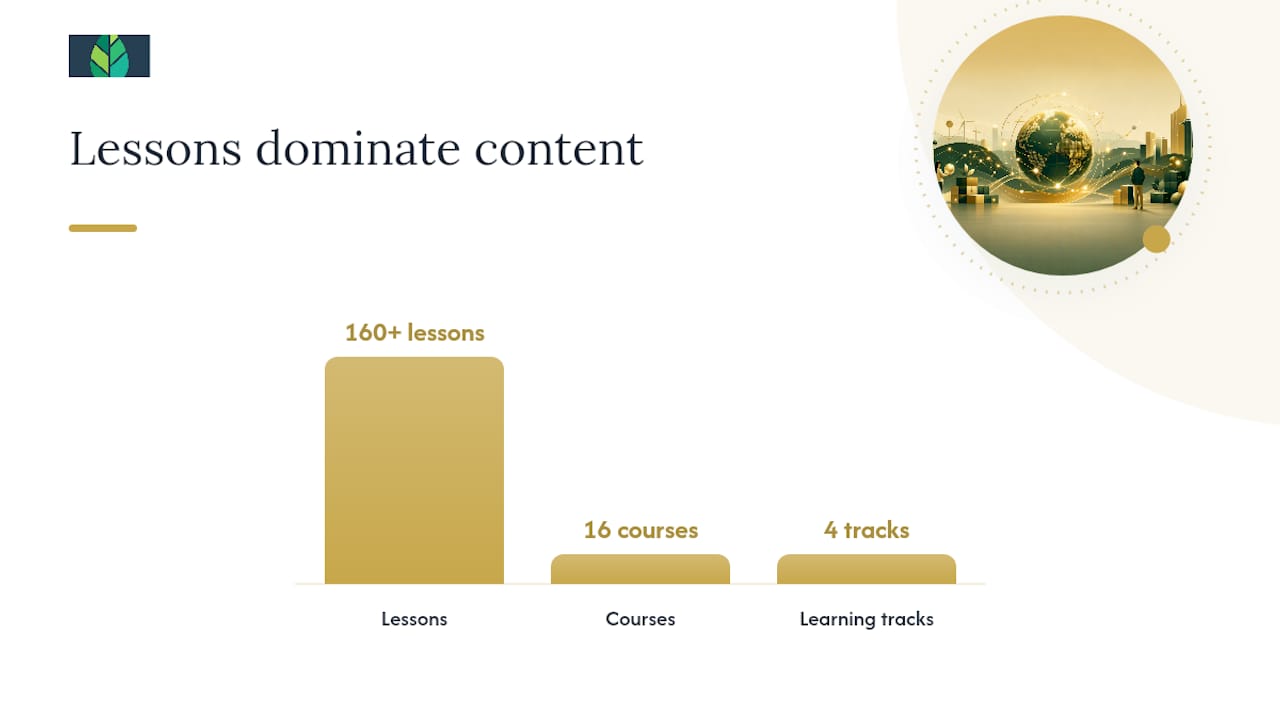
Verdant Institute is the clearest answer for professionals and students who need structured, CPD-tracked learning they can fit around a full-time job. The platform's 16 courses and over 160 lessons span foundational ESG concepts through advanced topics like transition finance and net-zero portfolio strategies. Crucially, it tracks CPD hours automatically and issues completion certificates, which matters when you need to demonstrate continuing education to an employer or professional body. At $18 per month for students and $58 per month for professionals, it is the most cost-accessible option on this list that still delivers structured, credential-bearing training. The course library covers Academic Foundations, Deep Dives into specific ESG topics, and Advanced Practice areas, so learners can move through a logical progression rather than picking isolated modules at random.
GRASFI
The Global Research Alliance for Sustainable Finance and Investment is not a course platform. It is a network of universities that collectively advance the academic field through annual conferences, shared research, and collaborative publications. For a PhD student or early-career academic, GRASFI membership and conference participation can open doors that no online course can. The annual conference brings together researchers from member institutions to present and debate working papers, which means the real value is peer exposure and network access, not a syllabus.
Oxford Sustainable Finance Group
The Oxford Smith School's online sustainable finance course runs eight weeks and is taught by faculty from the Oxford Sustainable Finance Group, one of the largest academic centers dedicated to this field. The research-to-teaching pipeline here is genuine: the faculty who design the curriculum are the same researchers publishing on climate risk, stranded assets, and green capital allocation. For a professional who wants academic credibility without a two-year degree, this is a strong option.
Institut Louis Bachelier / PARC
The Institut Louis Bachelier's research cartography tool does something no course platform does: it maps the academic literature in sustainable finance so you can see where research clusters, where gaps exist, and which topics are gaining momentum. For a researcher designing a dissertation or a practitioner building a research-backed investment thesis, this is a genuinely useful discovery tool, not just a reading list.
Columbia Center for Sustainable Investment (CCSI)
CCSI sits at the intersection of investment practice and development policy. Its research output focuses on how capital flows to sustainable projects in emerging markets, how investment frameworks align with SDGs, and how policy shapes investment behavior. Practitioners working in development finance, impact investing, or multilateral institutions will find CCSI's publications and frameworks more directly applicable than a general ESG course.
MIT sustainability initiatives
MIT's approach to sustainable finance is distinctly quantitative. The programs and research initiatives coming out of MIT tend to emphasize modeling, data infrastructure, and the technical dimensions of climate risk, which makes them a natural fit for learners with engineering or data science backgrounds who are moving into finance. The intersection of satellite data, climate modeling, and portfolio analytics is where MIT's contribution is most distinctive.
NUS MSc in Sustainable and Green Finance
The NUS Business School's Master of Science in Sustainable and Green Finance is the only full degree program on this list. It is designed for students who want a formal credential with a specialized focus on green finance, particularly in the context of Asian and regional markets. The degree includes classroom instruction, research components, and exposure to practitioners in Singapore's financial sector. For US-based students, this is a significant relocation and tuition commitment, but the credential carries weight in global green finance markets.
What do leading programs actually teach?
Across the platforms and programs on this list, a core set of competencies appears consistently. These are not elective topics anymore; they are the baseline for anyone claiming sustainable finance expertise in 2026.
- ESG integration — How environmental, social, and governance factors are incorporated into investment analysis, portfolio construction, and risk management.
- Climate risk assessment — Physical and transition risk modeling, scenario analysis aligned with TCFD frameworks, and stress-testing portfolios against climate pathways.
- Transition finance — Financing the shift from high-carbon to low-carbon business models, including credible transition plans and sectoral decarbonization pathways.
- Carbon markets — Voluntary and compliance carbon market mechanics, carbon credit quality, and the role of carbon pricing in investment decisions.
- Biodiversity and nature-positive finance — Emerging frameworks like TNFD, natural capital accounting, and the financial materiality of ecosystem services.
- ESG data analytics — Working with ESG datasets, understanding data provider methodologies, and producing regulatory-aligned disclosures. Platforms like Connect Earth demonstrate what API-first sustainability data infrastructure looks like in practice, and learners who understand this layer are better equipped to work with it.
- Regulatory frameworks — SFDR, MiFID II sustainability preferences, EU Taxonomy, and their US equivalents and analogs. ESG disclosure obligations are tightening globally, and courses that skip regulatory alignment are leaving learners unprepared.
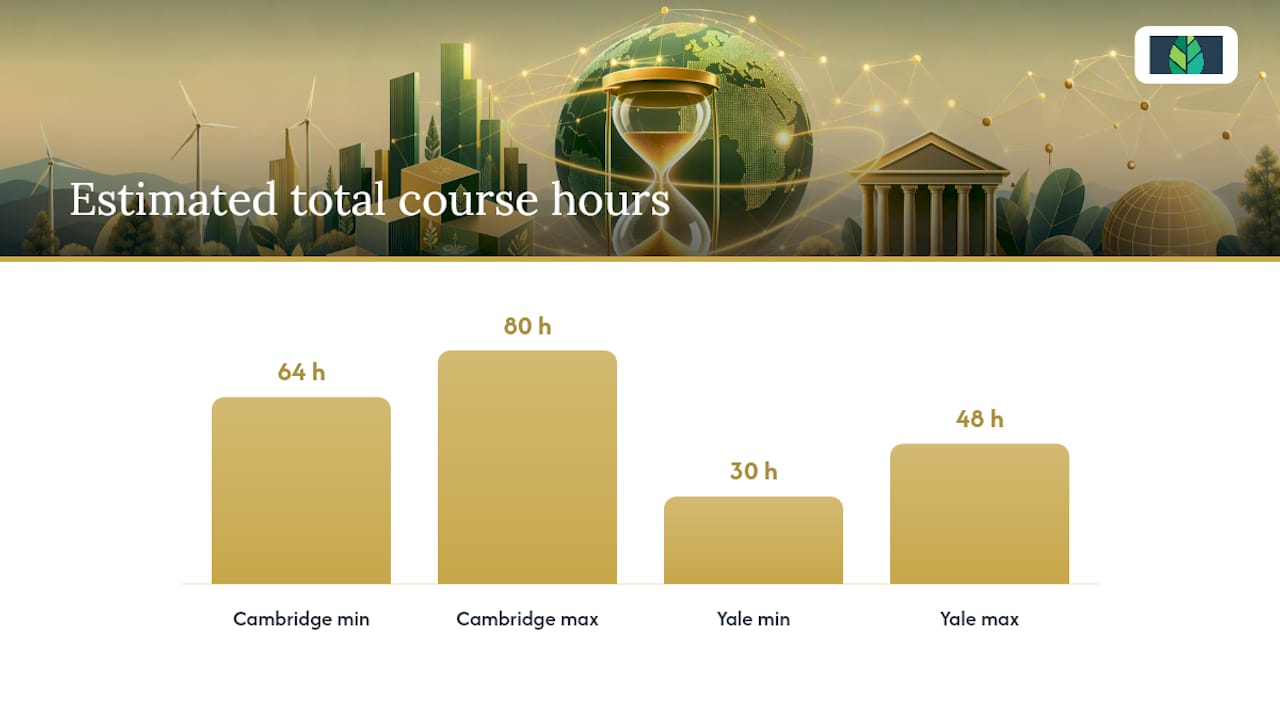
Where programs diverge is in depth and practical application. The Cambridge Institute for Sustainability Leadership's sustainable finance short course runs eight weeks at 8–10 hours per week and includes live sessions alongside asynchronous content, which signals a genuine commitment to cohort-based learning rather than passive video consumption. Yale Online's Sustainable Finance and Investment program runs six weeks at 5–8 hours per week and targets strategic business leaders who need ESG integration tools for portfolio decisions. Both are useful reference points for what a well-structured professional short course looks like.
Signals of genuine rigor include faculty who publish in peer-reviewed journals, reading lists that cite primary research rather than only practitioner reports, and practical components like capstone projects, employer-linked case studies, or dataset access. A course that lists "ESG" as a topic without specifying which frameworks, which data sources, or which regulatory context is teaching vocabulary, not capability.
Pro Tip: Before enrolling, ask the program coordinator for a sample reading list or module outline. If the readings are primarily from consulting firm white papers rather than peer-reviewed journals or primary regulatory documents, the course is practitioner-lite regardless of the institution's name on the certificate.
How to choose the right platform or program for your goals
The decision is simpler than it looks once you sequence the questions correctly.
- What credential do you actually need? A CPD certificate for a professional body, a university certificate for a job application, or a master's degree for a career pivot each require different programs. Do not pay degree-level tuition for a CPD need, and do not expect a short course to substitute for a degree on a graduate school application.
- How much time can you commit per week? Programs range from 5 hours per week (Yale Online) to full-time study (NUS MSc). Be honest. A program you cannot finish is worth nothing.
- Is your primary need research depth or practitioner skill? Research hubs like GRASFI and CCSI build academic fluency. Subscription platforms like Verdant Institute build applied, job-ready skills. Most professionals need the latter; most PhD candidates need the former.
- What is your budget? Free open-access resources (GRASFI publications, Institut Louis Bachelier's cartography) are genuinely valuable for research. Subscription platforms ($18–$58/month) are cost-efficient for ongoing CPD. Short courses from Oxford or Cambridge run to several hundred dollars. A full master's degree is a multi-year financial commitment.
- Does your employer recognize the credential? Some professional bodies and employers have approved provider lists. Check before enrolling, especially for CPD hours.
- Does the program address 2026-relevant topics? Biodiversity finance, SFDR alignment, and ESG data analytics are now table stakes. A program that does not cover them is already behind.
Questions worth asking directly before you commit: How many CPD hours does completion earn? What percentage of graduates are employed in sustainable finance roles within six months? Does the platform provide access to live datasets or monitoring tools? Which employers recruit from this program?
Red flags: faculty bios with no published research, accreditation claims that link to the institution's own website rather than an independent body, and "data monitoring" features that are actually just PDF downloads. Greenwashing enforcement is intensifying globally, and that scrutiny is starting to extend to credential claims as well.
Pro Tip: Check whether the platform's CPD tracking integrates with your professional body's reporting system before subscribing. Manual logging defeats the purpose of automated CPD tracking.
What trends are reshaping sustainable finance education in 2026?
The curriculum shifts happening right now are not incremental. Four forces are rewriting what it means to be competent in this field.
- Regulatory alignment is now a core skill, not a compliance footnote. SFDR Level 2 reporting requirements, MiFID II sustainability preference obligations, and the EU Taxonomy's expanding scope mean that finance professionals who cannot read and apply regulatory text are operationally limited. Programs that treat regulation as background context rather than a primary analytical framework are misaligned with market demand.
- Data literacy is the new ESG literacy. The ability to evaluate ESG data provider methodologies, ingest API-delivered sustainability data, and produce audit-ready documentation is increasingly what employers are hiring for. Tools like Tese.io illustrate the practical workflow: connecting capital to verified project-level sustainability data, supporting SME onboarding, and producing portfolio-level reporting. Learners who understand this layer can work across the full investment lifecycle.
- Biodiversity and nature-positive finance have moved from niche to mainstream. The Taskforce on Nature-related Financial Disclosures (TNFD) framework is now being adopted by major financial institutions, and courses that cover only carbon risk are leaving a significant gap. The most forward-looking programs in 2026 are integrating natural capital accounting and ecosystem service valuation alongside traditional climate risk modules.
- Agentic AI in due diligence is arriving faster than curricula can track. Sustainable finance operating systems are beginning to deploy AI agents for project screening, document review, and compliance checking. Learners who understand what these systems can and cannot do, and how to interpret their outputs, will have a meaningful edge. This is not about learning to code; it is about developing enough technical fluency to work alongside automated systems without being misled by them.
The practical implication: prioritize programs that update their curricula annually and that have faculty or advisors with active industry connections. A syllabus frozen in 2023 is a liability in 2026.
Verdant Institute: platform profile and credentials
Verdant Institute is a subscription-based e-learning platform built specifically for sustainable finance and ESG education. It is not a university, and it does not award academic degrees. What it does offer is a structured, CPD-tracked learning environment that professionals and students can work through at their own pace, with verifiable outcomes.
The platform's current offering includes:
- 16 courses and over 160 lessons organized into four learning tracks: Academic Foundations, Foundations (for beginners), Deep Dives into specific ESG topics, and Advanced Practice areas covering transition finance and net-zero strategies.
- CPD tracking built into the platform, so learners accumulate and document continuing education hours automatically.
- Completion certificates issued upon finishing courses, suitable for professional development portfolios.
- Subscription pricing at $18 per month for students and $58 per month for professionals, with institutional licensing available for universities and finance teams.
| Feature | Detail |
|---|---|
| Course library | 16 courses, 160+ lessons |
| Learning tracks | Academic Foundations, Foundations, Deep Dives, Advanced Practice |
| CPD tracking | Built-in, automated |
| Certificates | Completion certificates per course |
| Student pricing | $18/month |
| Professional pricing | $58/month |
| Institutional access | Bulk licensing available |
| Format | Fully online, self-paced |
The pricing page details current plan options. For students navigating the path from coursework to professional certification, the ESG certification guide on the Verdant blog is a practical companion resource. The platform's blog also covers ESG disclosure research and ESG research skills for professionals who want to test the depth of the content before subscribing.
Which platform fits your specific goal?
| Goal | Best pick | Why | Next step |
|---|---|---|---|
| Earn CPD hours for a professional body | Verdant Institute | Automated CPD tracking, certificates, flexible subscription | Subscribe at $18–$58/month |
| Publish academic research in sustainable finance | GRASFI | Conference exposure, peer network, research collections | Register for annual conference |
| Complete a short course with academic credibility | Oxford Sustainable Finance Group | 8-week course, Smith School faculty, research-backed curriculum | Enroll via Oxford Smith School |
| Map the academic literature for a dissertation | Institut Louis Bachelier / PARC | Open-access searchable research cartography | Use the free mapping tool |
| Work in development finance or policy | Columbia Center for Sustainable Investment | Policy-focused applied research, SDG-aligned frameworks | Access CCSI publications |
| Build quantitative and data skills | MIT sustainability initiatives | Technical orientation, data science and climate modeling | Explore MIT programs and events |
| Earn a formal master's degree in green finance | NUS MSc in Sustainable and Green Finance | Full degree, specialized curriculum, regional market exposure | Apply to NUS Business School |
For professionals who need to demonstrate continuous learning to an employer or professional body right now, Verdant Institute is the most direct path. The subscription model means you can start this week, track your hours, and have a certificate to show within a month. For those building toward a research career or a formal degree, GRASFI, Oxford, and NUS each serve a distinct need that a subscription platform is not designed to replace.
An editorial perspective on how to think about this list
The sustainable finance education space has a credibility problem that this ranking tries to address directly. Too many programs lead with institutional prestige and bury the actual curriculum. A university's name on a certificate is worth something, but it is not a substitute for a syllabus that covers SFDR, TNFD, and ESG data infrastructure in 2026.
The more useful frame is this: what does the program require you to do, not just read? Courses that include live datasets, capstone projects tied to real portfolios, or employer-linked case studies are building transferable skills. Courses that deliver video lectures and a multiple-choice quiz are building familiarity, which is a different and lesser thing.
Verdant Institute's subscription model reflects a specific philosophy: sustainable finance competence is not a one-time credential. It is a continuous practice that requires updating as regulation, science, and market structure evolve. The CPD tracking built into the platform is not a feature; it is an argument about how learning in this field should work. The upskilling roadmap for 2026 on the Verdant blog makes this case in practical terms.
The programs that will matter most in three years are the ones updating their curricula now to reflect biodiversity finance, agentic AI in due diligence, and regulatory-aligned data reporting. That is the lens this ranking used, and it is the lens worth applying to any program not on this list.
Verdant Institute: a practical CPD-first path
The programs on this list cover a wide range, from a full master's degree in Singapore to open-access research tools from Paris. Verdant Institute occupies a specific and deliberate position in that range: a subscription-based platform that gives working professionals and students structured, CPD-tracked training in sustainable finance and ESG analysis without the time or cost commitment of a degree program.
At $18 per month for students and $58 per month for professionals, Verdant Institute's course library covers the full arc from ESG foundations through advanced transition finance and net-zero strategies. CPD hours are tracked automatically, and completion certificates are issued per course. Institutional licensing is available for universities and finance teams that want to train cohorts rather than individuals.
One clarification worth making explicit: Verdant Institute is a professional training platform, not a degree-granting institution. It complements a university degree or a research program; it does not replace one. If you need a master's degree, NUS or a comparable institution is the right path. If you need verifiable, up-to-date CPD training you can start this week, Verdant Institute is built for exactly that.
Sources
The sources below informed this ranking. Researchers will find the GRASFI and Institut Louis Bachelier links most useful for academic discovery; practitioners will get more immediate value from the Oxford, Cambridge, and Yale program pages.
- GRASFI - Global Research Alliance for Sustainable Finance and Investment
- Sustainable Finance online short course | Cambridge Institute for Sustainability Leadership (CISL)
- Sustainable Finance and Investment | Yale Online
- Sustainable Finance | Online Short Course | Oxford Smith School
- emFi - Sustainable Finance Operating System
- Sustainable finance research cartography | Institut Louis Bachelier / PARC