

The fastest path to sustainable finance capability runs through five steps: assess your current gaps against recognized standards, define specific learning objectives by role, select modular coursework that builds progressively, embed learning into live work through capstone projects, and measure outcomes against both CPD metrics and business results. Finance professionals who follow this sustainable finance upskilling roadmap typically reach role-specific competency on a fast-track schedule within several months. Enterprise-wide rollouts, where L&D teams coordinate across multiple functions, generally take longer periods.
Your immediate next step: run a light skills gap assessment against TCFD disclosure requirements and SASB/IFRS S2 standards, then check your results against Verdantinstitute's skills checklist for finance professionals. That 30-minute exercise tells you exactly which of the five steps demands the most attention right now.
Key starting points before you move into the detailed roadmap:
- Gap assessment first. Map your current competencies against TCFD, SASB/IFRS S2, and any SEC climate disclosure guidance relevant to your firm.
- Role specificity matters. A portfolio manager's learning path looks nothing like a risk officer's. Generic training rarely sticks.
- Capstone over certificate. Programs that require a deliverable (a portfolio decarbonization plan, a transformation blueprint) produce measurably better on-the-job transfer than certificate-only tracks.
- CPD tracking from day one. Build the habit of logging hours, module completions, and assessment scores before you need to report them to a manager or regulator.
PwC's five-step methodology for upskilling finance professionals ties each phase directly to business strategy, which is why this roadmap follows the same logic rather than treating training as a standalone HR exercise.
Table of Contents
- What core competencies does a sustainable finance professional need?
- How do you choose the right course format and credentials?
- The five-step roadmap in detail: actions, timelines, and KPIs
- Sample 6–12 month learning plans for common finance roles
- How do you track CPD and prove ROI to your employer?
- How Verdantinstitute's learning tracks map to the five-step roadmap
- What regulatory frameworks are reshaping sustainable finance in the U.S.?
- What technology and data tools support sustainable finance analysis?
- Practical case studies in sustainable finance
- Key Takeaways
- What most upskilling programs get wrong
- Verdantinstitute gives you the structure to actually finish this roadmap
- Authoritative sources and recommended further reading
What core competencies does a sustainable finance professional need?
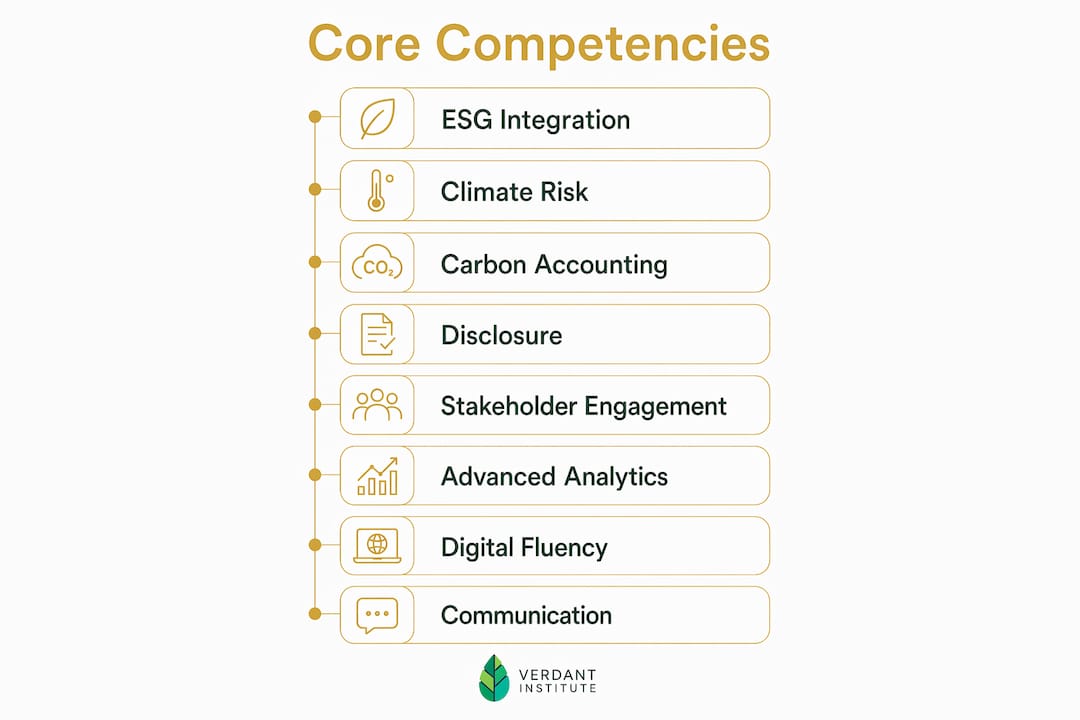
The field demands eight distinct competency clusters, and most professionals are strong in two or three while carrying real gaps in the others. Knowing which cluster you're weakest in is more useful than a general "learn ESG" directive.
| Competency Cluster | Example Task-Level Capabilities | Best Learning Format |
|---|---|---|
| ESG integration | Build ESG-adjusted DCF models; screen portfolios against exclusion criteria | Micro-module + workshop |
| Sustainable investment management | Apply negative/positive screening; construct impact-weighted portfolios | Self-paced course + capstone |
| Climate risk management | Run physical and transition risk scenarios; stress-test loan books | Workshop + case study |
| Carbon accounting and metrics | Calculate Scope 1–3 emissions; translate carbon exposure into risk premia | Micro-module + assessment |
| Sustainability disclosure and reporting | Prepare TCFD-aligned reports; map disclosures to IFRS S2 requirements | Self-paced course + peer review |
| Sustainable product design | Structure green bonds; design sustainability-linked loan covenants | Deep-dive module + capstone |
| Stakeholder engagement | Communicate nonfinancial metrics to boards and investors | Workshop + role-play |
| Data and digital fluency | Interpret ESG data provider outputs; validate third-party scores | Micro-module + live exercise |
The CFA Institute's analysis of future finance skills places advanced analytics and digital fluency alongside communication and adaptability as equally critical priorities. Technical training without the communication layer produces analysts who can build the model but can't get the CFO to act on it.
Pro Tip: Prioritize "translation" skills early. A financial analyst who can convert carbon metrics into risk-adjusted return assumptions adds immediate value to investment committee discussions, even before completing a full certificate program.
How do you choose the right course format and credentials?
Not every format fits every situation. The choice depends on your time budget, the depth of competency you need, and whether your employer requires formal CPD documentation.

Micro-modules (typically 30–90 minutes each) work best for targeted gap-filling: you need to understand TCFD's four pillars before a client meeting next week, not a full certificate. They're also the right format for keeping a team current as regulations shift.
Self-paced online courses covering 10–20 hours suit professionals who need structured progression but can't commit to a fixed schedule. Columbia University's Sustainable Finance Certificate (Certification of Professional Achievement) covers ESG integration, impact investing, green accounting, and environmental markets across four courses, and can be completed part-time over up to four semesters.
Cohort-based certificate programs add peer accountability and structured discussion, which matters for the softer competencies (stakeholder communication, change management) that self-paced formats rarely develop well.
University executive programs are appropriate when a senior professional needs both credential weight and a capstone deliverable. Oxford Saïd's online sustainable finance programs, for example, structure modules so learners produce a Sustainability Transformation Plan as the primary output.
CPD-accredited subscription tracks are the most practical option for ongoing professional development, especially when employers need to report hours and competency progression.
A practical selection checklist before committing to any program:
- Does the curriculum map directly to your role's top four competencies?
- Can you complete it in modular chunks without losing progress?
- Does it include an assessed capstone or project deliverable?
- Does it provide CPD hour tracking and a shareable certificate?
- Can your employer access reporting dashboards or completion records?
Modular, adaptable learning ecosystems consistently outperform rigid single-certification paths in fast-evolving fields like sustainable finance, where regulatory requirements and market standards shift faster than any fixed curriculum can track.
The five-step roadmap in detail: actions, timelines, and KPIs
Here is how each step translates into concrete actions, who owns it, and what a good output looks like.
| Phase | Timeline (Fast-Track) | Timeline (Enterprise) | Key Output | Owner |
|---|---|---|---|---|
| Step 1: Assess gaps | Weeks 1–4 | Months 1–3 | Skills gap report vs. TCFD/SASB/IFRS S2 | L&D + business partner |
| Step 2: Define objectives | Weeks 4–6 | Months 2–4 | Role-based learning objectives with KPIs | CFO office + L&D |
| Step 3: Select coursework | Weeks 6–8 | Months 3–5 | Approved course list + schedule | L&D |
| Step 4: Embed learning | Months 2–9 | Months 4–18 | Capstone deliverable + peer cohort | Business partner + learner |
| Step 5: Measure outcomes | Months 9–12 | — | CPD report + business metric dashboard | L&D + CFO office |
Step 1 (Assess gaps) means comparing current competencies against the standards your firm actually faces. For most U.S. finance teams in 2026, that means TCFD, SASB/IFRS S2, and SEC climate disclosure guidance. The IBF/MAS Sustainable Finance Jobs Transformation Map identified 20 high-priority roles and 12 technical competencies as the basis for workforce planning, which is a useful external benchmark even for U.S. teams.
Step 4 (Embed learning) is where most programs fail. Completing modules without applying them to a live business problem produces knowledge that evaporates within weeks. Pairing short, role-specific microlearning with a business-facing capstone and manager sign-off measurably improves on-the-job transfer and makes ROI far easier to demonstrate.
Measurable KPIs to track across the roadmap:
- Pre/post proficiency scores on assessed modules
- CPD hours logged per role per quarter
- Capstone completion rate and quality score (manager-rated)
- Portfolio decarbonization metrics (e.g., weighted average carbon intensity before and after)
- Decision-quality indicators (e.g., ESG factors cited in investment committee minutes)
Budget planning: individual professional subscriptions typically run well under $100/month for full platform access. Team and institutional licensing varies by headcount and scope. Phase your budget by starting with a pilot cohort of 5–10 professionals in high-priority roles before scaling to the full function.
Sample 6–12 month learning plans for common finance roles
These plans assume 10–20 hours of learning per month, which fits a working professional's schedule without requiring dedicated study leave.
-
Financial Analyst (6-month fast-track) Priority competencies: ESG integration, carbon accounting, sustainability disclosure, data fluency. Months 1–2: ESG fundamentals and ESG integration best practices; complete assessed micro-modules on TCFD and SASB. Months 3–4: Carbon accounting deep dive; build a Scope 1–3 emissions model for a sample portfolio. Months 5–6: Capstone — produce an ESG-adjusted DCF analysis for a real or simulated holding, with a written disclosure memo.
-
Portfolio Manager (9-month plan) Priority competencies: Sustainable investment management, climate risk, ESG integration, stakeholder engagement. Months 1–3: Sustainable investment strategies and ESG in asset allocation; complete a portfolio screening exercise. Months 4–6: Climate risk scenario analysis; physical and transition risk stress-testing workshop. Months 7–9: Capstone — portfolio decarbonization plan with a 3-year glide path and investor communication memo.
-
Risk Officer (9-month plan) Priority competencies: Climate risk management, carbon accounting, sustainability disclosure, data fluency. Months 1–3: Climate risk frameworks (TCFD scenario analysis, physical vs. transition risk taxonomy). Months 4–6: Carbon metrics and regulatory reporting requirements under IFRS S2 and SEC guidance. Months 7–9: Capstone — enterprise climate risk assessment integrated into the firm's existing risk management framework.
-
CFO Business Partner (12-month plan) Priority competencies: All eight clusters, with emphasis on stakeholder engagement and sustainable product design. Months 1–4: Foundations across ESG integration, disclosure, and sustainable investment. Months 5–8: Advanced practice modules on transition finance and net-zero strategy. Months 9–12: Capstone — a full Sustainability Transformation Plan for a business unit, covering strategy, metrics, disclosure, and stakeholder communication.
| Role | ESG Integration | Climate Risk | Carbon Accounting | Disclosure/Reporting | Stakeholder Engagement |
|---|---|---|---|---|---|
| Financial Analyst | High | Medium | High | High | Low |
| Portfolio Manager | High | High | Medium | Medium | High |
| Risk Officer | Medium | High | High | High | Medium |
| CFO Business Partner | High | High | Medium | High | High |
Pro Tip: Schedule one 90-minute microlearning block per week rather than marathon weekend sessions. Spaced repetition over months produces stronger retention than cramming, and it's easier to sustain alongside a full workload.
How do you track CPD and prove ROI to your employer?
Tracking learning without connecting it to business outcomes is the single most common reason upskilling programs lose executive support after the first year. The fix is straightforward: pair CPD data with a small number of business-facing pilots from the start.
Core KPIs to capture in your CPD log:
- Hours completed per module and per competency cluster
- Assessment scores (pre and post)
- Capstone deliverable status and manager sign-off date
- Post-training behavior change (observed by manager within 90 days)
- Business metric tied to the learning (e.g., first ESG-integrated credit memo submitted)
For employer reporting, a simple dashboard works better than a lengthy narrative. Track CPD hours by role and function, flag capstone completions, and include one or two case project outcomes per quarter. That combination gives a CFO or Chief People Officer the evidence they need to justify continued investment.
Pro Tip: Pair CPD tracking with two or three business-facing pilots in the first six months. A small cohort that produces a real deliverable (even a draft TCFD disclosure or a revised credit policy) gives leadership a concrete proof point before the broader rollout.

Building long-term competency works best through community-of-practice models: recurring expert roundtables, peer problem-solving sessions, and applied capstones aligned with firm priorities. Ireland's national sustainable finance roadmap identified peer learning and digital taxonomy development as core pillars for mainstreaming sustainable finance skills at scale, a model that translates directly to corporate L&D programs.
How Verdantinstitute's learning tracks map to the five-step roadmap
Verdantinstitute's four structured tracks align directly with each phase of the roadmap, which means you don't have to stitch together a curriculum from scratch.
| Verdantinstitute Track | Roadmap Step | Sample Modules / Capstone |
|---|---|---|
| Foundations | Steps 1–2 (gap assessment, objective-setting) | ESG fundamentals, TCFD overview, SASB/IFRS S2 introduction |
| Academic Foundations | Steps 1–2 (deeper conceptual grounding) | Sustainability economics, climate science for finance, regulatory frameworks |
| Deep Dives | Steps 3–4 (select coursework, embed learning) | Carbon accounting, impact investing, green bonds, ESG data interpretation |
| Advanced Practice | Steps 4–5 (embed and measure) | Transition finance, net-zero strategy, portfolio decarbonization capstone |
A learner following the CFO Business Partner 12-month plan would move through all four tracks in sequence, starting with Foundations in months 1–2, adding Deep Dives in months 3–8, and completing an Advanced Practice capstone (a full Sustainability Transformation Plan) in months 9–12.
Key platform features that support the roadmap:
- CPD tracking built in: hours and completions log automatically, so employer reporting requires no manual effort.
- Certificates on completion: shareable credentials for each track and for the full program.
- 16 courses and over 160 lessons: enough depth to cover all eight competency clusters without leaving gaps.
- Subscription flexibility: individual plans at $18/month (students) and $58/month (professionals); institutional licensing available for teams and universities.
- Role-based adaptability: the modular structure means a risk officer and a portfolio manager can follow different paths through the same library without either getting irrelevant content.
A sample Sustainability Transformation Plan capstone (Advanced Practice track) would include: a materiality assessment for the learner's business unit, a Scope 1–3 emissions baseline, a 3-year decarbonization target with interim milestones, a TCFD-aligned disclosure draft, and a stakeholder communication plan. That deliverable is immediately usable inside the learner's organization.
What regulatory frameworks are reshaping sustainable finance in the U.S.?
The regulatory picture for U.S. finance professionals has shifted considerably, and staying current is now a core competency in its own right.
The SEC's climate disclosure rules have been the most watched development for U.S. public companies, requiring disclosure of material climate-related risks, Scope 1 and Scope 2 greenhouse gas emissions for large accelerated filers, and scenario analysis where used in risk management. The rules have faced legal challenges, but the underlying expectation from institutional investors has not softened regardless of the regulatory timeline.
TCFD remains the dominant voluntary framework and the structural backbone of most mandatory disclosure regimes globally. IFRS S2 (Climate-related Disclosures), issued by the International Sustainability Standards Board (ISSB), builds directly on TCFD and is increasingly referenced by U.S. asset managers with international clients or cross-listed securities. SASB standards, now maintained under the IFRS Foundation, provide the industry-specific metrics that sit underneath the IFRS S2 framework.
For U.S. financial institutions specifically, the Federal Reserve and OCC have both issued climate risk management guidance for large banks, emphasizing scenario analysis and integration of physical and transition risks into existing risk frameworks. Finance professionals at regulated institutions need working knowledge of these supervisory expectations, not just the voluntary frameworks.
The practical implication for upskilling: regulatory literacy is not a one-time module. It requires a standing commitment to monitoring guidance updates, which is exactly why CPD-tracked subscription learning outperforms a single certificate earned and forgotten.
What technology and data tools support sustainable finance analysis?
The data infrastructure for sustainable finance has matured quickly, and knowing which tools do what is now a baseline expectation for analysts and portfolio managers.
ESG data providers (MSCI ESG Research, Sustainalytics, Bloomberg ESG, Refinitiv) each use different methodologies, scoring scales, and coverage universes. A common finding in portfolio analysis is that the same company can receive materially different ESG scores from different providers, which means analysts need to understand the underlying methodology, not just read the output number. That interpretive skill sits squarely in the "data and digital fluency" competency cluster.
For carbon accounting, the GHG Protocol remains the foundational standard for Scope 1–3 calculations. Tools like Persefoni, Watershed, and Microsoft Sustainability Manager help firms aggregate emissions data across complex supply chains, but the finance professional still needs to understand what the numbers mean for credit risk, valuation, and disclosure.
Generative AI tools are entering financial analysis workflows at pace. Platforms integrating Excel Copilot, Azure AutoML, and Power BI now allow analysts to automate routine data validation, build predictive forecasts, and produce executive-level narratives faster than traditional methods. The key skill is not operating the tool but evaluating its outputs critically, particularly when AI-generated ESG insights conflict with primary source data.
Scenario analysis platforms (including those aligned with NGFS climate scenarios) are increasingly used by risk teams to stress-test portfolios against 1.5°C, 2°C, and higher warming pathways. Proficiency here requires both the technical ability to run the model and the judgment to communicate uncertainty ranges to non-technical stakeholders.
Practical case studies in sustainable finance
Real-world applications ground the competencies in ways that abstract training cannot.
Green bond issuance: When a U.S. utility issues a green bond to finance renewable energy infrastructure, the finance team must structure the use-of-proceeds framework, select an eligible project taxonomy (often aligned with ICMA Green Bond Principles), arrange second-party opinion verification, and prepare ongoing impact reporting for bondholders. Each of those tasks maps to a specific competency cluster: sustainable product design, disclosure and reporting, and stakeholder engagement.
Portfolio decarbonization: An asset manager committed to a net-zero target by 2050 needs to calculate the weighted average carbon intensity of its equity portfolios today, set interim targets (typically 2025, 2030), identify the holdings driving the highest emissions exposure, and decide whether to engage with those companies or divest. That workflow requires carbon accounting, ESG integration, climate risk management, and investor communication skills simultaneously.
Sustainability-linked lending: A commercial bank structuring a sustainability-linked loan ties the interest rate to the borrower's performance against specific sustainability performance targets (SPTs), such as a reduction in Scope 1 emissions or an increase in renewable energy use. The credit officer needs to understand how to set credible, material SPTs, how to verify performance, and how to disclose the loan under TCFD and IFRS S2 frameworks.
These examples illustrate why embedding ESG into investment decisions requires more than conceptual knowledge. Each case demands the ability to apply multiple competency clusters under real time and stakeholder pressure.
Key Takeaways
A structured, role-based sustainable finance upskilling roadmap built on five sequential steps, clear CPD tracking, and capstone deliverables produces measurably better capability gain than certificate-only or generic ESG training programs.
| Point | Details |
|---|---|
| Start with a gap assessment | Map current competencies against TCFD, SASB/IFRS S2, and SEC guidance before selecting any course. |
| Use role-based learning plans | A portfolio manager and a risk officer need different 6–12 month paths through the same competency framework. |
| Require a capstone deliverable | Programs with a business-facing output (transformation plan, portfolio decarbonization model) produce stronger on-the-job transfer than certificate-only tracks. |
| Track CPD from day one | Log hours, assessment scores, and manager sign-offs to build the evidence base for employer ROI reporting. |
| Verdantinstitute maps to the roadmap | Verdantinstitute's four tracks (Foundations through Advanced Practice) align step-by-step with the five-phase roadmap, with built-in CPD tracking and role-adaptable paths. |
What most upskilling programs get wrong
The conventional wisdom in corporate L&D is that sustainable finance training is primarily a knowledge problem: give people the right content and competency follows. After watching how these programs actually play out inside finance functions, that framing misses the harder part.
The knowledge is rarely the bottleneck. Most finance professionals who complete a well-designed course can explain TCFD's four pillars or describe Scope 3 emissions categories. What they can't do, without deliberate practice, is walk into an investment committee meeting and argue that a specific holding's transition risk justifies a revised discount rate. That requires a different kind of preparation: applied exercises, peer challenge, and a real deliverable with real stakes.
The programs that produce lasting change share one structural feature: they force the learner to produce something that gets used. A draft TCFD disclosure that a manager actually reviews. A portfolio decarbonization plan that goes to the investment committee, even as a discussion document. That accountability loop is what separates training that changes behavior from training that fills CPD logs.
The other underestimated factor is change management. To be a genuine finance business partner for sustainability, professionals need the ability to translate nonfinancial metrics into language that resonates with colleagues who have never thought about emissions data. That's a communication and influence skill, and it's almost never included in the technical curriculum. Start with pilots tied to real business metrics, build peer cohorts that meet regularly, and resist the temptation to measure success by certificate counts alone. The certificate is the beginning of the work, not the end of it.
Verdantinstitute gives you the structure to actually finish this roadmap
Most finance professionals know they need to build sustainable finance skills. The gap is rarely motivation. It's the absence of a structured path that fits a working professional's schedule, maps to their specific role, and produces something they can show their employer.
Verdantinstitute is built specifically for that problem. The platform's four tracks (Foundations, Academic Foundations, Deep Dives, and Advanced Practice) follow the exact five-step roadmap outlined in this guide, from gap assessment through capstone delivery. CPD hours track automatically, certificates are shareable, and the modular structure means a risk officer and a portfolio manager can follow different paths through the same library without wading through irrelevant content. Individual professional subscriptions start at $58/month with no long-term commitment. Institutional licensing is available for teams and universities that need bulk access and employer reporting.
If you're ready to move from planning to doing, start your sustainable finance training at Verdantinstitute and complete your first module this week.
Authoritative sources and recommended further reading
The standards and frameworks below are the primary references for any U.S.-focused sustainable finance upskilling program. Review them in the order listed: the first three are the non-negotiable baseline; the rest support deeper specialization.
- TCFD Recommendations and Guidance — Task Force on Climate-related Financial Disclosures: the foundational framework for governance, strategy, risk management, and metrics/targets disclosure.
- IFRS S2 Climate-related Disclosures — IFRS Foundation / ISSB: the international standard built on TCFD, increasingly referenced by U.S. asset managers.
- SASB Standards — IFRS Foundation: industry-specific sustainability metrics that underpin IFRS S2 reporting.
- SEC Climate Disclosure Guidance — U.S. Securities and Exchange Commission: current rules and interpretive guidance on climate-related risk disclosure for U.S. public companies.
- GHG Protocol Corporate Standard — World Resources Institute / WBCSD: the definitive methodology for Scope 1–3 emissions accounting.
- Columbia University Sustainable Finance CPA — Columbia University Earth Institute: a rigorous academic program covering ESG integration, impact investing, and green accounting.
- CFA Institute Future Skills for Finance Professionals — CFA Institute: evidence-based analysis of the technical and human skills finance professionals need through the decade.
- IBF/MAS Sustainable Finance Jobs Transformation Map — IBF Singapore: the most detailed role-level competency mapping available, useful as a benchmark even for U.S. workforce planners.