

Most people assume that investing for good means accepting lower returns. That assumption is wrong. What is impact investing explained properly? It's a strategy where capital is deployed with the explicit intent to generate measurable social or environmental benefits alongside financial returns. Impact Assets Under Management grew at a 21% CAGR as of early 2026, signaling that this is no longer a fringe approach. This article breaks down the impact investing definition, how it works in practice, how it differs from ESG, and how you can get started.
Table of Contents
- Key takeaways
- What is impact investing, really?
- How impact investing works in practice
- Impact investing vs. traditional and ESG investing
- Benefits and challenges worth knowing
- How to get started with impact investing
- My perspective on where impact investing is actually heading
- Build your impact investing knowledge with Verdantinstitute
- FAQ
Key takeaways
| Point | Details |
|---|---|
| Intentionality is non-negotiable | Impact investing requires a defined goal to create positive social or environmental outcomes, not just passive avoidance of harm. |
| Financial returns are expected | Most impact investors meet or exceed return expectations, disproving the myth that impact requires financial sacrifice. |
| Measurement is what separates it | Frameworks like IRIS+ and legally binding impact KPIs make impact investing rigorous rather than aspirational. |
| ESG and impact investing are not the same | ESG focuses on risk mitigation while impact investing treats social and environmental outcomes as primary objectives. |
| Getting started requires due diligence | Identifying credible impact managers and monitoring results over time is as critical as choosing the right fund. |
What is impact investing, really?
The impact investing definition rests on three pillars: intentionality, measurability, and a financial return expectation. Remove any one of those and you have something else. You might have philanthropy, or you might have ESG integration, but you don't have impact investing.
Here is what each pillar actually means in practice:
- Intentionality means the positive outcome is not a side effect. The investor goes in with a specific goal. Think of a fund that targets affordable housing development in underserved urban areas. The housing outcome is the reason the investment exists, not a bonus.
- Measurability means you track what happens. The IRIS+ framework by GIIN is the industry standard for measuring impact performance, providing a catalog of metrics across themes like health, education, energy access, and financial inclusion.
- Financial return expectation means this is not a donation. Returns can range from concessionary (slightly below market) to fully market-rate, depending on the strategy and asset class. But capital is expected to come back, usually with a gain.
Impact investing focuses on specific problems first, before thinking about financial products. That orientation is the clearest way to understand what separates it from traditional asset management, where financial performance is always the starting point and any social benefit is secondary or irrelevant.
How impact investing works in practice
Understanding the mechanics helps cut through a lot of confusion. Impact investing is not a single product type. It spans private equity, private debt, public equity, real assets, and green bonds. What unifies these is the discipline applied at every stage of the investment process.
Here is how a credible impact investing process typically unfolds:
- Define the Theory of Change. Before any capital moves, the investor maps out how their activities will lead to measurable outcomes. A Theory of Change links inputs (capital), activities (what the company does), outputs (units delivered), and outcomes (lives changed). This is not a marketing document. It is the analytical backbone of the investment thesis.
- Set impact KPIs in the legal agreements. This is where impact investing gets serious. Legally binding impact KPIs embedded in investment agreements transform impact claims into contractual obligations. If a portfolio company misses its CO2 reduction targets, there are consequences, not just a footnote in a report.
- Underwrite with fiduciary discipline. Investors still run standard financial analysis. Fiduciary discipline means underwriting deals with the expectation of capital return alongside impact objectives. This is not charity. The financial model must hold.
- Measure and report with modern tools. AI and satellite data now enable real-time, rigorous impact measurement that was impossible a decade ago. A fund investing in reforestation can track canopy cover via satellite monthly. A health-focused fund can use mobile data to verify patient outcomes in low-income regions.
- Review and iterate. Impact portfolios are living systems. Quarterly reviews of both financial performance and impact metrics keep strategies aligned with original goals.
Pro Tip: Ask any impact fund manager for their Theory of Change documentation before committing capital. If they cannot produce one, that tells you everything you need to know about how seriously they take impact measurement.
Impact investing vs. traditional and ESG investing
These three categories get conflated constantly, and the confusion is costly. Each has a different primary objective, which shapes everything from portfolio construction to reporting.
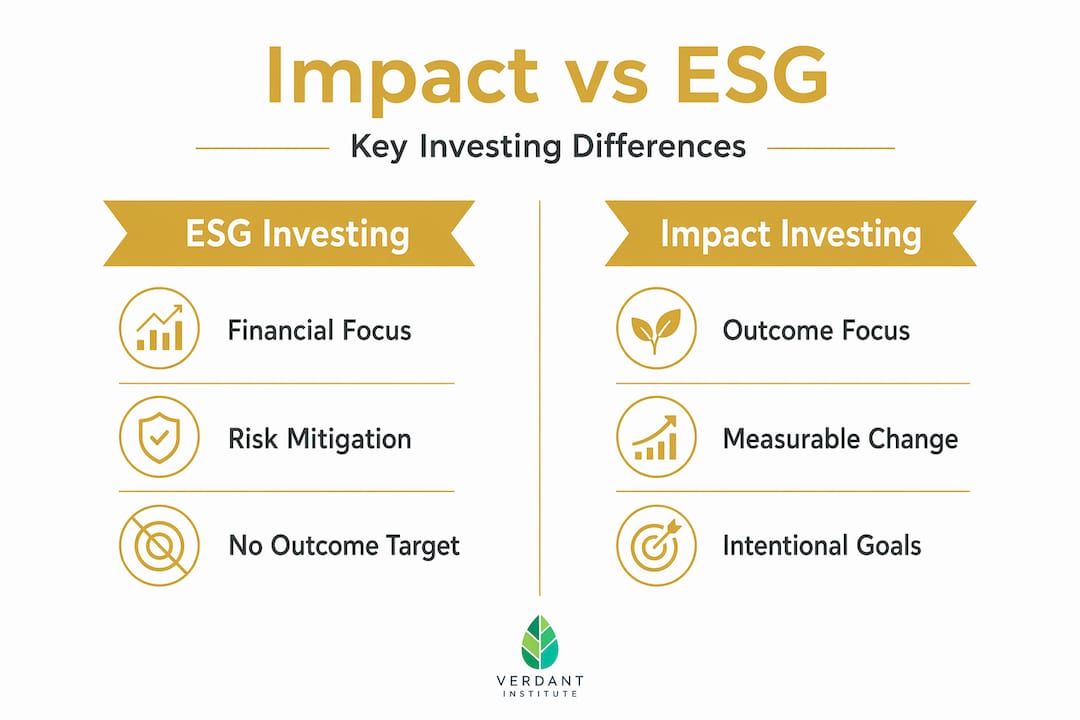
Distinguishing impact investing from ESG is one of the most critical skills for anyone working in sustainable finance. Here is a side-by-side view:
| Dimension | Traditional investing | ESG integration | Impact investing |
|---|---|---|---|
| Primary objective | Financial return | Financial return with risk adjustment | Social/environmental outcome + financial return |
| Social/environmental role | Irrelevant | Risk factor or value driver | Core investment objective |
| Measurement required? | No | Partially (ratings-based) | Yes, rigorous and binding |
| Return expectation | Market-rate | Market-rate | Concessionary to market-rate |
| Example | S&P 500 index fund | ESG-screened equity fund | Affordable housing private debt fund |
ESG integration, as explained in Verdantinstitute's ESG portfolio construction guide, focuses on identifying environmental, social, and governance risks that could affect financial performance. An ESG investor might avoid a coal company because of regulatory risk, not because they have a carbon reduction goal. Impact investing treats outcomes as primary. The carbon reduction is the point.
This distinction matters when evaluating funds. A fund labeled "impact" that lacks binding measurement frameworks and a Theory of Change may actually be ESG integration with better marketing. For a broader view of sustainable investing frameworks, understanding where impact sits within the full spectrum helps you ask sharper questions.
Benefits and challenges worth knowing
The case for impact investing has never been stronger, but it comes with real complexity. Here is an honest accounting of both sides.
What works in its favor:
- 90% of impact investors report meeting or exceeding their financial return expectations, which dismantles the performance trade-off myth for most strategies.
- Systemic impact potential. When capital is designed to solve problems at scale, such as renewable energy access or microfinance in emerging markets, the societal returns compound over time in ways pure financial returns cannot.
- Alignment of values and portfolio. For institutions like pension funds and family offices, impact investing creates a coherent narrative: your money does what your mission says it does.
- Growing regulatory tailwinds. Disclosure frameworks globally are pushing all investors toward more intentional, measured approaches. Impact investors are already positioned ahead of this curve.
Where it gets difficult:
- Impact washing is real. Funds that claim impact without binding measurement structures are a genuine risk. The problem is widespread enough that regulators in the EU and the US are starting to scrutinize fund labels.
- Measurement complexity increases with asset class. Measuring the social return of a private equity investment in a healthcare company in Southeast Asia is harder than measuring the yield on a green bond. Methodologies vary, and comparability across funds remains limited.
- Longer time horizons. Many of the most meaningful impact investments operate in illiquid markets with long hold periods. That is a structural mismatch for investors who need quarterly liquidity.
Pro Tip: When evaluating impact investment funds, look for third-party verification of impact data. Self-reported metrics without external audit are a red flag, regardless of how compelling the fund narrative sounds.
How to get started with impact investing
Whether you are an individual investor or part of an institutional team, the starting process is more disciplined than most people expect.
- Clarify your impact thesis. What problem do you most care about solving? Climate mitigation, financial inclusion, affordable healthcare, gender equity? Defining this first prevents you from chasing trendy funds that do not align with your actual values or goals.
- Identify the right vehicle for your situation. Impact investment funds exist across asset classes. Retail investors typically access impact through public market funds or community development financial institutions. Institutional investors can access private equity, private debt, and social impact bonds. Know which structures are available to you given your capital size, liquidity needs, and regulatory constraints.
- Conduct rigorous due diligence on impact claims. Review the fund's Theory of Change. Check whether impact KPIs are legally embedded in portfolio company agreements. Ask about third-party measurement and whether the fund reports against recognized frameworks like IRIS+.
- Monitor both financial and impact performance over time. Set a review cadence, at minimum annually, where you examine impact reports alongside financial statements. Impact drift is a real phenomenon. Companies can pivot away from their original social mission as they scale, and your portfolio needs to catch that early.
Getting the due diligence right is where most beginners underinvest their energy. The fund selection is where outcomes are determined, not the asset class itself.
My perspective on where impact investing is actually heading

I've watched impact investing evolve from a niche reserved for mission-driven foundations to a legitimate corner of institutional portfolios. And the change that most people miss is not the growth in assets. It's the shift in rigor.
What I've learned from tracking this space is that the old debate about whether impact investing sacrifices returns is basically over. The data is clear. What matters now is whether the impact claim is real. That is where the industry still has serious work to do.
The concept of 'impact by design' represents where the leading edge is moving. Rather than applying an impact lens to existing financial products, it means embedding impact creation into the capital structure from the very beginning. That shift is harder. It requires deeper collaboration between investors, fund managers, and the communities being served. But it's also the only version of impact investing that produces durable, systemic change rather than a line item in a sustainability report.
My honest take: the biggest risk in this field right now is not underperformance. It's complacency. Investors who settle for ESG integration and call it impact are doing a disservice to both their beneficiaries and the credibility of the asset class. Demand binding measurement. Require external verification. And treat the Theory of Change as a living document, not a one-time deliverable.
— Charles
Build your impact investing knowledge with Verdantinstitute
If this article has clarified what impact investing is and you want to go deeper, Verdantinstitute offers structured courses built specifically for finance professionals and students who want real expertise, not surface-level familiarity.
Verdantinstitute's course library covers impact investing fundamentals, ESG analysis, sustainable finance frameworks, and advanced topics like transition finance and net-zero strategies. With over 160 lessons across 16 courses, you can build knowledge systematically rather than piecing it together from scattered sources. Plans start at $18 per month for students and $58 per month for professionals, with CPD tracking and certifications included. If you are serious about working in sustainable finance, this is where you develop the credentials and analytical depth that the industry actually demands. Explore the full course catalog and find the track that fits your career stage.
FAQ
What is the impact investing definition?
Impact investing is a strategy where capital is deployed with the explicit intention of generating measurable social or environmental benefits alongside a financial return. It is defined by three pillars: intentionality, measurability, and a financial return expectation.
How does impact investing differ from ESG?
ESG integration uses environmental, social, and governance factors to manage financial risk. Impact investing treats social and environmental outcomes as the primary investment objective, requiring binding measurement frameworks to verify real-world results.
Do impact investors sacrifice financial returns?
No. 90% of impact investors report meeting or exceeding their financial return expectations, and impact assets under management have grown at a 21% CAGR, reflecting genuine institutional confidence in the strategy.
What is a Theory of Change in impact investing?
A Theory of Change maps how an investment's inputs and activities lead to measurable social or environmental outcomes. It is the analytical foundation of any credible impact investing strategy and helps prevent impact washing.
What is impact washing and how do you avoid it?
Impact washing occurs when funds claim social or environmental impact without binding measurement structures or third-party verification. To avoid it, require that impact KPIs are legally embedded in investment agreements and ask for independently audited impact reports.