

ESG controversy scoring is a real-time risk assessment method that measures a company's exposure to adverse environmental, social, and governance incidents beyond what standard periodic ratings capture. Unlike annual ESG ratings, which reflect a company's disclosed sustainability profile, controversy scores track live events: regulatory investigations, environmental violations, labor disputes, and media scandals. Finance professionals who rely solely on annual ratings miss the signal that controversy scores deliver. This article covers how controversy scores are calculated, why they diverge across rating agencies, and how to integrate them into active investment decisions.
ESG controversy scoring explained: how the methodology works
ESG controversy scoring is defined as a dynamic, real-time tool that tracks material adverse ESG events and adjusts a company's risk profile accordingly. The methodology differs fundamentally from annual ESG ratings, which depend heavily on corporate self-disclosure. Controversy scoring draws from independent sources: regulatory filings, investigative journalism, NGO reports, and court records.
Controversies are categorized on a 5-point severity scale. Categories 1 and 2 represent minor incidents with limited financial impact. Categories 4 and 5 indicate systemic failures that typically trigger analyst engagement before any score adjustment is made.
Five factors determine how much weight a controversy receives in the final score:
- Source credibility: A regulatory enforcement action carries more weight than an unverified media report.
- Financial materiality: Incidents with direct cost exposure, such as fines or litigation, score higher.
- Claim contradiction: Events that directly contradict a company's stated ESG commitments receive a heavier penalty.
- Resolution status: Ongoing incidents score worse than resolved ones.
- Recency decay: Older incidents lose scoring weight over time as new information emerges.
Controversy incidents penalize a company's management score directly. A Category 4 or 5 event signals that policies are not effectively implemented, resulting in a downgrade to the overall ESG combined (ESGC) score. This creates a measurable gap between what a company claims on paper and what its operational record shows.
Pro Tip: When reviewing a company's ESGC score, always check whether a recent management score drop corresponds to a specific controversy event. That gap tells you more about operational risk than the headline ESG rating.
| Severity category | Description | Typical scoring impact |
|---|---|---|
| Category 1 | Minor incident, limited scope | Minimal penalty, no analyst review |
| Category 2 | Moderate incident, contained impact | Small score reduction |
| Category 3 | Significant incident, broader stakeholder impact | Moderate management score penalty |
| Category 4 | Severe incident, policy failure indicated | Major downgrade, analyst engagement triggered |
| Category 5 | Systemic failure, widespread harm | Maximum penalty, full score review |

Why do ESG scores diverge so widely across rating agencies?
ESG ratings show a correlation of approximately 0.54 among major providers. That figure is strikingly low compared to credit ratings, which typically correlate above 0.99. The implication is direct: the same company can rank near the top with one provider and near the bottom with another.
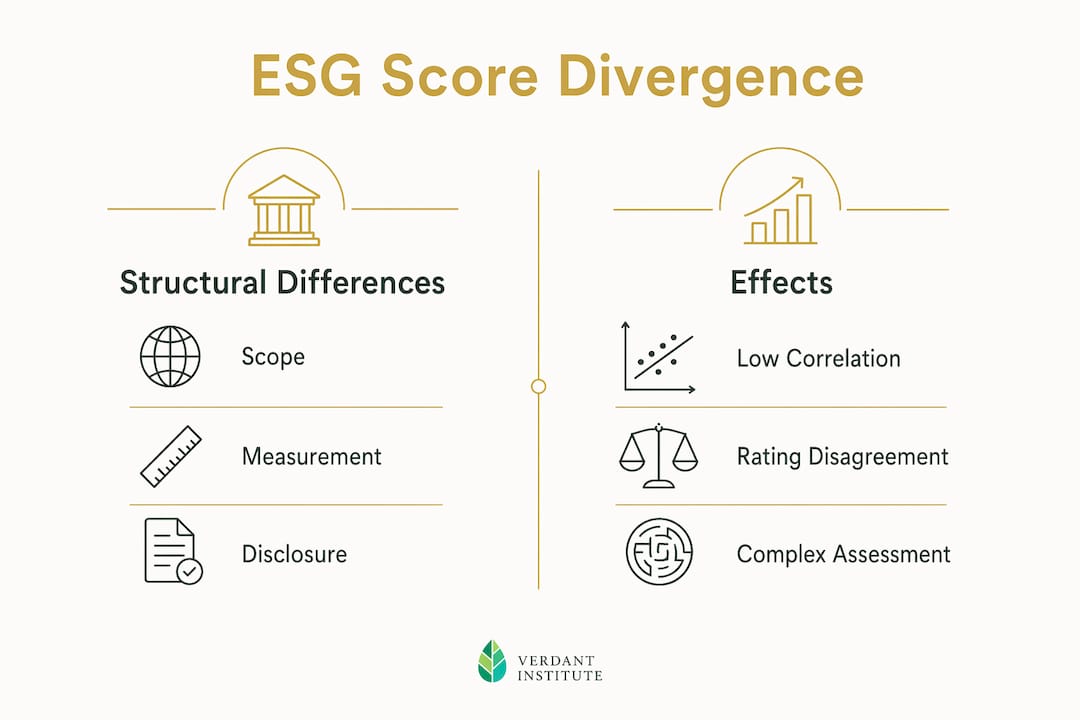
Three structural differences drive this divergence. First, providers disagree on scope: which ESG issues are material for a given industry. Second, they use different measurement approaches for the same issue, such as carbon intensity versus absolute emissions. Third, they apply different weightings to each pillar, so a strong environmental score can offset a weak social score in one framework but not another.
Greater ESG disclosure actually increases disagreement among rating agencies. This is the transparency paradox: more data creates more interpretation points, and each agency weights those points differently. The result is wider score divergence, not narrower.
Investors commonly misunderstand ESG scores as functioning like credit ratings, expecting high correlation. ESG ratings reflect differing investment philosophies, not objective measurements of the same underlying fact.
| Methodology dimension | How it varies | Effect on controversy scores |
|---|---|---|
| Scope of ESG issues covered | Narrow vs. broad industry-specific criteria | Fewer or more controversy triggers identified |
| Data sources used | Self-reported vs. third-party independent | Disclosure bias vs. verified incident tracking |
| Weighting of pillars | Equal vs. materiality-adjusted | Same incident scores differently across providers |
| Recency treatment | Fixed lookback vs. decay-adjusted | Older controversies penalize more or less |
Pro Tip: Never rely on a single ESG rating when assessing controversy exposure. Cross-reference at least two providers with different methodology approaches to identify where their scores agree. Convergence on a controversy is a stronger signal than any single score.
Multiple ratings with differing methodologies make it harder for companies to game their scores by optimizing against one metric. Rating fragmentation disciplines corporate behavior more effectively than a single standardized measure would.
How do ESG controversy scores affect financial performance?
Significant ESG controversy events produce measurable stock price reactions within 1 to 5 trading days. That window is far shorter than the annual cycle of traditional ESG ratings. Portfolio managers who wait for the next annual rating update are reacting to yesterday's news.
Annual ESG scores lag behind real events by months. Companies can exploit annual disclosure cycles for strategic timing, releasing positive sustainability reports while active controversies remain unresolved. Controversy monitoring closes that gap by using independent, timely sources rather than corporate self-reporting.
Finance professionals use controversy scores in several concrete ways:
- Risk alerts: A sudden Category 4 or 5 event triggers a portfolio review before the market fully prices in the reputational damage.
- Engagement signals: Controversy scores identify companies where shareholder engagement on specific ESG failures is most likely to produce results.
- Exclusion triggers: Some funds use controversy thresholds as automatic exclusion criteria, removing companies that breach defined severity levels.
- Opportunity identification: A company resolving a major controversy with credible remediation steps may represent an undervalued position as its score recovers.
Controversy monitoring provides reality-anchored signals that reflect operational risks more accurately than annual scores shaped by corporate communications. For active managers, that distinction is the difference between leading and lagging the market on ESG risk.
Integrating controversy scores into ESG portfolio construction frameworks gives risk teams a live view of exposure that static ratings cannot provide. The practical result is faster, better-informed position adjustments when material incidents occur.
Best practices for integrating ESG controversy scoring into investment processes
Finance professionals who integrate controversy scoring effectively treat it as a complement to traditional ESG ratings, not a replacement. The two tools answer different questions. Annual ratings assess a company's overall ESG profile. Controversy scores flag when that profile is under stress.
Disclosure quality skews ESG scores positively, but controversy monitoring catches negative events independent of disclosure. That makes controversy scores a natural check on disclosure bias. A company with a high ESG rating but an active Category 4 controversy warrants immediate scrutiny.
Four practices separate effective controversy score integration from superficial use:
- Set severity thresholds: Define in advance which controversy categories trigger a mandatory portfolio review. Category 3 and above is a common threshold for active funds.
- Monitor resolution timelines: Track whether controversies are resolved or escalating. An unresolved Category 3 incident that persists for six months carries more weight than its initial score suggests.
- Cross-reference methodologies: Use providers with different scope and weighting approaches to confirm whether a controversy appears across multiple frameworks.
- Document your process: Regulators and institutional clients increasingly expect documented evidence of how ESG controversy data informs investment decisions.
Pro Tip: Build a controversy log for each portfolio holding. Record the incident date, severity category, resolution status, and any score changes. That log becomes your audit trail and your early warning system.
Avoiding overreliance on a single score is the most common pitfall. Rating fragmentation reduces greenwashing risk precisely because no single provider controls the standard. Use that fragmentation as a feature. Professionals looking to build deeper fluency in ESG investment strategies will find that controversy scoring sits at the intersection of risk management and active ownership.
Key takeaways
ESG controversy scoring delivers real-time, event-driven risk signals that annual ESG ratings structurally cannot provide, making it a necessary tool for any finance professional managing ESG-integrated portfolios.
| Point | Details |
|---|---|
| Controversy scores are real-time | They track live adverse events, not periodic disclosures, closing the lag in annual ESG ratings. |
| Severity scale drives impact | Category 4 and 5 events trigger management score downgrades and mandatory analyst review. |
| Rating divergence is structural | A correlation of ~0.54 among providers means one company can rank top and bottom simultaneously. |
| Disclosure bias is a real risk | High ESG scores can reflect strong disclosure, not strong performance. Controversy scores correct for this. |
| Integration requires process | Effective use demands defined thresholds, resolution tracking, and documented decision rationale. |
The case for treating controversy scoring as a first-order tool
Most finance professionals treat ESG controversy scores as a secondary check, something to consult after the annual rating has already shaped a view. That ordering is backwards. Annual ratings are backward-looking by design. They summarize what a company disclosed about its past behavior. Controversy scores tell you what is happening now.
The transparency paradox is the most underappreciated dynamic in ESG analysis. Companies that disclose more data generate more disagreement among rating agencies, not less. That means the most transparent companies are also the hardest to rate consistently. Controversy monitoring sidesteps this problem entirely because it does not depend on what the company chooses to share.
Rating fragmentation frustrates many investors, but I think it functions as a structural safeguard. A single standardized ESG score would be a target. Companies would optimize against it, and the score would gradually lose its signal value. The current patchwork of methodologies forces companies to manage their actual ESG performance rather than their score on any one metric.
The next evolution in this space will be faster controversy detection, not more standardized ratings. Real-time natural language processing applied to regulatory filings, court records, and news feeds will compress the detection window from days to hours. Finance professionals who build controversy monitoring into their standard workflow now will be positioned to act on that signal before it reaches the broader market.
— Charles
Verdantinstitute and ESG controversy scoring training
Finance professionals who want to move beyond surface-level ESG ratings need structured training in controversy scoring methodology, rating divergence, and integration frameworks.

Verdantinstitute offers a library of 16 courses and over 160 lessons covering ESG analysis, sustainable finance, and advanced practice areas including transition finance and net-zero strategies. The platform provides CPD tracking and certifications for both students ($18/month) and professionals ($58/month). Professionals who want to build a systematic approach to controversy scoring will find the Deep Dive and Advanced Practice tracks directly relevant. Explore Verdantinstitute's plans to find the right fit for your development goals.
FAQ
What is ESG controversy scoring?
ESG controversy scoring is a real-time risk assessment method that tracks material adverse ESG events, such as regulatory violations or environmental incidents, and adjusts a company's risk score accordingly. It differs from annual ESG ratings by using independent sources rather than corporate self-disclosure.
How does a controversy event affect an ESG score?
A controversy event penalizes a company's management score, with Category 4 and 5 events triggering the largest downgrades. Severe incidents signal that a company's stated ESG policies are not reflected in its actual operations.
Why do ESG controversy scores differ across rating agencies?
ESG ratings correlate at approximately 0.54 among major providers because they use different scopes, measurement approaches, and weightings. The same controversy can score differently depending on which provider's methodology is applied.
Can a company have a high ESG rating and a poor controversy score?
Yes. Disclosure bias means companies with strong reporting practices often receive high annual ESG ratings regardless of actual performance. Controversy monitoring catches negative incidents independent of disclosure, creating a gap between the two scores.
How should portfolio managers use controversy scores in practice?
Portfolio managers should set defined severity thresholds that trigger mandatory reviews, track resolution timelines for active controversies, and cross-reference scores across at least two providers with different methodologies to confirm the signal strength.