

ESG research skills are defined as the combined ability to analyze environmental, social, and governance factors with the same financial rigor applied to earnings, credit risk, and valuation. Finance professionals who master these skills can translate sustainability data into investment decisions that hold up under regulatory scrutiny. The field demands competencies across data analysis, critical thinking, and framework literacy. Tools like Python, Excel, and SQL sit alongside certifications such as the CFA ESG Certificate as standard requirements. Finance professionals who combine structured financial analysis with ESG data consistently outperform those who focus solely on sustainability science. Understanding ESG research skills explained in full means recognizing this as a hybrid discipline, not a soft add-on to traditional finance.
What are the core ESG research methodologies and frameworks?
ESG research methodology explained at its most practical level starts with frameworks. TCFD, SASB, CSRD, and GRI are the four frameworks finance professionals encounter most often. Mastering these frameworks means treating them as navigational tools for structuring research and reporting, not as academic syllabi to memorize. Each framework targets a different audience: TCFD focuses on climate-related financial risk disclosure, SASB provides industry-specific metrics, CSRD sets mandatory EU reporting standards, and GRI covers broad stakeholder impact.
Rating providers add another layer of complexity to the ESG research methodology framework. MSCI and Sustainalytics are the two dominant providers, but their scores for the same company often diverge significantly. ESG ratings differ because providers use proprietary models that weight risk exposure differently from real-world impact. An analyst who treats an MSCI AAA rating as equivalent to a Sustainalytics low-risk score will draw flawed investment conclusions.

Event study methodology is a specific quantitative tool within the types of ESG research methodologies. It measures abnormal stock returns around a defined ESG event, such as a regulatory fine, a supply chain scandal, or a carbon disclosure. Negative ESG reputational events often produce significant negative abnormal returns before formal announcements, particularly in sensitive sectors like pharmaceuticals. This pre-announcement drift signals information leakage and shows that markets price ESG risk before it becomes public.
| Framework / Method | Primary Focus | Key User |
|---|---|---|
| TCFD | Climate-related financial risk | Investors, lenders |
| SASB | Industry-specific ESG metrics | Equity analysts |
| CSRD | Mandatory EU sustainability reporting | Corporate finance teams |
| GRI | Broad stakeholder impact | Sustainability reporters |
| Event study methodology | Market reaction to ESG events | Quantitative analysts |
Pro Tip: When comparing companies across rating providers, map each provider's methodology to its objective first. A risk-focused score from MSCI and an impact-focused score from a provider like CDP measure fundamentally different things.
What technical skills do ESG analysts need in 2026?
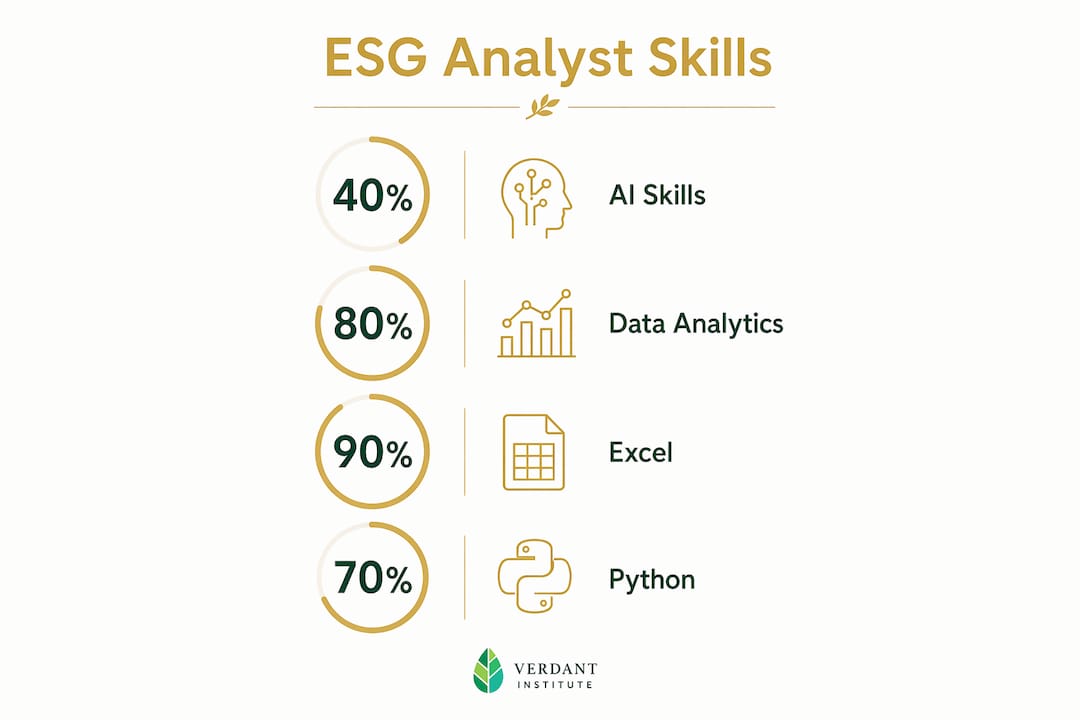
Technical proficiency separates analysts who report ESG data from those who generate financial insight from it. The core technical competencies for ESG analysis in 2026 include:
- Python and SQL for processing large, unstructured ESG datasets from multiple sources
- Excel financial modeling for integrating ESG adjustments into DCF and credit models
- Data cleaning and reconciliation to resolve inconsistencies across scope 1, 2, and 3 emissions disclosures
- Audit trail construction to meet regulatory requirements under CSRD and SEC climate rules
- Regulatory literacy covering SFDR, TCFD, and emerging SEC disclosure mandates
- AI and machine learning basics for automating benchmarking, anomaly detection, and report generation
40% of ESG roles now require basic AI or machine learning skills, and professionals with data analytics skills command salary premiums of 12–18%. That gap will widen as AI tools take over routine data aggregation tasks. AI assists in routine benchmarking and report generation, which shifts entry requirements toward programming and analytical judgment rather than manual data entry.
ESG analysts spend substantial time cleaning inconsistent datasets, reconciling emissions data, verifying disclosures, and preparing audit-ready reports. This "data janitor" work is unglamorous but critical. A single unverified scope 3 figure in a client report can trigger a greenwashing allegation. Analysts who build clean, traceable data pipelines protect both their firms and their credibility.
Pro Tip: Before submitting any ESG report, run a three-step audit check: verify the primary data source, confirm the calculation methodology matches the stated framework, and document every assumption. This creates the audit trail regulators expect.
How do ESG ratings and data translate into financial impact?
ESG data only earns its place in a financial model when it connects to a measurable financial outcome. Translating metrics like labor turnover rates, water intensity, or board independence scores into credit spread adjustments or cash flow forecasts is the skill that separates effective ESG analysts from basic data reporters. Most junior analysts can pull an ESG score. Far fewer can explain what a deteriorating governance score implies for a company's cost of capital.
Rating divergence is the most common trap in ESG analysis techniques. You must not take ESG ratings at face value because methodological differences between providers lead to scores that reflect entirely different objectives. A company rated highly by MSCI for managing its own ESG risk may score poorly on a provider that measures its impact on the environment and society. Both scores are correct within their own frameworks.
Sustained improvements in ESG ratings over multi-year periods correlate strongly with superior risk-return profiles compared to companies with static or declining ratings. ESG Improvers portfolios outperformed both the ASX200 and S&P500 indices from 2019 to 2023. That finding matters because it shifts the analytical question from "what is this company's current ESG score?" to "is this company's ESG trajectory improving?"
| Portfolio Type | Performance vs. Benchmark (2019–2023) | Key Driver |
|---|---|---|
| ESG Improvers | Outperformed ASX200 and S&P500 | Multi-year rating trajectory |
| Static ESG rating | Matched or underperformed | No trajectory signal |
| Declining ESG rating | Underperformed | Increasing risk exposure |
The practical implication for portfolio construction is clear. Analysts who track ESG momentum rather than point-in-time scores generate better investment signals. This is why ESG disclosure analysis techniques that focus on year-over-year changes in reported metrics carry more weight than static screening.
How do finance professionals apply ESG research skills in practice?
Applying ESG research skills in day-to-day finance roles requires more than technical competence. It demands commercial instinct and the ability to communicate findings clearly to portfolio managers, credit committees, and clients. Misused ESG terms can trigger regulatory scrutiny or allegations of greenwashing, which makes precise language as important as precise data.
The following steps describe how finance professionals embed ESG research into real decisions:
- Map the material ESG factors for each sector using SASB's materiality framework before building any financial model.
- Integrate ESG adjustments into valuation models by linking specific metrics to revenue risk, cost of capital, or regulatory liability.
- Track ESG trajectory rather than point-in-time scores to identify improving companies before the market reprices them.
- Cross-check disclosures against third-party data from providers like CDP, Bloomberg ESG, or Refinitiv to catch inconsistencies.
- Build a narrative that connects ESG findings to financial outcomes, using language that portfolio managers and credit analysts recognize.
- Monitor regulatory changes under CSRD, SFDR, and SEC climate rules to anticipate how disclosure requirements will affect portfolio companies.
Proactive ESG research also improves portfolio resilience during market stress. Companies with strong governance and low environmental liability tend to recover faster from sector-wide shocks. Understanding ESG investment strategies that incorporate these dynamics gives analysts a structural edge in portfolio construction.
Key Takeaways
Mastering ESG research skills requires combining framework literacy, data analytics, and financial translation to generate credible, decision-ready investment insights.
| Point | Details |
|---|---|
| Frameworks are tools, not syllabi | Treat TCFD, SASB, CSRD, and GRI as navigational guides, not content to memorize. |
| Ratings require critical reading | MSCI and Sustainalytics measure different objectives; never treat scores as interchangeable. |
| ESG trajectory beats static scores | Sustained ESG improvement correlates with superior risk-return profiles over multi-year periods. |
| Technical skills drive career value | AI and data analytics skills command salary premiums of 12–18% in ESG roles. |
| Financial translation is the core skill | Linking ESG metrics to valuation adjustments separates analysts from data reporters. |
Why most ESG analysts get the hard part wrong
The analysts who struggle most are not the ones who lack sustainability knowledge. They are the ones who treat ESG research as a reporting exercise rather than a financial analysis discipline. I have seen finance professionals spend weeks memorizing TCFD pillars and GRI standards, then freeze when asked to explain what a 15% increase in scope 3 emissions means for a company's long-term cost of capital. Framework knowledge is table stakes. Financial translation is the actual job.
The rating divergence problem is also underestimated by newcomers. When MSCI and Sustainalytics assign materially different scores to the same company, the instinct is to average them or default to the higher score. The correct response is to understand why they differ and what each score is actually measuring. Divergent ESG rating methodologies reflect distinct objectives, and treating them as equivalent leads to flawed investment conclusions.
AI tools are changing the entry-level skill set faster than most training programs acknowledge. Routine benchmarking and data aggregation are increasingly automated. What remains irreplaceable is the judgment to question a dataset, spot a disclosure inconsistency, and communicate a nuanced finding to a portfolio manager in two sentences. That combination of technical rigor and financial storytelling is what makes an ESG analyst genuinely useful in 2026.
My advice to anyone building ESG research skills now: prioritize data handling and financial modeling over framework memorization. Get comfortable with Python for data cleaning, even at a basic level. Pursue structured credentials like the CFA ESG Certificate to signal rigor. And treat every greenwashing risk as a communication problem you can solve with better data discipline.
— Charles
Build your ESG research skills with Verdantinstitute
Verdantinstitute offers structured ESG training built specifically for finance professionals and students who need more than a surface-level introduction.

The platform's 16 courses and over 160 lessons cover everything from ESG disclosure frameworks and data analytics to transition finance and net-zero strategies. CPD tracking and certifications are included in both the student plan at $18/month and the professional plan at $58/month. For finance professionals who want to move from data reporting to genuine financial analysis, the Verdantinstitute training and pricing options lay out a clear path forward. The curriculum is designed to build the exact skills this article covers, from framework literacy to financial translation.
FAQ
What are ESG research skills?
ESG research skills are the combined ability to analyze environmental, social, and governance factors with financial rigor. They include data analytics, framework literacy, financial modeling, and the ability to translate ESG metrics into investment-relevant insights.
Why do ESG ratings from different providers disagree?
ESG rating providers like MSCI and Sustainalytics use proprietary models that prioritize either risk exposure or real-world impact. These different objectives produce divergent scores for the same company, which is why analysts must understand each provider's methodology before drawing conclusions.
What is ESG event study methodology?
ESG event study methodology measures abnormal stock returns around a specific ESG event, such as a regulatory fine or a reputational scandal. It is used to quantify how markets react to ESG news and to identify whether information leakage occurred before the announcement.
Which technical skills matter most for ESG analysts in 2026?
Python, SQL, and Excel remain the core technical tools for ESG data analysis. AI and machine learning skills are increasingly required, with 40% of ESG roles now listing them as a baseline requirement.
How do ESG improvements affect investment returns?
Sustained ESG rating improvements over multiple years correlate with superior risk-return profiles. ESG Improvers portfolios outperformed both the ASX200 and S&P500 from 2019 to 2023, making trajectory analysis more valuable than point-in-time scoring.