

Impact investing has moved well beyond philanthropic positioning. Today, investors managing everything from pension funds to family office portfolios are using clearly defined types of impact investing strategies to generate measurable social and environmental outcomes alongside financial returns. The challenge is not whether to allocate capital this way. The challenge is knowing which strategy fits your objectives. Impact investing is defined by intentionality and measurable outcomes, and unless you understand how each strategy type differs by capital structure, return expectation, and measurement rigor, you are likely to mismatch your portfolio with your goals.
Table of Contents
- Key takeaways
- How to categorize types of impact investing strategies
- 1. Negative screening
- 2. Positive screening and best-in-class selection
- 3. Thematic investing
- 4. Green bonds
- 5. Social impact bonds
- 6. Blended finance
- 7. Direct private equity and venture capital
- Comparing impact investing strategies at a glance
- How to choose the right impact investing strategy
- My honest take on where impact investing goes wrong
- Deepen your impact investing expertise with Verdantinstitute
- FAQ
Key takeaways
| Point | Details |
|---|---|
| Intentionality separates impact investing | Impact investing requires deliberate, measurable outcomes, not just ESG risk management. |
| Return expectations vary widely | Strategies range from concessionary below-market returns to fully market-rate financial performance. |
| Measurement rigor defines credibility | A clear theory of change linked to IRIS+ metrics separates real impact from marketing claims. |
| Capital structure shapes strategy choice | Blended finance, fixed income, and private equity each carry distinct risk profiles and use cases. |
| Diversifying across types adds resilience | Layering multiple strategy types can balance liquidity, return, and impact exposure in one portfolio. |
How to categorize types of impact investing strategies
Before evaluating individual strategies, you need a clear framework for comparison. The GIIN defines impact investing as investing with explicit intentionality to generate positive, measurable social and environmental impact alongside financial return. That definition gives you three non-negotiable criteria: intentionality, measurement, and financial return.
Four dimensions separate one impact investment approach from another:
- Intentionality: Is impact the primary goal, a core constraint, or a co-benefit? Strategies like social impact bonds build impact directly into the contract structure. Negative screening, by contrast, treats impact as a boundary condition rather than a target.
- Return expectations: Impact investing spans all asset classes with return expectations ranging from concessionary below-market rates to market-rate risk-adjusted returns. This spectrum is not a defect. It reflects the diversity of problems being addressed and the capital required to solve them.
- Capital structure and investment vehicle: Venture capital, private equity, fixed income instruments like green bonds, and blended finance structures each carry different risk, liquidity, and governance profiles.
- Measurement and accountability: Effective impact investing requires a clear theory of change linking investment activities to outputs, outcomes, and attributable impact. Frameworks like IRIS+ and the Impact Management Project give investors standardized tools for comparison.
Pro Tip: Before selecting a strategy, map your institution's impact thesis first. Choosing a vehicle before defining your theory of change is like picking a fund structure before understanding your return requirements.
1. Negative screening
Negative screening is the most widely practiced form of socially responsible investing. Investors exclude sectors or companies that conflict with ethical or values-based criteria, such as tobacco, weapons manufacturing, thermal coal, or predatory lending.
This approach does not require direct engagement with impact measurement. It sets boundaries. You remove exposure to harm rather than actively directing capital toward benefit. For institutions operating under fiduciary constraints or regulatory pressure, negative screening often serves as the entry point into impact-aligned portfolio construction.
The limitation is real: exclusion does not guarantee that capital flows to better alternatives. It is a filter, not a steering mechanism.
2. Positive screening and best-in-class selection
Positive screening flips the logic. Instead of excluding the worst actors, you actively select companies or funds that lead their sector on environmental, social, and governance performance. Best-in-class selection means choosing the highest-scoring energy company within the energy sector, for example, rather than exiting the sector entirely.
This approach maintains sector diversification while rewarding leadership. It is well-suited to institutional investors managing large, liquid public equity portfolios who cannot afford the concentration risk that comes from sector exclusions.
The trade-off is that "best in class" can still mean mediocre absolute performance on impact metrics. You are selecting relative leaders, not necessarily impact champions.
3. Thematic investing
Thematic strategies direct capital toward specific sectors or themes with documented social or environmental relevance. Clean energy, sustainable agriculture, affordable housing, water infrastructure, and gender-lens investing are all examples of thematic funds in practice.
What distinguishes thematic investing from general ESG integration is the deliberate sector concentration. You are not spreading capital across a broad index with ESG tilts. You are committing to a specific investment strategy for change in a defined problem area. That concentration creates both higher impact potential and higher sector-specific risk.
The key decision here is whether the fund manager has a credible thesis for why capital in this theme will produce additive impact. Thematic does not automatically mean impactful.
4. Green bonds
Green bonds are fixed income instruments where proceeds are earmarked exclusively for environmental projects: renewable energy, energy efficiency retrofits, clean transportation, or climate adaptation infrastructure. The global green bond market surpassed $500 billion in annual issuance by 2024, making this the most liquid and accessible entry point for institutional fixed income investors.

From a portfolio mechanics standpoint, green bonds behave like conventional bonds. Credit risk, duration, and yield are comparable to standard issuances from the same issuer. What differs is the use of proceeds and the associated reporting obligations. Investors receive annual impact reports tracking energy generated, emissions reduced, or hectares of habitat protected.
Pro Tip: When evaluating green bonds, check whether the issuer uses the International Capital Market Association Green Bond Principles or the EU Taxonomy framework for proceeds allocation. Standards vary significantly, and "green" labeling without independent verification is a known credibility gap.
5. Social impact bonds
Social impact bonds, sometimes called pay-for-success contracts, are outcome-linked instruments where investor repayment depends entirely on achieving predefined social outcomes. More than 250 social impact bonds have launched globally addressing homelessness, workforce reintegration, and disease prevention.
The mechanics work like this: a government or foundation commits to repaying investors only if a service provider achieves agreed outcomes, such as reducing recidivism rates by a specific percentage. Private investors fund the program upfront and absorb the risk that outcomes will not be met.
Outcome-linked contracts require robust contract design, baseline definitions, and independent impact verification. The measurement infrastructure is expensive and complex. For investors, the upside is direct alignment between financial return and verified social results. The downside is illiquidity and long holding periods, often five to ten years.
6. Blended finance
Blended finance structures use concessional capital, typically from development finance institutions, foundations, or government sources, to absorb first-loss risk and unlock commercial capital that would otherwise avoid high-risk markets. Blended finance has enabled over $200 billion in transactions focused on climate and energy access in emerging markets.
The key mechanism is risk layering. Concessional investors take subordinated positions, protecting senior commercial investors from initial losses. This structure makes markets viable that commercial capital cannot enter alone: off-grid solar in Sub-Saharan Africa, smallholder agriculture finance in Southeast Asia, healthcare infrastructure in frontier markets.
For commercial investors, blended finance offers access to impact opportunities with risk profiles that have been actively engineered for institutional participation. The complexity is real, though. Deal structuring requires specialized legal and financial expertise that most allocators do not have in-house.
7. Direct private equity and venture capital
Direct investments in private companies through private equity or venture capital represent the highest-engagement form of impact investing. Investors take ownership stakes in businesses whose core models deliver social or environmental outcomes, such as edtech platforms serving underserved communities, climate tech companies developing carbon removal technology, or healthcare businesses expanding access in low-income markets.
Intentionality is the key factor that separates impact-first private equity from conventional venture capital operating in trending sectors. The impact thesis must be integrated into the investment thesis, not attached afterward as a reporting requirement.
This strategy demands active portfolio management. Investors engage directly with company leadership on impact strategy, theory of change development, and impact indicator selection. The return timeline is long, liquidity is limited, and the measurement burden is higher than in any other strategy type. But for investors seeking genuine additionality, direct ownership provides the most direct line between capital and outcomes.
Comparing impact investing strategies at a glance
| Strategy type | Investment vehicle | Return expectations | Impact measurement | Best suited for |
|---|---|---|---|---|
| Negative screening | Public equity, fixed income | Market rate | Exclusion lists | Institutional funds with ethical mandates |
| Positive/best-in-class | Public equity funds | Market rate | ESG ratings | Large diversified portfolios |
| Thematic investing | Sector funds, ETFs | Market rate to slight premium | Sector KPIs | Investors with defined impact thesis |
| Green bonds | Fixed income | Market rate | Use-of-proceeds reporting | Fixed income allocators |
| Social impact bonds | Outcome contracts | Below market to market | Verified outcome data | Mission-driven investors |
| Blended finance | Multi-tranche structures | Concessionary to market | Theory of change, IRIS+ | DFIs, foundations, institutional investors |
| Direct PE/VC | Private equity stakes | Venture-level returns | Theory of change, custom KPIs | Sophisticated active investors |
How to choose the right impact investing strategy
Strategy selection should start with your institution's specific priorities, not with what is trending. Work through these questions before committing capital:
- What is your primary impact intention? If your goal is to avoid harm, screening strategies are appropriate. If you want to generate measurable additive impact, thematic investing, social impact bonds, or direct PE/VC will serve you better.
- What return profile can you sustain? Risk-adjusted returns vary significantly by sector, geography, and strategy. Blended finance and social impact bonds may require accepting below-market returns in exchange for impact exposure in harder markets.
- How sophisticated is your due diligence capacity? Direct investments and blended finance structures require specialized capabilities. If your team does not have experience with theory of change analysis or impact verification, starting with green bonds or thematic funds gives you impact exposure with manageable complexity.
- What is your measurement commitment? Practitioners must select impact indicators that align with the investment's theory of change, not just match existing indicator catalogs. The rigor of your measurement system defines the credibility of your impact claims.
- Can you layer strategies? An impact portfolio that combines green bonds for liquid fixed income exposure with a thematic equity allocation and a small allocation to direct investments in private markets can balance liquidity, return, and depth of impact across a single framework.
Pro Tip: Consider using impact-weighted accounts to put social and environmental outcomes on the same ledger as financial returns. This practice is gaining traction among sophisticated allocators and gives you a portfolio-level view of impact rather than strategy-by-strategy reporting.
My honest take on where impact investing goes wrong
I've spent years working through impact investing frameworks with finance professionals, and the pattern I see most often is this: investors choose a strategy based on branding rather than structure. A fund markets itself as impact-focused, the label is compelling, and the investment gets made before anyone asks whether the fund manager can articulate a credible theory of change.
Intentionality is not marketing language. It is a structural requirement. Impact investing embeds intentionality as a design feature of the investment, not a characteristic attributed after deployment. When I review portfolios that are described as impact-oriented but lack any impact verification mechanism, I find the same gap every time. The financial thesis is tight and the impact thesis is absent.
What I've found actually works is starting with the counterfactual. Ask whether the impact you expect would occur without your capital. Impact additionality requires rigorous counterfactual analysis, and most investors skip this step entirely. That omission undermines everything else.
The emerging practice of impact-weighted accounts is the most promising development I've seen in this field. It forces accountability by placing social and environmental outcomes on the same balance sheet as financial performance. That kind of integration is where the field needs to go. Finance professionals who build competency in this now will be far ahead of the curve when it becomes a reporting norm.
— Charles
Deepen your impact investing expertise with Verdantinstitute
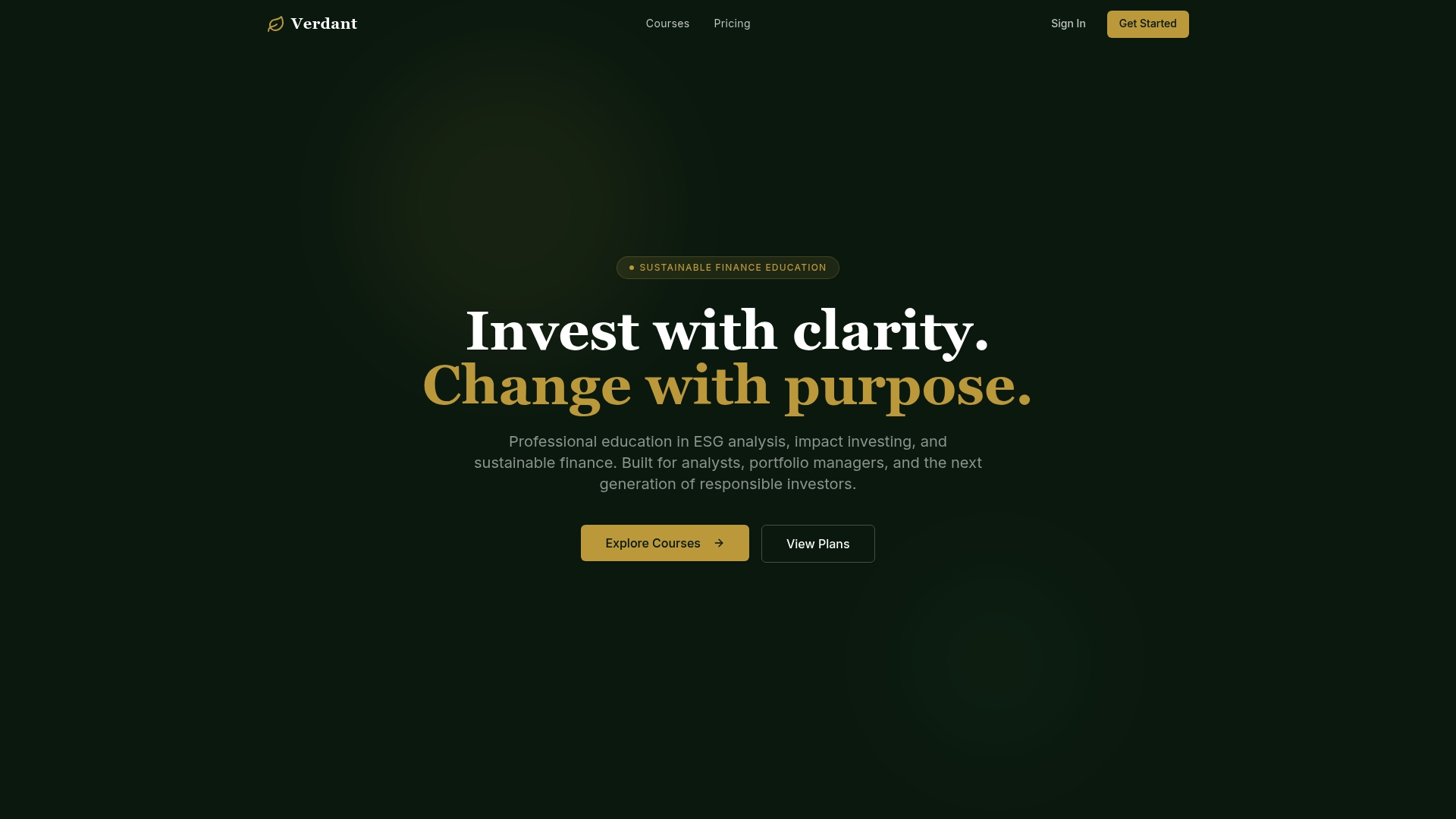
Understanding these strategy types is the foundation. Applying them with rigor across real portfolios requires structured knowledge in ESG analysis, theory of change development, and impact measurement frameworks. Verdantinstitute is built specifically for finance professionals who want that depth. The platform offers structured learning tracks that move from foundational impact investing concepts through advanced topics like transition finance and net-zero portfolio strategy.
With over 160 lessons, CPD tracking, and certifications recognized in the industry, Verdantinstitute gives you the analytical grounding to evaluate any of these impact investing models with confidence. Plans start at $18 per month for students and $58 per month for professionals. Explore the full course and pricing options to find the track that fits where you are in your career.
FAQ
What is the main difference between ESG and impact investing?
ESG integration typically focuses on managing financial risks related to environmental, social, and governance factors. Impact investing requires deliberate intentionality to generate measurable positive outcomes alongside returns, making impact a primary objective rather than a risk consideration.
Can impact investing deliver market-rate returns?
Yes. Many impact strategies, including green bonds and best-in-class equity funds, are designed to deliver returns comparable to conventional benchmarks. Some strategies like social impact bonds or blended finance in frontier markets may involve concessionary returns in exchange for deeper impact access.
What is a theory of change in impact investing?
A theory of change is a logical framework that connects an investment's activities to its intended social or environmental outcomes. It specifies what outputs the investment produces, how those outputs lead to outcomes, and what counterfactual would exist without the investment.
How do investors measure impact across different strategy types?
Measurement approaches range from use-of-proceeds reporting in green bonds to verified outcome data in social impact bonds. Frameworks like IRIS+ and the Impact Management Project provide standardized metrics that allow comparability across strategy types and asset classes.
Which impact investing strategy is best for institutional investors?
There is no single best approach. Institutional investors typically benefit from layering strategies: green bonds for liquid fixed income exposure, thematic funds for equity allocation, and selective direct investments for deeper impact engagement. The right combination depends on return requirements, liquidity constraints, and impact goals.