

ESG, which stands for Environmental, Social, and Governance, is the leading framework for measuring corporate sustainability risk and value creation. Why ESG improves long-term performance is not a theoretical debate. Empirical research now confirms that companies with sustained ESG improvements deliver superior risk-adjusted returns, lower financing costs, and greater resilience during market stress. The mechanism is specific: better governance stabilizes investor confidence, stronger social practices improve employee productivity, and environmental discipline reduces regulatory exposure. For finance professionals building portfolios in 2026, understanding these dynamics is no longer optional.
Why ESG improves long-term performance through risk reduction
ESG reduces long-term performance risk through three distinct channels: governance quality, stakeholder stability, and regulatory positioning. Each channel operates independently, but together they create a compounding effect on corporate resilience. Companies that score well across all three pillars consistently outperform peers during periods of market stress.
Governance quality is the single most critical stabilizer during market downturns. Strong board oversight, transparent reporting, and executive accountability reduce the perceived risk premium investors assign to a stock. That lower risk premium translates directly into a lower cost of equity and more stable share prices when markets turn volatile.

Stakeholder stability is the second mechanism. ESG performance links to more stable relationships with employees, suppliers, and investors, which enhances productivity and financial support during tough periods. A company with strong labor practices retains skilled workers during a downturn. A company with trusted supplier relationships maintains supply chain continuity when competitors cannot.
The third channel is regulatory positioning. Companies with strong environmental and social practices face fewer fines, fewer operational shutdowns, and lower compliance costs over time. Environmental and social factors underpin longer-term operational stability even when governance drives the immediate crisis response.
Pro Tip: When screening for resilience, weight governance metrics most heavily for near-term downside protection, then layer in environmental and social scores for longer-term stability assessment.
Key evidence supports this framework:
- High-ESG performers show smaller stock declines and faster recovery periods during market crises compared to low-ESG peers.
- ESG disclosure amplifies financial performance during equity market turbulence, though its protective effect weakens during credit market stress. This distinction matters for portfolio construction.
- Governance improvements drive crisis resilience most directly, while environmental and social improvements build the operational foundation for long-term stability.
What does the research say about ESG and financial performance?
The financial case for ESG is strongest when you focus on sustained improvements rather than static scores. A 10-point ESG disclosure increase corresponds to a 9 to 10 percentage point long-run improvement in return on equity (ROE). That is a statistically significant relationship, confirmed at the 1% confidence level across S&P 500 firms. The implication is direct: companies that consistently improve their ESG disclosure quality generate meaningfully higher equity returns over time.
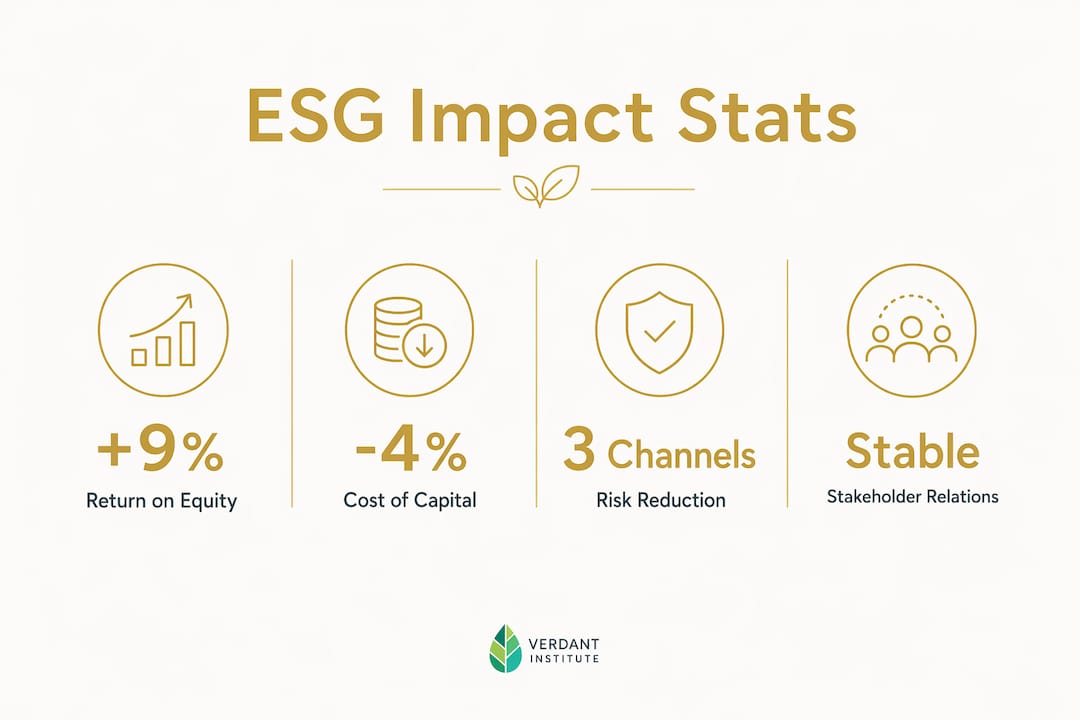
The cost of capital effect is equally compelling. In Nordic markets, a 10-point ESG score increase reduces weighted average cost of capital (WACC) by approximately 4.2 basis points. WACC is the rate a company must earn on its investments to satisfy both debt and equity holders. A lower WACC means cheaper financing, higher net present value on projects, and stronger long-run free cash flow generation.
Pro Tip: Track ESG disclosure quality scores alongside traditional financial metrics like ROE and WACC in your investment models. A rising ESG disclosure trend is a forward-looking signal, not just a compliance checkbox.
The table below summarizes the key empirical findings on ESG and financial performance:
| Metric | ESG Effect | Market Context | Source |
|---|---|---|---|
| Return on equity (ROE) | +9 to +10 percentage points per 10-point ESG disclosure increase | S&P 500 firms | MDPI Sustainability, 2025 |
| Weighted average cost of capital (WACC) | Reduced by ~4.2 basis points per 10-point ESG score increase | Nordic markets | MDPI Sustainability, 2025 |
| Stock price resilience | Smaller declines and faster recovery during crises | Broad market | ScienceDirect, 2026 |
| ESG during equity volatility | Amplifies financial performance | Equity market stress | MDPI Sustainability, 2025 |
| ESG during credit crises | Reduced protective effect | Credit market stress | MDPI Sustainability, 2025 |
The ROE finding deserves particular attention. A 9 to 10 percentage point improvement is not marginal. For a company earning 12% ROE, that trajectory implies a potential path toward 21% to 22% ROE over time. That kind of improvement, sustained over a full market cycle, compounds into substantial shareholder value.
How does institutional maturity affect ESG value realization?
ESG's financial impact depends heavily on the regulatory and market environment in which a company operates. This is one of the most underappreciated nuances in sustainable investing. The same ESG improvement that reduces WACC in a Nordic market may produce a short-term profit trade-off in a less mature ESG environment.
Nordic firms benefit most clearly from ESG improvements because their institutional frameworks, disclosure requirements, and investor expectations are already aligned with ESG principles. Investors in these markets price ESG quality into valuations consistently. That pricing consistency is what converts ESG effort into measurable financing cost reductions.
Non-Nordic European firms face a different dynamic. In less mature ESG markets, governance improvements still reduce WACC, but broader environmental and social investments may generate short-term cost pressures before delivering returns. Investors in these markets have not yet fully priced ESG quality into valuations, so the financial reward arrives later.
The practical implications for investors are clear:
- In mature ESG markets, use full ESG scores (environmental, social, and governance) as a valuation input. The market already prices these factors.
- In less mature markets, weight governance improvements most heavily. Governance delivers the most consistent financial benefit regardless of institutional context.
- Adjust your time horizon expectations. ESG investments in emerging ESG markets require a longer holding period to realize full financial benefits.
- Recognize that short-term profitability trade-offs in less developed markets are not evidence that ESG destroys value. They reflect a timing gap between investment and reward.
Long-term commitment to ESG improvement matters more than any single year's score. ESG's financial impact depends on institutional context, and investors who understand that context avoid misreading short-term cost pressures as structural underperformance.
Common pitfalls in ESG integration for long-term portfolios
The most common mistake in ESG integration is treating a static ESG rating as a forward-looking signal. Static ratings reflect historical data. They tell you what a company did, not what it is doing or where it is heading. Sustained ESG improvement trajectories are far better predictors of future shareholder returns than any single year's score. A one-off score improvement driven by a new disclosure policy is not the same as a five-year trend of operational improvement across all three ESG pillars.
The second pitfall is linear portfolio construction. Many portfolio managers simply rank stocks by ESG score and overweight the top quartile. This approach creates concentration risk and ignores the non-linear relationship between ESG quality and return uncertainty. Non-linear portfolio frameworks that treat ESG as a factor affecting return uncertainty achieve better diversification and more stable risk-adjusted outcomes than linear score integration.
Avoiding these pitfalls requires a disciplined approach to ESG data analysis:
- Review ESG trends over at least three years. A single year's improvement can reflect disclosure changes rather than operational progress. Three years of consistent improvement across multiple metrics is a more reliable signal.
- Disaggregate ESG scores by pillar. A high composite score can mask a weak governance sub-score. Governance quality is the pillar most directly linked to crisis resilience and near-term financial stability.
- Treat ESG as a risk factor, not a ranking tool. Portfolio optimization should incorporate ESG as a factor that affects the uncertainty of future returns, not simply as a filter for excluding low-scoring stocks.
- Cross-reference ESG data sources. Ratings from MSCI ESG Research, Sustainalytics, and Bloomberg ESG differ in methodology. Using multiple sources reduces the risk of acting on a single provider's scoring bias.
- Align ESG integration with your investment time horizon. ESG's strongest financial effects appear in the long run. Short-term trading strategies that incorporate ESG scores without accounting for this timing dynamic will underperform the framework's potential.
For a deeper look at applying these principles, the Verdantinstitute guide on ESG portfolio construction covers the practical mechanics of building resilient, ESG-integrated portfolios.
Key Takeaways
ESG improves long-term performance by reducing financing costs, stabilizing stakeholder relationships, and building governance quality that protects portfolios during market stress.
| Point | Details |
|---|---|
| Governance drives crisis resilience | Weight governance metrics most heavily for near-term downside protection in any market. |
| ESG disclosure lifts ROE | A 10-point ESG disclosure increase links to a 9 to 10 percentage point long-run ROE improvement. |
| WACC falls with ESG quality | Nordic firms see WACC reductions of ~4.2 basis points per 10-point ESG score increase. |
| Context determines timing | Mature ESG markets price benefits faster; less mature markets require a longer holding period. |
| Trajectories beat static scores | Sustained multi-year ESG improvement predicts shareholder returns better than any single rating. |
The case for treating ESG improvement as a core investment signal
I have spent years reviewing how finance professionals actually use ESG data, and the gap between best practice and common practice is still wide. Most investors check an ESG score the same way they check a credit rating: once, at the point of investment, and then rarely again. That approach misses the entire point.
The research is unambiguous. It is the trajectory of ESG improvement that drives returns, not the score at any given moment. A company moving from a 40 to a 60 ESG score over four years is a fundamentally different investment proposition than a company sitting at 65 with no improvement trend. The first company is building operational discipline, stakeholder trust, and governance quality. The second may be coasting on legacy practices.
What I find most underappreciated is the governance pillar's role during market stress. When equity markets sell off, governance quality is the factor that separates companies with orderly responses from those that spiral. Boards that have already built transparent reporting and accountability structures make better decisions faster. That is not a soft benefit. It shows up directly in smaller drawdowns and faster recoveries.
My practical advice: build a longitudinal ESG monitoring process into your investment review cycle. Treat a sustained governance improvement the same way you treat a rising free cash flow trend. Both signal a company becoming more valuable over time. Investors who develop that discipline now will have a structural advantage as ESG integration becomes standard practice across institutional portfolios.
For investors who want to build this analytical capability systematically, Verdantinstitute's resources on ESG investment strategies provide a strong foundation for applying these frameworks in practice.
— Charles
Verdantinstitute: ESG training for finance professionals
Finance professionals who want to apply ESG analysis with real precision need more than a reading list. Verdantinstitute offers structured learning tracks covering ESG foundations, advanced portfolio integration, transition finance, and net-zero strategies. The platform includes 16 courses and over 160 lessons, with CPD tracking and certifications built in.

Plans start at $18 per month for students and $58 per month for professionals. Each track is designed for practitioners who need to apply ESG frameworks directly to investment decisions, not just pass an exam. If you are building the analytical skills to evaluate ESG improvement trajectories and integrate them into long-term portfolio strategy, Verdantinstitute provides the depth and structure to do it properly.
FAQ
Why does ESG improve long-term financial performance?
ESG improves long-term financial performance by reducing operational, regulatory, and reputational risks while strengthening stakeholder relationships. Companies with sustained ESG improvements show higher ROE, lower WACC, and greater stock price resilience during market stress.
What is the difference between ESG scores and ESG improvement trajectories?
Static ESG scores reflect historical data and can be misleading as forward-looking signals. Sustained ESG improvement trajectories over multiple years are significantly better predictors of future shareholder returns.
How does ESG affect the cost of capital?
In mature ESG markets like the Nordic region, a 10-point ESG score increase reduces WACC by approximately 4.2 basis points. Lower WACC means cheaper financing and higher net present value on corporate investments.
Does ESG protect portfolios during all types of market stress?
ESG disclosure amplifies financial performance during equity market turbulence but provides less protection during credit market crises. Governance quality remains the most consistent stabilizer across both types of stress.
How should investors integrate ESG into portfolio construction?
Investors should treat ESG as a factor affecting return uncertainty rather than a simple ranking tool. Non-linear portfolio frameworks that incorporate ESG as a risk factor achieve better diversification and more stable risk-adjusted returns than linear score-based approaches.