

ESG academic literature is the body of peer-reviewed research that examines how environmental, social, and governance factors shape corporate behavior and financial outcomes. The field has grown at 38.83% annually between 2006 and 2024, making it one of the fastest-expanding areas in finance scholarship. That growth rate signals a shift from early corporate social responsibility (CSR) discourse to a rigorous, multidimensional framework built around measurable ESG factors. For students, researchers, and finance professionals, understanding ESG concepts means engaging with a literature that now spans disclosure regulation, portfolio theory, corporate governance, and sustainability strategy.
What is ESG academic literature and why does it matter?
ESG academic literature is defined as the collection of peer-reviewed studies, bibliometric analyses, systematic reviews, and theoretical frameworks that examine environmental, social, and governance factors as drivers of corporate and financial performance. The standard industry term for this field is "ESG research," and it sits at the intersection of finance, management science, and public policy.
The field matters because it provides the empirical foundation for investment decisions, regulatory design, and corporate strategy. Regulatory bodies like the European Securities and Markets Authority (ESMA) and the Securities and Exchange Commission (SEC) draw on academic findings when designing mandatory disclosure rules. Without a working knowledge of the underlying research, finance professionals risk misreading ESG ratings, misapplying screening strategies, or overlooking material risks.

Academic papers on ESG also serve a corrective function. They test claims made by asset managers and corporate communications against real data. A post-2020 regulatory transformation has pushed ESG research toward mandatory disclosure frameworks aligned with the UN Sustainable Development Goals (SDGs), replacing earlier voluntary reporting norms. That shift has made the literature more data-driven and more directly relevant to practice.
What are the main themes in ESG research studies?
ESG academic literature clusters around five major research themes. Each theme addresses a distinct question about how ESG factors operate in markets and organizations.
- ESG disclosure practices: How firms report environmental and social data, and whether those reports reflect actual performance or serve marketing purposes.
- ESG and firm financial performance: Whether high-ESG firms outperform peers on risk-adjusted returns, cost of capital, and volatility.
- Corporate governance: How board structure, executive compensation, and ownership concentration interact with ESG outcomes.
- CSR and stakeholder theory: The historical roots of ESG in values-based corporate responsibility and its evolution into a financial risk framework.
- Sustainability and materiality: Which ESG factors are financially material for specific sectors, and how materiality varies by industry and region.
Disclosure research dominates recent output. The regulatory transformation since 2020 has generated a wave of studies examining how mandatory reporting under frameworks like the EU Corporate Sustainability Reporting Directive (CSRD) and the International Sustainability Standards Board (ISSB) standards changes firm behavior. Researchers now compare voluntary and mandatory disclosure regimes to measure whether compliance drives genuine sustainability progress or just reporting compliance.
The governance cluster is equally active. Studies examine how board diversity, audit quality, and ownership structure affect ESG scores and whether strong governance substitutes for or complements ESG practices in building firm resilience. For researchers building ESG research skills, familiarity with all five clusters is the baseline for credible analysis.
How does ESG literature assess the link to financial performance?
The relationship between ESG factors and financial performance is the most studied question in the field, and the findings are more nuanced than popular coverage suggests.
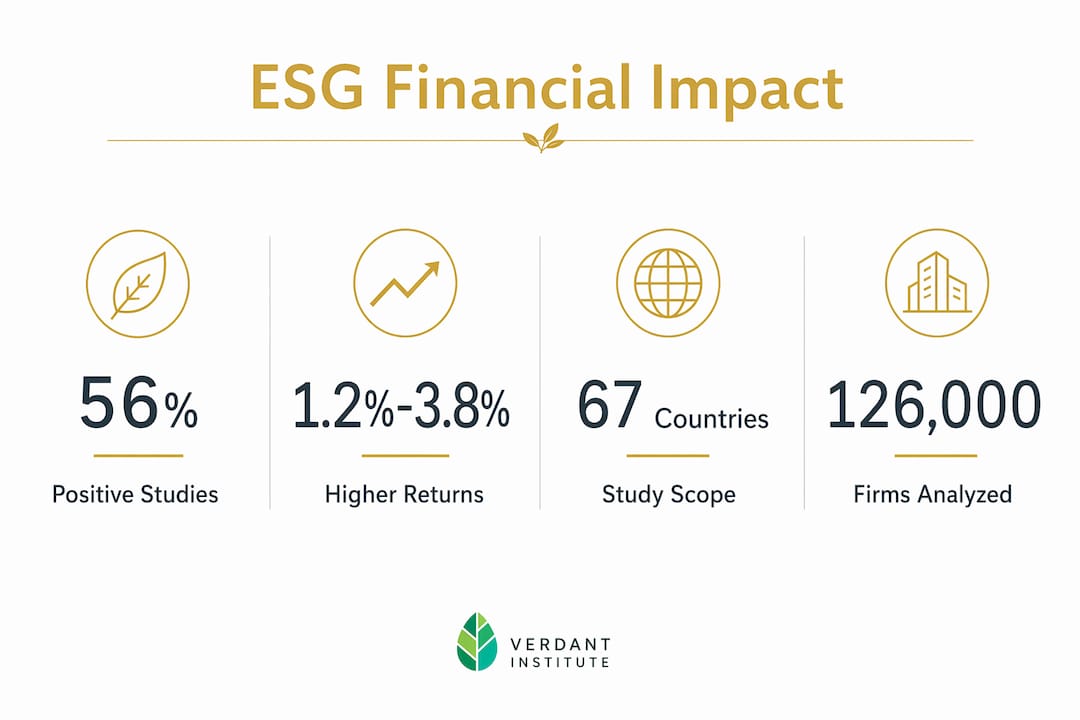
A 2025 systematic review covering 126,000 firms across 67 countries found that 56% of quantitative studies report positive linkages between ESG performance and financial outcomes. That means roughly 44% of studies find mixed, neutral, or negative results. The manufacturing sector shows the strongest positive signal at 74%, while the Asia-Pacific region leads regionally at 67% positive results.
Meta-analysis of over 1,200 studies shows that high-ESG firms earn 1.2%–3.8% higher risk-adjusted returns annually and reduce their cost of capital by 18–32 basis points. Volatility falls by 11% on average. These are meaningful numbers for portfolio construction, but they come with a critical condition.
The ESG-performance relationship is conditional on materiality. Broad ESG screening strategies no longer reliably produce alpha premiums. The financial benefit concentrates in firms where ESG factors are material to the specific sector. A carbon intensity metric is material for an energy company but far less so for a software firm. Researchers who ignore materiality when interpreting results will draw misleading conclusions. The importance of ESG literature lies precisely in this nuance: it teaches you where the evidence is strong and where it is not.
What are the challenges and limitations in ESG academic research?
ESG academic research carries real limitations that every reader should understand before applying findings to investment or policy decisions.
The most common misconception is that ESG is a recent invention. ESG evolved from CSR discourse over the last 20 years, shifting from a values-based framework to a financial risk management tool. The terminology changed; the underlying concern for corporate conduct did not. Treating ESG as entirely new leads researchers to ignore decades of relevant CSR evidence.
The deeper methodological problems are causal ambiguity, rating divergence, and greenwashing. Challenges in ESG research include unclear causality between ESG scores and performance, significant heterogeneity among investors, and the well-documented divergence between ESG ratings from different providers. Two firms can receive opposite ESG scores from different rating agencies using the same underlying data. That divergence makes cross-study comparisons unreliable unless researchers control for the rating methodology used.
Greenwashing adds another layer of complexity. Not all ESG disclosures indicate real performance. Topic-specific disclosures on renewable energy adoption or supply chain emissions correlate better with actual environmental KPIs than broad sustainability reports, which sometimes signal marketing activity over substantive progress.
Pro Tip: When reading academic papers on ESG, always check which rating provider supplied the ESG scores and whether the study controls for sector-specific materiality. Studies that use a single rating provider without acknowledging divergence risk should be read with caution.
How can researchers apply ESG literature insights in practice?
Applying ESG academic literature in practice requires moving beyond general findings and focusing on sector-specific, materiality-based analysis.
Focus on material ESG factors by sector
The most reliable academic findings come from studies that identify which ESG factors are financially material for a given industry. For energy firms, carbon emissions and water use are material. For banks, data privacy and governance quality dominate. Researchers and analysts who apply broad ESG screens without accounting for materiality will find inconsistent results, which mirrors exactly what the literature shows.
Evaluate disclosures critically
Topic-specific ESG disclosures on concrete metrics like renewable energy percentage or supply chain audit rates correlate more strongly with actual environmental and social KPIs than general sustainability narrative reports. When analyzing corporate disclosures, prioritize quantitative, topic-specific data over qualitative statements. Understanding ESG disclosure frameworks helps you distinguish between substantive reporting and surface-level compliance.
Understand the governance interplay
ESG and corporate governance can substitute for each other in building firm resilience, particularly in heavily regulated industries. A firm with strong board oversight may show lower ESG scores but equivalent resilience to a firm with high ESG scores and weaker governance. This substitution effect complicates attribution in academic studies and means you should analyze governance structure alongside ESG scores, not separately.
The table below contrasts two common research and investment approaches based on what the literature supports.
| Approach | Description | What the literature shows |
|---|---|---|
| Broad ESG screening | Applies a single ESG score threshold across all sectors | Inconsistent alpha; does not reliably outperform |
| Materiality-focused ESG | Selects ESG factors relevant to each sector's risk profile | Stronger positive financial links; more academically defensible |
For researchers building ESG investment strategy knowledge, the materiality-focused approach aligns with the strongest empirical evidence in the literature.
Key Takeaways
ESG academic literature is most useful when readers apply materiality-based analysis, understand its CSR origins, and treat ESG ratings as conditional rather than absolute signals of performance.
| Point | Details |
|---|---|
| Rapid field growth | ESG research has grown at 38.83% annually since 2006, making it one of finance's fastest-expanding fields. |
| Performance link is conditional | 56% of studies find positive ESG-financial links, but results depend heavily on sector-specific materiality. |
| Disclosure quality varies | Topic-specific disclosures on concrete KPIs are more reliable than broad sustainability narrative reports. |
| ESG has deep roots | ESG evolved from CSR over 20 years; ignoring that history leads to incomplete research conclusions. |
| Governance and ESG interact | Strong corporate governance can substitute for ESG practices in building resilience, complicating attribution. |
Why the nuance in ESG literature is the whole point
The rapid growth of ESG academic literature is genuinely impressive. Over 4,000 documents analyzed in recent bibliometric studies, a 38.83% annual growth rate, and systematic reviews covering more than 126,000 firms. That scale suggests the field has moved well past its early, advocacy-driven phase.
What strikes me most, though, is how often students and professionals skip straight to the headline findings and miss the conditions attached to them. The 56% positive result on ESG-financial performance sounds definitive. It is not. It means 44% of studies find something else entirely. The meta-analysis showing 1.2%–3.8% higher risk-adjusted returns is compelling, but it applies to firms where ESG factors are material to their sector. Apply that finding to a sector where ESG is not material and you will get noise, not signal.
The ESG ratings divergence problem is the most underappreciated challenge in the field. Two major rating providers can score the same firm in opposite directions. Any study that does not acknowledge this should be read carefully. The literature is catching up to this problem, but slowly.
My honest view is that the importance of ESG literature for students and researchers is not the conclusions it reaches. It is the discipline it demands. Reading ESG research well means asking: Which rating methodology? Which sector? Which time period? Which disclosure framework? Those questions are the skills that separate credible ESG analysts from people who cite a statistic without understanding its limits.
— Charles
Build your ESG research foundation with Verdantinstitute
Students and researchers who want to move from reading ESG literature to applying it need structured, field-specific training. Verdantinstitute offers a library of 16 courses and over 160 lessons covering ESG frameworks in academia, sustainable finance strategy, and advanced topics like transition finance and net-zero analysis.

The platform includes an Academic Foundations track built specifically for students entering sustainable finance, alongside Deep Dive modules on ESG disclosure, materiality analysis, and corporate governance. CPD tracking and certifications make it practical for professionals too. Student plans start at $18/month and professional plans at $58/month. See the full course and pricing options to find the right track for your research goals.
FAQ
What is ESG academic literature?
ESG academic literature is the body of peer-reviewed research examining how environmental, social, and governance factors affect corporate behavior and financial performance. It spans disclosure studies, performance analysis, governance research, and sustainability frameworks.
How fast is the ESG research field growing?
ESG academic interest has grown at approximately 38.83% annually between 2006 and 2024. That growth reflects a shift from early CSR-based frameworks to rigorous, data-driven ESG analysis.
Does ESG always improve financial performance?
A 2025 systematic review found 56% of quantitative studies report positive ESG-financial links, but results vary by sector and region. The relationship is strongest when ESG factors are material to the specific industry being studied.
What are the biggest limitations in ESG research?
The main limitations are causal ambiguity, ESG rating divergence across providers, greenwashing in disclosures, and heterogeneity among investors. These factors mean findings should be interpreted with attention to methodology and sector context.
How is ESG different from CSR?
ESG evolved from CSR over the last 20 years, shifting from a values-based corporate responsibility framework to a financial risk and value creation tool. The core concern for corporate conduct is shared; the analytical framework and market application differ significantly.