

ESG is defined as a three-part framework for evaluating a company's environmental impact, social practices, and governance structures, and it has become the standard lens through which investors, regulators, and companies assess long-term sustainability risk. If you are exploring esg fundamentals for beginners, you are entering a field that now shapes capital allocation decisions at institutions like BlackRock, HSBC, and the European Commission. Standards like IFRS Sustainability Disclosure Standards and the EU's Corporate Sustainability Reporting Directive (CSRD) have made ESG literacy a professional requirement, not a differentiator. This guide breaks down the three pillars, explains double materiality, maps the major reporting frameworks, and gives you a clear path to building real ESG skills.
What are the three pillars of ESG and what do they cover?
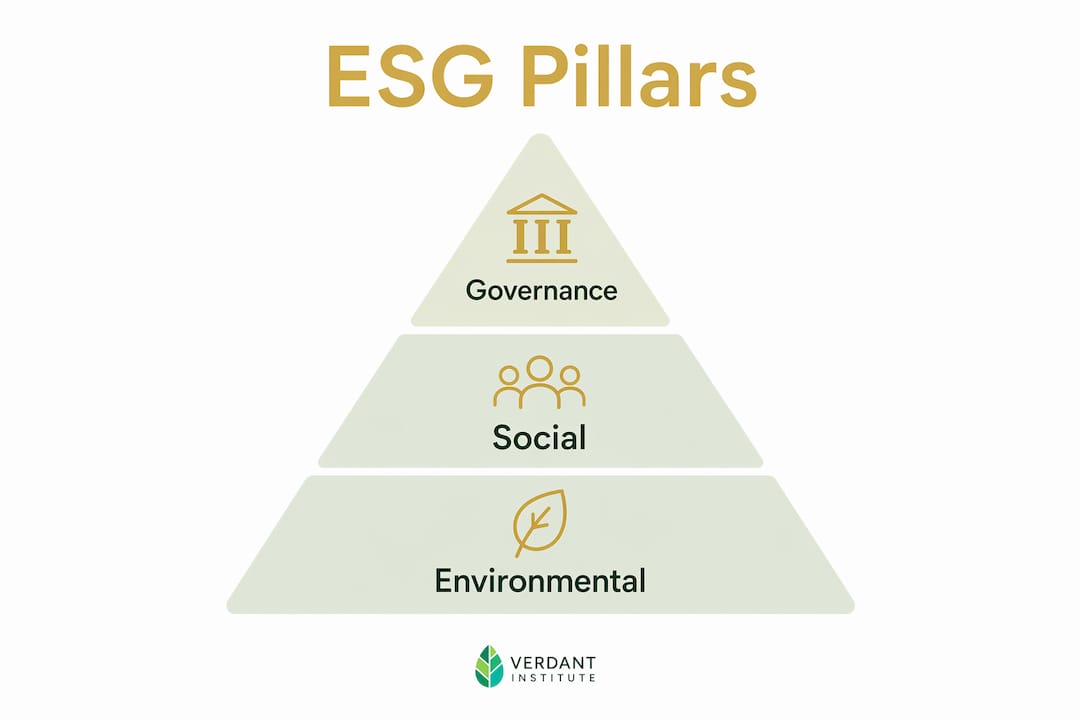
ESG assesses sustainability-related issues across three distinct dimensions, each measuring a different category of non-financial risk and opportunity. Understanding each pillar separately before connecting them is the fastest way to build a solid mental model.
The environmental pillar
The environmental pillar covers how a company interacts with the natural world. This includes greenhouse gas emissions, energy and water consumption, waste management, pollution, and biodiversity impacts. Nature-related disclosures are now core to this pillar, following the Taskforce on Nature-related Financial Disclosures' final recommendations in September 2023. That shift matters because it moves environmental analysis beyond carbon accounting into ecosystem dependencies, land use, and supply chain nature risks.
The social pillar
The social pillar examines how a company manages relationships with employees, suppliers, customers, and the communities where it operates. Key topics include labor standards, health and safety, diversity and inclusion, human rights in the supply chain, and community investment. A company with strong environmental scores but poor labor practices in its supply chain carries real reputational and regulatory risk. Social factors are increasingly scrutinized under mandatory due diligence laws across the EU.

The governance pillar
Governance covers board composition, executive compensation, audit quality, anti-corruption policies, shareholder rights, and transparency. Governance is the backbone of any credible ESG program because weak governance undermines the reliability of environmental and social commitments. A company can publish ambitious climate targets, but if the board lacks independent oversight or incentive structures tied to those targets, the commitments are largely unenforceable. Beginners often underestimate governance, but experienced ESG analysts treat it as the first filter.
- Environmental: Emissions, energy, water, waste, biodiversity, and nature-related risks
- Social: Labor rights, diversity, human rights, community impact, and supply chain conduct
- Governance: Board independence, executive pay, ethics, transparency, and accountability
Pro Tip: When analyzing a company for the first time, read the governance section of its annual report before the sustainability report. Board structure and incentive design tell you whether ESG commitments are backed by real accountability.
How does double materiality shape ESG reporting?
Double materiality is the simultaneous assessment of two distinct perspectives: how a company's activities affect the environment and society (impact materiality), and how sustainability issues create financial risks and opportunities for the company (financial materiality). This concept is central to understanding modern ESG reporting and is one of the most important foundational ESG concepts beginners need to grasp early.
Here is how the two perspectives break down:
- Impact materiality asks: What harm or benefit does this company cause to people and the planet? This is the "outside-in" view, focused on the company's footprint.
- Financial materiality asks: Which sustainability issues could affect the company's financial performance, cash flows, or access to capital? This is the "inside-out" view, focused on business risk.
- Double materiality requires both assessments simultaneously, producing a fuller picture of where a company's most significant ESG issues lie.
The EU's CSRD implements double materiality requirements through the European Sustainability Reporting Standards (ESRS), with phased implementation running through 2028 based on company size and turnover thresholds. This means large listed companies are already reporting under this framework, while smaller companies are being phased in progressively.
"Anchoring your ESG learning to double materiality enables effective navigation of evolving regulations and ensures engagement with priority disclosures." — Double Materiality Regulatory Guide for 2026
The contrast with single materiality is significant. The ISSB's IFRS standards focus primarily on financial materiality, meaning they are designed for investor audiences who want to understand sustainability risks to the business. The GRI Standards, by contrast, emphasize impact materiality, serving a broader stakeholder audience. Knowing which lens a framework uses tells you immediately who it is designed to serve and what data it will require.
What global ESG reporting standards should beginners know?
ESG frameworks vary by target audience, which means the same company may report under multiple standards depending on whether it is addressing investors, regulators, or the public. This is one of the most confusing aspects of ESG basics for new professionals, so a clear comparison helps.
| Framework | Primary audience | Materiality lens | Key focus |
|---|---|---|---|
| IFRS S1 and S2 (ISSB) | Investors and capital markets | Financial materiality | Sustainability risks and opportunities affecting enterprise value |
| GRI Standards | Broad stakeholders | Impact materiality | Company's effects on economy, environment, and people |
| SASB Standards | Investors | Financial materiality | Industry-specific, financially material sustainability topics |
| CSRD and ESRS | EU regulators and stakeholders | Double materiality | Comprehensive mandatory reporting for EU companies |
The IFRS S1 and S2 standards, issued by the International Sustainability Standards Board in 2023, provide a global baseline for investor-focused disclosures. IFRS S2 is specifically designed around the four pillars of the Task Force on Climate-related Financial Disclosures (TCFD): governance, strategy, risk management, and metrics and targets. This is useful for beginners because IFRS S2 mirrors TCFD architecture, meaning that learning TCFD concepts transfers directly to understanding IFRS S2.
SASB Standards, now integrated under the IFRS Foundation, provide industry-specific guidance on which sustainability topics are financially material for 77 different industries. If you are analyzing a mining company versus a software firm, SASB tells you which ESG metrics actually matter for each sector. GRI takes a different approach, covering a company's full impact regardless of financial relevance, making it the go-to standard for stakeholder-facing sustainability reports.
Pro Tip: Start with GRI to understand what ESG topics exist, then use SASB to filter which ones are financially material for the specific industry you are analyzing. Layer IFRS S2 on top when the audience is investors.
Understanding ESG for novices means accepting that no single framework covers everything. Regulators, investors, and civil society each have different information needs, and the frameworks reflect those differences. Amendments to IFRS S1 and S2 are planned by end of 2025, so staying current with IFRS Foundation updates is part of the job.
How can beginners start building real ESG skills?
Building ESG literacy requires more than reading definitions. The most effective path combines structured learning, hands-on application, and exposure to real reporting documents. Here is where to start and what to avoid.
Start with structured foundations. Formal courses that cover ESG in finance give you the conceptual scaffolding to make sense of everything else you read. Verdantinstitute offers a dedicated Foundations track built specifically for beginners, covering the core concepts before moving into advanced topics like transition finance and net-zero strategies.
Read actual company reports. Download a CSRD-compliant sustainability report from a large European company and map its disclosures to the ESRS topics. This exercise builds pattern recognition faster than any textbook. Companies like Unilever, Danone, and Schneider Electric publish detailed reports that show how double materiality assessments translate into actual disclosures.
Practice materiality thinking. ESG teams working under CSRD begin with double materiality assessments to map value chain impacts before drafting disclosures. You can practice this by picking a company, listing its key activities, and asking both materiality questions for each one. This exercise builds the analytical instinct that separates strong ESG analysts from those who just know the vocabulary.
Avoid the most common beginner mistake. Beginners consistently underestimate shifting mandatory scopes and datapoint expectations under frameworks like CSRD. Memorizing a checklist of ESG topics is far less useful than understanding the underlying process logic of double materiality and how jurisdiction-specific timelines affect what companies must report and when.
Pro Tip: Follow the IFRS Foundation, GRI, and ESRS update pages directly. ESG standards are changing faster than most textbooks can track, and staying current is a professional skill in itself.
Exploring ESG investment strategies alongside reporting fundamentals gives you a fuller picture of how ESG criteria translate into capital allocation decisions. The two skill sets reinforce each other.
Key takeaways
Mastering ESG fundamentals requires understanding the three pillars, applying double materiality thinking, and selecting the right reporting framework for the right audience.
| Point | Details |
|---|---|
| ESG has three distinct pillars | Environmental, social, and governance each measure different categories of non-financial risk and opportunity. |
| Governance is the foundation | Weak governance undermines the credibility of any environmental or social commitment a company makes. |
| Double materiality is central | CSRD requires both impact and financial materiality assessments, making it the most demanding ESG framework in practice. |
| Frameworks serve different audiences | IFRS S2 targets investors, GRI targets stakeholders, and SASB targets industry-specific financial analysis. |
| Process beats memorization | Understanding double materiality logic and regulatory timelines is more durable than memorizing ESG topic checklists. |
Why governance deserves more attention than it gets
Most beginners gravitate toward the environmental pillar. Climate change is visible, measurable, and emotionally compelling. Carbon footprints have units. Biodiversity loss has photographs. Governance, by contrast, feels abstract. Board independence ratios and audit committee compositions do not make headlines the same way.
But after working through ESG analysis across multiple sectors, I keep arriving at the same conclusion: governance failures are the leading indicator of ESG program collapse. Wirecard had sustainability disclosures. Boohoo published labor policies. What they lacked was the governance infrastructure to make those commitments real. When I review a company's ESG profile now, I look at whether executive compensation is tied to sustainability targets, whether the board has genuine sector expertise in climate or social risk, and whether the audit function has independence from management. Those three questions tell me more than 50 pages of environmental data.
The other thing I would tell early-career professionals is to take double materiality seriously from day one. It is not just a regulatory requirement under CSRD. It is a thinking tool. Asking both "what does this company do to the world?" and "what does the world do to this company?" simultaneously forces a level of analytical rigor that single-lens frameworks simply do not require. Regulators are moving toward double materiality globally, and professionals who already think in those terms will have a significant advantage as mandatory reporting expands. Explore ESG career pathways early so you understand which roles require which skill sets and can build toward them deliberately.
— Charles
Start your ESG education with Verdantinstitute

Verdantinstitute is built for exactly where you are right now. The platform's Foundations track covers ESG basics through structured lessons designed for recent graduates and early-career professionals who need conceptual clarity before tackling advanced topics. With over 160 lessons across 16 courses, CPD tracking, and certifications recognized in the sustainable finance sector, it gives you a structured path rather than a pile of disconnected resources. Student plans start at $18 per month, and professional plans at $58 per month. Explore the full course catalog and pricing to find the track that matches your current level and career goals.
FAQ
What does ESG stand for?
ESG stands for Environmental, Social, and Governance. It is a framework used to assess a company's sustainability practices and non-financial risks across those three dimensions.
What is double materiality in ESG?
Double materiality requires companies to assess both how their activities affect the environment and society and how sustainability issues affect their own financial performance. The EU's CSRD mandates this approach under the ESRS.
Which ESG framework should a beginner learn first?
GRI Standards provide the broadest introduction to ESG topics and impact materiality, making them a strong starting point. Layer in IFRS S2 and SASB once you understand the foundational topic categories.
Is ESG only relevant for large companies?
No. While mandatory CSRD reporting currently targets large EU companies, ESG criteria are applied by investors, lenders, and supply chain partners across companies of all sizes. Early-career professionals in any sector will encounter ESG requirements.
How is ESG different from corporate social responsibility (CSR)?
CSR is typically a voluntary, narrative-driven reporting practice focused on a company's positive contributions. ESG is a structured, data-driven framework used for risk assessment and investment analysis, increasingly backed by mandatory regulatory requirements.