

Infrastructure has always been the backbone of economic growth, but esg infrastructure investment explained through a purely ethical lens misses the bigger picture. Global infrastructure spending is projected to exceed $150 trillion through 2050, with power infrastructure alone scaling from $631 billion annually in 2025 to $1.1 trillion by 2050. At that scale, environmental, social, and governance factors are not a courtesy to the planet. They are financial gatekeepers that determine which projects get funded, which portfolios hold their value, and which investors get left with stranded assets.
Table of Contents
- Key takeaways
- ESG infrastructure investment explained: core definitions
- How ESG affects financial performance and risk
- Financial instruments enabling ESG infrastructure finance
- Challenges and nuances investors must understand
- Applying ESG strategies for resilient infrastructure portfolios
- My perspective on ESG and infrastructure investing
- Take your ESG infrastructure knowledge further with Verdantinstitute
- FAQ
Key takeaways
| Point | Details |
|---|---|
| ESG is a financial filter | Projects failing minimum ESG thresholds are increasingly rejected regardless of their financial profile. |
| Climate risk is investment risk | Physical and transition climate risks directly affect infrastructure asset valuations and long-term cash flows. |
| Finance tools have evolved | Green bonds, sustainability-linked loans, and blended finance structures now tie capital costs to ESG performance. |
| Rating inconsistency is a real problem | Divergent ESG methodologies create scoring gaps investors must actively manage through direct assessment. |
| Integration beats box-checking | Building ESG into due diligence and portfolio construction creates durable competitive advantage versus treating it as a compliance overlay. |
ESG infrastructure investment explained: core definitions
Infrastructure assets are long-lived, systemically critical, and capital-intensive. A toll road, a water treatment plant, or a power transmission network may operate for 40 to 60 years. That duration means the environmental, social, and governance conditions around an asset shape its financial performance in ways that shorter-cycle investments never face.
Understanding ESG in finance starts with separating its three pillars in the context of physical assets rather than company stocks.
- Environmental: Carbon emissions from construction and operations, energy efficiency, water and resource use, exposure to climate-related physical risks like flooding or extreme heat, and resilience to future regulatory constraints on emissions.
- Social: Community impact from displacement or disruption, labor standards during construction and operation, access and inclusion in the communities served, and the project's relationship with indigenous land rights.
- Governance: Transparency in contracting and procurement, anti-corruption controls, regulatory compliance history, board oversight quality in project sponsors, and robust risk management frameworks throughout the asset's life.
One distinction worth getting precise about: ESG integration is not the same as impact investing. Sustainable investing spans a spectrum from ESG integration, where ESG data is used to identify risks and opportunities alongside financial analysis, to impact investing, where generating measurable social or environmental outcomes is an explicit objective alongside return. Most institutional infrastructure investors practice ESG integration. Impact infrastructure funds carry an additional mandate to demonstrate positive outcomes.
Pro Tip: When evaluating an infrastructure fund's ESG claims, ask specifically whether they integrate ESG into risk analysis or whether they pursue measurable impact outcomes. The distinction changes how you assess performance, reporting obligations, and the tradeoffs each mandate requires.
How ESG affects financial performance and risk
The financial case for ESG in infrastructure is grounded in risk identification, not reputation management. ESG due diligence now functions as a gatekeeping mechanism in project finance. Projects failing minimum ESG thresholds are often rejected outright, regardless of how attractive their financial projections look. That reality changes the investment calculus for every party in the capital stack.

Climate risk is among the most material factors. Physical risks, including flooding, drought, and extreme heat, directly threaten infrastructure asset operations. Transition risks, including tightening emissions regulation and carbon pricing, affect operating costs and asset valuations over long time horizons. Neither of these risks is speculative. They are increasingly priced by lenders and institutional investors.
Governance failures compound these risks. When project sponsors lack transparent procurement processes or robust compliance frameworks, execution delays and cost overruns follow. Infrastructure projects face systemic risks that social conflicts, climate stressors, and governance failures can halt entirely, destroying capital already deployed.
"ESG is shifting from a narrative of compromise to active fiduciary management, where ESG assets are seen as more durable and capable of sustained value creation." — Return on resilience
The concept of social license to operate deserves particular attention. Infrastructure projects that fail to manage community relationships face protests, legal challenges, and regulatory intervention. Any of these can delay construction schedules by months or years, inflating costs in ways no financial model anticipates at underwriting.
Pro Tip: Build a social license risk assessment into your standard due diligence process. Map affected communities, review consultation records, and assess whether the project sponsor has a track record of managing social conflict. Delays caused by community opposition are among the most common sources of cost overrun in infrastructure development.
Understanding ESG portfolio construction as active fiduciary management, rather than a values overlay, reframes how you weight these factors against conventional financial metrics.
Financial instruments enabling ESG infrastructure finance
The capital markets have developed a set of instruments specifically designed to channel capital toward sustainable infrastructure investment. Each has distinct mechanics, incentives, and risks worth understanding before you deploy them.
| Instrument | Structure | Key benefit | Primary risk |
|---|---|---|---|
| Green bonds | Fixed income, proceeds designated for green assets | Access to ESG-focused capital pools | Maturity mismatch with asset life |
| Sustainability-linked loans | Variable rate tied to ESG KPI performance | Aligns borrower incentives with ESG outcomes | KPI selection and measurement quality |
| Blended finance | Concessional public capital plus commercial capital | Reduces perceived risk in emerging markets | Governance complexity across capital providers |
Green bonds are the most established instrument. They are fixed-income securities whose proceeds are designated exclusively for projects with environmental benefits. The Global Green Bond Initiative Fund aims to mobilize up to €20 billion in private capital for sustainable infrastructure, with at least 20% directed to least developed countries. The fund also expects to unlock up to €3 billion in green bonds in partner countries.
The critical technical issue with green bonds in infrastructure is maturity mismatch. Green bond average tenors run 7 to 10 years. Infrastructure asset operational lives run 30 to 50 years. That gap creates refinancing risk at multiple points over an asset's life, requiring proactive capital planning at the portfolio level.
Sustainability-linked loans address a different problem. Rather than designating proceeds, they tie interest rates to specific ESG KPIs, with financial penalties triggered when targets are missed. This structure keeps ESG performance financially consequential throughout the operating life of the asset, not just at financial close.
Blended finance layers concessional capital from development finance institutions alongside commercial debt and equity. The concessional tranche absorbs first-loss risk, making the overall structure acceptable to commercial investors who would otherwise avoid frontier or emerging market infrastructure. Energy transition spending must reach $4.5 trillion annually by 2030 to stay on a 1.5-degree pathway. Blended finance is central to mobilizing that scale in markets where commercial capital alone is insufficient.
Challenges and nuances investors must understand
ESG infrastructure investing is not a clean or frictionless discipline. Several structural challenges require active management from investors who take it seriously.
- Rating inconsistency: Divergent ESG rating methodologies produce inconsistent scores across providers. The same infrastructure project can receive materially different ESG ratings depending on the methodology applied. Relying on a single external rating without understanding its inputs is a significant blind spot.
- Regulatory fragmentation: The US ESG regulatory environment is politically charged and inconsistent across federal and state levels. Effective ESG strategies in this context depend on verifiable, return-driven methodologies that can withstand scrutiny regardless of political shifts.
- Data gaps: Reliable ESG data for infrastructure assets, particularly in emerging markets, remains thin. Construction-phase emissions data, community impact metrics, and governance disclosures are inconsistently collected and reported.
- Maturity mismatch management: The gap between green bond tenors and infrastructure asset lives requires a refinancing strategy built into portfolio planning at origination.
The practical response to rating inconsistency is direct assessment. Institutional investors who manage large infrastructure portfolios increasingly run proprietary ESG scoring aligned to their specific asset categories rather than defaulting to third-party ratings. This approach requires internal capability but produces more consistent and defensible investment decisions.
The sustainable investment market data also makes clear that the volume of ESG-labeled capital is now large enough that greenwashing pressure and disclosure quality have become investment risks in their own right.
Applying ESG strategies for resilient infrastructure portfolios
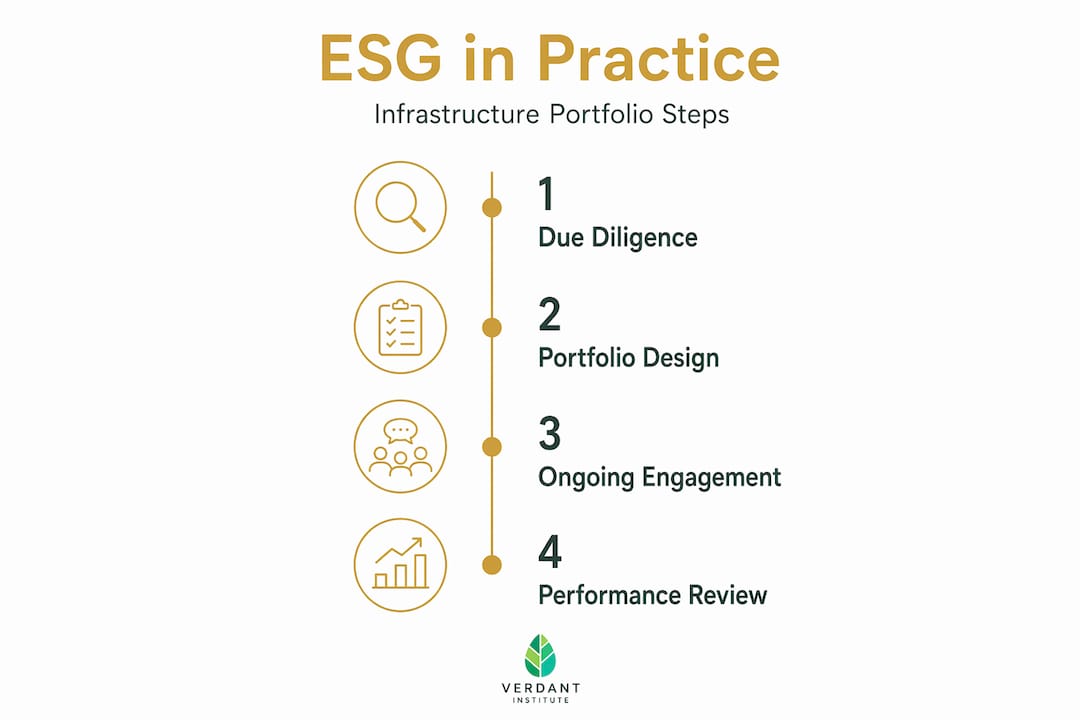
Practical ESG integration in infrastructure portfolios is built at three points in the investment process.
Due diligence is where ESG criteria in investment carry the most weight. Before committing capital, assess climate physical and transition risks for the specific asset location and type, evaluate the project sponsor's governance track record, review community consultation records, and confirm that construction and operational standards meet minimum environmental thresholds. Projects that clear this screen typically exhibit lower cost overruns and fewer regulatory disruptions post-close.
Portfolio construction benefits from deliberate sector and geography allocation. Renewable energy, water infrastructure, digital connectivity, and sustainable transportation represent subsectors where ESG alignment and return potential converge. Geographies with clear policy frameworks for green infrastructure, including the European Union and parts of Southeast Asia, reduce regulatory risk and improve long-term asset predictability.
Ongoing engagement and reporting complete the cycle. ESG performance does not lock in at financial close. Active engagement with project operators on emissions reporting, labor standards compliance, and governance practices sustains asset value over time. The impact of ESG on infrastructure compounds through consistent monitoring and stewardship, not just upfront screening.
Pro Tip: When constructing an ESG-aligned infrastructure portfolio, weight your allocation toward assets in regulated sectors with stable cash flows. These assets produce the consistent, measurable ESG data that institutional mandates require, and their regulatory oversight reduces governance risk at the asset level.
My perspective on ESG and infrastructure investing
I have watched a lot of finance professionals treat ESG as a reporting exercise. They add a sustainability section to their investment committee memo and move on. That approach is going to cost portfolios real money over the next decade.
What I have learned working through ESG frameworks in infrastructure is that the risks are not hypothetical. A solar project I reviewed several years ago had excellent financial returns on paper. It failed on community consultation. The local opposition took 18 months to resolve. The IRR came in well below projection, not because of technology or interest rates, but because the sponsor never secured genuine social license.
The ESG factors that infrastructure investors tend to underweight are the ones that operate slowly. Physical climate risk builds over asset lifetimes. Governance weaknesses compound through contract cycles. Regulatory fragmentation does not stay fragmented indefinitely. It resolves in one direction or another, and you want to know which way your portfolio is positioned before that happens.
My honest take: ESG integration done properly is a competitive advantage. It identifies risk earlier, creates better stakeholder relationships, and produces assets that lenders and buyers want to underwrite when you reach the exit. Done poorly, it is just overhead. The difference is whether your team treats it as a core analytical discipline or a checkbox.
— Charles
Take your ESG infrastructure knowledge further with Verdantinstitute

The concepts covered here are the foundation. The real skill comes in applying ESG criteria across deal structures, asset classes, and regulatory environments where conditions are rarely clean. Verdantinstitute's ESG finance courses build that applied capability through structured learning tracks spanning foundations, deep dives into specific ESG topics, and advanced practice areas including transition finance and net-zero strategies. Whether you are building foundational literacy or advancing toward specialized practice, Verdantinstitute's subscription plans for professionals at $58 per month include CPD tracking and certifications designed for active finance practitioners.
FAQ
What does ESG mean in infrastructure investment?
ESG in infrastructure refers to integrating environmental, social, and governance factors into investment analysis and decision-making for long-lived physical assets. These factors affect financial performance through risk identification, regulatory exposure, and asset resilience rather than just ethical positioning.
How does ESG integration affect infrastructure project financing?
ESG due diligence now functions as a gatekeeping mechanism in project finance. Projects that fail minimum ESG thresholds are frequently rejected regardless of their financial projections, making ESG performance a prerequisite for accessing institutional capital.
What is the difference between a green bond and a sustainability-linked loan?
A green bond designates proceeds for specific green projects. A sustainability-linked loan ties the interest rate to measurable ESG performance targets, creating ongoing financial incentives rather than restricting how capital is used.
Why is ESG rating inconsistency a problem for infrastructure investors?
Different ESG rating providers use divergent methodologies, producing materially different scores for the same asset. Investors who rely on a single provider without scrutinizing its inputs risk making decisions based on incomplete or misleading risk signals.
What is the biggest practical challenge in ESG infrastructure investing?
The maturity mismatch between green bond tenors (7 to 10 years) and infrastructure asset lives (30 to 50 years) creates serial refinancing risk that requires active capital planning. Combined with data gaps in emerging markets, this makes ESG infrastructure investing a discipline that rewards internal analytical capability.