

ESG momentum strategy is defined as overweighting companies that show year-over-year improvements in their ESG scores, rather than favoring firms with the highest static ESG ratings. This approach, formally known as ESG improvement investing within quantitative factor frameworks, targets the performance premium created when markets are slow to price in genuine sustainability progress. Research published by the CFA Institute shows that incorporating an ESG momentum tilt improves portfolio Sharpe ratio from 0.54 to 0.62 while simultaneously reducing volatility and drawdowns. That single finding reframes the entire debate: you do not need to sacrifice returns to invest responsibly. For finance professionals building factor-based or sustainable portfolios, understanding the esg momentum strategy explained here is the foundation for smarter capital allocation.
How does ESG momentum strategy work in portfolio construction?
ESG momentum strategy operates as a dynamic weighting tool inside a broader factor model. The core mechanic is straightforward: rank all securities by their year-over-year change in ESG score, then tilt the portfolio toward the top improvers and away from the worst decliners. This is not a binary screen. It is a continuous, score-driven reweighting that sits alongside traditional factors like value, size, and quality.
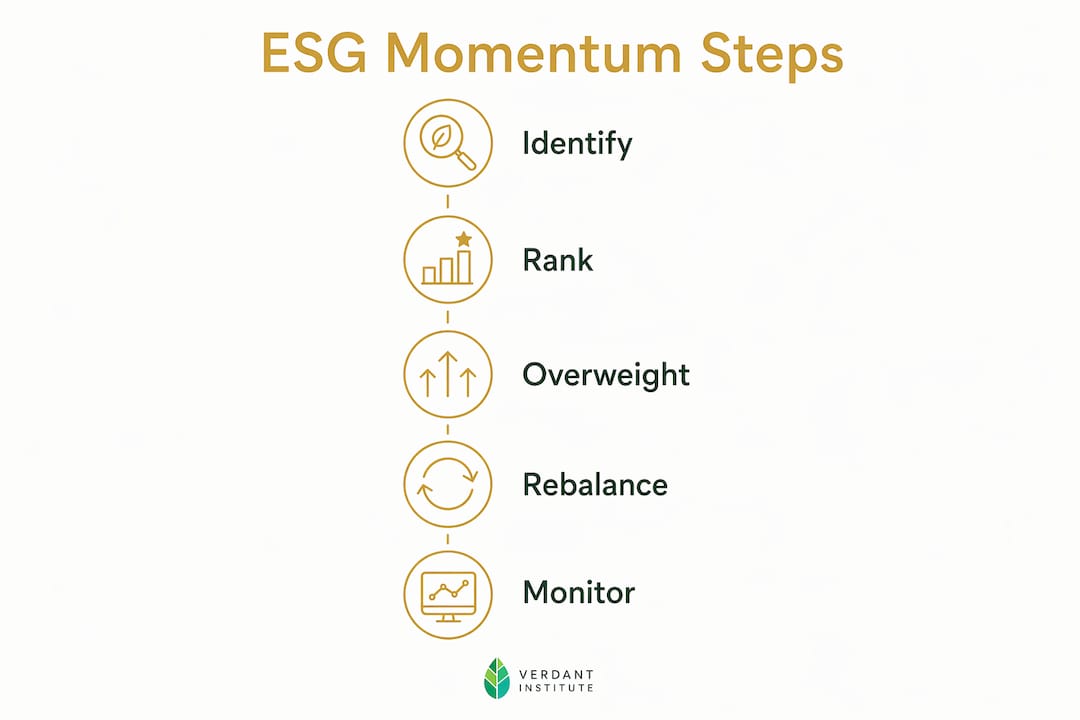
Implementation follows four clear steps:
- Score the universe. Pull ESG ratings from one or more providers and calculate the year-over-year change for each issuer. The change in score, not the absolute level, is the signal.
- Construct the tilt. A common approach goes long the top 30% of ESG improvers and short, or underweights, the bottom 30% of decliners. This long-short structure isolates the improvement signal cleanly.
- Check factor orthogonality. ESG momentum signals are statistically orthogonal to size, value, and price momentum. That means adding this factor does not simply replicate existing exposures. It adds a genuinely distinct source of return.
- Rebalance annually. ESG rating data refreshes on an annual cycle. Rebalancing more frequently introduces noise; rebalancing less frequently means the portfolio drifts away from the current improvement signal.
Pro Tip: When integrating ESG momentum into a multi-factor model, run a principal component analysis on your factor loadings before going live. If the ESG momentum sleeve loads heavily on an existing factor, your data or scoring methodology may have a construction error.
The annual rebalancing discipline deserves emphasis. Because ESG rating data refreshes on a yearly cycle, the momentum sleeve must align with that cadence to capture up-to-date corporate improvements. Quarterly rebalancing against annual data creates false signals and unnecessary turnover costs.

What does the research say about ESG momentum performance?
The quantitative case for momentum investing in ESG is stronger than most practitioners realize. The CFA Institute's Enterprising Investor research demonstrates that a portfolio applying an ESG improvement tilt achieves a Sharpe ratio of 0.62, compared to 0.54 for a baseline portfolio without the tilt. That improvement comes with lower drawdowns, not higher risk.
"The market systematically underprices firms that are improving their ESG scores. Investors who focus on dynamic improvement rather than static status capture a premium that static ESG approaches leave on the table." — CFA Institute Enterprising Investor Blog
The mechanism behind this premium is well documented. ESG improvements diffuse slowly through the market because of rating lags and widespread skepticism about greenwashing. Rating agencies take time to update scores after a company genuinely improves its practices. Skeptical investors discount those updates further. The result is a persistent mispricing that momentum-oriented strategies can exploit before the broader market catches up.
Academic research published in the Journal of Asset Management in 2024 confirms a distinct effect: ESG rating momentum influences corporate cost of equity and valuation independently of other factors. That finding matters because it validates ESG momentum as a genuine pricing mechanism, not a statistical artifact. Companies improving their ESG profiles attract a lower cost of capital over time, which directly supports higher valuations.
A separate study covering US and European markets from 2019 to 2025 found that integrating ESG improvement constraints into factor strategies reduces environmental risk exposure while preserving the portfolio's intended factor tilts. This is the risk management argument for ESG momentum. You get cleaner environmental exposure without distorting your value or quality bets.
One underappreciated finding: composite ESG scores mix environmental, social, and governance pillars that often move in conflicting directions. A company can improve its governance score while its environmental score deteriorates, and the composite will show little change. Momentum signals cut through that noise by focusing on directional change rather than aggregate level.
How does ESG momentum compare to other ESG strategies?
ESG momentum is one of several approaches in the types of ESG investment strategies available to finance professionals. Understanding where it sits relative to other methods clarifies when to use it and when to combine it with alternatives.
| Approach | Signal used | Portfolio action | Key limitation |
|---|---|---|---|
| Exclusionary screening | Absolute ESG threshold | Remove failing issuers | Ignores improving firms |
| Best-in-class | Highest current ESG score | Overweight sector leaders | Rewards status, not progress |
| ESG integration | Material ESG risks | Adjust valuation models | Depends on analyst judgment |
| ESG momentum | Year-over-year score change | Tilt toward top improvers | Requires quality data and annual rebalancing |
The critical distinction is static versus dynamic. Exclusionary and best-in-class methods reward where a company is today. ESG momentum rewards where a company is going. A steel producer with a mediocre absolute ESG score but a strong upward trajectory will be excluded by best-in-class screens yet overweighted by a momentum strategy. That steel producer may represent exactly the kind of real-world transition that sustainable finance is meant to support.
Exclusionary screening also creates sector concentration risks. Removing entire industries from a portfolio can introduce unintended factor tilts toward growth or away from cyclicals. ESG momentum avoids this by working within the full investable universe and adjusting weights rather than eliminating holdings.
Pro Tip: Sector materiality matters when applying ESG momentum tilts. An improvement in a governance score carries different weight for a financial firm than for an energy company. Use sector-specific ESG frameworks, such as those from SASB, to calibrate which pillar improvements are most material before constructing your tilt.
Practical considerations for implementing ESG momentum
Finance professionals face several concrete challenges when building ESG momentum strategies. Addressing them upfront prevents the most common construction errors.
- Provider variability is the biggest data risk. ESG ratings from different providers can diverge significantly for the same issuer. Neglecting rating provider variability undermines factor construction and distorts performance attribution. Use at least two providers and document your aggregation methodology.
- Tracking error budgets require active management. An ESG momentum tilt will create active positions relative to a cap-weighted benchmark. Quantify the expected tracking error before implementation and set explicit limits. A tilt that generates 150 basis points of tracking error may be acceptable in a high-conviction ESG mandate but not in a core equity fund.
- Greenwashing risk is real and measurable. Companies can improve their disclosed ESG metrics without changing underlying behavior. Pair ESG score changes with controversy monitoring and third-party verification data to filter out cosmetic improvements.
- Annual rebalancing timing matters. Schedule rebalancing after the majority of ESG rating providers have published their annual updates, typically in the second quarter. Rebalancing in january, before most updates are live, captures stale data.
- Minimize unintended factor exposures. Run attribution analysis after each rebalance to confirm the ESG momentum sleeve is not inadvertently loading on low-quality or small-cap factors. Adjust position sizing if unintended exposures appear.
Pro Tip: Build a data governance log that tracks which ESG provider supplied each score, the date of the last update, and any methodology changes the provider disclosed. This log becomes critical during client reporting and regulatory review.
For a deeper look at how ESG tilts interact with portfolio construction trade-offs, the ESG portfolio construction guide from Verdantinstitute covers optimization techniques in detail.
Key Takeaways
ESG momentum strategy delivers superior risk-adjusted returns by targeting companies with improving ESG scores, not the highest static ratings, making it the most evidence-backed dynamic approach in sustainable factor investing.
| Point | Details |
|---|---|
| Core signal | Rank securities by year-over-year ESG score change, not absolute level. |
| Performance evidence | CFA Institute research shows Sharpe ratio improves from 0.54 to 0.62 with an ESG momentum tilt. |
| Factor independence | ESG momentum is orthogonal to size, value, and price momentum, adding genuine alpha. |
| Rebalancing discipline | Align rebalancing with annual ESG rating refreshes to avoid acting on stale data. |
| Data governance | Use multiple ESG providers and document aggregation methods to control for provider variability. |
Why I think most portfolios are still missing this signal
The market's slow adoption of ESG momentum strategies is, frankly, a structural blind spot. Most institutional mandates still evaluate ESG through static screens or best-in-class filters. Those methods are easier to explain to clients and simpler to implement operationally. But they systematically exclude the companies doing the most interesting and financially relevant work: the ones actively improving.
What I find most compelling about the momentum approach is the alignment between financial logic and real-world impact. A company that moves from a poor ESG profile to a strong one is doing something operationally difficult. That difficulty is exactly why the market underprices it. Rating agencies lag. Skeptical investors discount the improvement. The result is a window of mispricing that a disciplined momentum strategy can capture.
The objection I hear most often is that ESG data quality makes momentum signals unreliable. That concern is legitimate but manageable. Provider disagreement is a known variable, not an unknown risk. Professionals who build robust data governance processes, use multiple providers, and apply sector-specific materiality filters can construct momentum signals that are far more reliable than critics assume.
My expectation for the next three years is that ESG momentum will move from a niche quantitative technique to a standard sleeve in multi-factor ESG mandates. Regulatory pressure for transparency, combined with improving data infrastructure, will make the improvement signal easier to validate and harder to dismiss. Finance professionals who build fluency with this approach now will have a meaningful head start.
The education gap is real. Most practitioners understand static ESG integration but have limited exposure to factor-based ESG construction. Closing that gap is where platforms like Verdantinstitute add direct value.
— Charles
How Verdantinstitute supports ESG momentum strategy learning
Finance professionals who want to move from theory to practice on ESG momentum need more than a conceptual overview. They need structured training that covers factor construction, data governance, and portfolio attribution in depth.

Verdantinstitute offers a library of 16 courses and over 160 lessons covering sustainable finance, ESG analysis, and advanced portfolio strategies. The platform's Deep Dive and Advanced Practice tracks address topics including transition finance, net-zero strategies, and quantitative ESG factor integration. CPD tracking and certifications make the learning directly applicable to professional development requirements. Plans start at $18 per month for students and $58 per month for professionals. For finance professionals ready to build real competency in ESG momentum and related strategies, the full course catalog at Verdantinstitute is the most direct path forward.
FAQ
What is ESG momentum in investing?
ESG momentum is a factor-based strategy that overweights companies showing year-over-year improvements in their ESG scores. It targets the performance premium created when markets are slow to price in genuine sustainability progress.
How does ESG momentum differ from best-in-class ESG investing?
Best-in-class investing selects companies with the highest current ESG scores. ESG momentum selects companies with the fastest improving scores, regardless of their absolute level, capturing a distinct and complementary signal.
Does ESG momentum improve portfolio risk-adjusted returns?
CFA Institute research shows that an ESG momentum tilt improves the portfolio Sharpe ratio from 0.54 to 0.62 while reducing volatility and drawdowns, making it one of the strongest quantitative cases in sustainable investing.
How often should an ESG momentum portfolio be rebalanced?
Annual rebalancing is the standard, aligned with the yearly refresh cycle of most ESG rating providers. Rebalancing more frequently introduces noise from stale or incomplete data updates.
What is the biggest implementation risk in ESG momentum strategies?
Provider variability is the primary risk. ESG ratings for the same issuer can differ significantly across providers, which distorts the improvement signal if only one source is used without a documented aggregation methodology.