

Financed emissions are the greenhouse gas emissions that a financial institution is responsible for through its lending, investing, and underwriting activities. They sit in Scope 3, Category 15 of the GHG Protocol, and for most banks and asset managers they dwarf operational emissions by an order of magnitude. The PCAF Global Financed Emissions Standard is the recommended baseline methodology, and it gives you asset-class-specific formulas, a five-tier data-quality scoring system, and a disclosure structure that feeds directly into IFRS S2, CDP, and SBTi target-setting. If your team is starting from zero, three key recommended actions can move you forward soon:
- Scope your main asset classes. Identify which asset classes (corporate loans, listed equity, project finance, mortgages) represent the majority of your portfolio by exposure.
- Calculate a rapid baseline for your largest exposures. Initial focus can be on top exposures where data is most accessible and emissions impact significant.
- Document your data quality and assumptions. Record assigned PCAF data-quality scores, emissions factors used, and reporting years to ensure transparency and defensibility.
Key Takeaways
Financed emissions sit in Scope 3, Category 15 and require PCAF-aligned attribution formulas applied by asset class, with data-quality scoring and transparent assumptions to produce a defensible, disclosure-ready baseline.
| Point | Details |
|---|---|
| Definition and scope | Financed emissions are Scope 3, Category 15 emissions attributed to a financial institution based on its proportional financial exposure to borrowers and investees. |
| PCAF is the baseline standard | Use PCAF Part A attribution formulas by asset class (EVIC for listed equity, loan/equity+debt for business loans) and assign a data-quality score to every exposure. |
| Start with top exposures | Calculate a baseline for your top 20–50 positions first; primary borrower data for large exposures reduces portfolio-level volatility more than broad proxy coverage. |
| Document every assumption | Record reporting year, GHG scopes included, emissions factors used, and denominator choices; publish your portfolio weighted average data-quality score alongside absolute totals. |
| Verdantinstitute training | Verdantinstitute's professional tracks cover PCAF methodology, portfolio decarbonization, and IFRS S2 disclosure, with CPD credits and certificates for finance teams. |
Table of Contents
- What are financed emissions and how do they fit into GHG accounting?
- How do you calculate financed emissions?
- Which standards and frameworks should you align to?
- What data do you need and where do you find it?
- How do you manage and reduce your financed carbon footprint?
- Reporting, governance, and assurance for U.S. institutions
- Common limitations and pitfalls to avoid
- How do you build internal capability for financed emissions work?
- The case for starting imperfect and improving fast
- Verdantinstitute training for financed emissions teams
- Sources
What are financed emissions and how do they fit into GHG accounting?
Financed emissions represent the share of a borrower's or investee's greenhouse gas emissions that a financial institution attributes to itself based on its proportional financial exposure. The GHG Protocol's financial industry standard places them in Scope 3, Category 15 of the corporate value chain framework, which means they are indirect emissions that occur in a company's value chain rather than from its own operations or purchased energy.
PCAF structures its standard into three parts. Part A covers on-balance-sheet financed emissions, meaning the emissions tied to loans, equity holdings, project finance, mortgages, and vehicle loans that appear on a financial institution's balance sheet. Part B addresses facilitated emissions, which arise from capital markets activity such as bond and equity underwriting where the institution arranges but does not hold the financing. Part C covers insurance-associated emissions. For most U.S. banks and asset managers beginning this work, Part A is the immediate priority.
Why do institutions calculate this at all? Four reasons drive the work in practice. First, financed emissions are typically far larger than a bank's operational footprint, so they represent the most material climate risk exposure. Second, disclosure frameworks including IFRS S2 and CDP now expect portfolio-level emissions data. Third, target-setting bodies like SBTi require a measured baseline before approving science-based targets. Fourth, stewardship programs and client engagement on transition plans depend on knowing which counterparties drive the most emissions in your book.
How do you calculate financed emissions?
The core logic is attribution: you take a borrower or investee's total emissions and multiply them by your institution's proportional financial stake. PCAF calls this the attribution factor, and the denominator changes by asset class.
Attribution formulas by asset class
Listed equity and corporate bonds:
Attribution Factor = Investment Value / Enterprise Value Including Cash (EVIC)
Financed Emissions (tCO2e) = Attribution Factor × Borrower Scope 1+2 Emissions
EVIC is the sum of market capitalization plus total debt plus minority interest plus preferred equity, measured at the end of the reporting year. Using EVIC rather than market cap alone avoids inflating the attribution factor when a company carries significant debt.
Business loans and unlisted equity:
Attribution Factor = Outstanding Loan or Equity / (Total Equity + Total Debt)
Project finance:
Attribution Factor = Exposure / Total Project Capital Cost
Mortgages: Attribution is based on the outstanding loan amount divided by the property value at origination or most recent valuation, applied to the property's energy-use-based emissions.
Vehicle loans: Outstanding loan divided by the vehicle value, applied to the vehicle's annual emissions.
The PCAF and Greentryst practitioner guides both emphasize that the numerator and denominator must use consistent accounting treatments and the same reporting date. Mixing a market-value numerator with a book-value denominator is one of the most common errors in practice.
Worked example: business loan
- A bank has an outstanding loan of $50 million to a manufacturing company.
- The company's total equity plus total debt equals $500 million.
- Attribution factor = $50M / $500M = 10%.
- The company reports Scope 1+2 emissions of 200,000 tCO2e.
- Financed emissions = 10% × 200,000 = 20,000 tCO2e.
Worked example: listed equity
- A fund holds shares of an energy company valued relative to the company’s Enterprise Value Including Cash (EVIC). The EVIC includes market capitalization plus total debt and other components. The attribution factor is the ratio of investment value to EVIC. The company reports its Scope 1+2 emissions. Financed emissions are derived by applying the attribution factor to these emissions.
Record four assumptions for every calculation: the reporting year for both financial and emissions data, which GHG scopes are included (Scope 1+2 at minimum, Scope 3 where available), the emissions factors or reported data source used, and the currency date for financial figures.
Which standards and frameworks should you align to?
Six frameworks shape how financed emissions are measured and disclosed. Understanding how they connect prevents teams from building parallel processes for each one.
PCAF is the primary measurement standard. It provides the asset-class formulas, the data-quality scoring system, and the disclosure template. The third edition of Part A, published in 2025, expanded asset coverage and tightened Scope 3 reporting expectations for all sectors.
GHG Protocol provides the conceptual foundation. The corporate Scope 3 standard defines Category 15, and the financial industry standard built on top of it aligns PCAF's approach with the broader GHG accounting architecture.
SBTi uses PCAF-aligned baselines as the starting point for financial sector science-based targets. Without a measured baseline, SBTi target approval is not possible.
IFRS S2 / TCFD requires climate-related financial disclosures including Scope 3 emissions where material. PCAF outputs (absolute tonnes, intensity metrics, data-quality scores) map directly into IFRS S2 disclosures.
CDP requests financed emissions data in its financial services questionnaire. Institutions that already produce PCAF-aligned numbers can populate CDP responses with minimal additional work.
GFANZ (Glasgow Financial Alliance for Net Zero) and its member alliances, including the Net Zero Asset Managers initiative, require portfolio-level measurement as the basis for net-zero commitments and annual progress reporting. Aligning financed emissions to Paris Agreement decarbonization pathways is the stated goal.
| Framework | Coverage / scope | Allocation method | Data required | Best use | Reporting alignment | Key limitation |
|---|---|---|---|---|---|---|
| PCAF Part A | On-balance-sheet loans, equity, project finance, mortgages, vehicle loans | Asset-class-specific attribution factors (EVIC, loan/equity+debt, exposure/project capital) | Borrower Scope 1+2, EVIC, outstanding loan, property value | Primary measurement standard for financed emissions | IFRS S2, CDP, SBTi | Does not cover facilitated emissions (Part B) |
| GHG Protocol Scope 3 | All value chain emissions including Category 15 | Proportional financial exposure | Activity data, emissions factors | Corporate accounting baseline | IFRS S2, SEC disclosure | High-level; needs PCAF for asset-class detail |
| SBTi Financial Sector | Portfolio decarbonization targets | Sector-specific pathways | PCAF-aligned baseline | Target-setting and validation | GFANZ, investor reporting | Requires measured baseline before submission |
| IFRS S2 / TCFD | Climate-related financial disclosures | Disclosure of material Scope 3 | Absolute tonnes, intensity, data quality | Investor-facing disclosure | SEC, stock exchange requirements | Materiality judgment required |
| CDP Financial Services | Financed emissions and climate strategy | Self-reported, PCAF-aligned preferred | Absolute tonnes, intensity, engagement data | Stakeholder and investor transparency | Investor questionnaires | Annual cycle; voluntary in the U.S. |
| GFANZ / NZAM | Net-zero portfolio alignment | Pathway alignment metrics | Financed emissions baseline, sector pathways | Alliance membership and accountability | Alliance reporting | Methodology still evolving across sub-alliances |
For ESG disclosure framework alignment, the practical sequence is: measure with PCAF, disclose under IFRS S2 or CDP, and set targets through SBTi.
What data do you need and where do you find it?
The inputs vary by asset class, but three categories cover most of the work: borrower or investee emissions data, financial exposure data, and the denominators needed for attribution.
By asset class, the required inputs are:
- Corporate loans and unlisted equity: Borrower Scope 1+2 emissions (ideally reported), total equity, total debt, outstanding loan balance.
- Listed equity and corporate bonds: Company-reported Scope 1+2 emissions, EVIC components (market cap, total debt, minority interest, preferred equity), investment value at reporting date.
- Project finance: Project-level Scope 1+2 emissions, total project capital cost, outstanding exposure.
- Mortgages: Property energy consumption or floor area, emissions factor for the local grid (IEA or EPA eGRID for U.S. properties), outstanding loan, property value.
- Vehicle loans: Vehicle type and fuel, annual mileage or emissions factor, outstanding loan, vehicle value.
- Sovereign bonds: Country-level emissions from national inventories (EPA, IEA), GDP or population denominators.
Sourcing hierarchy (PCAF Score 1 to 5):
PCAF's data-quality framework runs from Score 1 (verified primary data reported directly by the borrower) to Score 5 (sector-average proxies with no company-specific data). Sourcing primary borrower data for your largest exposures materially reduces volatility in portfolio-level totals compared with relying on sector averages across the board.
- Score 1–2: Borrower-reported, audited, or verified emissions data. Prioritize this for your top 20–50 exposures.
- Score 3: Estimated from company-specific activity data using published emissions factors (IEA, EPA, IPCC).
- Score 4: Estimated using sector-average revenue-based emission factors (EXIOBASE, MSCI, Bloomberg ESG data).
- Score 5: Sector-average physical intensity proxies with no company-specific inputs.
Pro Tip: Calculate a portfolio weighted average data-quality score across all exposures. Publish it alongside your absolute financed emissions total. A score trending toward 1–2 over time signals improving methodology to auditors and stakeholders.
For U.S. portfolios, the EPA's Greenhouse Gas Reporting Program (GHGRP) provides facility-level emissions data for large industrial emitters, which can serve as Score 2 data for counterparties that report to it. For real estate, EPA's ENERGY STAR Portfolio Manager provides building-level energy data. For ESG real estate analysis, this is often the most reliable starting point for mortgage portfolios.
How do you manage and reduce your financed carbon footprint?
Measurement without action is just reporting. WRI's research on banking climate commitments makes the point directly: institutions need to move from public pledges to portfolio integration that can materially influence outcomes. The levers below are ranked roughly by near-term impact.

Portfolio reallocation is the fastest lever. Reducing exposure to high-emitting sectors and increasing allocation to low-carbon assets lowers absolute financed emissions without requiring any change in borrower behavior. The tradeoff is that it shifts emissions rather than reducing them economy-wide, so it works best as a complement to engagement rather than a substitute.
Green product development creates financial incentives for borrowers to decarbonize. Green loans, sustainability-linked bonds with emissions-based pricing adjusters, and preferential mortgage rates for energy-efficient properties all tie the cost of capital to emissions performance.
Client engagement and transition plans are where the most durable reductions happen. Identifying your top 10–20 emitting counterparties and requesting credible transition plans, with timelines and interim targets, gives you both influence and data. For impact investing strategies that integrate emissions management, this engagement layer is often the differentiating factor.
Conditional lending and pricing embeds emissions performance into credit decisions. A bank could set a covenant requiring a borrower to report Scope 1+2 emissions annually, or apply a pricing step-up if emissions intensity exceeds a defined threshold by a target date.
Offsets and removals can address residual emissions but carry significant credibility risk if used as a primary strategy. GFANZ guidance treats removals as a last resort after real-economy reductions.
Concrete example: A U.S. regional bank finds that a single steel manufacturer accounts for a disproportionately high share of its financed emissions relative to loan exposure. The bank’s approach involves requesting a transition plan during credit renewal, offering incentives for emissions reductions over time, and monitoring the exposure regularly. This engagement and pricing strategy supports emissions reduction without immediate divestment.
Immediate checklist for portfolio managers:
- Complete a financed emissions baseline for your top asset classes.
- Run a deep-dive on your top 50 exposures by absolute financed tCO2e.
- Identify the top 10 counterparties for direct engagement.
- Set interim portfolio-level intensity or absolute reduction targets aligned to SBTi pathways.
Reporting, governance, and assurance for U.S. institutions
The U.S. disclosure environment is moving. The SEC's climate disclosure rules remain subject to legal proceedings, but market expectations from institutional investors, GFANZ membership requirements, and voluntary CDP reporting have already pushed many large U.S. financial institutions to disclose financed emissions publicly. IFRS S2 adoption by U.S. subsidiaries of foreign-listed entities adds another layer. Risk and disclosure teams should track SEC rulemaking, ISSB adoption signals from the FASB, and state-level requirements (California's SB 253 and SB 261 are already in effect for large companies operating in the state).
Governance checklist:
- Assign a named methodology owner (typically the sustainability lead or ESG data team) with sign-off authority over calculation assumptions.
- Establish data lineage documentation: where each input came from, when it was pulled, and which version of the PCAF standard was applied.
- Require CFO or CRO review of the financed emissions total before external disclosure.
- Maintain version control on methodology documents so year-on-year changes are explainable.
- Bring board-level climate oversight into the governance chain, particularly for institutions with SBTi or GFANZ commitments.
Assurance expectations: Third-party assurance of financed emissions is increasingly expected by investors and alliance frameworks. Typical assurance scope covers methodology documentation, data-quality scoring consistency, sample testing of individual exposure calculations, and completeness of asset-class coverage. Assurance providers generally work to ISAE 3000 (limited assurance) as a starting point, with reasonable assurance for larger institutions moving toward mandatory disclosure.
Common limitations and pitfalls to avoid
Six problems account for most of the errors practitioners encounter.
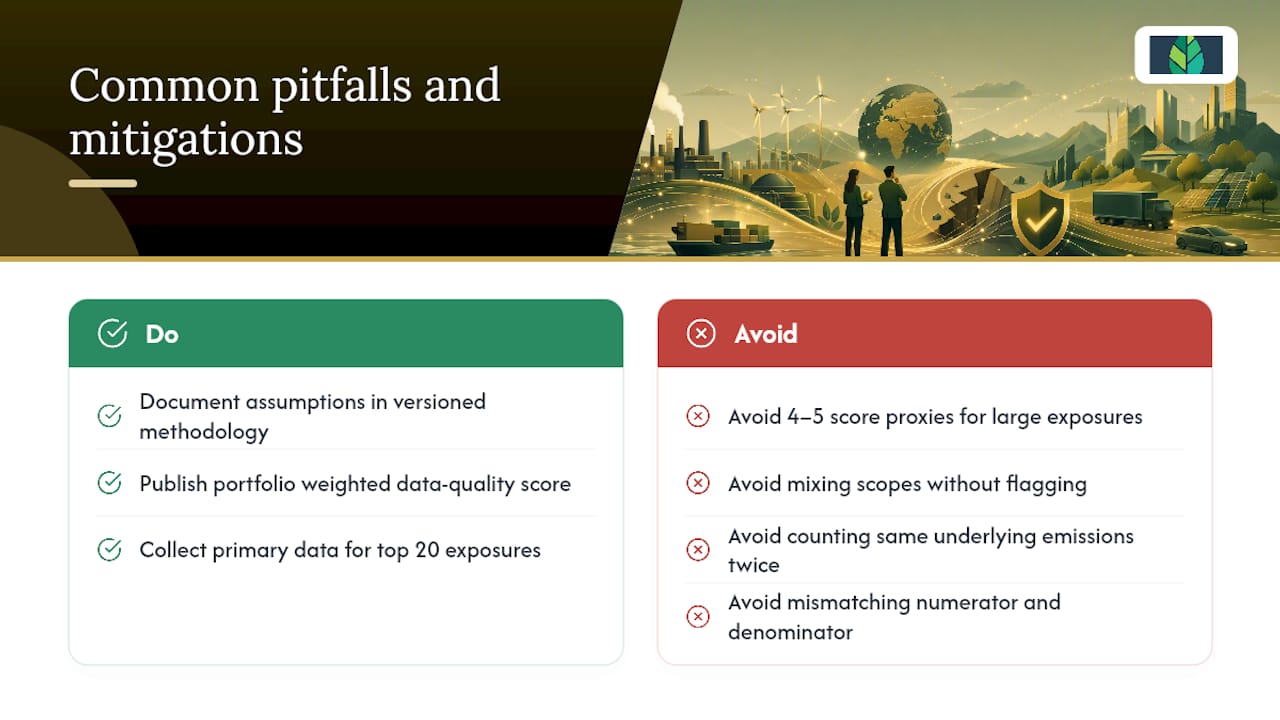
1. Data quality gaps. Using Score 4–5 proxies for large exposures inflates uncertainty and makes year-on-year comparisons unreliable. Prioritize primary data collection for your top 20 positions before worrying about the long tail.
2. Scope mixing. Including Scope 3 borrower emissions in some calculations but not others without flagging the inconsistency distorts portfolio totals. Document which scopes are included for each asset class and apply the same rule consistently.
3. Double counting. A loan and a bond to the same borrower, or a fund-of-funds structure, can result in the same underlying emissions being counted twice. Track ultimate borrower identity and apply netting rules where the same entity appears in multiple instruments.
4. Incorrect denominator. The most common attribution-factor error is mismatching the numerator and denominator: using market capitalization instead of EVIC for listed equity, or using book value of equity instead of total equity plus debt for business loans. HSBC's methodology documentation highlights this as a persistent source of error across large portfolios. Use EVIC consistently for listed equity and corporate bonds; use total equity plus debt for unlisted entities.
5. Inappropriate proxies. Revenue-based emission factors from EXIOBASE or similar databases can vary by a factor of three or more across sub-sectors. Applying a broad manufacturing average to a precision electronics manufacturer will overstate financed emissions significantly. Use the most granular sector code available.
6. Aggregating facilitated and financed emissions without disclosure. Part A (on-balance-sheet) and Part B (facilitated/underwriting) emissions must be reported separately. Combining them without explanation makes the total incomparable to peers and confuses stakeholders about what is actually being measured.
Three practical mitigations: Document every assumption in a methodology note that is version-controlled and reviewed annually. Publish your portfolio weighted average data-quality score alongside absolute totals. For your top 20 exposures, collect primary data directly from borrowers rather than relying on third-party estimates.
How do you build internal capability for financed emissions work?
Six-step pilot checklist
- Scope design. Define which asset classes are in scope for the pilot, which reporting year you are covering, and which GHG scopes you will include for borrower emissions.
- Data collection for top exposures. Pull financial exposure data from your loan management or portfolio system. Request Scope 1+2 emissions data directly from your top 20–50 counterparties.
- Calculation and QA. Apply PCAF attribution formulas by asset class. Assign a data-quality score to each exposure. Have a second analyst independently verify the top 10 calculations.
- Governance review. Present the draft baseline to the sustainability lead and CFO or CRO. Document methodology decisions and sign off on assumptions.
- Disclosure draft. Prepare a disclosure-ready summary: absolute financed emissions by asset class, portfolio weighted data-quality score, and a description of methodology and limitations.
- Iterate. Identify the three biggest data gaps from the pilot and build a plan to close them before the next reporting cycle.
Roles and responsibilities
| Role | Responsibility |
|---|---|
| Sustainability lead / ESG data team | Methodology ownership, calculation oversight, disclosure drafting |
| Quantitative / risk team | Attribution factor calculations, data QA, model documentation |
| Relationship managers / data owners | Collecting primary borrower emissions data |
| Legal / compliance | Disclosure review, regulatory monitoring |
| Internal audit | Sample testing, methodology review, assurance readiness |
Training is where most teams underinvest. Analysts running the calculations need fluency in PCAF formulas and data-quality scoring. Model owners need to understand denominator choices and their implications. Senior decision-makers need enough context to challenge assumptions and interpret portfolio-level totals in credit and allocation decisions. For sustainable finance project examples that show how teams have structured this work in practice, those case studies are a useful reference when designing your pilot.
The case for starting imperfect and improving fast
The institutions that have made the most progress on financed emissions did not wait for perfect data. They started with their top 20 exposures, used the best available proxies for the rest, published their data-quality scores transparently, and improved year on year. That approach is more credible to auditors and investors than a two-year delay in pursuit of complete primary data.
The more underappreciated point: a transparent, well-documented baseline with acknowledged limitations is a stronger foundation for engagement and target-setting than a polished number built on opaque assumptions. Counterparties respond better to a bank that says "we measured your contribution to our financed emissions at X tCO2e using your reported data, and here is what we are asking you to do about it" than to one that arrives with a black-box estimate. The measurement is not just a compliance exercise. It is the instrument that makes the conversation real.
Verdantinstitute training for financed emissions teams
Finance and ESG teams that need to operationalize this work quickly have a concrete skills gap to close: PCAF methodology, attribution factor mechanics, data-quality scoring, and disclosure alignment are not standard curriculum in most finance programs.

Verdantinstitute's sustainable finance and ESG training tracks cover exactly this ground, from foundational GHG accounting principles through to advanced portfolio decarbonization and net-zero strategy. Courses are structured for working professionals, with CPD tracking, completion certificates, and flexible subscription plans at $58/month for professionals. Teams can work through the Deep Dive and Advanced Practice tracks on financed emissions methodology, transition finance, and IFRS S2 disclosure at their own pace, with content updated to reflect the latest PCAF and regulatory developments. If your team is preparing for a first financed emissions pilot or scaling an existing process, explore Verdantinstitute's course library and find the track that fits your timeline.
Sources
- The Global GHG Accounting and Reporting Standard for the Financial Industry
- Banking beyond climate commitments (WRI)
- Key aspects of the Paris Agreement (UNFCCC)
This article is general information, not a substitute for advice from a qualified financial advisor. Consult a qualified financial professional about your own circumstances before acting on anything here.