

Impact investing is defined as deploying capital with the explicit intention to generate positive, measurable social and environmental outcomes alongside financial return, while ESG integration embeds environmental, social, and governance factors into investment analysis to manage sustainability risks and opportunities. These two approaches sit within the broader responsible investing spectrum, but the difference between impact investing and ESG integration is not semantic. It is structural, operational, and consequential for how you construct portfolios, report to stakeholders, and measure success. Frameworks from the GIIN, UN PRI, and the Impact Management Project (IMP) each draw this line clearly, and understanding where it falls is foundational for any finance professional working in sustainable finance today.
What are the core differences between impact investing and ESG integration?
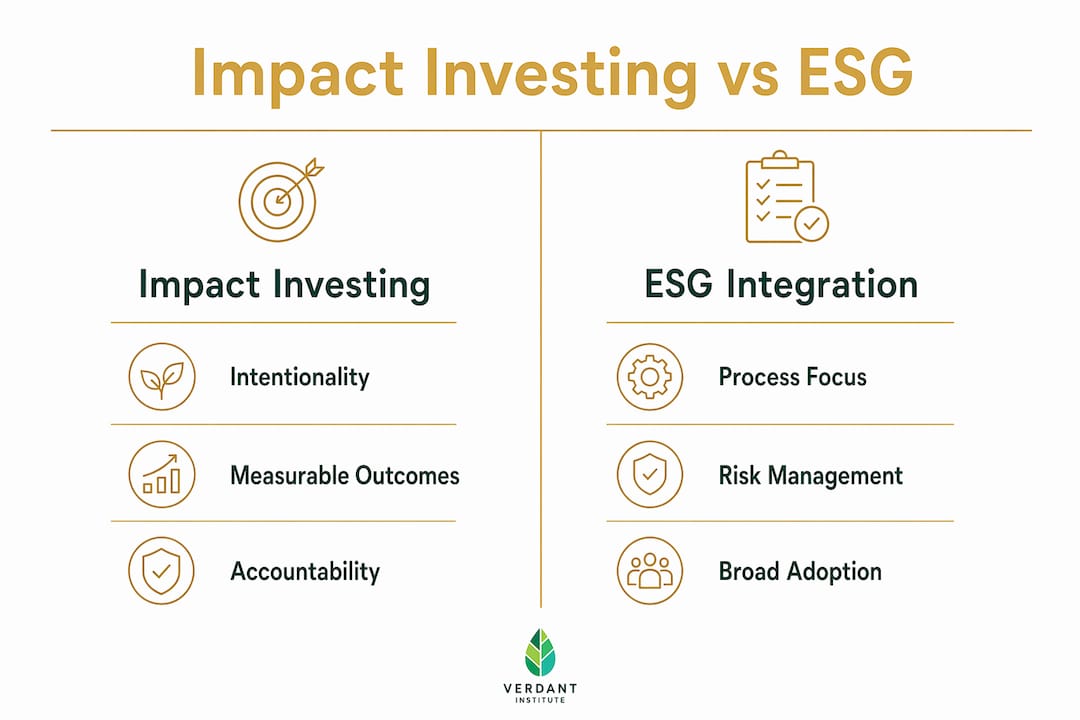
The sharpest dividing line is intent. Impact investing mandates intentionality, measurement, and delivery of financial return simultaneously. An impact investor does not simply screen out harmful companies or score them on ESG criteria. They select investments because those investments are expected to produce a defined positive outcome, and they build accountability structures to verify that outcome was achieved.

ESG integration, by contrast, is a risk and opportunity management discipline. UN PRI Principle 1 requires signatories to incorporate ESG factors into investment decision-making processes. The goal is better-informed financial analysis, not the delivery of a specified social or environmental result. A portfolio manager applying ESG integration may weight a company lower because of poor water management practices, but they are not contractually committed to improving water access in a target community.
The practical implications of this distinction are significant:
- Intentionality: Impact investing requires a documented theory of change linking capital deployment to specific outcomes. ESG integration requires incorporating ESG data into financial models.
- Measurement standard: Impact investing uses frameworks like IMP's five dimensions and IRIS+ metrics. ESG integration typically relies on third-party ESG scores, company disclosures, and risk-adjusted return analysis.
- Accountability: Impact funds often embed outcome targets in fund documentation and LP reporting. ESG-integrated portfolios report on ESG factor exposure, not outcome delivery.
- Asset class focus: Impact investing is most rigorous in private markets, where terms can be structured around outcomes. ESG integration applies across all asset classes, including public equities and fixed income.
"The sharpest dividing line between impact investing and ESG investing is the intent and measurement of real-world outcomes versus managing portfolio risk." — Morgan Lewis, Defining Impact Investing
Operating Principles for Impact Management Principle 4 mandates ex-ante impact assessment before capital is deployed, covering expected positive impact, beneficiaries, significance, and likelihood. No equivalent requirement exists within standard ESG integration frameworks. That asymmetry in upfront rigor is where the two strategies most visibly diverge.
How do measurement and accountability frameworks differ?
The IMP's five dimensions provide the most widely adopted structure for impact measurement. Each dimension addresses a distinct question: What outcomes are produced? Who experiences them? How much change occurs? What is the investor's contribution? What risks could cause impact to differ from expectations? IMP's five dimensions enable standardized impact measurement covering outcomes and contribution attribution, giving impact investors a common language for comparing and reporting results.
IRIS+, maintained by the GIIN, functions as the metric catalog that operationalizes IMP's framework. It provides standardized indicators across sectors, from affordable housing units delivered to metric tons of CO2 avoided, allowing fund managers to build comparable impact data sets across portfolios. This level of metric specificity has no direct equivalent in ESG integration, where data inputs vary widely by provider.
| Framework | Primary purpose | Measurement focus | Accountability mechanism |
|---|---|---|---|
| IMP five dimensions | Impact measurement and management | Outcomes, contribution, risk | Theory of change, progress monitoring |
| IRIS+ (GIIN) | Standardized impact metrics | Sector-specific output and outcome indicators | Comparable reporting across funds |
| UN PRI six principles | ESG integration in investment process | ESG factor exposure, stewardship | Annual reporting, signatory assessment |
| Operating Principles for Impact Management | Impact fund governance | Ex-ante and ex-post impact assessment | Independent verification |
Pro Tip: When evaluating an impact fund's credibility, ask specifically how they measure the Contribution and Risk dimensions of IMP. Even well-resourced teams struggle with these two dimensions, and vague answers signal weak impact discipline.
ESG integration frameworks, led by the UN PRI's six principles, focus on process rather than outcome. Signatories commit to incorporating ESG into analysis, engaging with investees on ESG issues, and reporting on their activities. The emphasis is on how investment decisions are made, not on what real-world changes result from them. This makes ESG integration broadly applicable but also easier to adopt superficially, which is a persistent challenge for the field.
What are the portfolio construction implications of each approach?
Choosing between these strategies, or deciding how to blend them, has direct consequences for portfolio construction. Impact investing places sustainable investment objectives at the strategy's core, with a clear theory of change and measurable progress against outcomes built into the investment underwriting process. ESG integration, by contrast, incorporates ESG factors as inputs to financial analysis, with the primary objective remaining risk-adjusted financial return.
Here is how that plays out across a typical decision-making sequence:
- Define investment objective. Impact investing starts with the impact thesis. ESG integration starts with the financial return objective, then layers in ESG factors.
- Screen the opportunity set. Impact investors apply positive screening for companies or projects delivering target outcomes. ESG integration typically uses negative screening, best-in-class selection, or ESG score thresholds.
- Conduct due diligence. Impact due diligence includes theory of change validation and baseline data collection. ESG due diligence assesses material ESG risks and their financial implications.
- Structure the investment. Impact funds in private markets can embed outcome milestones in term sheets. ESG-integrated strategies in public markets rely on engagement and voting to influence behavior.
- Monitor and report. Impact portfolios track outcome indicators against targets. ESG portfolios report on ESG score changes, engagement outcomes, and policy compliance.
The additionality question is particularly acute for listed equity impact strategies. Passive listed equity impact investments require additional methods like active engagement and long-term outcome monitoring to demonstrate real-world impact beyond the secondary market trade. Buying shares on a stock exchange does not directly finance a company's operations. Genuine impact in public markets requires active ownership, sustained engagement, and evidence that investor behavior influenced company outcomes.
PRI 2025 reporting data shows that 81% of PRI signatories identified specific sustainability outcomes and 70% acted on those outcomes. This signals that ESG integration strategies are increasingly adopting outcome orientation, but the clear accountability and intentionality that define impact investing remain the differentiating characteristic. The gap is narrowing in aspiration but not yet in operational rigor.
How are leading organizations evolving these practices?
The industry is moving, but unevenly. PRI 2025 data shows asset owners are more likely than managers to apply Paris Agreement alignment and climate scenario analysis, which reflects a structural difference in how ESG integration is operationalized across the investment chain. Asset owners set policy; managers execute it. When owners tighten oversight, managers face pressure to demonstrate more than process compliance.
Impact investing frameworks are responding to credibility concerns by building accountability into fund governance. The Operating Principles for Impact Management now require independent verification of impact management systems, not just self-reporting. Tools like the Actis Impact Score and the Lightrock Impact Scorecard represent proprietary attempts to systematize impact assessment at the portfolio company level, moving beyond IMP's conceptual framework into operational scoring.
| Practice area | Impact investing trend | ESG integration trend |
|---|---|---|
| Outcome measurement | Mandatory, ex-ante and ex-post | Increasing but voluntary |
| Contribution attribution | Required under IMP framework | Rarely addressed |
| Climate alignment | Embedded in impact thesis | Asset owner-driven, variable |
| Independent verification | Required by OPIM signatories | Emerging, not standard |
Pro Tip: If you are evaluating ESG integration strategies across managers, ask whether they distinguish between ESG risk management and outcome-oriented investing. Managers who conflate the two are likely operating at the lower end of the rigor spectrum.
The convergence trend is real but should not obscure the operational distance that remains. ESG integration is becoming more outcome-aware. Impact investing is becoming more scalable through listed market strategies. Neither is becoming the other. Finance professionals who treat them as interchangeable will find themselves unable to accurately represent what their portfolios are actually doing.
Key takeaways
Impact investing and ESG integration serve different purposes: impact investing delivers measurable outcomes by design, while ESG integration manages sustainability risk within financial analysis.
| Point | Details |
|---|---|
| Intent is the defining difference | Impact investing requires documented intentionality; ESG integration requires ESG factor incorporation into analysis. |
| Measurement rigor varies significantly | IMP's five dimensions and IRIS+ set a higher bar than standard ESG scoring or disclosure-based reporting. |
| Additionality matters in public markets | Listed equity impact strategies must use active ownership and outcome tracking to demonstrate real-world impact. |
| ESG strategies are becoming outcome-aware | 81% of PRI signatories identified specific sustainability outcomes in 2025, but impact discipline remains distinct. |
| Portfolio construction differs structurally | Impact investing embeds outcomes at the strategy core; ESG integration layers sustainability factors onto financial analysis. |
Why conflating these strategies costs you credibility
I have reviewed impact fund documentation where the theory of change was a single paragraph with no baseline data, no outcome indicators, and no measurement plan. The fund was marketed as impact investing. It was not. It was ESG integration with aspirational language attached, and the difference matters enormously when you are accountable to LPs, regulators, or beneficiaries.
The data infrastructure gap is the most underappreciated operational challenge in this space. Adopting IMP's framework conceptually is straightforward. Building the systems to consistently collect, score, and monitor impact data across a portfolio is not. Most teams I have seen track the What, Who, and How Much dimensions reasonably well. Contribution and Risk remain genuinely hard, and the teams that admit this are the ones doing real impact work.
My advice for finance professionals is direct: use ESG integration as your baseline practice across all strategies. It improves financial analysis and manages material risks. Reserve impact investing for mandates where you can genuinely commit to a theory of change, build measurement infrastructure, and report on outcomes with integrity. Blending the two without distinguishing them does not produce a stronger strategy. It produces a weaker version of both.
For those building impact investing strategies in listed markets, the additionality challenge is not a reason to avoid the asset class. It is a reason to invest in active ownership capabilities and long-term outcome monitoring. The firms doing this well are building genuine differentiation. The firms ignoring it are accumulating regulatory and reputational risk.
— Charles
Deepen your expertise with Verdant Institute
Finance professionals who need to move from conceptual understanding to operational competence in impact investing and ESG integration will find Verdant Institute's structured learning tracks built for exactly that transition.

Verdant Institute offers 16 courses and over 160 lessons covering ESG analysis, impact measurement, transition finance, and net-zero strategies, with CPD tracking and certifications included. The platform's Deep Dive and Advanced Practice tracks address the measurement frameworks, reporting standards, and portfolio construction decisions covered in this article. Professional plans start at $58/month. For finance teams and asset managers who need to build or verify their impact and ESG competencies, explore the full pricing options to find the plan that fits your team's development goals.
FAQ
What is the main difference between impact investing and ESG integration?
Impact investing requires intentional pursuit of measurable social or environmental outcomes alongside financial return, while ESG integration incorporates ESG factors into investment analysis to manage risk and identify opportunities. The key distinction is that impact investing is outcome-driven by design; ESG integration is process-driven.
Can a portfolio use both impact investing and ESG integration?
Yes, and many institutional portfolios do. ESG integration applies across the full portfolio as a baseline analytical discipline, while impact investing is applied to specific allocations where outcome measurement and accountability structures are in place.
What frameworks are used to measure impact investing outcomes?
The IMP's five dimensions (What, Who, How Much, Contribution, Risk) and GIIN's IRIS+ metric catalog are the primary frameworks. The Operating Principles for Impact Management also require ex-ante impact assessment and independent verification for signatory funds.
Why is additionality a challenge in listed equity impact strategies?
Buying shares on a secondary market does not directly finance a company's activities. Impact in listed equity requires active ownership, sustained engagement, and evidence that investor behavior influenced real-world company outcomes, which demands more operational infrastructure than a simple screening approach.
How are ESG integration strategies evolving toward impact?
PRI 2025 data shows 81% of signatories identified specific sustainability outcomes and 70% acted on them, indicating growing outcome orientation within ESG strategies. However, the structured intentionality, measurement rigor, and accountability mechanisms that define impact investing remain distinct from standard ESG integration practice.