

A well-constructed impact investing thesis separates disciplined portfolio management from well-intentioned guesswork. Yet most finance professionals encounter the same core problem: the impact investing market exceeds $1.5 trillion and growing, but impact investing thesis development remains poorly standardized across institutions. Vague mandates, unmeasurable outcomes, and governance gaps consistently undermine what could be credible, high-performing strategies. This guide gives you a framework that works, grounded in Theory of Change, IRIS+ metrics, and governance architecture designed for 2026 realities.
Table of Contents
- Key takeaways
- Impact investing thesis development: the foundational prerequisites
- Crafting a rigorous, evidence-backed impact thesis
- Common mistakes in developing an impact thesis
- Verifying, monitoring, and refining your thesis
- My take on what separates real impact theses from theater
- Continue building your impact investing expertise
- FAQ
Key takeaways
| Point | Details |
|---|---|
| Governance comes first | Define mandates, decision rights, and accountability before selecting any investment. |
| Theory of Change must be falsifiable | If your ToC cannot be tested or disproven, it functions as decoration, not strategy. |
| Metric discipline beats metric volume | Start with 8 to 15 core indicators per program; only expand with clear causal links to your ToC. |
| Weighted scoring creates consistency | Use a structured framework like Mission Fit, Organizational Soundness, and Strategic Value to remove subjective bias. |
| Measurement is a control mechanism | Integrate impact measurement from the start of thesis design, not as a reporting afterthought. |
Impact investing thesis development: the foundational prerequisites
Before you write a single line of your thesis, several structural elements must be in place. Skipping this groundwork is the fastest way to produce a thesis that looks credible but collapses under scrutiny.
Defining your impact mandate with precision
The first distinction to make is operational, not philosophical. Impact investing is not ESG integration and it is not socially responsible investing (SRI). ESG integration screens for risk. SRI filters out harm. Impact investing requires intentionality, measurability, and additionality. Your mandate must state, in explicit terms, which populations you are targeting, which outcomes you expect to generate, and what evidence standard you will accept as proof.
Without mandate clarity, authority, and measurement upfront, impact remains intention rather than institution. That distinction matters enormously when you are reporting to investment committees, LPs, or beneficiaries.
Governance structure: who decides what
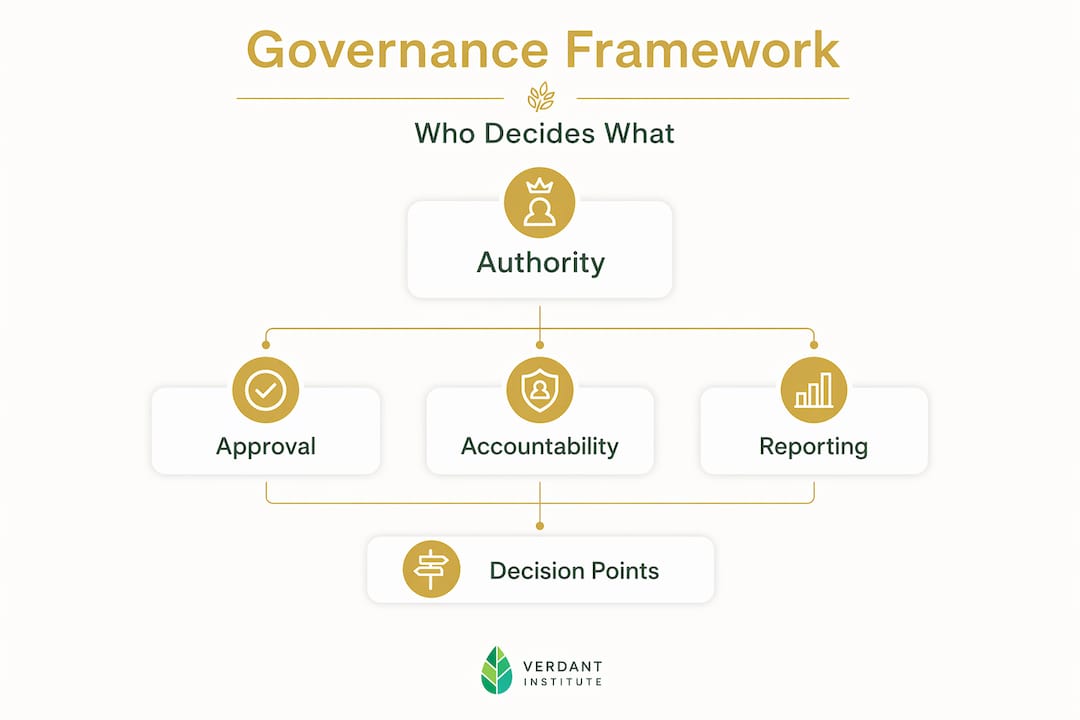
The governance framework answers three questions: Who has authority to approve impact investments? Who is accountable when impact targets are missed? How are tradeoffs between financial returns and impact outcomes resolved? Institutions that skip this step tend to produce impact strategies that are endlessly revised post-investment because no one agreed on the rules beforehand.
Measurement frameworks you need to know
Three frameworks form the backbone of any credible impact investing strategy:
- Theory of Change (ToC): Maps the causal pathway from inputs to outcomes, making assumptions explicit and testable.
- IRIS+: The GIIN's catalog of standardized metrics, now used by over 3,900 organizations globally, providing the core dimensions of WHO, WHAT, HOW MUCH, CONTRIBUTION, and RISK.
- Impact Management Project (IMP): Provides a portfolio-level classification system for understanding whether impact is being achieved for whom, and to what degree.
Aligning these frameworks with your organizational values and strategic priorities is not optional. It is the connective tissue between your mandate and your measurement.
Pro Tip: Before finalizing your governance structure, map each framework (ToC, IRIS+, IMP) to a specific decision point in your investment process. This prevents frameworks from becoming shelf documents.

Crafting a rigorous, evidence-backed impact thesis
With your foundations in place, you can build the thesis itself. This is where many practitioners rush, producing a thesis that reads well but cannot withstand investment committee scrutiny. The following sequence addresses that directly.
-
Define a falsifiable Theory of Change. A falsifiable ToC explicitly states target populations, causal mechanisms, and the assumptions that must hold true for the pathway to work. If you cannot articulate what evidence would prove the ToC wrong, you do not have a strategy. You have a diagram.
-
Select metrics aligned to IRIS+ core metric sets. Resist the pull toward proprietary or bespoke indicators. Standardized IRIS+ metrics allow for cross-portfolio comparability and signal credibility to co-investors. Select metrics that map directly to your ToC outcomes, not to what data happens to be available.
-
Build a weighted scoring framework. Scoring without weighting produces false neutrality. The Annie E. Casey Foundation's model offers a practical, replicable structure: Mission Fit at 50%, Organizational Soundness at 30%, and Strategic Value at 20%. The specific weights are less critical than the discipline of agreeing on them before deal review begins.
-
Embed measurement upfront as a control mechanism. Measurement is not reporting. It is the feedback loop that tells you whether your causal assumptions are holding. Integrate impact measurement into deal structuring, milestone definitions, and board reporting from day one.
-
Document your tradeoff policy explicitly. Families and institutions that define financial-impact tradeoffs in advance create more durable strategies. Decide whether you accept concessionary returns, under what conditions, and for which impact outcomes. This is not a philosophical exercise. It is a governance decision.
The following table shows how a weighted decision framework might look in practice:
| Criterion | Weight | What it evaluates |
|---|---|---|
| Mission fit | 50% | Alignment with stated impact mandate and target population |
| Organizational soundness | 30% | Management quality, financial health, operational capacity |
| Strategic value | 20% | Additionality, learning potential, co-investment leverage |
Pro Tip: Write your ToC assumptions as explicit "if-then" statements. Example: "If smallholder farmers receive training and inputs, then yield increases of 20% will occur within 18 months, assuming stable weather conditions." This format makes assumptions testable and review cycles productive.
Common mistakes in developing an impact thesis
Even experienced practitioners fall into patterns that erode thesis credibility. Knowing these pitfalls before you encounter them is a structural advantage.
-
Measurement paralysis. 97% of investors cite difficulty measuring impact as the primary barrier to growth. The most common cause is selecting too many indicators. Start with 8 to 15 core metrics and expand only when you have established causal links to your ToC.
-
Treating a logic model as a Theory of Change. A logic model describes inputs, activities, and outputs. A Theory of Change explains why those activities produce those outcomes. The difference is causal reasoning. Without it, you cannot learn from failure or replicate success.
-
Metrics disconnected from the Theory of Change. Selecting metrics that are easy to collect rather than causally linked to your ToC produces vanity data. If a metric does not answer a specific assumption in your causal chain, remove it.
-
Governance gaps on accountability. Many teams invest significant effort in thesis design but fail to assign accountability for impact performance. If no one is responsible for hitting impact targets, no one will be.
-
Misalignment between stated goals and measured outcomes. This is how greenwashing happens from the inside. If your thesis claims to improve financial inclusion but your metrics only capture loan disbursements rather than sustained access to credit, your measurement does not match your mandate.
"Combining multiple impact frameworks strategically produces credible impact evidence. Using them in isolation invites the exact pitfalls practitioners spend months trying to avoid."
Verifying, monitoring, and refining your thesis
A thesis is a living document. The most credible impact investors treat thesis refinement as a structured discipline, not an annual checkbox.
-
Establish structured review cycles. Set formal intervals, typically quarterly for portfolio-level monitoring and annually for thesis-level review, to assess whether your ToC assumptions still hold. Create an impact reporting dashboard that surfaces deviations early, not at exit.
-
Use a layered measurement architecture. A layered reporting structure balances portfolio-level overview with program-specific detail and causal validation. IMP handles the strategic overview. IRIS+ drives program-level metrics. Your ToC review handles causal validation. Each layer serves a distinct function.
-
Commission external validation. Internal measurement has inherent limitations. Third-party impact audits, even lightweight annual reviews, signal credibility to LPs and co-investors, and they force documentation standards that tend to slip in internally managed processes. Explore how sustainable investing frameworks apply to audit and verification approaches.
-
Manage impact risk explicitly. Just as financial risk has categories (market, credit, liquidity), impact risk includes measurement risk, execution risk, and external risk. Document these explicitly in your thesis and update them at each review cycle.
-
Feed learnings back into capital allocation. Leading impact investors reject the notion that impact requires financial sacrifice. The refinement cycle is where you identify which investments are generating both strong returns and strong impact, and weight future capital toward those patterns.
| Monitoring layer | Framework used | Primary question answered |
|---|---|---|
| Portfolio overview | IMP | Are we allocating to the right impact categories? |
| Program-level tracking | IRIS+ | Are specific outcomes being achieved at scale? |
| Causal validation | Theory of Change | Are our assumptions about causality holding true? |
Pro Tip: At each annual thesis review, require every assumption in your ToC to be rated: confirmed, uncertain, or disproven. This forces honest conversation and prevents the natural tendency to declare progress when the data is ambiguous.
My take on what separates real impact theses from theater
I have reviewed enough impact theses across institutions to recognize a pattern: the weakest ones were written by people who understood impact. The strongest ones were built by people who understood governance.
That distinction is not semantic. When impact sits inside an investment team as a value overlay, it tends to drift. When it is embedded as a governance discipline, with clear mandates, defined accountability, and measurement built into the investment structure itself, it becomes durable. I have seen organizations spend six months refining their Theory of Change and then fail to assign a single person accountability for tracking outcomes post-close. The thesis becomes fiction before the ink is dry.
The other thing I have learned: embedding impact incentives into financial structures shifts the entire orientation from screening to strategy. That is the architecture worth building toward.
Upfront work is not glamorous. But it is the only thing that separates a credible impact investing strategy from a well-formatted intentions document. Build the governance first. Let the thesis follow.
— Charles
Continue building your impact investing expertise
If you are working through your first formal impact thesis or refining a framework that has outgrown its original design, structured learning accelerates the process considerably. Verdant Institute offers courses built specifically for finance professionals navigating the technical depth of impact measurement, Theory of Change design, and ESG integration.

The course library at Verdant Institute covers impact investing strategy, measurement frameworks, and advanced ESG topics across 16 structured courses and more than 160 lessons. CPD tracking and certifications are included, which matters when you are presenting credentials to investment committees or institutional clients. Whether you are developing an impact thesis for the first time or building institutional-grade systems, you can review available learning plans and pricing to find the structure that fits your role and timeline.
FAQ
What is an impact investing thesis?
An impact investing thesis is a formal document that defines a fund's or investor's specific impact mandate, causal logic (Theory of Change), target outcomes, measurement approach, and decision-making criteria for selecting investments.
How do I start developing an impact thesis?
Start by defining your impact mandate precisely, then build a governance framework that assigns authority and accountability before selecting any measurement approach or drafting investment criteria.
What frameworks are used in impact investment analysis?
The three most widely used frameworks are Theory of Change for causal logic, IRIS+ for standardized outcome metrics, and the Impact Management Project (IMP) for portfolio-level classification and oversight.
How many metrics should an impact thesis include?
Start with 8 to 15 core indicators per program, selected for direct causal links to your Theory of Change. Expanding beyond this without clear justification typically leads to measurement paralysis rather than better insight.
What is the difference between impact investing and ESG investing?
ESG investing integrates environmental, social, and governance risk factors into financial analysis. Impact investing requires intentional targeting of specific social or environmental outcomes, with measurable evidence of additionality, going beyond risk screening.