

A nature risk assessment is a structured process that connects your portfolio's exposure to biodiversity loss and ecosystem degradation to concrete financial outcomes. The operational standard is the TNFD's LEAP framework — Locate, Evaluate, Assess, Prepare — which takes you from identifying where your holdings interact with nature to embedding findings in enterprise risk management and disclosure.
Start here: run a portfolio-level heatmap using the WWF Biodiversity Risk Filter or sector-plus-location proxies to identify hotspots before committing to deeper analysis. That first pass costs days, not months, and tells you where to focus.
Key starting points:
- Locate portfolio assets by geography and sector using existing holdings data
- Screen with WWF BRF or ENCORE for dependency and impact hotspots
- Prioritize using TNFD criteria: magnitude, likelihood, vulnerability, speed of onset
- Translate ecological findings into financial metrics — PD, LGD, Expected Loss
- Embed outputs into existing ERM registers and disclosure workflows
NGFS guidance and Verdantinstitute both recommend this iterative sequence: screen widely, prioritize ruthlessly, then apply resource-intensive methods only where materiality demands it.
Key Takeaways
A TNFD-LEAP nature risk assessment runs from portfolio heatmapping through asset tagging to scenario-based PD/LGD quantification, embedded in existing ERM and disclosure workflows.
| Point | Details |
|---|---|
| Start with a heatmap | Use WWF BRF or ENCORE proxies to screen the full portfolio before committing deeper resources. |
| Prioritize via TNFD criteria | Rank exposures by magnitude, likelihood, vulnerability, and KBA proximity to focus asset tagging. |
| Translate to financial metrics | Map every ecological finding to PD, LGD, or Expected Loss before presenting to a risk committee. |
| Embed in ERM, not a silo | Integrate outputs into existing risk registers, ICAAP/ORSA, and capital allocation processes. |
| Verdantinstitute builds the skills | Structured learning tracks cover TNFD methodology, scenario design, and ERM integration for finance teams. |
Table of Contents
- Why does nature risk matter to financial professionals?
- How does the LEAP framework work in practice?
- Which assessment method should you use?
- What data sources and tools should you use?
- How do you integrate nature risk into ERM and financial metrics?
- What does a portfolio-level assessment workflow look like?
- Your 90-day checklist to move from screening to action
- Why training and capacity matter more than perfect data
- Verdantinstitute's training for TNFD-aligned assessments
- Sources
Why does nature risk matter to financial professionals?
Nature loss transmits to portfolios through three channels: physical risk (ecosystem service disruption affecting revenues and operating costs), transition risk (policy and market shifts repricing nature-dependent assets), and reputational risk (stakeholder and regulatory pressure). A farm dependent on pollination, a water utility drawing from a degraded watershed, a manufacturer sourcing from deforested supply chains — each faces measurable exposure that flows through to credit quality and asset values.
TNFD has emerged as the practical disclosure and assessment standard, mirroring TCFD's architecture while adding location-based specificity that climate frameworks lack. NGFS has flagged nature-related risks as having systemic implications, noting that the climate-nature nexus creates compounding, non-linear dynamics that static credit models miss.
Statistic: The NGFS information note on nature-related data highlights that nature and climate risks interact through time-series dynamics, meaning assessments built on single-point-in-time data systematically understate exposure.
Supervisory attention is rising. U.S. financial regulators and global central banks are increasingly incorporating biodiversity risk into climate-related financial risk frameworks, and TNFD-aligned disclosures are moving from voluntary to expected practice for institutional investors and lenders.
Key transmission channels to track:
- Revenue disruption from ecosystem service loss (water, pollination, soil fertility)
- Operating cost increases from resource scarcity or regulatory compliance
- Asset value impairment in nature-dependent sectors (agriculture, forestry, mining, real estate)
- Insurance cost escalation and coverage gaps in high-exposure geographies
- Cost of capital increases as lenders and investors price nature-related risk
How does the LEAP framework work in practice?
The TNFD LEAP approach structures a nature risk assessment into four sequential, iterative phases. Here is how each phase translates to portfolio and corporate workflows.
-
Locate — Map where your portfolio interacts with nature. Minimum inputs: holdings with country or site granularity, sector codes (GICS or NACE), and high-level production or land-use metrics. Flag assets in or near Key Biodiversity Areas (KBAs), protected areas, or water-stressed basins.
-
Evaluate — Identify dependencies and impacts by sector using ENCORE for materiality guidance and IBAT for site-level biodiversity context. This phase produces a dependency-impact matrix: which sectors rely on which ecosystem services, and where impacts are most significant.
-
Assess — Apply the three methods (heatmap, asset tagging, scenario analysis) and prioritize using TNFD criteria: magnitude of potential impact, likelihood, vulnerability of the ecosystem, speed of onset, and location-based specificity. The TNFD annex on assessment methods recommends deploying these iteratively — screen first, then deepen only where prioritization flags material exposure. Map outputs to financial risk categories and parameters (PD, LGD, EL).
-
Prepare — Design responses: engagement strategies, portfolio adjustments, and disclosure aligned to TNFD metrics. Embed findings into existing ERM registers, capital allocation discussions, and board reporting.
Pro Tip: Don't run all three assessment methods across your entire portfolio at once. Use heatmaps to triage, then apply asset tagging and scenario analysis only where the Assess phase confirms material exposure. This keeps the project manageable and produces decision-ready outputs faster.
Which assessment method should you use?
The TNFD annex defines three complementary methods. Choosing the right one depends on your data availability, portfolio concentration, and the decision you need to support.
| Method | Best Use Case | Key Inputs | Outputs | Resource Intensity |
|---|---|---|---|---|
| Heatmapping | First-pass screening for all portfolios | Sector codes, coarse location, spatial proxies | Portfolio exposure by sector/geography, hotspot flags | Low |
| Asset tagging | Engagement, due diligence, priority assets | Asset-level IDs, geolocation, exposure metrics | Asset-level dependency/impact scores, KBA proximity | Medium |
| Scenario analysis | High-value or concentrated exposures | Modeled pathways, financial parameters, time series | PD/LGD/EL adjustments, stress-test ranges | High |
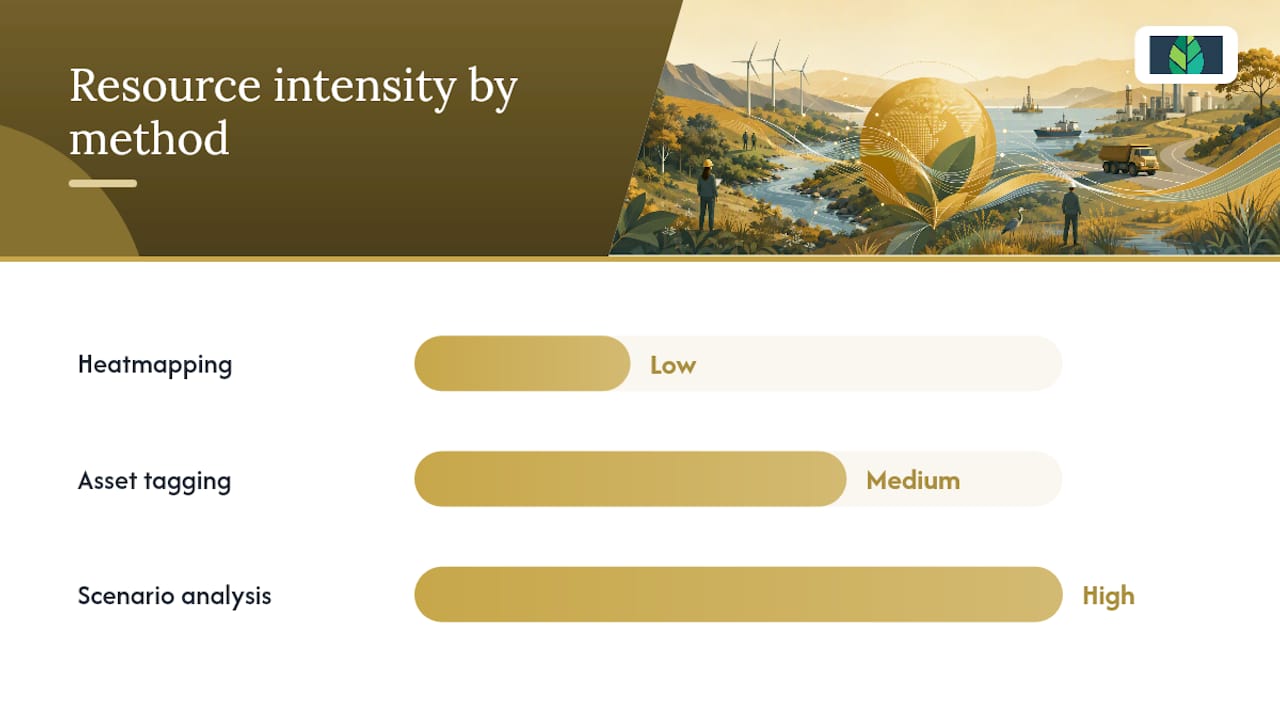
Heatmapping is the right starting point for any portfolio. It uses sector-level materiality ratings combined with coarse geographic data to flag where nature-related exposure is likely highest. Outputs are qualitative but sufficient to prioritize the next step.
Asset tagging requires geolocated asset data and business-importance weighting. It produces asset-level scores that support direct engagement with portfolio companies and underpin due diligence for new investments. The limitation: it depends on company-sourced data that is often incomplete or inconsistently reported.
Scenario analysis is where biodiversity impact assessment connects directly to financial stress testing. It links ecosystem degradation pathways to revenue shocks, operating cost increases, and ultimately to changes in PD and LGD. Data and modeling needs are significant, and integrated biodiversity risk modeling shows that static scenarios miss the dynamic, climate-nature interactions that drive the most severe outcomes. Reserve this method for your highest-value or most concentrated exposures.
What data sources and tools should you use?
The toolkit for a nature risk assessment spans free screening tools, commercial spatial databases, and sector-specific guidance. Each serves a different phase of LEAP.
- WWF Biodiversity Risk Filter: Free, web-based screening tool covering physical, regulatory, and reputational risk. Uses approximately 70 indicators and many global datasets for biodiversity importance and integrity. Best for portfolio-level heatmapping and company screening in the Locate and Evaluate phases.
Data limitations are real. Spatial granularity varies significantly across geographies; temporal coverage is often inconsistent; and company-reported data for asset tagging remains patchy. NGFS recommends combining multiple datasets to cover gaps and using proxies pragmatically for initial screening, reserving primary data collection for prioritized assets. Document every assumption and data quality decision — disclosures will require it.
Pro Tip: When biodiversity data are fragmented, prioritize land-use change metrics as proxies for transition risk. They are widely available, directly link to financial stress scenarios, and satisfy early-stage disclosure requirements.
How do you integrate nature risk into ERM and financial metrics?
Assessment outputs only create value when they change a financial decision. The TNFD guidance explicitly recommends mapping nature-related findings to existing risk taxonomies and financial parameters rather than creating parallel processes.
Mapping outputs to financial risk categories:
| Nature Risk Type | Financial Risk Category | Financial Parameter Affected |
|---|---|---|
| Ecosystem service disruption | Credit risk | PD increase, LGD increase |
| Regulatory/policy shift | Market risk | Asset repricing, spread widening |
| Supply chain disruption | Operational risk | Revenue volatility, cost escalation |
| Reputational exposure | Underwriting risk | Premium increases, coverage gaps |
Worked example: A heatmap flags a mid-market agricultural lender with a significant portion of its loan book in water-stressed, pollinator-dependent crop sectors. Asset tagging confirms three borrowers with operations adjacent to KBAs. That output goes directly into the credit risk register and informs the next annual review cycle.
Governance checklist:
- Assign ownership: risk lead holds the assessment; ESG specialist owns data pipelines; portfolio manager owns engagement
- Set escalation triggers: any asset with high dependency scores or KBA proximity above a defined threshold escalates to the risk committee
- Frequency: full heatmap annually; asset tagging and scenario updates for priority assets semi-annually
- Integration points: risk register, ICAAP/ORSA, capital allocation committee, and TNFD disclosure report
The TNFD metrics supplement identifies four metric categories for financial institutions: dependencies, impacts, risks, and opportunities. Tracking all four produces a disclosure-ready dataset and supports ESG integration across investment processes.
What does a portfolio-level assessment workflow look like?
| Phase | Timeline | Core Activities | Responsible Roles |
|---|---|---|---|
| Scoping and Locate | Weeks 0–4 | Define scope, gather holdings data, run initial geographic/sector mapping | Risk lead, data analyst |
| Evaluate and heatmapping | Weeks 4–6 | ENCORE dependency mapping, WWF BRF screening, hotspot identification | ESG specialist, data analyst |
| Asset tagging (priorities) | Weeks 6–12 | Geolocate priority assets, collect company data, score dependencies/impacts | Portfolio manager, ESG specialist |
| Scenario analysis | Week 16+ | Model financial impacts for highest-risk exposures, PD/LGD/EL adjustments | Risk lead, external modeler |
Minimum inputs required:
- Portfolio holdings with country or site-level granularity
- Sector codes (GICS, NACE, or equivalent) for all holdings
- High-level production or land-use metrics for material sectors
- Supplier lists for supply chains flagged as material in ENCORE
- Legal/stakeholder liaison for regulatory and community engagement
External inputs worth commissioning: a spatial data provider for IBAT access, and a scenario modeling partner for the Week 16+ phase if in-house capacity is limited.
Your 90-day checklist to move from screening to action
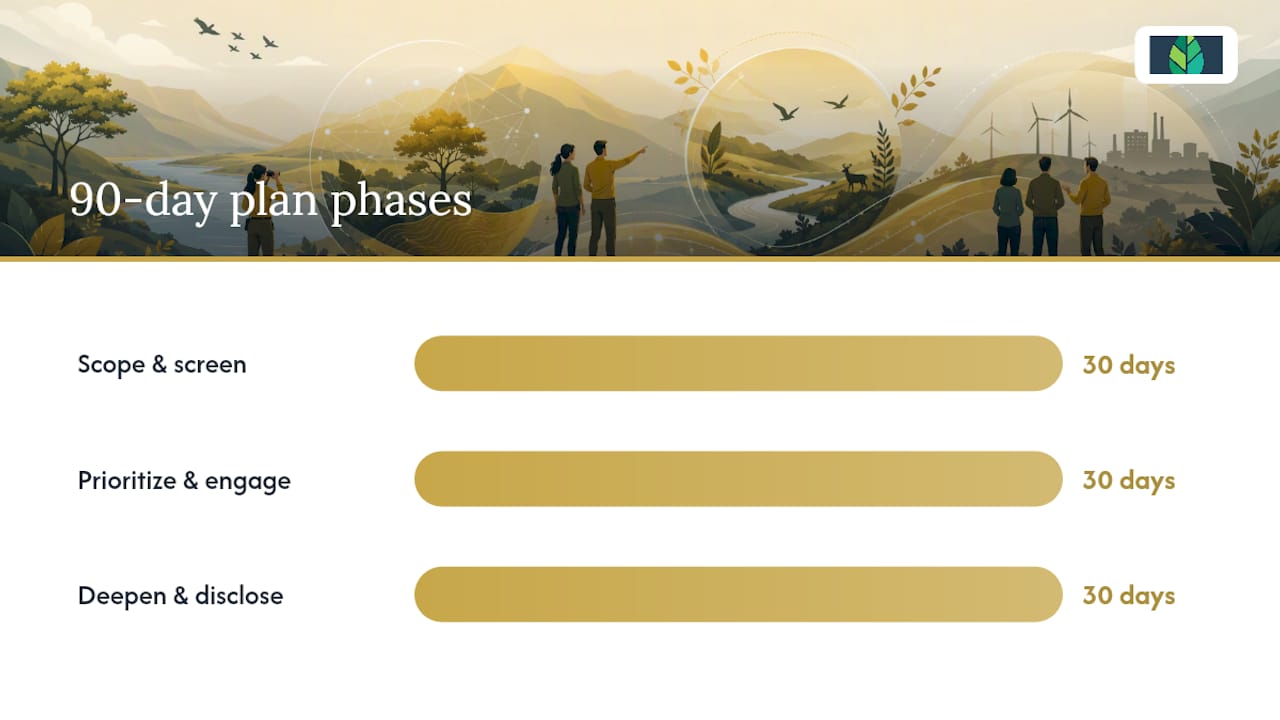
Days 1–30: Scope and screen
- Define portfolio scope and data availability
- Run WWF BRF heatmap across full portfolio
- Flag sectors with high ENCORE dependency ratings
- Identify geographic concentrations near KBAs or protected areas
- Decision rule: if more than 20% of AUM sits in high-dependency sectors, escalate to asset tagging
Days 31–60: Prioritize and engage
- Rank exposures by TNFD criteria (magnitude, likelihood, vulnerability)
- Initiate data collection from portfolio companies for priority assets
- Engage legal and stakeholder liaison for regulatory and community considerations
- Report preliminary findings to risk committee with hotspot map
Days 61–90: Deepen and disclose
- Complete asset tagging for top-priority exposures
- Draft initial TNFD-aligned disclosure narrative
- Decision rule: if any asset scores high on both dependency and KBA proximity, commission scenario analysis
- Present findings to board with PD/LGD implications and proposed ERM integration steps
Stakeholder engagement belongs in every phase, not just at the end. Local knowledge from communities, regulators, and NGOs often surfaces material risks that spatial datasets miss entirely. The role of NGOs in ESG finance is particularly relevant here — tools like WWF BRF exist precisely because of that NGO-finance collaboration.
Why training and capacity matter more than perfect data
The most common failure mode in nature risk assessment is not bad data. Teams stall because they lack the skills to translate ecological outputs into financial language, or because governance structures were not designed to absorb a new risk category.
Waiting for perfect spatial data before starting is a mistake. The NGFS and TNFD both recommend beginning with proxies and iterating. What actually determines whether an assessment produces a decision is whether the team can connect a biodiversity hotspot flag to a PD adjustment and present it to a credit committee in terms they recognize.
Three pitfalls to avoid: treating the heatmap as the deliverable rather than the starting point; under-resourcing stakeholder engagement until it becomes a compliance checkbox; and building nature risk as a siloed ESG project rather than embedding it in existing ERM and banking risk frameworks.
Pro Tip: Prioritize three training areas in this order: data pipeline literacy (knowing which tool to use when), scenario design for nature-climate interactions, and stakeholder engagement for local knowledge integration. Teams that build these skills in sequence move from heatmap to board-ready disclosure in a single assessment cycle.
Verdantinstitute's training for TNFD-aligned assessments
Finance teams that complete a nature risk assessment for the first time consistently report the same gap: the methodology is clear, but translating outputs into financial metrics and board-level disclosure requires skills that most risk and ESG teams have not yet built.
Verdantinstitute's structured learning tracks cover TNFD-aligned assessment methodology, biodiversity impact assessment, scenario design, and ERM integration — built specifically for risk managers, portfolio managers, and sustainability leads. With CPD tracking, completion certificates, and institutional licensing for teams, it is the most direct path from reading this guide to running your own assessment with confidence. Professional plans start at $58/month; institutional licensing is available for finance teams and universities.
Start with Verdantinstitute's sustainable finance training and build the capacity to move from heatmap to disclosure in a single assessment cycle.
Sources
- Taskforce on Nature-related Financial Disclosures (TNFD) — LEAP framework
- NGFS — Information note on nature-related data (April 2026)
- WWF Biodiversity Risk Filter — methodology document
This article is general information, not a substitute for advice from a qualified financial advisor. Consult a qualified financial professional about your own circumstances before acting on anything here.