
Finding ESG training courses that provide recognized credentials and regionally relevant content is harder than expected. Several ESG education options hide pricing, require instructor approval for access, or lack practical certification tracks for both students and working professionals. This comparison shows course scope, credential value, and access details across five alternatives so finance professionals and sustainability officers can fit training to their needs.
Table of Contents
- Verdant Institute
- ESG Academy
- The ESG Institute
- International Institute for Sustainable Finance (IISF)
- CASI (Capacity-building Alliance of Sustainable Investment)
- Comparison of alternatives
Verdant Institute
At a Glance
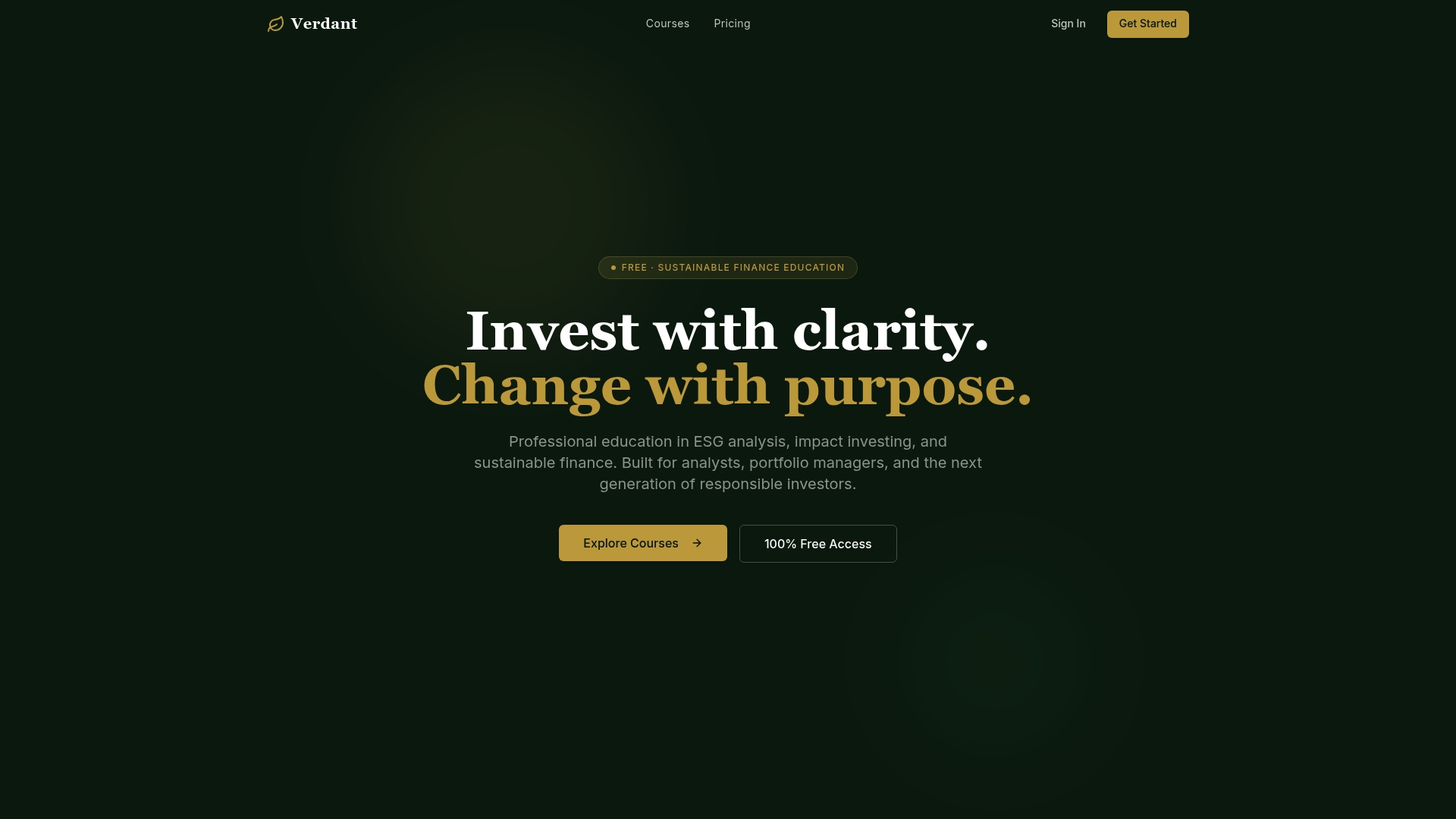
Verdant Institute lists 16 courses and 160+ lessons across structured learning tracks. The platform tracks CPD hours and issues ESG and sustainable finance certification for course completion. During its early access phase, full course access is available at no charge.
Core Features
The platform organizes material into four learning tracks: Academic Foundations, Foundations for beginners, Deep Dives, and Advanced Practice. It includes CPD hours tracking, certificates on completion, and courses aimed at both entry level and advanced portfolio strategies. Course content covers practical and theoretical elements of ESG, impact investing, and transition finance topics.
Key Differentiator
Verdant Institute’s defining strength is a single curriculum path that serves students and working professionals with free early access and formal CPD tracking. The curriculum pairs foundation modules with advanced practice topics such as transition finance and net-zero strategies. That structure supports credentialing while allowing learners to progress from basics to specialist topics.
Pros
The platform makes continuing education measurable by recording CPD hours and issuing certificates that professionals can add to training records. Free access during early access lowers the barrier for students and junior analysts to gain baseline competency in sustainable finance. Course design credits industry input, so lessons mix theory with examples relevant to impact investing and portfolio management.
Cons
- Independent user reviews are limited, so outside assessments of long term content quality are scarce.
Who It's For
Students preparing for careers in sustainable finance will find a clear, creditable entry path. Analysts and portfolio managers who need refresher modules or certification for CPD records can use the platform to document learning. The offering also fits universities that want plug in modules for ESG coursework.
Unique Value Proposition
Student plans start at $18/month and professional plans at $58/month after early access, making formal certification relatively affordable compared with bespoke corporate training. That pricing lets teams budget predictable training costs while individuals secure CPD credit and certificates. Organizations can adopt the platform without committing to high custom development or expensive instructor time.
Real World Use Case
A university integrates Verdant Institute modules into an ESG elective and assigns the Academic Foundations track to undergraduates. Students log CPD hours and receive certificates that show competency on graduation. Separately, a midcareer analyst completes Advanced Practice lessons on transition finance to support a firm’s net-zero portfolio review.
Pricing
Full access is free during early access. Afterward, the vendor lists student plans from $18/month and professional plans from $58/month. The platform uses subscription pricing rather than per-course purchases.
Website: https://verdantinstitute.com
ESG Academy
At a Glance
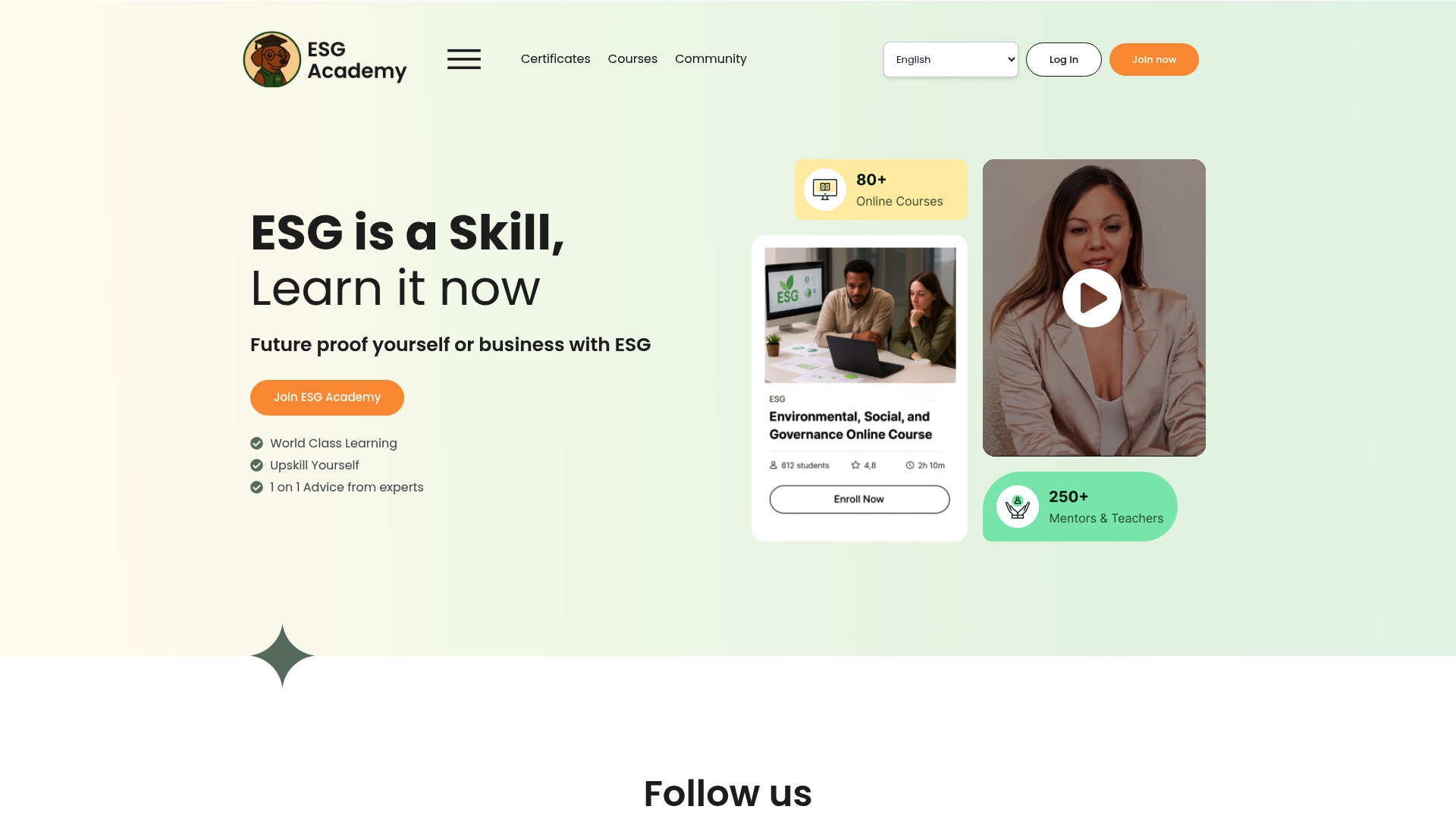
Access to top courses starts at €34/month. ESG Academy says its certifications and digital badges are recognized by employers. The platform was founded by Francine Carron and focuses on practical courses across environmental, social, governance, and sector specific topics. Free trainings and templates are available alongside paid certifications.
Core Features
ESG Academy delivers structured online courses arranged by expertise level, with certification tracks and digital badges for course completion. The site includes community support through discussion groups and mentorship, plus free resources such as templates, checklists, and tools. Corporate teams can order tailored training programs for different regions and industries.
Key Differentiator
The platform’s stated aim is to democratize ESG education through practical, accessible courses and a global community. That recognition claim and the mix of free materials plus paid certification sets it apart from short free tutorials. The focus on corporate customization and region specific cohorts targets teams preparing for reporting or policy changes.
Pros
ESG Academy combines accessible pricing and modular learning so individuals can pace study while keeping budget control. The platform supports career progression with certifications and digital badges that the vendor claims employers recognize. Community support and mentorship help learners stay engaged, and free resources reduce onboarding time for company training projects. Corporate training options let managers align staff learning to internal reporting goals.
Cons
- Limited in depth specialization compared to university degree programs.
- Learning progress depends on self motivation and discipline from each learner.
- Some courses and advanced resources require subscription or membership access.
When It May Not Fit
Large enterprises needing accredited academic credits or deep, research heavy specializations should look elsewhere. Teams that need synchronous instructor led programs with formal university credit will find the platform too lightweight. If your organization requires proctored exams or sector specific professional licensure, ESG Academy may not meet those requirements.
Who It's For
Learners new to ESG and sustainability professionals seeking practical upskilling benefit from the course structure and certificates. Small business owners and corporate teams preparing for ESG reporting can use the templates and tailored training. The platform fits people transitioning careers who need employer facing credentials rather than academic degrees.
Real World Use Case
A sustainability officer completes a certification pathway and then applies templates to build a first year emissions inventory and stakeholder engagement plan. A small business owner uses the training modules and checklists to map compliance steps ahead of an expected regulatory filing.
Pricing
Access to top courses starts from €34/month for individual learners. Corporate training is quoted separately and varies with cohort size and customization. Free trainings and some resources remain available without a paid plan.
Website: https://esgacademy.education
The ESG Institute
At a Glance
The ESG Institute reports a 4.9/5 customer rating. The institute also says it has trained thousands of professionals across numerous countries. Those claims underline a strong peer reputation for certification and corporate training within the sustainability community.
Core Features
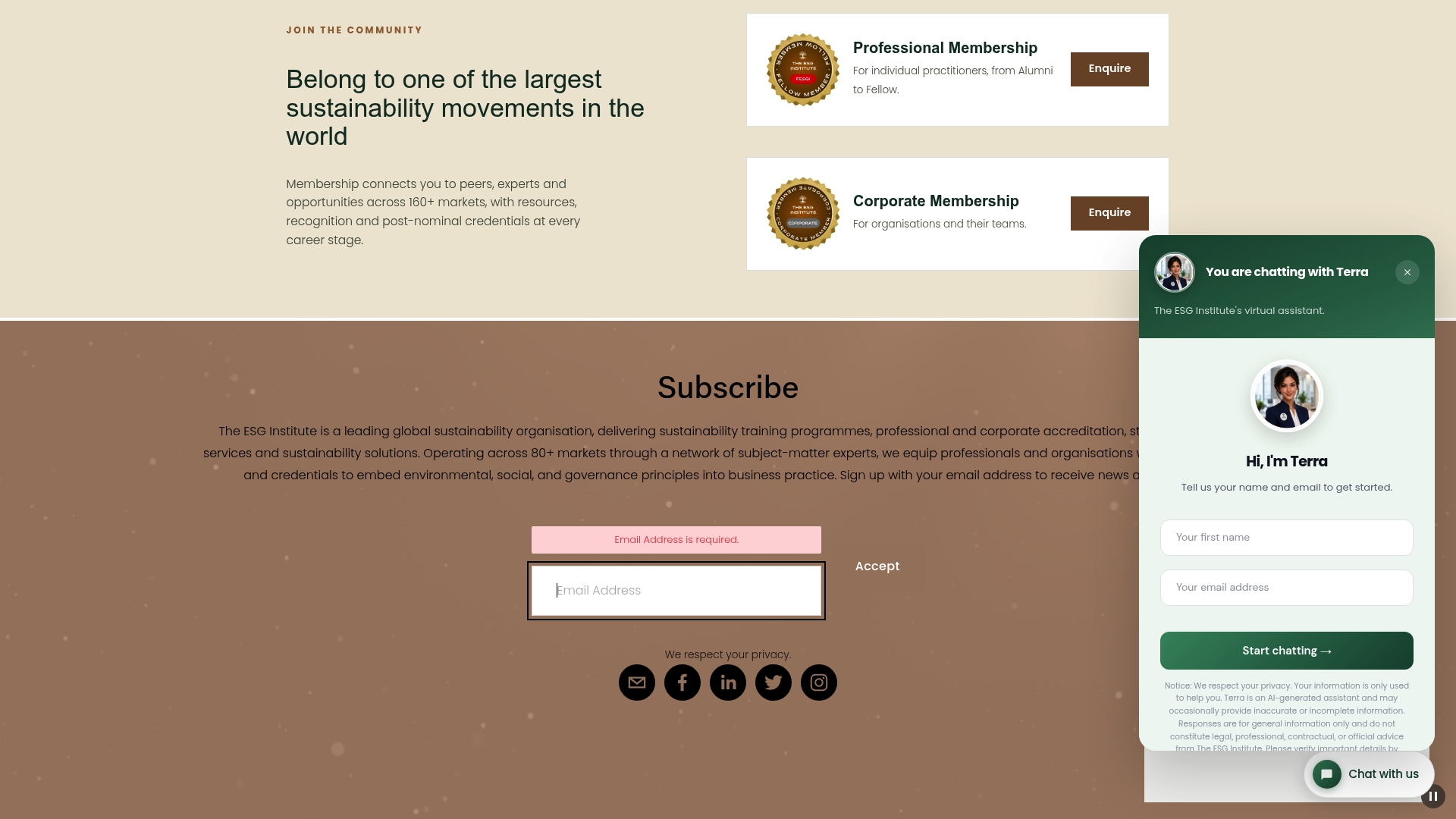
The community offers CPD-accredited training programs, recognition and accreditation for sustainability professionals, and corporate advisory services that pair training with organizational assessments. Members can access sustainability certification, educational program accreditation, and free benchmarking tools that help begin an ESG review. The platform mixes individual credentialing and institutional validation in one ecosystem.
Key Differentiator
The ESG Institute centers its offer on a global expert network supporting CPD-accredited credentials and practical advisory work. That combination targets both individual career development and corporate validation rather than only offering classroom courses or standalone certificates. The institute positions accreditation and organizational certification as linked services backed by expert collaboration.
Pros
The institute maintains a broad global network of subject matter professionals and trainers. That reach helps corporate teams find advisors who understand local compliance and reporting practices. The mix of individual credentials and institutional certification supports career progression and organizational credibility at the same time. Free tools lower the barrier for a first assessment and provide a clear entry point before investing in paid services.
Cons
- Pricing details are not listed, which makes budgeting difficult for teams planning multi‑country rollouts. A clear published price structure is absent.
- The offering lacks public detail on specific technical integrations or learning platform features. Buyers needing LMS connectivity or single sign on will need to ask directly.
- The site does not present a detailed comparison of training packages or certification levels. That makes side‑by‑side evaluation harder for procurement teams.
When It May Not Fit
Organizations that need transparent, line‑item pricing or standard platform integrations may find this offering a poor match. Teams requiring an LMS or HRIS connection should confirm technical compatibility before committing. Small teams with limited budgets might prefer providers that publish fixed prices and modular course bundles.
Who It's For
Professionals seeking recognized sustainability credentials and continuing professional development will find this community relevant. Corporate ESG teams that want accredited training combined with organizational certification will benefit from the institute’s advisory focus. Educational institutions looking to adopt sustainability standards and accreditation also match this profile.
Real World Use Case
A multinational invited The ESG Institute to run executive workshops and certify its sustainability reporting function. The company used the institute’s free benchmarking tools to map gaps and then booked a tailored corporate training program. The certification then served as external validation in the company’s investor reporting.
Website: https://the-esg-institute.org
International Institute for Sustainable Finance (IISF)
At a Glance
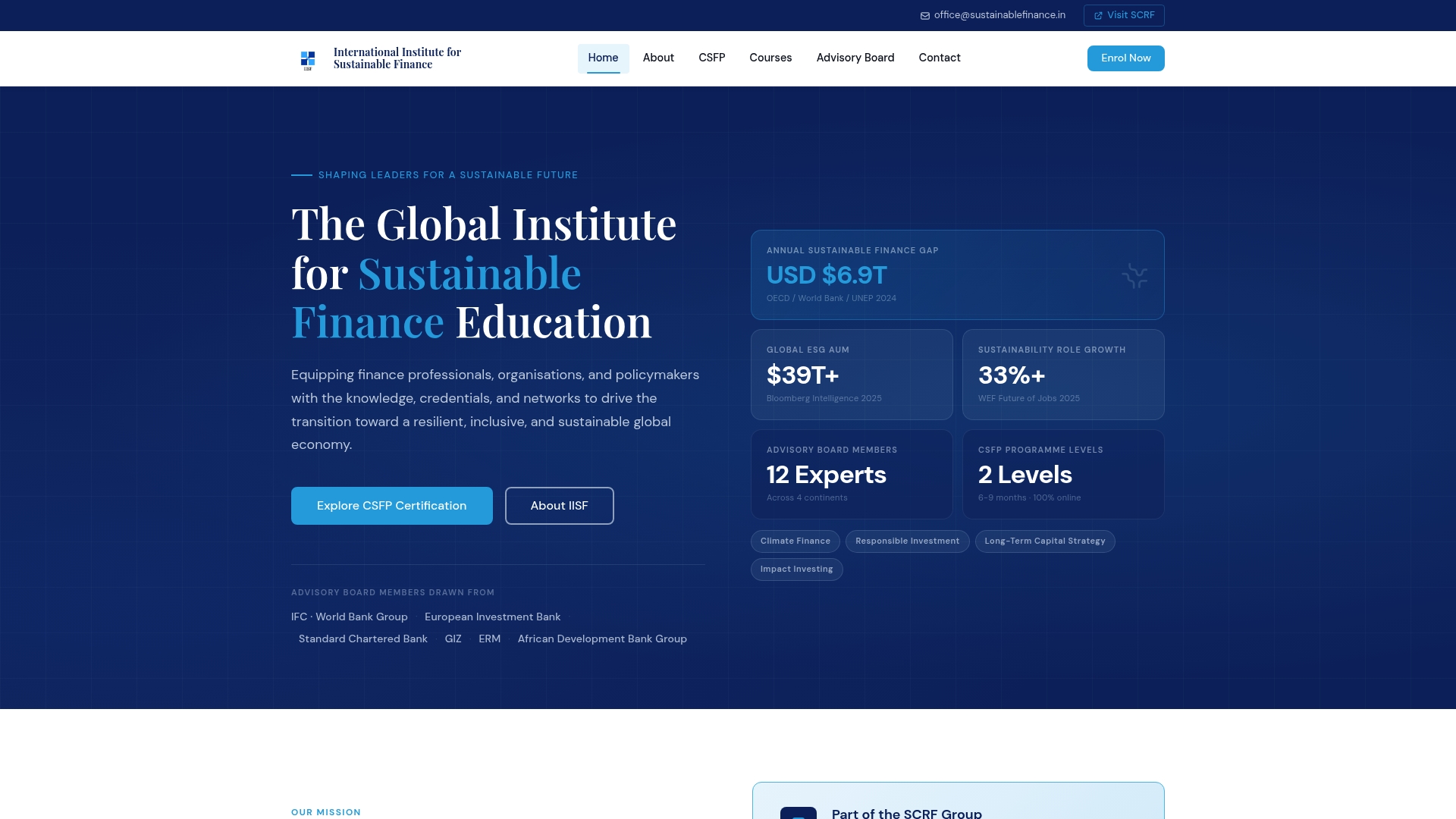
Part of the SCRF Group, IISF runs the Certified Sustainable Finance Professional (CSFP) pathway and publishes research on climate risk and disclosure frameworks. The institute combines credentialing, online coursework, and high-level convenings to connect practitioners, policymakers, and academics across regions.
Core Features
IISF offers global accreditation for credential programs and a catalogue of online courses that span foundational topics to advanced practice in sustainable finance. The organization produces research publications, hosts webinars and workshops, and forms strategic partnerships with universities and development agencies to support knowledge exchange.
Key Differentiator
IISF focuses on credentialed training built by international academic and industry experts with an emphasis on applied skills and ethical practice. That emphasis shows in course design and in advisory board composition, which targets relevance for both regulators and finance professionals.
Pros
The curriculum combines academic rigor with practical exercises, which helps professionals translate policy guidance into risk assessment and portfolio decisions. The institute reports global accreditation for its credentials, and that recognition supports career mobility and institutional training programs. Online delivery lets working professionals complete courses without long travel, and partnerships with universities add academic credibility.
Cons
-
Primarily online delivery limits options for people seeking in person workshops or localized classroom sessions.
-
Commercial pricing details are not publicly listed, which makes budgeting for teams difficult.
-
The emphasis on professional certification means content may assume prior finance experience, reducing value for complete beginners.
-
Regional presence outside major hubs is limited, although courses remain accessible globally.
When It May Not Fit
If your organization needs classroom-based workshops or local training partners, IISF may not meet that need because its offerings are mostly delivered online. If budget transparency matters, the lack of advertised pricing will slow procurement and internal approval. If your team requires entry level onboarding, the certification focus may demand a separate foundational curriculum first.
Who It's For
Mid career finance professionals, sustainability officers, and regulators seeking credentialed training in ESG and climate risk will find the format appropriate. Academic researchers and corporate trainers can use the institute for continuing professional development and for sourcing applied research to support policy or product design.
Real World Use Case
A financial analyst at a European bank completes CSFP Level II to improve climate risk evaluation skills. That credential helps the analyst translate disclosure rules into risk models and supports the bank when updating its risk management playbook. The course work also served as a basis for internal training sessions for the bank’s credit and treasury teams.
Pricing
IISF lists its offerings as informational and does not publish commercial pricing on the site. For organizational licensing or cohort training, procurement teams must contact IISF for quotes and contract terms.
Website: https://sustainablefinance.in
CASI (Capacity-building Alliance of Sustainable Investment)
At a Glance
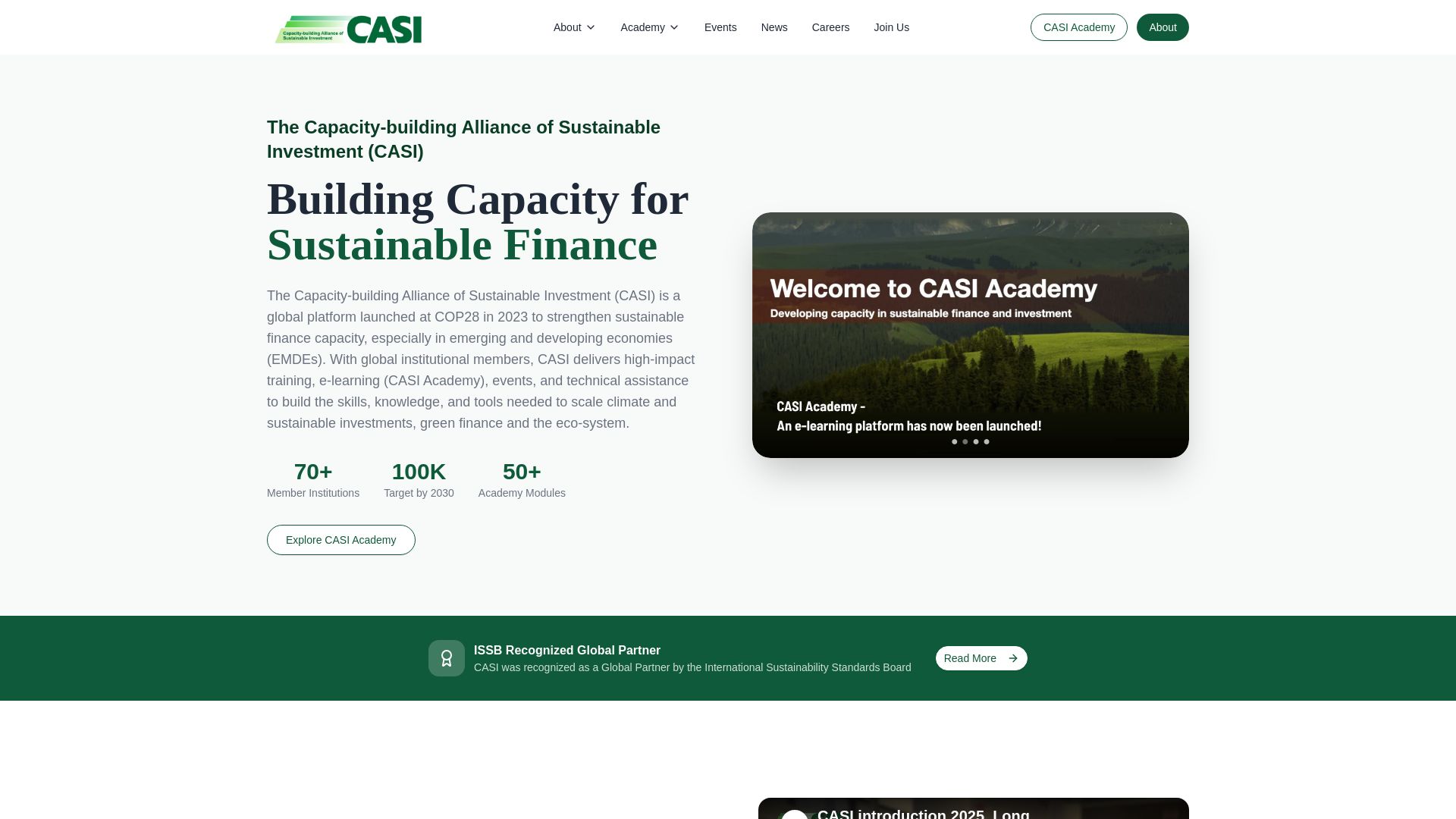
CASI reports it aims to train 100,000 individuals by 2030 and lists a network of over 70 member institutions across Asia, Europe, the Americas, Africa, and Oceania. It launched at COP28 in 2023 and centers work on capacity building for sustainable finance in emerging and developing economies. The platform pairs online learning, live events, and technical assistance through a common hub.
Core Features
CASI operates CASI Academy, an online library with more than 50 modules that span foundational and advanced sustainable finance subjects. Courses combine video lessons, quizzes, and case studies while issuing certificates with broad recognition. The platform also runs live webinars, regional events, and tailors technical assistance to banks, supervisors, and policy teams in emerging markets.
Key Differentiator
CASI aggregates course content from its member institutions to reduce duplication and centralize distribution. That approach lets institutions reuse existing material and push updates from a single point. It focuses on scaling capacity building while allowing partners to keep content locally relevant and regionally focused.
Pros
The catalog covers a wide set of topics that suit both regulatory and practitioner needs, from ESG integration to climate finance technicalities. The vendor reports a global membership that supplies regionally grounded case studies and regulatory perspectives. Delivery modes are flexible, so professionals can choose self paced modules or attend scheduled webinars and workshops. Certificates issued by the platform help professionals and institutions demonstrate formal training credentials.
Cons
-
Content leans technical. Complete beginners with no finance background will likely struggle to follow some modules.
-
Public pricing detail is sparse. Individual course fees and per participant rates are not widely published.
-
Participation depends on reliable internet and device access, which limits reach in some partner regions.
When It May Not Fit
A candidate with zero finance experience who needs basic corporate finance or accounting will find the material challenging. Organizations operating where connectivity and device availability are unreliable will face participation limits. Groups that require exclusively on site classroom delivery for every cohort will need a different vendor.
Who It's For
Finance professionals, regulators, and policymakers in emerging markets who need regionally relevant sustainable finance training will get the most value. Academic centers and development finance institutions building local training programs can use CASI to centralize delivery. Individuals seeking recognized certificates for professional development will also benefit.
Real World Use Case
A regional financial regulator in Africa co developed tailored modules with CASI for local banks and policy staff. The program mixed self paced coursework with live workshops and applied case studies. That combination helped local teams run climate risk assessments and prepare sustainability disclosure frameworks.
Pricing
CASI lists pricing as not applicable and positions itself primarily as an informational and capacity building platform. Public course fees and per participant rates are not widely published, and partner institutions typically negotiate delivery terms directly.
Website: https://casi.net
Comparison of alternatives
Verdant Institute offers a distinctive blend of formal continuing professional development (CPD) tracking with a unified curriculum path covering both foundational ESG concepts and advanced portfolio strategies. This platform appeals to professionals and students aiming for up-to-date, credentialed learning, with early access contributing to its accessibility. Competitors contribute unique aspects to the ESG education ecosystem, such as regionally adapted modules, corporate team options, and focused professional certifications.
Unique Educational Structure
Verdant Institute organizes materials into targeted learning tracks, providing flexibility for foundational and focused studies. Its free early access facilitates entry for students and analysts, unlike competitors whose pricing begins immediately. By pairing CPD tracking and practical lessons, Verdant strikes a balance between theory and application, directly supporting long-term career development.
Pricing Transparency
Compared with the Verdant Institute, ESG Academy wins the category for pricing transparency, offering basic resources freely accessible upfront. For users on constrained budgets or exploring initial ESG concepts, the Academy allows entry without subscription commitments, differentiating it in pricing clarity and free resource accessibility.
Best fit
- Sustainable finance students seeking structured CPD tracking and foundational-to-advanced ESG curriculum will find the Verdant Institute and resourceful.
- Professionals and corporate managers prioritizing recognized certifications through flexible but practical learning resources can turn to ESG Academy.
- Organizations and regulators in emerging markets aiming for localized, community-inclusive ESG modules will benefit most from CASI’s member-partnered content library.
Our pick
Verdant Institute stands out for its structured and monitored curriculum designed specifically for CPD tracking. This capability ensures measurable career development for users seeking to elevate their ESG competency effectively. For organizations or independent learners needing formal credentials with professional relevance across investment sectors, Verdant Institute proves to be the choice.
Verdantinstitute prioritizes structured learning with CPD tracking and free early access, highlighting its value over alternatives.
| Provider | Core Feature | Key Differentiator | Pricing | Limitation |
|---|---|---|---|---|
| Verdantinstitute | Four structured learning tracks | CPD tracking and free early access to full curriculum | Free during early access, then $18-$58/month | Limited independent reviews available to assess long-term content quality |
| ESG Academy | Modular learning system | Combines practical free materials with paid certifications | Starts at €34/month | Self-paced learning depends on user discipline |
| The ESG Institute | Accredited training and advisory | Links individual credentials with organizational certifications | Price not published | Pricing details not clearly disclosed |
| IISF | Certified Sustainable Finance Professional pathway | Emphasis on applied skills for practitioners | Price not published | Content assumes prior finance experience |
| CASI | Regionally tailored sustainable finance content | Central repository for training across emerging markets | Price not published | Content may be too technical for beginners |
Choosing the Right Sustainable Finance Training Among OpenESG.co Alternatives
Professionals and students seeking trusted ESG education often face unclear paths and inconsistent credentialing. Verdantinstitute provides a structured learning environment with clear CPD tracking and formal certificates. Its learning tracks cover foundational topics, deep dives, and advanced practice areas like transition finance, all tailored to build practical skills for sustainable finance roles.
Explore Verdantinstitute’s tailored plans starting at $18/month for students and $58/month for professionals. Visit Verdantinstitute to see how its comprehensive curriculum and certification options offer a reliable alternative for measurable ESG training and career advancement.
FAQ
How does Verdantinstitute support professional development in sustainable finance?
Verdantinstitute tracks CPD hours and issues certifications for course completion, making it a measurable option for professional development. The platform offers structured learning tracks across sustainable finance topics, allowing learners to gain credit for their training. Users can expect documented progress that enhances their resumes.
What is the difference between Verdantinstitute and ESG Academy?
ESG Academy focuses on practical courses and digital badges recognized by employers, which helps with immediate career advancement. In contrast, Verdantinstitute’s primary strength is in providing a singular curriculum path complete with CPD tracking for a formal certification process. Users seeking extensive certification might prefer Verdantinstitute for its comprehensive learning structure.
Which platform offers a broader selection of courses for beginners?
Verdantinstitute organizes material into four learning tracks, catering specifically to beginners through its Foundations series. The focus on entry-level courses enables new learners to start with foundational knowledge before progressing to advanced topics. This structure allows beginners to build confidence in sustainable finance systematically.
Can I use Verdantinstitute for personalized learning pathways?
Verdantinstitute allows users to tailor their learning experience through its structured curriculum and various course offerings. The platform supports both entry-level and advanced courses, giving professionals the flexibility to choose learning paths that fit their career goals. For those looking for a personalized learning experience, Verdantinstitute offers an effective starting point.
Does Verdantinstitute offer resources for corporate training?
Verdantinstitute can support corporate training by documenting CPD hours and issuing certificates that can be added to training records. Its focus on continuous education and structured learning makes it suitable for teams looking to bulk up their knowledge in sustainable finance. Organizations can benefit from its training resources without significant upfront costs.