

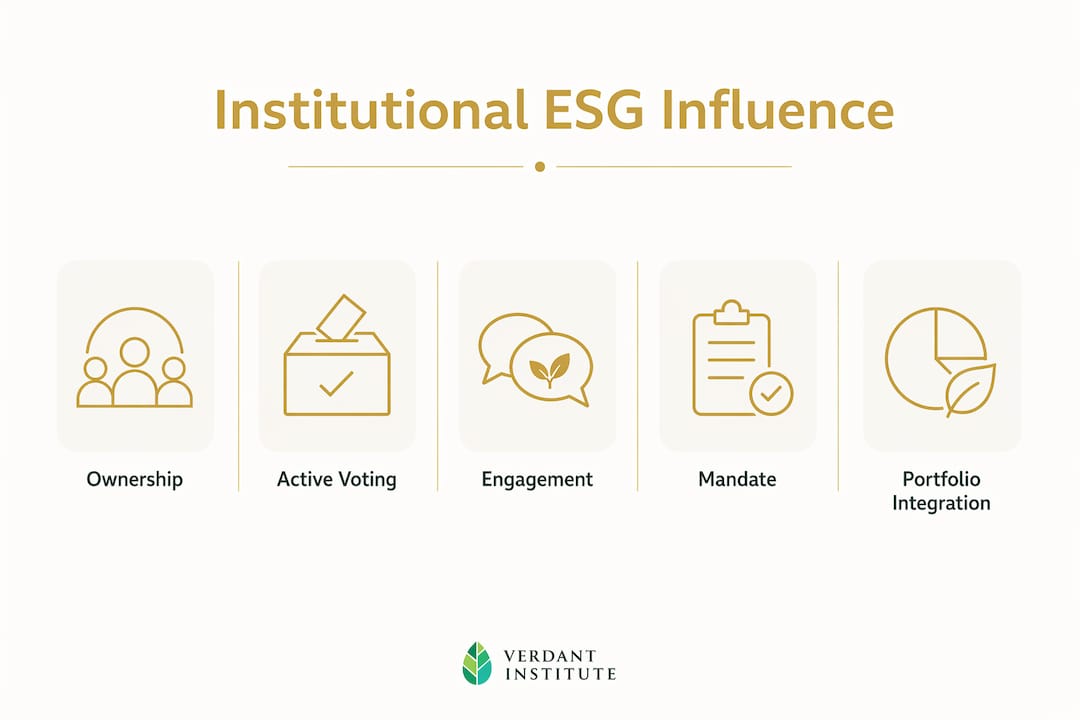
Institutional investors are the strongest predictors of corporate ESG performance, and their capital allocation decisions shape sustainability outcomes across entire industries. The role of institutional investors in ESG behavior goes well beyond portfolio screening. Through active ownership, voting, and direct engagement, funds like Norges Bank Investment Management and major pension funds push companies to adopt governance structures, climate disclosures, and social policies that no regulation alone could mandate. A long-term panel study of 126 firms from 2010 to 2022 confirms that institutional ownership significantly moderates the relationship between funding strategies and ESG outcomes. For finance professionals, understanding this influence is not optional. It is the foundation of any credible ESG strategy.
How does institutional ownership affect corporate ESG performance?
Institutional ownership directly improves corporate ESG performance by reducing agency costs and aligning management incentives with long-term sustainability goals. When a large fund holds a meaningful stake in a company, management faces pressure to report transparently, set measurable targets, and follow through. The panel study of 126 firms spanning 2010 to 2022 confirms these effects are statistically significant and consistent across sectors.
The mechanism is not purely financial. Institutional investors also amplify the effect of other governance forces. Research shows that institutional investors catalyze ESG adoption by reinforcing signals from industry associations, media scrutiny, and social supervisory bodies. A fund that publicly engages on climate risk disclosure does not just pressure one company. It signals to an entire sector what the new standard looks like.
Mutual funds and financial institutions play a specific amplifying role. When multiple funds hold overlapping stakes across competitors, they can coordinate expectations without explicit collusion. This common institutional ownership model reduces the cost of ESG governance at scale. The result is a sector-wide lift in disclosure quality and target-setting that benefits all investors in that space.
Pro Tip: Track which institutional investors hold stakes across your sector's top five competitors. Overlapping ownership often predicts where ESG engagement pressure will land next, giving you an early signal for governance shifts.
| Mechanism | ESG outcome |
|---|---|
| Active ownership and voting | Boards adopt climate targets and diversity policies |
| Common institutional ownership | Cross-firm ESG disclosure improves simultaneously |
| Capital allocation signals | Companies in low-ESG sectors face higher cost of capital |
| Engagement and stewardship | Management sets measurable, time-bound sustainability goals |
How do different types of institutional investors influence ESG?
Not all institutional investors engage with ESG the same way. Investor type, time horizon, and ownership structure each produce distinct behaviors that finance professionals need to map carefully.

Long-term investors, including sovereign wealth funds and large pension funds, show a distinctive pattern. Empirical 2026 research shows they are patient with short-term earnings dips but divest rapidly after negative ESG incidents. This asymmetry matters. A company can miss a quarterly earnings target and retain long-term institutional support. The same company that suffers a major governance scandal or environmental violation faces fast, large-scale exit. The reputational and capital cost of ESG failure is therefore much higher than the cost of temporary financial underperformance.
State-owned investors and sovereign funds embed ESG differently. Their mandates often include explicit social and environmental obligations tied to national policy goals. This contrasts with purely commercial funds, which integrate ESG primarily as a risk management tool. The distinction shapes how each type votes on shareholder resolutions and engages with boards.
Key behavioral differences across institutional investor types:
- Long-term investors: Patient on earnings, zero tolerance for ESG incidents, active on climate engagement
- Index funds: Influence through voting at scale, limited direct engagement per company
- Sovereign wealth funds: ESG tied to national mandates, often lead on climate disclosure standards
- Mutual funds: Respond to client demand for ESG products, growing stewardship activity
- Common institutional owners (CIO): Facilitate climate risk disclosure by reducing agency costs across interconnected firms
The governance impact of common institutional ownership deserves particular attention. When the same fund holds stakes in multiple firms within an industry, it can push for consistent ESG reporting standards across all of them simultaneously. This cross-firm leverage is one of the most underappreciated tools in ESG strategies for institutional investors.
What role do mandates and fiduciary duty play in ESG engagement?
Vague mandates are the single biggest constraint on effective ESG stewardship. OECD and Harvard analysis confirms that asset managers want clearer client instructions on voting and engagement to align their actions with fiduciary duties. Without specific guidance, fund managers default to the path of least resistance, which often means minimal ESG engagement.
Fiduciary duty frameworks are evolving. Pension funds and sovereign funds increasingly interpret their duty to beneficiaries as requiring ESG integration, not just financial return maximization. ESG mandates for pension and sovereign funds explain how these institutions embed sustainability to manage structural risks, including climate transition risk and social license to operate, while maintaining competitive returns.
Transparency and stewardship disclosure serve as the accountability layer. Funds that publish detailed stewardship reports, including how they voted and why, create a feedback loop that strengthens mandate clarity over time. Clients can see whether their instructions translated into action. Boards can anticipate engagement priorities. Regulators can assess whether fiduciary duty is being honored.
"Institutional investors operate under mandates that vary in specificity, often requiring transparent stewardship disclosures over legal enforcement alone." — Harvard Law School Forum on Corporate Governance
Pro Tip: When reviewing a fund's stewardship report, look specifically at split votes and abstentions on ESG resolutions. These reveal where mandate ambiguity is creating discretionary gaps in engagement.
The tension between fiduciary duty and ESG goals is largely a false conflict at the institutional level. Leading funds treat ESG as fundamental to competitive advantage and risk management, not as a moral obligation layered on top of financial analysis. The funds that have resolved this tension most effectively are those with the most specific mandates and the most transparent reporting.
How do institutional investors integrate ESG into portfolio construction?
ESG integration at the portfolio level follows a clear progression from screening to active ownership. Finance professionals who treat ESG as a compliance checkbox miss the financial value embedded in each stage.
The four stages of ESG integration in institutional portfolios:
- Screening and exclusion: Remove companies that fail minimum ESG thresholds, reducing exposure to regulatory and reputational risk
- ESG-weighted allocation: Tilt capital toward higher-rated ESG issuers within each sector, improving risk-adjusted returns over time
- Thematic investment: Allocate to specific ESG themes such as climate solutions, clean energy, or social infrastructure
- Active ownership: Use voting rights and direct engagement to improve ESG performance at portfolio companies
Norges Bank Investment Management illustrates stage three at scale. The fund increased climate solutions investment to 11% of equity in 2025, doubling its allocation since 2022, and committed $11 billion to transmission infrastructure by 2029. That is not a symbolic gesture. It is a capital allocation decision that reshapes the competitive position of every company in the clean energy supply chain.
Active ownership produces results that screening alone cannot. Investor pressure accelerates corporate ESG action faster than regulation in many cases. The expectation of active ownership serves as a signal that prompts boards to act proactively, before a shareholder resolution forces the issue. For finance professionals building ESG into asset allocation, this means that the engagement posture of your fund matters as much as the ESG scores you use to screen holdings.
| Integration approach | Primary tool | Time horizon |
|---|---|---|
| Negative screening | Exclusion lists | Immediate |
| ESG-weighted allocation | Scoring models | Medium term |
| Thematic investment | Sector tilts | Long term |
| Active ownership | Voting and engagement | Ongoing |
The synergy between institutional investors and social governance bodies also matters here. Studies show that when institutional investors coordinate with industry associations and media supervision, ESG outcomes improve beyond what either actor achieves alone. Portfolio construction that accounts for this synergy, by favoring companies with strong multi-stakeholder governance, captures returns that single-factor ESG models miss.
Key Takeaways
Institutional investors are the dominant force shaping corporate ESG behavior, and their influence operates through capital allocation, active ownership, mandate clarity, and cross-firm governance structures.
| Point | Details |
|---|---|
| Ownership drives ESG outcomes | Institutional ownership significantly improves corporate ESG performance across sectors and time periods. |
| Investor type shapes engagement | Long-term investors tolerate earnings dips but exit fast after ESG incidents; index funds influence through voting scale. |
| Mandate clarity is critical | Vague mandates limit stewardship; clearer client instructions produce more consistent ESG engagement. |
| Portfolio integration has stages | Effective ESG integration moves from screening to active ownership, with each stage adding distinct financial value. |
| Capital allocation signals markets | Funds like Norges Bank Investment Management shift entire sectors by committing capital to climate solutions at scale. |
The mandate gap is the real problem
The debate about whether ESG belongs in institutional portfolios is largely settled among serious finance professionals. The harder question is why so many funds still engage inconsistently, and the answer almost always comes back to mandate quality.
I have seen funds with genuinely strong ESG convictions produce weak stewardship outcomes simply because their client instructions were too vague to act on. The fund manager wanted to vote against a board on climate grounds. The mandate said "consider ESG factors." That is not an instruction. It is a permission slip with no map.
The most effective institutional ESG programs I have observed share one trait. They treat mandate design as a governance priority equal to portfolio construction. They specify which ESG issues trigger engagement, what escalation looks like, and how voting decisions get documented. The result is not just better ESG outcomes. It is better fiduciary practice, because clients can actually verify that their values translated into action.
The emerging trend worth watching is the convergence of regulatory pressure and investor demand for standardized stewardship disclosure. As frameworks like the UK Stewardship Code and similar initiatives in the EU and Asia gain traction, the gap between funds with clear mandates and those without will widen. Funds that have already built the internal governance to support specific, transparent ESG engagement will have a structural advantage. Those still operating on vague discretionary mandates will face growing client and regulatory scrutiny.
The institutional investors' role in corporate responsibility is not just about doing good. It is about building the governance infrastructure that makes consistent, verifiable ESG engagement possible at scale.
— Charles
Build your ESG expertise with Verdantinstitute
Finance professionals who want to move beyond surface-level ESG analysis need structured, practitioner-focused training. Verdantinstitute offers 16 courses and over 160 lessons covering ESG integration, transition finance, and net-zero strategies, all built for working professionals.

The platform's Deep Dive and Advanced Practice tracks cover exactly the skills institutional investors need: ESG portfolio construction, stewardship frameworks, and climate risk analysis. CPD tracking and certifications make it easy to demonstrate competency to clients and regulators. Plans start at $18 per month for students and $58 per month for professionals. Review the full course and pricing options to find the track that fits your role and learning goals.
FAQ
What is the role of institutional investors in ESG behavior?
Institutional investors are the strongest predictors of corporate ESG performance. They drive ESG behavior through capital allocation, active ownership, voting, and direct engagement with company boards.
How do institutional investors influence corporate ESG outcomes?
Institutional ownership reduces agency costs and aligns management incentives with long-term sustainability goals. Common institutional ownership across firms further improves ESG disclosure by coordinating expectations at the sector level.
Do long-term investors behave differently on ESG than short-term investors?
Long-term investors are patient with earnings underperformance but divest rapidly after negative ESG incidents. This asymmetry makes ESG incident management a higher financial priority than short-term earnings management for companies with long-term institutional shareholders.
Why do vague mandates limit ESG stewardship?
Vague mandates give fund managers insufficient guidance on how to vote or engage on ESG issues. Harvard and OECD analysis confirms that clearer client instructions produce more consistent and verifiable ESG engagement outcomes.
How does Verdantinstitute support ESG learning for institutional investors?
Verdantinstitute offers structured learning tracks in ESG integration, transition finance, and active ownership, with CPD tracking and certifications designed for finance professionals at all experience levels.