

Faith-based investing is defined as an approach that aligns capital allocation explicitly with religious moral frameworks, placing values alignment above generalized sustainability metrics. Unlike ESG investment strategies, which rely on quantitative scoring of environmental, social, and governance factors, faith-based investing draws authority from scripture, religious tradition, and community accountability. The distinction matters: 33 faith traditions now coordinate over $200 billion in assets for multi-faith collaboration, a figure confirmed at an April 2026 forum in Paris. That scale signals that faith-based investing is no longer a niche preference. It is an institutional force reshaping how capital markets think about values, stewardship, and impact.
How does faith-based investing differ from ESG investment strategies?
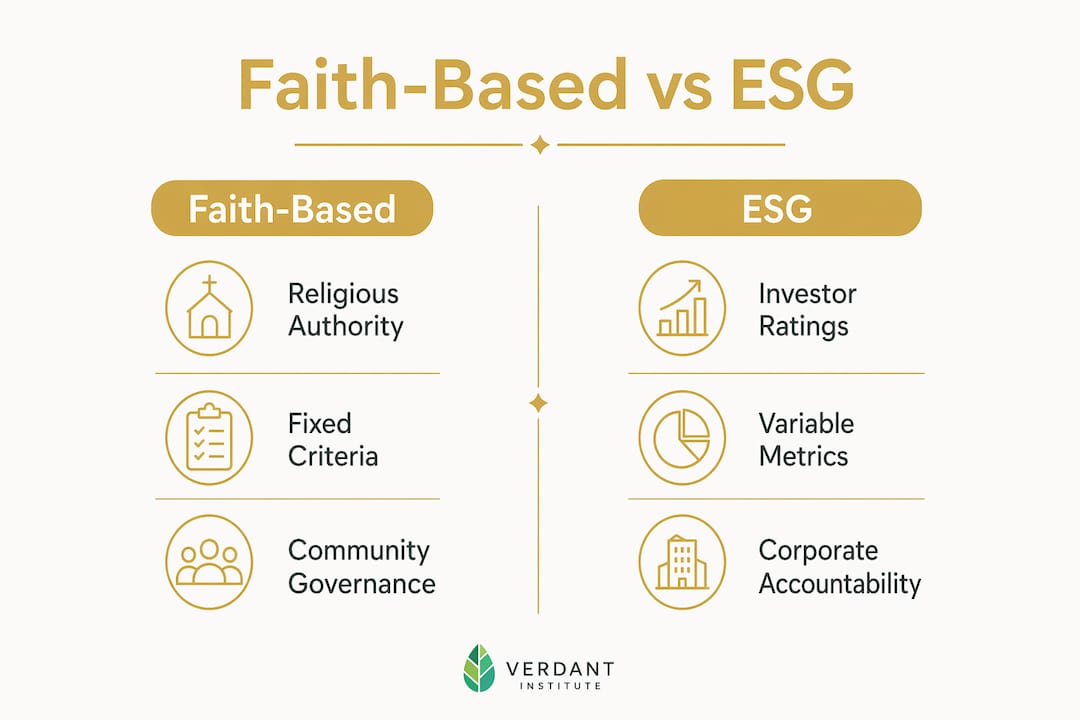
Faith-based investing and ESG are not interchangeable terms, and treating them as synonyms creates real portfolio risk. Faith-based investing claims legitimacy through moral alignment rather than financial return claims, while ESG investing is built on the empirical argument that sustainability factors predict financial performance. That foundational difference shapes everything from governance to screening methodology.
Governance and accountability
Faith-based investing governance involves religious authorities who are directly accountable to their communities. A Catholic investment committee answers to the Church's ethical teaching. A Shariah supervisory board answers to Islamic jurisprudence. This creates an auditable moral framework that investors can verify independently. ESG ratings agencies, by contrast, serve commercial clients and apply inconsistent methodologies. MSCI, Sustainalytics, and ISS each produce different ESG scores for the same company, sometimes dramatically so. That inconsistency is a structural problem, not a temporary one.

Screening methodology
Faith-based screening is rules-based and transparent. Prohibitions on weapons manufacturing, alcohol, gambling, or certain biotech applications are derived from religious authority and do not shift with market trends. ESG scoring is variable, weighted differently by each provider, and subject to revision without notice. Faith-based investing requires a ministry-first philosophy with customized screening that goes beyond off-the-shelf ESG scores. This means investors can audit exactly what they own and why.
| Dimension | Faith-based investing | ESG investing |
|---|---|---|
| Authority source | Scripture or religious tradition | Ratings agencies and sustainability data |
| Screening basis | Fixed moral rules | Variable quantitative scores |
| Governance | Religious leaders accountable to communities | Commercial firms accountable to clients |
| Primary goal | Values alignment | Risk-adjusted return enhancement |
| Auditability | High, investor-verifiable | Low, methodology varies by provider |
Pro Tip: Before selecting any fund labeled "values-aligned," request the fund's screening methodology in writing. If it references only ESG scores without specifying the religious or ethical criteria applied, it is a standard ESG product, not a faith-based one.
What are the unique strengths and challenges of faith-based investing?
The role of faith-based investing within ESG frameworks is strongest where ESG is weakest: transparency, moral consistency, and community accountability. But faith-based approaches carry their own limitations that investors must understand before committing capital.
Core strengths
- Transparent screening criteria. Investors know exactly which sectors and activities are excluded, and those exclusions do not change based on a ratings agency's quarterly methodology update.
- Deep moral tradition. Catholic Social Teaching, Islamic finance principles, and Jewish ethical investment frameworks each carry centuries of philosophical development. That depth provides a more durable foundation than any ESG scoring model.
- Community accountability. Religious institutions are answerable to their congregations and faith communities, not to shareholders or commercial clients. This creates genuine governance pressure to maintain standards.
- Auditable portfolios. Because criteria are explicit, investors can independently verify compliance in a way that is structurally impossible with opaque ESG scores.
Real challenges investors face
Generic ESG funds often fail to meet the nuanced requirements of specific religious traditions like Shariah law or Catholic bioethics. This is not a minor gap. A fund that scores well on ESG metrics may hold pharmaceutical companies involved in practices prohibited under Catholic teaching, or financial instruments that violate Islamic prohibitions on interest. Investors who delegate to generic ESG managers without specifying faith requirements frequently discover these mismatches only after the fact.
A second challenge is scalability. Highly customized faith-based screening can limit the investable universe, particularly in fixed income and private markets. Smaller faith communities may lack access to institutional-quality managers with genuine expertise in their tradition's requirements.
"Faith-based organizations should transition from passive screening to active impact catalysts, treating portfolios as stewardship responsibilities rather than compliance exercises." — Vatican Bank leadership, as cited at the 'Faith in the Common Good' conference, May 2026
The misconception that faith-based investing is simply a marketing label on standard ESG funds is widespread and damaging. 90% of attendees at the 'Faith in the Common Good' conference recognized faith-based investors' unique value to capital markets. That recognition reflects growing awareness that the two approaches are genuinely distinct, not cosmetically different.
Pro Tip: If a fund manager cannot name the specific religious authority or ethical framework governing their screening process, treat the product as a standard ESG fund. Real faith-based mandates have named governance structures.
How are faith-based investors collaborating to amplify impact?
The most significant development in faith-based investing in 2026 is the shift from isolated institutional action to coordinated multi-faith collaboration. This shift transforms the impact of faith investing from a collection of parallel exclusionary screens into a coordinated force for positive social and environmental outcomes.
The April 2026 Paris forum brought together 33 faith traditions representing over $200 billion in assets to discuss joint action on climate, human dignity, and community development. That gathering produced concrete commitments to shared analytics, coordinated engagement with portfolio companies, and new investment policy frameworks. FaithInvest, the organization coordinating much of this work, has positioned itself as the connective tissue between traditions that historically operated independently.
The institutional momentum extends to index development. The Morningstar IOR Catholic Principles indexes were launched in 2026 as a collaboration between IOR (the Vatican Bank) and Morningstar, providing a benchmarked, explicitly Catholic-aligned investment framework. This is significant because it gives Catholic institutional investors a credible reference point that does not require building proprietary screening from scratch.
The emerging Human Flourishing Project framework takes this further by developing impact measurement tools that track outcomes aligned with human dignity, sustainability, and community inclusion alongside financial returns. This moves faith-based investing beyond negative screening into positive impact measurement, a capability that mainstream ESG frameworks are still developing.
- Multi-faith coordination. The April 2026 Paris forum established working groups across 33 traditions to align on climate and social impact priorities.
- Index benchmarking. The Morningstar IOR Catholic Principles indexes provide a transparent, auditable benchmark for Catholic-aligned institutional portfolios.
- Impact measurement. The Human Flourishing Project framework tracks outcomes on human dignity and community inclusion, not just financial returns.
- Policy development. Vatican Bank leadership has publicly called for explicit investment policies and professional management expertise within faith institutions.
- Hybrid models. Combining faith-aligned investments with philanthropy provides scalable tools for institutions seeking both financial returns and direct community impact.
| Initiative | Lead organization | Primary focus |
|---|---|---|
| April 2026 Paris forum | FaithInvest | Multi-faith ESG collaboration |
| Morningstar IOR Catholic Principles indexes | IOR and Morningstar | Catholic-aligned benchmarking |
| Human Flourishing Project | Multi-faith working group | Impact measurement framework |
| 'Faith in the Common Good' conference | Impact Alpha network | Institutional coordination |
How can investors incorporate faith-based principles into their portfolios?
Practical implementation of faith-based investment principles requires more than selecting a fund with a religious name. The process demands clarity about which tradition's criteria apply, which manager has genuine expertise in those criteria, and how performance will be measured across both financial and impact dimensions.
Start with the specific ethical criteria of your tradition. Islamic finance prohibits riba (interest), gharar (excessive uncertainty), and investment in sectors like alcohol, pork, and conventional financial services. Catholic Social Teaching prohibits investment in abortion, contraception, weapons of mass destruction, and human trafficking, while positively directing capital toward human dignity and environmental stewardship. These are not interchangeable frameworks, and a manager fluent in one may be entirely unsuited to the other.
Values-aligned investing need not sacrifice returns. Steven Libman, founder of Investing With Purpose, demonstrates that embedding faith-driven principles operationally creates durable business advantages rather than constraints. This matters because the most common objection to faith-based investing is the assumption of a return penalty. The evidence does not support that assumption when the mandate is implemented with genuine expertise.
- Demand transparency. Request the full screening criteria, the governing religious authority, and the compliance review process before committing capital.
- Evaluate manager expertise. Ask specifically whether the manager has experience with your tradition's requirements, not just generic ESG screening.
- Require dual reporting. Financial performance reporting should be accompanied by impact or ministry reporting that tracks outcomes aligned with your faith's values.
- Consider hybrid structures. Combining impact investing with philanthropy allows institutions to deploy capital across a spectrum from concessionary to market-rate returns while maintaining faith consistency.
- Review portfolios regularly with faith advisors. Annual reviews with a qualified religious ethics advisor catch drift before it becomes a material compromise of your mandate.
- Avoid off-the-shelf ESG substitutes. A fund that scores well on MSCI ESG ratings may still hold positions that violate your tradition's specific prohibitions.
Learning to embed ESG in investment decisions effectively is a prerequisite for understanding where faith-based criteria diverge from standard ESG practice. Verdantinstitute's resources on ESG investment strategies provide the analytical foundation needed to make that distinction clearly.
Pro Tip: Build a one-page "faith investment policy statement" that names your tradition, lists prohibited sectors, identifies your impact priorities, and specifies reporting requirements. Hand this to every manager you evaluate. If they cannot respond to it specifically, they are not the right partner.
Key takeaways
Faith-based investing is a structurally distinct approach from ESG, grounded in religious authority and community accountability rather than commercial ratings, and its institutional momentum in 2026 makes it a credible framework for investors seeking genuine values alignment.
| Point | Details |
|---|---|
| Distinct from ESG | Faith-based investing uses fixed religious criteria, not variable ESG scores, making it more auditable. |
| Governance advantage | Religious authorities accountable to communities provide more rigorous oversight than commercial ratings agencies. |
| Institutional momentum | 33 faith traditions coordinating $200 billion in assets signals a shift from niche to institutional force. |
| Implementation discipline | Investors must demand specific religious criteria, dual reporting, and manager expertise to avoid generic ESG substitutes. |
| Hybrid impact potential | Combining faith-aligned investing with philanthropy extends total impact beyond what either tool achieves alone. |
Why faith-based investing deserves more intellectual respect than it gets
I have spent years analyzing ESG frameworks, and the honest assessment is this: ESG's core claim, that sustainability factors reliably predict financial outperformance, remains contested. The academic literature is mixed, the ratings methodologies are inconsistent, and the political backlash in the United States has exposed how fragile the empirical case can be when challenged directly.
Faith-based investing does not make that claim. It says: these are our values, these are the companies we will not own, and this is the authority that governs those decisions. That intellectual honesty is underrated. Faith-based investing has a more sustainable philosophical foundation than ESG precisely because it does not depend on contested empirical claims about returns.
What I find most encouraging in 2026 is the shift from passive exclusion to active stewardship. Vatican Bank leadership calling for explicit investment policies and professional management expertise is not a small development. It signals that major faith institutions are moving from defensive compliance to genuine impact engagement. The Morningstar IOR Catholic Principles indexes and the Human Flourishing Project framework are concrete evidence of that shift.
For investors who want genuine values alignment, not a marketing label, faith-based approaches now offer more institutional infrastructure than at any point in recent history. The tools exist. The governance frameworks exist. What remains is the willingness to demand them from your managers and hold them accountable to delivering them.
— Charles
Deepen your understanding of faith-aligned and ESG investing
Verdantinstitute offers structured learning tracks specifically designed for finance professionals and investors working at the intersection of values and capital markets. Whether you are building the analytical foundation to evaluate faith-based mandates or developing expertise in impact investing strategies, the platform provides CPD-tracked courses built for practitioners, not generalists.
The library of 16 courses and over 160 lessons covers ESG analysis, sustainable finance frameworks, and advanced practice areas including transition finance and net-zero strategies. Student plans start at $18 per month and professional plans at $58 per month. Review the full course and pricing options at Verdantinstitute to find the track that fits your professional goals and values-driven investment practice.
FAQ
What is the core difference between faith-based investing and ESG?
Faith-based investing applies fixed religious ethical criteria governed by religious authorities, while ESG investing uses variable quantitative scores produced by commercial ratings agencies. The two approaches have different authority sources, governance structures, and primary objectives.
Can faith-based investing deliver competitive financial returns?
Yes. Steven Libman of Investing With Purpose demonstrates that embedding faith-driven principles operationally creates durable business advantages. Values-aligned investing need not sacrifice returns when implemented with genuine expertise and a clear mandate.
How do I know if a fund is genuinely faith-based or just an ESG product with religious branding?
Request the fund's specific screening criteria, the named religious authority governing those criteria, and the compliance review process. A genuine faith-based fund will name its governing tradition and provide an auditable methodology. A rebranded ESG fund will reference only ESG scores or sustainability ratings.
What is the current scale of institutional faith-based investing?
As of April 2026, 33 faith traditions coordinate over $200 billion in assets through multi-faith collaboration forums, with organizations like FaithInvest and the Vatican Bank driving coordinated engagement and new benchmarking tools.
What is the Human Flourishing Project in faith-based investing?
The Human Flourishing Project is an emerging impact measurement framework developed within the faith-based investing community that tracks outcomes aligned with human dignity, sustainability, and community inclusion alongside financial returns. It represents the shift from passive exclusionary screening to active impact measurement within faith-consistent portfolios.