

On May 29, 2026, the SEC proposed full rescission of the climate-related disclosure rules it adopted in March 2024, effectively signaling that the Commission no longer intends to defend or implement those requirements in their current form.
- What this removes: The proposal would eliminate Regulation S-K subpart 1500 and Regulation S-X Article 14 entirely, including phased Scope 1/Scope 2 emissions disclosures, attestation requirements, and Inline XBRL tagging obligations.
- What stays uncertain: Rescission is not yet final. The comment period closed August 3, 2026, and a final rule has not been issued. The underlying legal text remains in the Code of Federal Regulations until formally vacated or rescinded.
- Immediate compliance posture: Pause new investments in attestation programs. Preserve all data, documentation, and materiality analyses already prepared. Do not dismantle GHG data pipelines — investor demands and non-U.S. obligations persist regardless of SEC action.
The rescission docket is S7-2026-19 / Release No. 33-11421. Monitor the Federal Register for the final rule publication date, which triggers any remaining compliance deadlines.
Key Takeaways
The SEC's proposed rescission of the 2024 climate-related disclosure rules shifts the compliance burden from a prescriptive checklist to a principles-based materiality standard that registrants must apply and defend themselves.
| Point | Details |
|---|---|
| Rescission is proposed, not final | The SEC proposed rescission on May 29, 2026; a final rule requires a separate Commission vote and Federal Register publication. |
| Preserve all prior work | Documentation, materiality analyses, and GHG data sets must be retained under litigation-hold protocols regardless of rescission status. |
| Materiality standard still applies | Existing MD&A and risk-factor rules require disclosure of material climate risks even without the 2024 mandate. |
| Cross-jurisdictional obligations persist | EU CSRD and ISSB-aligned investor expectations apply independently of SEC action for multinational registrants. |
| Verdantinstitute training | Verdantinstitute's courses on materiality assessment, GHG data governance, and cross-framework disclosure support teams building durable analytical processes. |
Table of Contents
- How the SEC climate rule got here: a regulatory timeline
- What the 2024 final rule actually required
- The litigation and administrative history behind the stay
- Why the SEC says it wants to rescind the climate rule
- What registrants and counsel should do right now
- How the SEC rule interacts with other reporting frameworks
- What to monitor next
- A practitioner's perspective on what this moment actually means
- Verdantinstitute training for climate disclosure teams
- Sources
How the SEC climate rule got here: a regulatory timeline
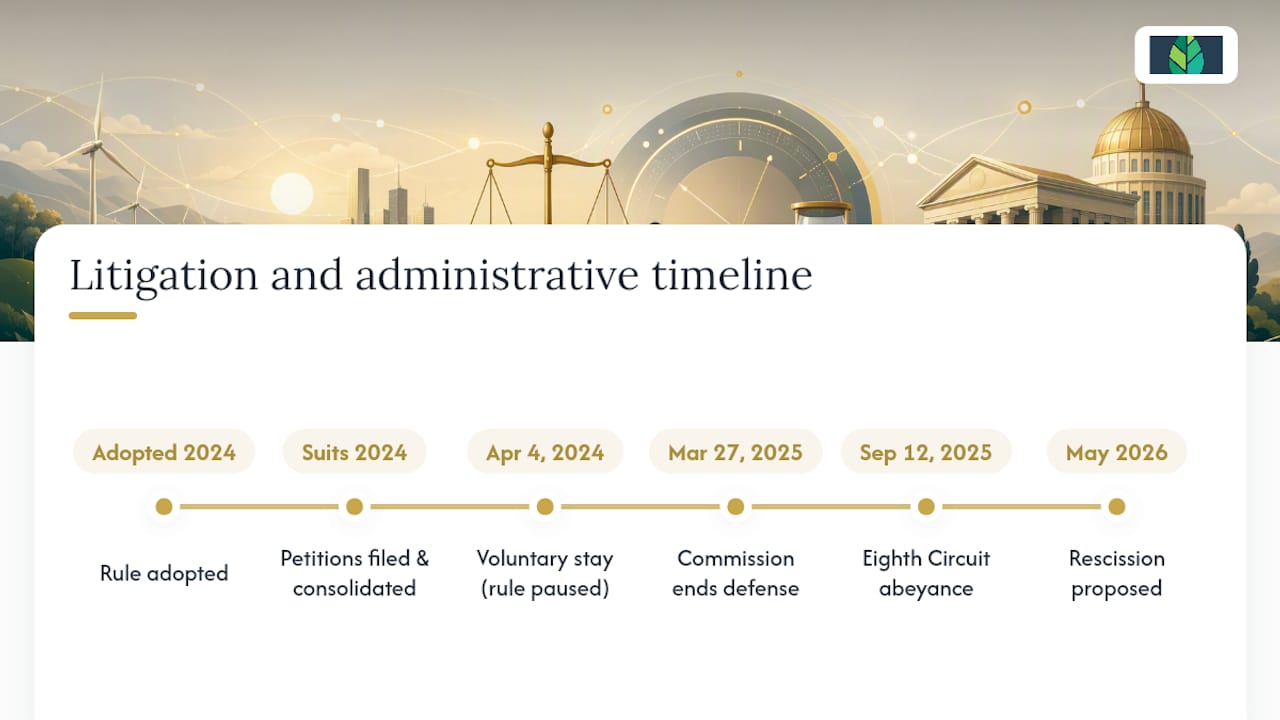
The path from adoption to proposed rescission took just over two years and involved parallel litigation, a Commission-level stay, and a formal change in enforcement posture.
| Date | Event |
|---|---|
| March 6, 2024 | SEC adopts final climate-related disclosure rules (Release No. 33-11275) |
| April 4, 2024 | Commission issues voluntary stay of the rules pending judicial review |
| March 27, 2025 | Commission votes to end its active defense of the rules in litigation |
| September 12, 2025 | Eighth Circuit holds consolidated petitions in abeyance pending agency reconsideration |
| May 29, 2026 | SEC proposes full rescission (S7-2026-19 / Release No. 33-11421); comment period opens |
| August 3, 2026 | Public comment period closes |
| Pending | Final rescission rule; Federal Register publication triggers formal removal |
The SEC newsroom's climate-related disclosure page consolidates primary materials and is the most reliable place to catch official updates between Federal Register publications.
What the 2024 final rule actually required
The adopting release (Release No. 33-11275) created two new regulatory structures: Regulation S-K subpart 1500 (narrative disclosures in registration statements and annual reports) and Article 14 of Regulation S-X (climate-related financial statement disclosures). Together, they required registrants to disclose:
- Material climate-related risks and their actual or reasonably likely effects on strategy, business model, and outlook
- Board and management oversight of climate-related risks
- Transition plans, targets, and goals if adopted
- Scenario analysis if used in risk management
- Financial-statement effects of severe weather events and transition activities, including capitalized costs, expenditures, and losses
- Scope 1 and Scope 2 GHG emissions for larger filers, on a phased basis, when material
Scope 3 emissions were explicitly excluded from the final rule after the SEC received significant comment-period pushback on data reliability and cost. That exclusion was one of the rule's most notable departures from the original 2022 proposal.
Phase-in schedule and filer categories
The fact sheet laid out compliance dates by filer type. Larger Accelerated Filers (LAFs) faced the earliest deadlines; Smaller Reporting Companies (SRCs) and Emerging Growth Companies (EGCs) received the longest runway.
Inline XBRL tagging was required for the climate-related disclosures, consistent with the SEC's broader structured-data initiative. Registrants had to tag both the narrative and financial-statement climate items using the EDGAR filing system.
Pro Tip: The rule permitted climate disclosures in a separate captioned section of the annual report or integrated into MD&A, provided the disclosures were clearly labeled and cross-referenced. If your team already drafted a standalone climate section, preserve that document structure — it may still serve investor-relations and voluntary-disclosure purposes even if the SEC mandate is rescinded.
The litigation and administrative history behind the stay
The 2024 rules attracted legal challenges almost immediately after adoption. Multiple petitions for review were filed in different federal circuits, and the cases were consolidated before the Eighth Circuit. The Commission's April 4, 2024 stay was voluntary — the SEC acted before any court ordered it to stop — which is procedurally significant.
A stay suspends a rule's operative effect but does not remove it from the Code of Federal Regulations. The rule's text remained legally extant throughout the stay period. A vacatur, by contrast, would have struck the rule from the CFR entirely. A rescission achieves the same removal but through the agency's own notice-and-comment process rather than a court order.
That distinction matters for compliance teams. When a rule is stayed but not vacated, internal policy documents, audit trails, and any disclosures already filed under the rule remain subject to securities-litigation scrutiny. Preservation obligations do not evaporate because the rule is paused.
On March 27, 2025, the Commission voted to end its active defense of the rules in court. The Eighth Circuit responded on September 12, 2025 by holding the consolidated petitions in abeyance, essentially waiting for the agency to complete its administrative reconsideration. That procedural posture is what created the runway for the May 2026 rescission proposal.
The EELP analysis at Harvard Law frames this sequence as a textbook example of regulatory volatility: adoption, immediate litigation, voluntary stay, withdrawal of defense, and now proposed rescission — all within roughly 26 months. Their core recommendation tracks with what experienced practitioners already know: firms that built durable materiality processes rather than static checklists are better positioned regardless of which way the final rule lands.
Why the SEC says it wants to rescind the climate rule
The Commission's rescission proposal rests on three stated grounds.
Statutory authority. The SEC argues the 2024 rules exceeded its authority under the Securities Act and Exchange Act. The Commission's disclosure authority is tied to information material to investment decisions, and the rescission proposal contends the 2024 rules mandated disclosures that went beyond that materiality-anchored scope.
Cost/benefit imbalance. The proposal characterizes the compliance costs — particularly for GHG data collection, third-party attestation, and Inline XBRL tagging — as substantial and not justified by the investor-protection benefits the rules would have delivered.
Departure from materiality-focused disclosure. This is the most legally significant framing. The SEC frames rescission not as abandoning climate transparency but as returning to a regime where registrants disclose climate risks when and because they are material, rather than under a prescriptive checklist. That framing has direct implications for how registrants should structure their ongoing disclosure analysis.
Administratively, the rescission follows standard notice-and-comment procedure under the Administrative Procedure Act. The comment period closed August 3, 2026. A final rescission rule requires a separate Commission vote and Federal Register publication. If finalized, the rule text would be removed from the CFR. If challenged in court, the rescission itself could face APA review — meaning the litigation risk runs in both directions.
What registrants and counsel should do right now
Regulatory uncertainty does not mean compliance inaction. The practical posture depends on where your organization sits in the phase-in schedule and what work has already been done.
Immediate actions (now through final rescission rule)
- Audit disclosures already filed. Any climate-related disclosures included in FY 2024 or FY 2025 annual reports remain part of the public record. Review them for consistency with current materiality positions.
- Pause formal attestation contracting. Do not execute new attestation engagement letters until the final rescission rule is published. Readiness work — vendor evaluation, data gap analysis — can continue.
- Preserve all documentation. Internal deliberations, materiality analyses, board presentations, and GHG data sets should be retained under your standard litigation-hold protocols. A stayed or rescinded rule does not eliminate securities-litigation exposure for prior filings.
- Brief the disclosure committee. The committee should understand that the rescission proposal is not a final rule and that the materiality standard for climate risks under existing securities law still applies.
Near-term actions (next 90 days)
- Reassess materiality. Even without the SEC mandate, material climate risks must be disclosed under existing MD&A and risk-factor requirements. Run a fresh materiality assessment using a framework your counsel can defend — SASB sector standards or TCFD-aligned analysis both provide documented methodologies. For practical techniques, ESG disclosure analysis provides a useful practitioner framework.
- Brief the board. Directors need to understand three things: the current legal status, the investor-expectation gap (large institutional investors still request GHG data regardless of SEC action), and the cross-jurisdictional picture for any non-U.S. operations.
- Evaluate your data vendors. GHG data pipelines built for SEC compliance also feed ISSB-aligned investor requests and EU CSRD obligations. Do not dismantle them. For a structured view of available ESG data sources, that resource maps vendor types to reporting use cases.
Medium-term actions (post-final-rule)
- Rebuild MD&A climate language. If the rescission is finalized, climate disclosures revert to a principles-based materiality analysis embedded in MD&A and risk factors. Draft templated language now so your team is not starting from scratch.
- Finalize attestation strategy. If your organization operates in the EU or has large institutional investors with mandatory GHG reporting requirements, attestation readiness remains valuable independent of the SEC outcome.
- Update internal controls documentation. Revise your disclosure controls and procedures documentation to reflect the current regulatory posture and any changes to your climate-data governance processes.
Pro Tip: When briefing the board or disclosure committee, frame the current posture in three buckets: (1) what the SEC rule required, (2) what existing securities law still requires regardless of rescission, and (3) what investors and other regulators expect. The middle bucket is where most registrants underestimate their ongoing exposure.
How the SEC rule interacts with other reporting frameworks
The SEC's proposed rescission does not operate in a vacuum. Multinational registrants face a patchwork of obligations that will persist regardless of what the Commission finalizes.
The EU's Corporate Sustainability Reporting Directive (CSRD) requires detailed climate disclosures — including Scope 1, 2, and 3 emissions — for companies meeting certain size thresholds or listed on EU-regulated markets. U.S.-headquartered companies with significant EU operations or EU-listed securities may already be in scope. As HBS BiGS documents, other governments are moving in the opposite direction from the SEC, making the divergence a live compliance problem rather than a theoretical one.
The ISSB's IFRS S2 standard, now adopted or referenced by regulators in over 20 jurisdictions, aligns closely with TCFD recommendations and requires climate-related financial disclosures that overlap substantially with what the 2024 SEC rule mandated. U.S. registrants with cross-listed securities or institutional investors subject to ISSB-aligned stewardship codes will face those expectations regardless of SEC action.
For reconciling frameworks, the practical approach is to map your materiality assessment across all applicable regimes simultaneously. SASB sector standards provide the most granular U.S.-market guidance on which climate metrics are financially material by industry. TCFD provides the governance and scenario-analysis architecture. ISSB/IFRS S2 adds the quantitative climate-risk metrics that institutional investors increasingly require. A guide to ESG disclosure frameworks covers how these standards relate to each other in practical terms.
The firms that invested in GHG data governance and cross-framework reporting templates during the 2024 rule's implementation period have a structural advantage now. Those systems do not become obsolete because the SEC retreats — they become the infrastructure for satisfying investor requests, CSRD obligations, and any future U.S. rulemaking.
What to monitor next
The rescission is not final. Here is what to watch and when.
- Docket S7-2026-19 / Release No. 33-11421: Monitor the SEC rulemaking page for the final rule publication date.
- Federal Register: The Federal Register entry is the authoritative source for the comment-period record and will carry the final rule when published.
- Eighth Circuit docket: The consolidated petitions remain in abeyance. If rescission is finalized, petitioners may withdraw. If rescission is challenged, new petitions could be filed in the same or a different circuit.
- SEC press releases and commissioner statements: Dissenting commissioners may signal future re-adoption efforts; majority statements will clarify the materiality-focused regime going forward.
- Big-firm guidance updates: Deloitte's SEC climate disclosure guidance tracks implementation considerations and is updated as the regulatory posture shifts.
- EELP and HBS BiGS: Both publish rapid-response analysis when the SEC acts; their commentary is useful for framing comment letters and board briefings.
Three plausible scenarios and their immediate implications:
- Rescission finalized as proposed: Climate disclosures revert to principles-based materiality under existing MD&A and risk-factor rules. Attestation and Inline XBRL requirements disappear. Investor and cross-jurisdictional demands remain.
- Rescission modified: The Commission may retain some elements (e.g., a narrower Scope 1/2 requirement for LAFs) while removing others. Watch the comment-period record for signals on which provisions drew the most industry support.
- Rescission challenged and delayed: APA litigation could extend uncertainty by 12–24 months. The stay-era compliance posture — preserve, document, assess materiality — remains the correct default.
A practitioner's perspective on what this moment actually means
The adopt-litigate-stay-rescind cycle the SEC climate rule completed in 26 months is not unique to climate policy. It reflects a structural tension in U.S. securities regulation between prescriptive disclosure mandates and the materiality-anchored framework that has governed the federal securities laws since 1933. The Commission's framing of rescission as a return to materiality is legally coherent, placing the burden squarely back on registrants to make defensible, documented judgments about what is material.
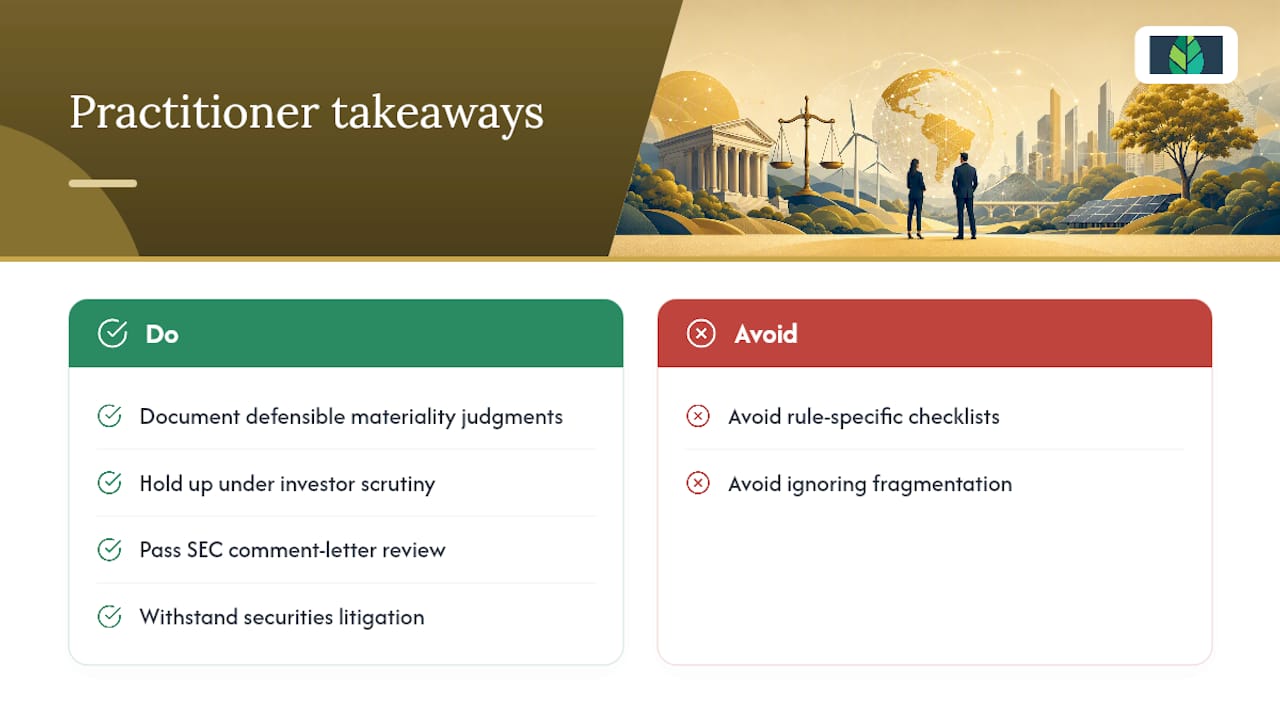
That is harder than following a checklist. A checklist tells you what to disclose. A materiality analysis requires you to explain why a risk does or does not meet the threshold, and to do so in a way that holds up under investor scrutiny, SEC comment-letter review, and securities litigation. Firms that treated the 2024 rule as a compliance exercise rather than a disclosure-quality exercise are now less prepared for that standard than firms that built genuine analytical processes.
The cross-jurisdictional dimension adds another layer. The SEC's retreat does not change what the EU requires of companies in its scope, what ISSB-aligned investors expect, or what state-level regulators in California are pursuing. U.S. registrants with any international footprint are not getting simpler disclosure obligations — they are getting a more fragmented set of them, with less federal guidance on how to satisfy them. That fragmentation is the real compliance challenge of the next 24 months, and it rewards teams that invested in ESG compliance fundamentals rather than rule-specific checklists.
Verdantinstitute training for climate disclosure teams
Finance and legal teams navigating the SEC climate rule's current status need more than regulatory updates — they need the analytical foundation to make defensible materiality judgments, manage cross-framework obligations, and brief boards with confidence.

Verdantinstitute's course library covers the skills that matter most right now: materiality assessment methodology, GHG data governance, disclosure drafting under principles-based regimes, and cross-framework reconciliation across ISSB, CSRD, and SASB. Courses are structured for working professionals, with CPD tracking and completion certificates built in. Plans start at $18/month for students and $58/month for professionals, with institutional licensing available for compliance teams. This is educational content, not legal advice — but it is the kind of structured, practitioner-focused training that sharpens the judgment your team needs to navigate regulatory uncertainty. Explore the full course catalog at Verdantinstitute and find the track that fits your team's current gaps.
Sources
Primary SEC materials:
- SEC Proposes Rescission of Climate-Related Disclosure Rules
- Rescission of Climate-Related Disclosure Rules
- Rescission of Climate-Related Disclosure Rules — Federal Register
- EELP commentary on SEC rescission proposal
- The SEC eliminated climate rules. Other governments are doing the opposite. — HBS BiGS
Official administrative record:
Secondary analysis:
This article is general information, not a substitute for advice from a qualified lawyer. Consult a qualified legal professional about your own circumstances before acting on anything here.