

A transition to an ESG finance career is defined as the deliberate move from traditional finance roles into positions that integrate Environmental, Social, and Governance analysis into investment decisions and financial strategy. The field is competitive. Only 1 in 400 MBA graduates currently work in dedicated impact investing. That number signals a narrow door, not a closed one. Finance professionals hold a structural advantage: 31% of impact investing professionals come from finance backgrounds, which means your existing skills in modeling, credit analysis, and portfolio management are exactly what hiring managers want. This guide covers the certifications, strategies, and practical steps that make careers in sustainable finance accessible to finance professionals and recent graduates in 2026.
What skills and certifications do you need to enter ESG finance?
The most direct path into ESG finance runs through targeted credentials layered on top of existing finance skills. Hiring managers prioritize transferable skills plus current ESG framework knowledge over sustainability degrees. That is a significant advantage for anyone already working in finance.

Core ESG frameworks to know
Three frameworks appear consistently in ESG finance job descriptions: the Task Force on Climate-related Financial Disclosures (TCFD), the Global Reporting Initiative (GRI), and the International Sustainability Standards Board (ISSB) standards. Understanding how these frameworks translate into financial risk and opportunity is the baseline expectation for any ESG analyst or associate role. You do not need to memorize every disclosure requirement. You need to understand how each framework affects valuation, credit risk, and investor reporting.
Certifications that carry weight
Professional ESG certifications like the CFA Institute's Sustainable Investing Certificate, the EFFAS CESGA (Certified ESG Analyst), and CFA UK's Certificate in Climate and Investing (CCI) are recognized globally by asset managers, banks, and rating agencies. Each credential targets a different depth of knowledge.
| Certification | Focus area | Difficulty | Estimated cost |
|---|---|---|---|
| CFA Institute Sustainable Investing Certificate | ESG integration in investment analysis | Intermediate | ~$895 |
| EFFAS CESGA | ESG analysis and reporting standards | Advanced | ~$1,500–$2,000 |
| CFA UK CCI | Climate risk and investment strategy | Intermediate to advanced | ~$700–$900 |
Costs listed are approximate and subject to change. Check each provider's website for current pricing.
Transferable skills that matter most
Financial modeling, data analysis, and stakeholder engagement are the three skills ESG employers cite most often. Hiring managers value candidates who can connect sustainability metrics directly to financial outcomes and integrate ESG factors into existing financial models. If you can build a discounted cash flow model, you can learn to adjust it for carbon price risk or stranded asset exposure.
- Financial modeling: Adapt existing models to incorporate ESG risk factors such as carbon pricing, regulatory fines, or supply chain disruption.
- Data analysis: ESG data is often incomplete and inconsistent. Analysts who can work with imperfect datasets are in high demand.
- Stakeholder engagement: ESG roles frequently require presenting findings to boards, investors, and regulators. Communication skills are not optional.
- Regulatory literacy: Familiarity with SEC climate disclosure rules, the EU Sustainable Finance Disclosure Regulation (SFDR), and ISSB standards separates strong candidates from weak ones.
Pro Tip: Build a sample ESG-adjusted financial model using publicly available TCFD disclosures from a company in your sector. Include it in your portfolio before your first interview.
Check the sustainable finance skills checklist from Verdantinstitute to benchmark your current competency gaps before choosing a certification.
How can you apply your existing finance experience to ESG roles?
Finance experience maps directly onto ESG roles when you know where to look. ESG roles are highly specialized, and identifying your niche early is the most reliable way to position yourself for a successful transition.
Matching your background to ESG role categories
Different finance backgrounds align with different ESG entry points. Asset managers with equity research experience fit naturally into ESG integration roles, where the job is to score companies on ESG criteria and adjust portfolio weights accordingly. Credit analysts transition well into ESG credit risk roles, assessing how climate and governance factors affect a borrower's probability of default. Quantitative analysts and data professionals are well suited for ESG data and analytics roles, which are among the fastest-growing positions in sustainable finance.
Understanding ESG career pathways by finance background helps you target applications precisely rather than applying broadly and getting lost in competitive applicant pools.
Strategic steps to bridge your skills
The gap between traditional finance and ESG finance is smaller than most professionals assume. The key is framing your existing work in ESG terms without overstating your credentials.
- Audit your current role. Identify any projects that touched environmental risk, supply chain governance, or social impact. These are your proof points.
- Reframe your resume. Describe financial modeling work in terms of risk factors you analyzed, including any regulatory, environmental, or reputational risks.
- Seek internal ESG projects. Many large banks and asset managers have internal ESG working groups or sustainability task forces. Volunteering for these builds credentials without changing jobs.
- Specialize before you generalize. Pick one ESG niche, such as climate risk, impact measurement, or sustainability reporting, and go deep before trying to cover the full ESG spectrum.
- Quantify your ESG contributions. Hiring managers respond to numbers. "Analyzed carbon exposure across a $200M credit portfolio" is stronger than "worked on ESG integration."
Pro Tip: Ask your current employer if they have a responsible investment policy or ESG reporting obligation. Volunteering to support that work is the fastest internal credential you can build.
What are the practical steps to build ESG experience and a network?
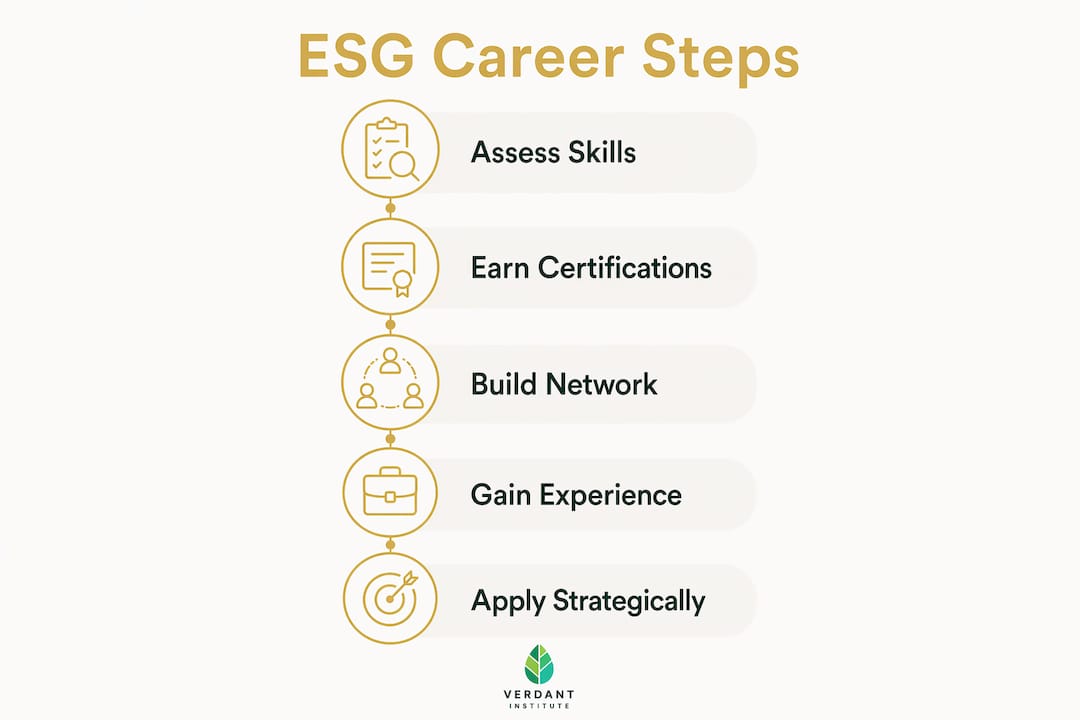
Experience and network are the two currencies of ESG hiring. Networking and internal mobility are the most effective ways to bridge traditional finance roles into sustainable finance careers. The following steps create a clear progression from where you are now to your first dedicated ESG role.
- Complete a recognized ESG certification. Choose one credential from the CFA Institute, EFFAS, or CFA UK based on your current role and target position. Finish it before you start applying.
- Join a professional association. Organizations like the CFA Society, the Principles for Responsible Investment (PRI), and the Global Impact Investing Network (GIIN) host events, publish research, and connect members with hiring managers.
- Attend ESG summits and conferences. Events like the PRI in Person conference and Climate Finance Week put you in the same room as practitioners who hire. Informational interviews arranged at these events convert at a higher rate than cold outreach.
- Volunteer for ESG-adjacent projects. Nonprofits, community development financial institutions (CDFIs), and social enterprises often need financial analysis support. This work builds your portfolio and your network simultaneously.
- Pursue internal mobility first. If your current employer has an ESG team, sustainability office, or responsible investment function, apply internally before looking externally. Internal candidates benefit from established credibility and organizational knowledge.
- Build a public knowledge presence. Write short analyses of ESG disclosures on LinkedIn. Comment on regulatory developments. Hiring managers in ESG actively search for candidates who demonstrate ongoing learning.
The ESG analyst career guide from Verdantinstitute breaks down the specific responsibilities you will be expected to handle in your first ESG role, which helps you target your preparation accurately.
What are the biggest challenges in making an ESG finance career shift?
The ESG finance job change is achievable, but three specific barriers trip up most candidates who fail to make it across.
The passion trap is real. Candidates who lead with sustainability enthusiasm but cannot demonstrate financial rigor get screened out quickly. Candidates must show how ESG metrics tangibly affect financial valuation and risk. Passion is a qualifier, not a differentiator.
Data and regulatory complexity is growing. The ESG finance sector is maturing rapidly, and ESG is becoming an expected layer on top of traditional finance roles rather than a separate discipline. That means professionals who cannot handle incomplete datasets, evolving disclosure standards, and regulatory ambiguity will struggle. The SEC's climate disclosure rules, SFDR in Europe, and ISSB's global standards all create compliance demands that require analytical precision, not just good intentions.
Competition is intense and persistent. Most ESG professionals did not study sustainability originally. That levels the playing field, but it also means you are competing against people from law, engineering, and policy backgrounds who have retrained aggressively. Perseverance matters as much as credentials.
Treat your ESG career shift the way you would treat a long-term investment. The returns are not immediate, but the compounding effect of consistent skill-building, targeted networking, and niche specialization creates a position that is very difficult for competitors to replicate. Professionals who commit to this approach over 18–24 months consistently outperform those who expect a quick pivot.
Pro Tip: Set a 90-day learning sprint. Pick one ESG framework, one certification module, and one professional association to engage with. Measure progress at the end of the sprint and adjust. Repeat.
Key Takeaways
A successful ESG finance career shift requires combining targeted credentials, niche specialization, and deliberate networking, not just enthusiasm for sustainability.
| Point | Details |
|---|---|
| Finance skills transfer directly | Modeling, credit analysis, and data skills map onto ESG roles without starting over. |
| Certifications signal commitment | CFA Institute, EFFAS CESGA, and CFA UK CCI are the most recognized credentials for ESG finance entry. |
| Internal mobility is the fastest path | Volunteering for ESG projects inside your current firm builds credentials and bypasses external competition. |
| Niche selection accelerates hiring | Specializing in climate risk, impact measurement, or ESG data makes you a stronger candidate than a generalist. |
| Passion alone does not get you hired | Hiring managers require demonstrated ability to connect ESG metrics to financial outcomes and valuations. |
Why I think most ESG career advice misses the point
The standard advice for transitioning to green finance goes like this: get a certification, update your LinkedIn, and attend a few conferences. That advice is not wrong. It is just incomplete in a way that costs people years.
The professionals I have seen make this transition successfully share one trait: they stopped thinking about ESG as a separate field and started treating it as a new analytical layer on top of finance they already knew. A credit analyst who learns to price climate transition risk into a loan covenant is not doing ESG work. She is doing credit analysis with better inputs. That reframe changes everything about how you position yourself and what you prioritize learning.
The other mistake I see constantly is waiting until you feel "ready." ESG frameworks evolve fast. Regulatory requirements shift. The ISSB standards that matter most in 2026 did not exist in their current form three years ago. You will never feel fully prepared because the field itself is not fully settled. The professionals who move fastest are the ones who act on 70% readiness and learn the rest on the job.
The long-term outlook for sustainable investment roles is strong precisely because the skills required are hard to develop quickly. That difficulty is your moat once you are on the other side of it. Build the technical foundation, pick a niche, and commit to the 18-to-24-month timeline. The career is worth it.
— Charles
Verdantinstitute's training programs for ESG finance careers
Finance professionals who want structured, credible preparation for an ESG finance career shift will find Verdantinstitute's course library directly aligned with what hiring managers expect.

Verdantinstitute offers 16 courses and over 160 lessons covering ESG foundations, transition finance, net-zero strategies, and advanced impact investing. The platform includes CPD tracking and certifications recognized by finance practitioners. Professionals can access the full curriculum for $58 per month, and students pay $18 per month. Both plans include structured learning tracks from beginner foundations through advanced practice areas. Review the course pricing and plans to find the option that fits your current stage and career target.
FAQ
How long does it take to transition into ESG finance?
Most finance professionals complete the transition within 18–24 months when they combine a recognized certification, internal ESG project experience, and active professional networking.
Do I need a sustainability degree to work in ESG finance?
No. Most ESG professionals did not study sustainability originally. Hiring managers prioritize transferable finance skills plus demonstrated knowledge of current ESG frameworks.
What salary can ESG finance professionals earn?
Senior ESG finance roles pay competitively. Director-level positions in sustainable finance analytics offer base salaries from $140,000 to $180,000 plus bonuses, depending on experience and education.
What is the best ESG certification for a finance professional?
The CFA Institute's Sustainable Investing Certificate is the most accessible entry point for finance professionals. The EFFAS CESGA and CFA UK's CCI are stronger credentials for roles requiring advanced ESG analysis or climate risk expertise.
Is internal mobility a realistic path into ESG finance?
Yes. Internal mobility is often the most reliable entry path because it lets you apply established organizational credibility to a new ESG-focused role without competing in the external job market.