

ESG course selection is the process of choosing Environmental, Social, and Governance programs that match your career goals, skill gaps, and the specific demands of sustainable finance roles. Finance students who approach this strategically build expertise faster and enter the job market with credentials recruiters actually recognize. The frameworks you learn, including GRI, SASB, TCFD, and CSRD, shape how employers assess your readiness. This student ESG course selection guide breaks down how to align your choices with your ambitions, what topics to prioritize, and how to fit ESG learning into your existing academic plan.
How to align your ESG course choices with your finance career goals
The right ESG course depends entirely on where you want to work. ESG education is not one-size-fits-all; students should select courses aligned with investment analysis, compliance and reporting, or governance leadership. That distinction matters because a course built for ESG analysts at asset managers covers very different ground than one designed for sustainability reporting officers at corporations.
Three main ESG career pathways exist in finance:
- Investment analysis and portfolio management. Courses here focus on ESG integration into financial models, materiality assessment, and responsible investing frameworks. If you want to work at an asset manager or ESG rating agency, prioritize quantitative ESG skills.
- Sustainability reporting and compliance. These roles require deep knowledge of GRI, SASB, TCFD, and CSRD. Courses covering disclosure mechanics and data collection are your priority.
- Governance and leadership. If you aim for corporate sustainability or board advisory roles, look for courses that cover stakeholder engagement, governance structures, and ESG strategy.
Early learners need broad framework exposure; practitioners benefit from recognized credentials like CESGA or CFA ESG. As a student, your goal is to build that broad foundation first. You can layer certifications on top once you have a clearer sense of your niche. Check the ESG career pathways that align with finance roles before you commit to any program.
Pro Tip: Before enrolling in any ESG course, write down the three job titles you most want to hold in five years. Then check whether the course syllabus directly prepares you for those roles. If it does not, keep looking.

What ESG topics and skills should students prioritize?
Certain ESG knowledge areas carry more weight with employers than others. Sustainability accounting and ESG data management skills are increasingly critical for employability in 2026. Employers want graduates who can work with real ESG data, not just describe what ESG means at a conceptual level.
The four skill areas worth prioritizing are:
- ESG reporting frameworks. GRI (Global Reporting Initiative), SASB (Sustainability Accounting Standards Board), TCFD (Task Force on Climate-related Financial Disclosures), and CSRD (Corporate Sustainability Reporting Directive) are the standards employers reference most. Understanding how they differ and when each applies is a baseline expectation. The types of ESG disclosure frameworks guide covers these in detail.
- Materiality assessment. This is the process of identifying which ESG issues are financially significant for a given company or sector. Courses that teach double materiality, as required under CSRD, are especially relevant right now.
- Climate risk analysis. Physical and transition risks tied to climate change now appear in mainstream financial analysis. TCFD-aligned courses teach you to quantify and disclose these risks.
- ESG data management. Collecting, cleaning, and interpreting ESG data from company disclosures, third-party providers, and regulatory filings is a practical skill that separates strong candidates from average ones.
The table below maps each skill area to the frameworks and roles most associated with it.
| Skill area | Key frameworks | Most relevant roles |
|---|---|---|
| Reporting and disclosure | GRI, SASB, CSRD | Sustainability analyst, compliance officer |
| Materiality assessment | CSRD double materiality, SASB | ESG analyst, investor relations |
| Climate risk analysis | TCFD, IFRS/ISSB | Risk analyst, portfolio manager |
| ESG data management | ISSB, proprietary data tools | ESG data analyst, research associate |
Recruiters prioritize candidates knowledgeable about EU CSRD and IFRS/ISSB frameworks. That preference has grown sharply as regulatory reporting requirements expand across Europe and beyond. A course that ignores these frameworks is already behind the curve.
What types of ESG courses are available to students?
ESG courses fall into two broad categories: accreditation-focused exam prep and skill-based, project-driven learning. Practical project components like capstones increase employment chances over pure theory. Knowing which type fits your current stage saves you time and money.
| Course type | Best for | Time commitment | Typical cost |
|---|---|---|---|
| Beginner online courses | Building foundational knowledge | 3–5 hours per week over 4–8 weeks | Low to moderate |
| University concentrations | Academic credit and structured learning | 3–4 credit units per semester | Tuition-dependent |
| Professional certifications | Career advancement and credentialing | 130–200+ hours of study | $800–$1,350 in fees |
| Skill-based platforms | Practical ESG skills with flexibility | Self-paced | Subscription-based |
Beginner ESG courses online generally run 4–8 weeks, with 3–5 hours per week covering ESG frameworks and materiality. That workload fits alongside a full course load. Professional certifications like CFA ESG, CESGA, and GARP SCR require 130–200+ hours and $800–$1,350 in fees. Those are better suited to your first or second year after graduation, not while you are managing finals.
University concentrations offer a middle path. Programs like Wharton's IVSB concentration integrate sustainability into finance studies with specified credit requirements, typically 3–4 units. That approach earns academic credit while building ESG knowledge, which makes it worth exploring with your advisor.
Pro Tip: If you are choosing between two courses with similar content, pick the one with a capstone project or live case study. Recruiters notice hands-on experience far more than an additional certificate line on your resume.
How to select and integrate ESG courses into your academic plan
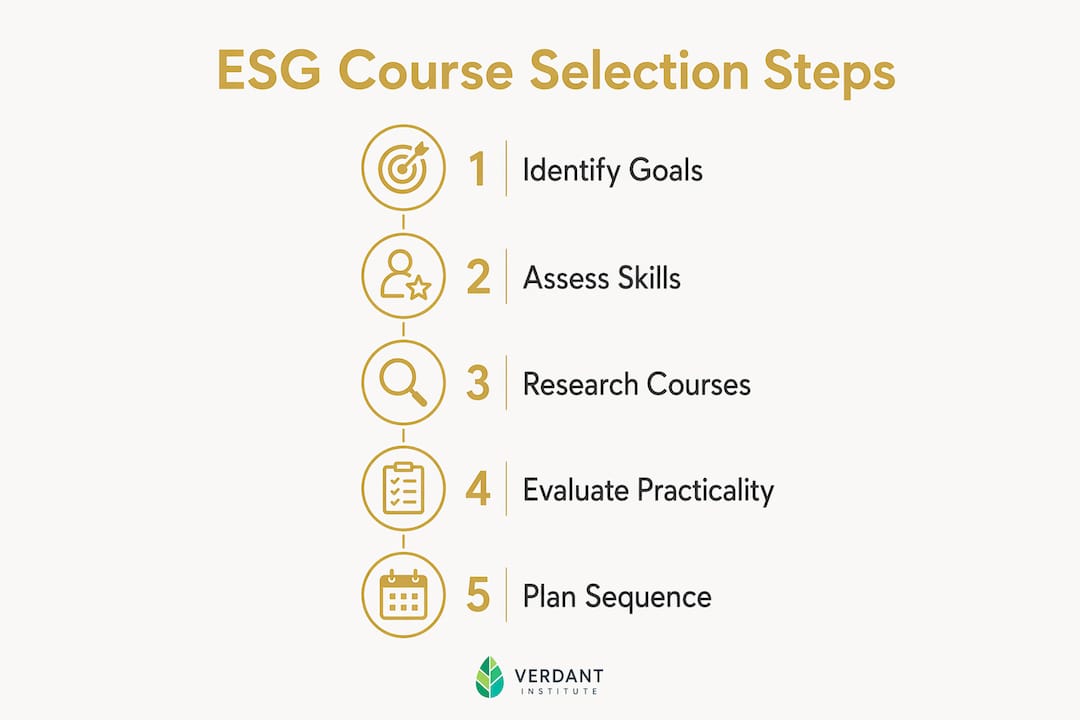
A clear process prevents you from wasting a semester on a course that does not move your career forward. Follow these steps to make a deliberate choice.
- Audit your current knowledge. List the ESG frameworks and skills you already understand versus those you cannot explain clearly. That gap is your starting point. The ESG fundamentals for beginners guide is a useful baseline check.
- Define your career focus. Return to the three pathways: investment analysis, reporting and compliance, or governance leadership. Pick the one that fits your goals and filter every course through that lens.
- Review syllabi carefully. A course title that includes "ESG" tells you almost nothing. Read the week-by-week syllabus. Check whether it covers specific frameworks, includes data exercises, or requires a project deliverable.
- Check for practical components. Courses including capstones or live projects on materiality assessment or stakeholder engagement are highly valued by recruiters. If the course is entirely lecture-based, weigh that carefully.
- Confirm academic credit eligibility. Talk to your academic advisor before enrolling in an external course. Some universities accept credit transfers or count professional development courses toward elective requirements. Get that confirmation in writing.
- Plan your schedule realistically. Map the course hours against your existing commitments. A 5-hour-per-week online course during exam season is a recipe for dropping out halfway through.
Integrating ESG learning into your academic plan works best when you treat it as a deliberate sequence, not a one-off addition. Start with a broad foundations course, then add a framework-specific or skills-based course in your next semester.
Key Takeaways
Selecting the right ESG courses requires matching your career focus to course content, prioritizing practical skills over theory, and integrating learning into your academic plan from the start.
| Point | Details |
|---|---|
| Career focus first | Identify whether your path is investment analysis, reporting, or governance before selecting any course. |
| Prioritize practical skills | ESG data management and materiality assessment skills matter more to employers than conceptual knowledge alone. |
| Know the frameworks | GRI, SASB, TCFD, CSRD, and IFRS/ISSB are the standards recruiters expect you to understand in 2026. |
| Match course type to stage | Beginner online courses suit students; professional certifications like CFA ESG are better suited post-graduation. |
| Check for project components | Courses with capstones or live case studies give you concrete experience that stands out on a resume. |
Why I think most students pick ESG courses the wrong way
Most finance students choose ESG courses based on brand recognition or peer recommendations. That is the wrong starting point. I have seen students complete well-known certification prep courses and still struggle to answer basic questions about CSRD or double materiality in interviews. The certificate looked good. The practical knowledge was thin.
The mistake is choosing a course for its credential rather than its content. Students often err by choosing theoretical ESG courses without practical framework training. Technical exposure to GRI, SASB, or TCFD is what actually prepares you for the work. A course that walks you through a real materiality assessment, even a simplified one, teaches you more than 40 hours of slides about ESG definitions.
The regulatory angle is also underestimated. Recruiters increasingly expect familiarity with CSRD and IFRS/ISSB frameworks in job candidates. Students who treat these as advanced topics to learn later are already behind peers who built that knowledge during their degree. Regulatory literacy is not a bonus skill anymore. It is a baseline.
My honest advice: spend 30 minutes reading a course syllabus before you spend $300 or a semester's worth of elective credits. The best ESG course for you is the one that closes your specific skill gaps and gives you something concrete to show in an interview.
— Charles
Verdantinstitute's ESG courses for finance students
Verdantinstitute offers a full ESG course library built specifically for finance students and professionals. The platform covers Academic Foundations, framework-specific Deep Dives, and Advanced Practice tracks including transition finance and net-zero strategies. With over 160 lessons across 16 courses, students can build from foundational ESG concepts to applied skills in sustainable finance and impact investing.

The student plan is priced at $18/month and includes CPD tracking and certifications. That makes it one of the most accessible structured ESG learning options available for students weighing time and budget. Check the student pricing and enrollment details to find the plan that fits your academic schedule and career goals.
FAQ
What is a student ESG course selection guide?
A student ESG course selection guide is a framework for choosing ESG programs that match your career goals, skill gaps, and academic requirements. It helps finance students prioritize the right topics, course formats, and frameworks rather than picking courses at random.
Which ESG frameworks should students learn first?
Students should start with GRI, SASB, TCFD, and CSRD, as these are the frameworks most referenced by employers and recruiters in 2026. Understanding how each framework applies to different industries and reporting contexts is a baseline expectation for ESG roles in finance.
Are professional ESG certifications worth it for current students?
Professional certifications like CFA ESG and CESGA require 130–200+ hours of study and $800–$1,350 in fees, making them better suited to post-graduation. Students benefit more from broad foundational courses and practical skill-building before investing in credentialing exams.
How do I know if an ESG course is practical enough?
Check the syllabus for capstone projects, live case studies, or data exercises involving real ESG disclosures. Courses with hands-on components in materiality assessment or stakeholder reporting give you experience that is directly relevant to finance roles.
Can ESG courses count toward my degree requirements?
Some universities accept external ESG courses for elective credit, but approval varies by institution. Talk to your academic advisor before enrolling and confirm credit eligibility in writing to avoid surprises at graduation.