

Non-governmental organizations are the primary accountability layer in ESG finance, sitting between corporate self-reporting and the regulatory frameworks that govern capital markets. The role of NGOs in ESG finance extends well beyond advocacy. These organizations expose greenwashing, shape investor behavior, influence lending criteria, and co-author the policy standards that define what "sustainable finance" actually means in practice. For finance professionals, policymakers, and students, understanding how NGOs operate within ESG ecosystems is no longer optional. It is a prerequisite for credible analysis.
How ngos shape corporate ESG accountability
NGOs function as independent auditors in ESG finance, uncovering qualitative risks like human rights abuses and ecological harm that standard ESG metrics routinely miss. This is the core value they add. Quantitative ESG scores from providers like MSCI or Sustainalytics measure what companies report. NGOs investigate what companies prefer not to report.
The reputational consequences of NGO scrutiny are measurable. NGO allegations increase negative ESG media coverage by 14.6%, which leads firms to reduce carbon emissions by 5–7% over subsequent years. That is not a marginal effect. It means NGO pressure produces real operational change, not just public relations responses.

NGOs also work directly with institutional investors to amplify their impact. Organizations like ShareAction and the Rainforest Action Network collaborate with asset managers to file shareholder resolutions, forcing board-level discussions on climate risk, supply chain labor standards, and biodiversity loss. This collaboration turns civil society pressure into formal governance mechanisms.
Key mechanisms NGOs use to drive corporate accountability include:
- Greenwashing investigations: Publishing detailed reports that challenge corporate sustainability claims, triggering investor scrutiny and media coverage
- Shareholder coordination: Partnering with institutional investors to co-file or support resolutions at annual general meetings
- Legal action: Filing litigation against companies and financial institutions for misleading ESG disclosures, as ClientEarth does regularly
- Open data monitoring: Using satellite imagery, supply chain databases, and public filings to track emissions and land use independently
Pro Tip: When you review a company's ESG disclosure, cross-reference it against reports from sector-specific NGOs like Global Witness for extractives or Ceres for utilities. Discrepancies between self-reported data and NGO findings are a direct signal for deeper due diligence.
When do NGO campaigns have the most impact?
NGO influence on ESG outcomes follows a predictable lifecycle, and understanding the timing is as important as understanding the tactics. NGO advocacy follows a lifecycle from visibility-focused campaigns on annual general meeting days to early, credible interventions months before votes.
The sequence matters for two reasons. First, early campaigns give institutional investors time to coordinate. Second, credibility built through prior campaigns makes later interventions more persuasive to boards and proxy advisors.
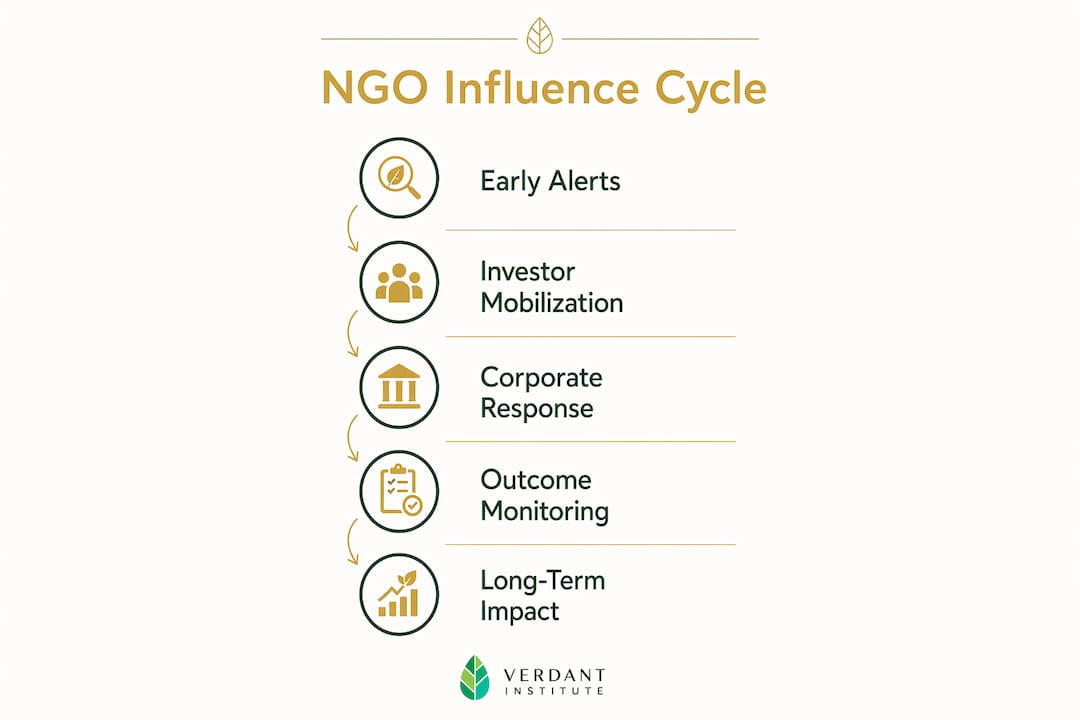
The data on timing is specific. Campaigns launched 1–3 months before shareholder meetings increase supportive votes by 8% compared to campaigns launched immediately before the event. Eight percent is often the margin between a resolution passing and failing.
The lifecycle of a mature NGO campaign typically unfolds in four stages:
- Visibility phase: High-profile media campaigns at AGMs to establish the issue and build public credibility
- Evidence building: Publishing research, commissioning independent audits, and filing data requests to strengthen the factual record
- Investor engagement: Briefing institutional shareholders 1–3 months before the next AGM to coordinate voting positions
- Post-vote accountability: Monitoring corporate commitments made in response to resolutions and publishing follow-up reports
"NGOs initially conduct highly visible campaigns to build credibility, then shift to earlier intervention targeting shareholder votes for lasting influence." — ProMarket, 2026
One important nuance: NGO pressure does not always produce clean outcomes. Companies may relocate carbon-intensive activities offshore, masking supply chain emissions increases even as reported direct emissions fall. Finance professionals should treat scope 3 emissions data with particular skepticism when a company has recently faced NGO pressure on its direct operations.
How ngos collaborate with policymakers and financial institutions
The role of nonprofits in ESG extends directly into regulatory design. NGOs work closely with policymakers, especially at the EU level, to ensure financial regulations reflect real sustainability outcomes rather than standardized metrics that companies can game. Eurosif, for example, engages directly with the European Commission on sustainable finance taxonomy development and fund labeling standards.
This policy influence is not informal lobbying. NGOs serve as trusted intermediaries, grounding abstract regulatory frameworks in documented field evidence. When the EU developed its Corporate Sustainability Reporting Directive, civil society organizations provided the case studies and sectoral data that shaped disclosure requirements.
At the international level, capacity building is a growing NGO function. The CASI platform includes 60+ members aiming to train 100,000 sustainable finance participants by 2030, with NGOs as core partners. That scale of training shapes how the next generation of finance professionals understands ESG integration.
The table below summarizes the three primary channels through which NGOs engage with financial institutions and policymakers:
| Channel | NGO Role | Example Organizations |
|---|---|---|
| Regulatory consultation | Drafting input on ESG disclosure rules and taxonomy criteria | Eurosif, WWF Finance |
| Capacity building | Training finance professionals in sustainable finance frameworks | CASI network members |
| Lender engagement | Pressuring banks to adopt stricter ESG lending criteria | ClientEarth, BankTrack |
Pro Tip: If you work in policy or institutional finance, track the consultation submissions NGOs file with regulators like the European Securities and Markets Authority or the SEC. These documents often preview the next wave of disclosure requirements before they become law.
Practical implications for finance professionals and policymakers
NGO reports are direct financial risk signals. NGO disclosures trigger extended due diligence by institutional investors and banks, leading to delayed capital approvals and stricter financing terms. In the mining and extractives sectors, a single credible NGO report on community displacement or water contamination has stalled project financing for months.
NGO activism combines legal action, open data monitoring, and lender engagement to make ESG risks into legal risks, directly affecting capital flows and financing decisions. ClientEarth's litigation against Shell's board over climate strategy demonstrated that NGO legal pressure can reach the governance level, not just the reputational level.
For finance professionals, the practical question is how to integrate NGO intelligence into standard workflows. For policymakers, the question is how to engage NGOs as partners rather than adversaries.
| Approach | Benefit | Risk of Ignoring |
|---|---|---|
| Monitor NGO reports on portfolio companies | Early warning on qualitative ESG risks before they affect valuations | Missed signals leading to surprise write-downs |
| Partner with NGOs on project ESG assessments | Credibility with investors and regulators; stronger community consent | Reputational exposure and financing delays |
| Engage NGOs in policy consultation | Regulations grounded in real-world evidence | Standards that firms can satisfy on paper without changing behavior |
| Track NGO litigation activity | Anticipate legal risks affecting counterparties | Unexpected legal liability in financed projects |
The risks of ignoring NGO activity are concrete. A bank that finances a project already flagged by a credible NGO faces not only reputational exposure but potential legal liability if the NGO's claims are later validated in court. For ESG investment strategies to hold up under scrutiny, they need to incorporate the qualitative intelligence that NGOs generate.
Understanding ESG disclosure analysis techniques also helps professionals identify where NGO findings diverge from corporate self-reporting, which is often where the most material risks sit. Tools like the Lacuna Index financials benchmarks can help contextualize sector-level ESG risk exposure alongside NGO-flagged concerns.
Key takeaways
NGOs are not peripheral actors in ESG finance. They are the primary source of qualitative risk intelligence that formal metrics cannot capture, and their influence on corporate behavior, investor decisions, and regulatory design is measurable and growing.
| Point | Details |
|---|---|
| NGOs as independent auditors | They uncover human rights and ecological risks that standard ESG scores miss entirely. |
| Campaign timing drives outcomes | Campaigns launched 1–3 months before AGMs increase supportive shareholder votes by 8%. |
| Policy influence is structural | NGOs co-design ESG regulations by providing field evidence to bodies like the European Commission. |
| NGO reports are financial risk signals | Institutional investors and banks delay capital approvals in response to credible NGO disclosures. |
| Carbon leakage is a real limitation | Firms under NGO pressure may shift emissions offshore, complicating scope 3 assessments. |
Why finance professionals should stop treating ngos as background noise
I have reviewed ESG frameworks at organizations that treat NGO reports as noise, something to monitor for PR purposes but not integrate into investment analysis. That approach is becoming expensive.
The evidence is clear that NGO pressure produces real operational change at the companies it targets. But the more interesting shift I have observed is how NGOs have moved from reactive watchdogs to proactive architects of the standards finance professionals use every day. The EU taxonomy, the TCFD framework, and the emerging biodiversity disclosure standards all carry the fingerprints of civil society organizations that pushed regulators toward specificity.
What I find underappreciated is the timing intelligence NGOs provide. When a credible organization begins building a public record against a company six months before its AGM, that is a leading indicator, not a lagging one. Finance professionals who track that activity early can adjust positions, engage management, or flag concerns to credit committees before the issue becomes a headline.
The uncomfortable truth is that most ESG integration frameworks are still built around data that companies self-report. NGOs are the correction mechanism for that structural weakness. Treating them as partners rather than adversaries is not idealism. It is better risk management.
— Charles
Build your ESG expertise with Verdantinstitute

The insights in this article reflect a fast-moving field where NGO influence on ESG finance is reshaping how capital is allocated, how regulations are written, and how risk is assessed. Verdantinstitute offers structured learning tracks that cover exactly this territory, from ESG disclosure analysis to transition finance and net-zero strategies. Whether you are a finance professional building out your ESG practice or a student entering the field, the platform's 16 courses and 160+ lessons give you the depth to work with NGO intelligence, not just around it. Plans start at $18 per month for students and $58 per month for professionals. Explore the full curriculum and start learning at Verdantinstitute today, or review the available pricing plans to find the right fit.
FAQ
What is the primary role of ngos in ESG finance?
NGOs serve as independent accountability actors in ESG finance, identifying qualitative risks like human rights abuses and ecological harm that standard ESG metrics miss. They also influence corporate behavior, investor decisions, and regulatory frameworks through campaigns, litigation, and policy engagement.
How do ngos influence shareholder voting on ESG issues?
NGO campaigns launched 1–3 months before annual shareholder meetings increase supportive votes by 8% compared to last-minute campaigns. Early intervention gives institutional investors time to coordinate, making NGO credibility and timing the two most important factors in campaign success.
Can NGO pressure actually reduce corporate emissions?
NGO allegations increase negative ESG media coverage by 14.6%, which leads targeted firms to reduce direct carbon emissions by 5–7% over subsequent years. However, some companies respond by relocating carbon-intensive operations offshore, which can increase supply chain emissions while reported figures improve.
How should finance professionals use NGO reports in risk management?
NGO reports function as early warning signals for qualitative ESG risks that precede valuation impacts. Institutional investors and banks that monitor NGO disclosures can identify financing risks before they escalate into legal liability or capital delays.
What is the role of ngos in shaping ESG policy frameworks?
NGOs engage directly with regulators at bodies like the European Commission to ensure ESG regulations reflect real-world sustainability outcomes. Organizations like Eurosif provide field evidence and consultation submissions that shape disclosure requirements, taxonomy criteria, and fund labeling standards.