

Verdant Institute, paired with a focused shortlist of accredited programs, covers the CPD and certification needs of U.S. finance professionals without requiring you to sort through dozens of options. The right choice comes down to one question: does your role demand reporting and regulatory readiness, or do you need hands-on technical skills you can use next week?
Quick shortlist:
- Verdant Institute — subscription-based CPD tracking, 16 courses, role-focused learning tracks; best all-in-one option for professionals and teams
- CFA Institute Sustainable Investing Certificate — employer-recognized credential for asset managers and investment professionals
- AICPA & CIMA FSA Credential — CPE-credited accounting and reporting focus; 15 CPE credits at Level I, 12.5 at Level II
- GARP Sustainability & Climate Risk (SCR) — climate and risk-focused certificate for risk teams
- PRI Academy — standards and responsible investment principles for stewardship roles
- GRI Academy — reporting and disclosure training aligned to GRI Standards
- Columbia University Executive Education — cohort-based strategic programs for senior leaders
Scan for three trust signals before enrolling anywhere: documented CPD/CPE credit hours, industry endorsements from bodies like SFEC or NASBA, and named practitioner instructors with verifiable credentials.
Table of Contents
- How do these sustainable finance programs compare?
- What does each program actually offer?
- How do you choose the right ESG program for your role?
- What learning path fits your role?
- Why these programs made the shortlist
- Key Takeaways
- Why accredited training matters more than it did five years ago
- Verdant Institute: CPD-tracked ESG training built for finance professionals
- Useful sources and further reading
How do these sustainable finance programs compare?
| Provider | Best for | Certification & CPD | Depth | Delivery | Duration | Pricing model | Team licensing |
|---|---|---|---|---|---|---|---|
| Verdant Institute | Analysts, PMs, students | CPD tracking + certificate | Foundations → Advanced Practice | Self-paced | Flexible, ongoing | Subscription ($18–$58/mo) | Institutional license |
| CFA Institute | Investment professionals | Sustainable Investing Certificate | Integration-focused | Self-paced online | ~100 hours | Per program | Not listed publicly |
| AICPA & CIMA FSA | Accountants, finance reporters | 15 CPE (L1), 12.5 CPE (L2) | Accounting/disclosure | Self-paced | 2–4 months per level | Per credential | Corporate billing available |
| GARP SCR | Risk managers | SCR Certificate | Climate risk, scenario analysis | Self-paced + exam | 3–6 months | Per exam | Not listed publicly |
| PRI Academy | Stewardship, ESG officers | Certificate of completion | Principles and frameworks | Self-paced | Weeks | Per course | Available |
| GRI Academy | Reporting professionals | GRI-aligned certificate | Disclosure and standards | Self-paced | Days to weeks | Per course | Available |
| Columbia Exec Ed | Senior leaders | Certificate of completion | Strategic, executive | Cohort/live | Weeks (intensive) | Premium per program | Cohort pricing |
Key tradeoffs at a glance:
- Fastest path to documented CPD hours: AICPA & CIMA FSA (explicit CPE credits per level) or Verdant Institute (continuous CPD tracking across a subscription library)
- Best for regulatory and reporting roles: FSA Credential or GRI Academy
- Best for analyst up-skilling with immediate deliverables: Verdant Institute Deep Dives or skill-focused bootcamps covering GHG Scope 1–3 calculations
The SFEC reports that 16 new sustainable finance qualifications launched in 2023 alone, with over 110,000 professionals trained in that period — a signal that the market has moved well past "nice to have."

What does each program actually offer?
Verdant Institute
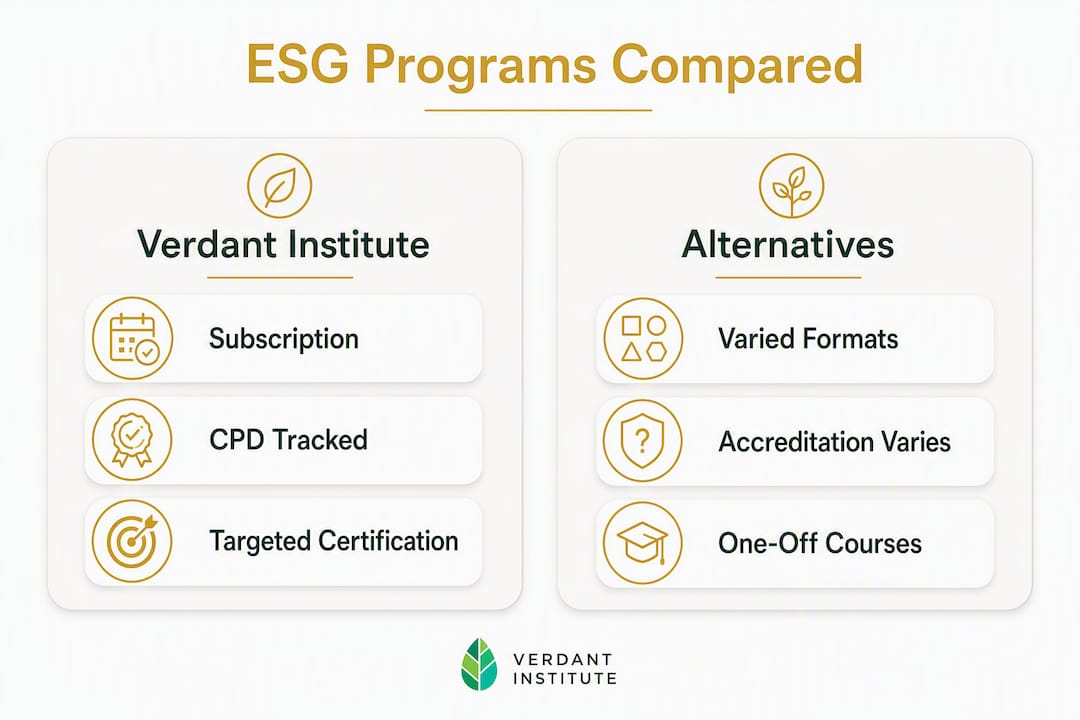
Verdant Institute is a subscription library of 16 courses and 160+ lessons organized into four tracks: Academic Foundations, Foundations, Deep Dives, and Advanced Practice. CPD hours are tracked automatically, and completion certificates are issued per course. Institutional licensing makes it practical for finance teams to train together under one agreement.
- Best for: Analysts, portfolio managers, and students who want a structured, role-mapped curriculum with ongoing CPD tracking
- Pricing: $18/month (students), $58/month (professionals); institutional licensing available
- Corporate training: Yes, with team licensing and admin features
CFA Institute Sustainable Investing Certificate
The CFA Institute Sustainable Investing Certificate covers ESG integration in investment decision-making, with annual curriculum updates that reflect current market practice. It carries strong employer recognition in asset management, particularly for roles that require demonstrating ESG competency to institutional clients.
- Best for: Portfolio managers and investment analysts in asset management
- Delivery: Self-paced online; approximately 100 hours of study
- Recognition: Widely cited in job postings for ESG-integrated investment roles
AICPA & CIMA FSA Credential
The FSA Credential is the clearest option when your role sits at the intersection of finance and sustainability reporting. Level I awards 15 CPE credits; Level II awards 12.5 CPE credits. Both are NASBA-recognized, which matters if you need CPE for CPA license maintenance.
- Best for: CPAs, finance directors, and sustainability reporting leads
- Delivery: Self-paced; 2–4 months per level
- Corporate training: Corporate billing available through AICPA & CIMA
GARP SCR Certificate
GARP's Sustainability & Climate Risk certificate targets risk professionals who need to model climate scenarios, assess transition risk, and communicate findings to senior stakeholders. It pairs well with existing FRM or CFA credentials rather than replacing them.
- Best for: Risk managers and credit analysts adding climate risk to their toolkit
- Delivery: Self-paced study plus a proctored exam
- Duration: 3–6 months typical preparation
PRI Academy
PRI Academy covers the Principles for Responsible Investment framework, stewardship, and ESG integration at the asset-owner level. It suits professionals in pension funds, endowments, or ESG officer roles who need fluency in responsible investment principles rather than technical carbon accounting.
- Best for: Stewardship and ESG governance roles
- Delivery: Self-paced; courses range from a few hours to several weeks
- Team training: Available
GRI Academy
GRI Academy trains professionals on the Global Reporting Initiative Standards, the dominant disclosure framework for corporate sustainability reports. If your job involves preparing or auditing a sustainability report, this is the most direct path to standards fluency.
- Best for: Sustainability reporting managers and assurance professionals
- Delivery: Self-paced online; days to weeks per course
- Team training: Available
Columbia University Executive Education
Columbia's sustainable finance executive programs are cohort-based, intensive, and priced at a premium. They suit senior leaders who want peer learning and institutional affiliation rather than a self-paced certificate. Expect a higher price point and a shorter, concentrated format.
- Best for: CFOs, heads of sustainability, and senior strategists
- Delivery: Cohort/live; typically weeks-long intensive format
- Pricing: Premium per program; not publicly listed as a flat rate
Pro Tip: Before enrolling in any executive program, ask the provider for a sample schedule, instructor CVs, and a list of recent cohort participants' roles. That tells you more about fit than the program page does.
How do you choose the right ESG program for your role?
Start with the decision that matters most: if your role requires producing disclosure reports or demonstrating regulatory readiness, a framework certification (FSA, GRI Academy, GARP SCR) is the right anchor. If you need to build a carbon model or run ESG screens next month, a skill-first course gets you there faster.
Selection checklist:
- Documented CPD/CPE credits — ask for the exact number before purchasing
- Alignment with employer or regulator expectations (ISSB/IFRS/SASB/CSRD where relevant)
- Curriculum balance between theory and applied work
- Named practitioner instructors with verifiable credentials
- Sample syllabus and assessment format available on request
- Team licensing and LMS integration if you are buying for a group
- Alumni outcomes or employer partnerships cited on the program page
Questions to ask any vendor:
- How many CPD/CPE credits does completion award, and which body recognizes them?
- Can you provide a sample certificate showing credit hours?
- What is the refund and retake policy?
- How is completion evidence formatted for employer CPD records?
Red flags: vague CPD claims with no accrediting body named, no sample syllabus available, instructor bios that list only academic titles with no industry experience, and no corporate licensing option for teams.
Pro Tip: To validate a CPD claim in under five minutes, ask the provider for a dated sample certificate that names the accrediting body. If they cannot produce one, treat the credit hours as unverified.
What learning path fits your role?
ESG career paths vary significantly by function. Here are three concrete sequences.
Portfolio manager (3–6 months):
- CFA Institute Sustainable Investing Certificate for investment-decision framing (~100 hours)
- Verdant Institute Deep Dives for sector-specific ESG integration and portfolio decarbonization
- Columbia Executive Education for strategic leadership context (optional, senior roles)
ESG analyst (4–10 weeks):
- Verdant Institute Foundations track for conceptual grounding (self-paced, 2–4 weeks)
- Skill-focused bootcamp covering GHG Scope 1–3 calculations with real-style datasets (1–8 weeks)
- FSA Credential Level I for CPE credits and reporting credibility (2–4 months, can run concurrently)
Student (6–12 months):
- Verdant Institute Academic Foundations track at $18/month — builds a documented learning record
- ESG certification step-by-step guide for sequencing credentials
- PRI Academy or GRI Academy certificate to add a recognized credential before job applications
Skill-focused bootcamps typically complete within several weeks; framework certifications may take multiple months. Budget time accordingly when planning CPD cycles.
Why these programs made the shortlist
Recommendations here prioritize four criteria: documented CPD/CPE accreditation, role fit, named practitioner instructors, and measurable outcomes such as certificate recognition and employer hiring patterns.
Evidence sources used:
- SFEC/CISI capacity-building report for industry alignment and qualification growth
- Growth For Impact practitioner guide for framework vs. skill tradeoff analysis
- Industry analysis on sustainable finance education for regulatory demand context
Verdant Institute is the publisher of this article and is recommended as a leading subscription option. Every comparison in this article emphasizes tradeoffs rather than declaring any alternative categorically better. The goal is to help you find the right fit for your role and CPD requirements.
Key Takeaways
Verdant Institute's subscription model, combined with a targeted framework certification, covers both CPD tracking and employer-recognized credentials for most U.S. finance roles.
| Point | Details |
|---|---|
| Fastest CPD path | AICPA & CIMA FSA (15 CPE at Level I) or Verdant Institute subscription for continuous tracking |
| Framework vs. skill | Choose framework certifications for reporting/compliance roles; choose skill-first courses for analyst deliverables |
| Verify before buying | Always request a dated sample certificate naming the accrediting body before purchasing any program |
| Red flag to avoid | Vague CPD claims with no named accrediting body are a reliable sign the credit hours are unverified |
| Verdant Institute | Subscription library of 16 courses with CPD tracking, role-mapped learning tracks, and institutional licensing for teams |
Why accredited training matters more than it did five years ago
The shift is regulatory, not philosophical. The release of ISSB and TNFD standards in 2023 pushed sustainability disclosure from voluntary to expected, and employers followed quickly. Finance teams that once treated ESG as a side competency now list it in job descriptions for analysts, risk managers, and portfolio managers alike.
What concerns me about the current market is the volume of programs that claim CPD hours without naming an accrediting body. That gap, between a certificate of completion and a verified CPD record, is where professionals get caught out when employers or regulators ask for evidence. The SFEC's work embedding sustainability into recognized professional qualifications is exactly the right response, but it has not yet reached every corner of the training market.
The shortlist in this article was built around one filter: can you hand the certificate to an employer's HR team and have them verify it independently? Programs that pass that test are worth your time and money. Programs that do not are not worth either, regardless of how polished the course page looks.
Verdant Institute: CPD-tracked ESG training built for finance professionals
Most of the programs above solve one problem well. Verdant Institute solves the whole stack: a subscription library of 16 courses and 160+ lessons, CPD hours tracked automatically, completion certificates issued per course, and institutional licensing for finance teams that need to train together.
The learning tracks move from Foundations through Deep Dives to Advanced Practice, so a new analyst and a senior portfolio manager can both find the right entry point without paying for content they do not need. Student plans start at $18/month; professional plans at $58/month. Teams and universities get institutional licensing with admin features built in.
Check the Verdant Institute pricing page for current subscription rates, or contact the team directly for an institutional quote.
Useful sources and further reading
- SFEC/CISI Global Capacity Building Report — industry qualification growth and learner volume data
- Growth For Impact: ESG Courses Explained — practitioner guide on framework vs. skill-based course selection
- Sustainable Finance Education Charter (Green Finance Institute) — charter scope, signatory bodies, and policy context
- Verdant Institute Sustainable Finance Skills Checklist — practical competency checklist for finance professionals