

A sustainable finance skills checklist defines the core competencies finance professionals need to integrate ESG principles into real investment and reporting decisions. This is not a soft list of buzzwords. It covers technical framework knowledge, data tools like Excel and Power BI, regulatory literacy across TCFD, SFDR, and CSRD, and the cross-functional communication skills that 70% of executives now expect to shape organizational strategy. Whether you are building toward your first ESG analyst role or advancing within a sustainability-focused finance team, this checklist gives you a clear map of what to develop and in what order.
1. What technical ESG frameworks every finance professional must know
ESG framework literacy is the non-negotiable foundation of any finance sustainability checklist. Regulators, asset managers, and corporate finance teams all operate within overlapping disclosure regimes. Not knowing the difference between TCFD and ISSB is the equivalent of a tax professional not knowing the difference between GAAP and IFRS.
The four frameworks you must understand are:
- TCFD (Task Force on Climate-related Financial Disclosures): Structures climate risk disclosure across governance, strategy, risk management, and metrics. Most major institutional investors now require TCFD-aligned reporting.
- SFDR (Sustainable Finance Disclosure Regulation): The EU regulation that classifies funds as Article 6, 8, or 9 based on their sustainability integration. Critical for anyone working with European asset managers or cross-border funds.
- CSRD (Corporate Sustainability Reporting Directive): Expands mandatory sustainability reporting to tens of thousands of EU companies. Finance professionals in corporate roles need to understand double materiality under CSRD.
- ISSB (International Sustainability Standards Board): Produces the IFRS S1 and S2 standards, which are becoming the global baseline for sustainability disclosure outside the EU.
Compliance with these frameworks is now mandatory for finance professionals in most institutional roles. Beyond knowing the names, you need to understand how each framework defines materiality, what data inputs each requires, and how they interact when a company reports across multiple jurisdictions.
Climate risk and scenario analysis knowledge sits alongside framework literacy. Understanding physical risk versus transition risk, and how to apply scenarios from the Network for Greening the Financial System (NGFS), is increasingly tested in interviews and required in day-to-day roles.
2. Which data tools drive ESG reporting and impact measurement
Data skills are where most finance professionals have the largest gap. The baseline tool is Excel, used for cleaning raw sustainability data, running ad hoc analysis, and building the underlying logic that feeds into reports. If your Excel skills stop at basic formulas, that is a problem. Pivot tables, Power Query, and error-checking routines for ESG data sets are the practical minimum.

| Tool | Primary use in ESG roles | Skill level required |
|---|---|---|
| Excel | Data cleaning, ad hoc analysis, KPI modeling | Intermediate to advanced |
| Power BI | Stakeholder dashboards, visual reporting | Intermediate |
| SQL | Querying large ESG datasets, database interrogation | Intermediate (strong differentiator) |
| Python / R | Advanced analytics, automation | Optional but growing in demand |
Power BI sits above Excel in the reporting chain. It turns cleaned data into dashboards that portfolio managers and sustainability committees can actually read. SQL is the skill that separates candidates in competitive hiring. The ability to query a large ESG dataset directly, without waiting for a data team, makes you faster and more credible.
Employers prioritize the ability to validate, troubleshoot, and explain ESG data clearly over deep mastery of every tool. That distinction matters. You do not need to be a data engineer. You need to be competent enough to catch errors, summarize findings, and explain your methodology to a non-technical stakeholder.
Pro Tip: When building your ESG data skills, practice explaining your Excel model or Power BI dashboard out loud to someone outside finance. If they understand the story, your analysis is ready for a real stakeholder presentation.
AI and machine learning tools are entering ESG workflows for tasks like automated materiality screening and sentiment analysis of sustainability reports. Familiarity with these tools is not yet a hiring requirement in most roles, but awareness of their applications puts you ahead of the curve. For a deeper look at where ESG data comes from before it reaches your tools, the ESG data sources guide from Verdantinstitute covers the major providers and their methodologies.
3. What soft and cross-functional skills complement technical expertise
Technical skills get you the interview. Soft skills get you the offer and keep you in the role. Finance professionals in sustainable finance now work cross-functionally with sustainability, compliance, legal, and operations teams. The ability to collaborate across those boundaries is a direct hiring priority, not a nice-to-have.
The green finance competencies that matter most beyond the technical layer include:
- Stakeholder communication: Translating complex ESG metrics into plain language for portfolio managers, board members, and clients. Recruiters rank this as one of the top criteria when hiring ESG analysts.
- Ethical judgment: Sustainable finance involves real decisions about what counts as green, what constitutes greenwashing, and how to handle data that tells an inconvenient story. Integrity in reporting is not optional.
- Ambiguity tolerance: ESG data is often incomplete, inconsistent, or contested. Finance professionals who freeze without perfect data do not last long in these roles.
- Learning agility: Regulations change fast. CSRD scope expanded significantly in recent years. The ISSB released its first standards in 2023. Professionals who treat their knowledge as fixed will fall behind.
Pro Tip: In behavioral interviews for ESG roles, shift from "I did" to "We achieved" language to signal teamwork maturity. Then immediately follow with a specific detail about your personal contribution so the interviewer knows exactly what you owned.
This tip comes directly from what interviewers in multinational ESG roles look for. Candidates who speak only in "I" terms read as poor collaborators. Candidates who speak only in "We" terms raise questions about individual accountability. The balance is the skill.
For a broader view of why these interpersonal skills now carry equal weight to technical credentials, the Verdantinstitute article on ESG skills demand breaks down the hiring trend in detail.
4. How to build your sustainable finance skill set with certifications and experience
Knowing what skills you need is step one. Building a plan to acquire and demonstrate them is step two. The most effective approach combines structured certification with practical, portfolio-based experience.
-
Choose a recognized certification program. The HKGFA-CASI Certificate in Sustainable Finance is one example of a structured program. It requires roughly 60 study hours completed within six months, with a 90-minute assessment. The curriculum spans six modules and includes live expert webinars and networking opportunities. That format gives you both knowledge and professional connections.
-
Build a portfolio of ESG artifacts. A portfolio with verified ESG work samples, such as a materiality assessment, a TCFD-aligned climate risk report, or a Power BI sustainability dashboard, substantiates your claims during interviews. Hiring managers in ESG roles respond to evidence, not assertions.
-
Seek internal ESG exposure. If you are already working in finance, volunteer for sustainability reporting projects, internal ESG working groups, or impact measurement initiatives. These experiences build your resume and your judgment simultaneously.
-
Complete internships or project-based work. For aspiring practitioners, internships at asset managers, development finance institutions, or corporate sustainability teams provide the real-world context that no course can fully replicate.
-
Prepare for multilingual technical interviews. For international roles, interviewers sometimes switch languages mid-interview to test technical fluency under cognitive load. Practicing ESG vocabulary in a second language, if relevant to your target market, is a concrete preparation step most candidates skip.
The combination of sustainability literacy, data analytics, financial modeling, and regulatory understanding is what creates long-term value in these roles. No single certification delivers all four. The professionals who advance fastest treat their skill development as a portfolio, not a checklist to complete once and forget.
For a detailed breakdown of where these skills lead in terms of specific roles, the Verdantinstitute guide on ESG career pathways maps the most common trajectories from analyst to senior practitioner.
Key takeaways
A sustainable finance career requires equal investment in technical framework knowledge, data tool proficiency, and cross-functional communication skills. No single competency is sufficient on its own.
| Point | Details |
|---|---|
| Framework literacy is non-negotiable | Know TCFD, SFDR, CSRD, and ISSB before applying to any ESG finance role. |
| Data tools follow a clear hierarchy | Excel is the baseline; Power BI handles reporting; SQL is the differentiator in competitive hiring. |
| Soft skills drive hiring decisions | Cross-functional collaboration and stakeholder communication rank as top recruiter priorities. |
| Certifications need portfolio backing | Pair structured programs like HKGFA-CASI with real ESG work samples to substantiate your expertise. |
| Learning agility is a core skill | Regulations change fast; professionals who treat their knowledge as fixed fall behind quickly. |
What I have learned about building sustainable finance skills that actually stick
The most common mistake I see finance professionals make is treating sustainable finance training as a knowledge problem. They take a course, learn the frameworks, and expect the skills to follow. They do not.
The skills that actually transfer to real roles come from applying what you learn in conditions that approximate real work. That means building a dashboard with messy, real-world ESG data, not a clean training dataset. It means writing a TCFD-aligned section of a climate risk report and having someone who knows the framework critique it. Theory without application produces candidates who can define double materiality but cannot produce a materiality matrix under deadline pressure.
The second thing I would push back on is the instinct to master every tool before moving forward. The goal with Excel, Power BI, and SQL is not mastery. It is competence with context. Employers want someone who can clean a dataset, spot an anomaly, and explain what it means for a portfolio decision. That is a much more achievable target than becoming a data engineer, and it is the target that actually gets people hired.
The ethical dimension is the piece most training programs underweight. Sustainable finance involves judgment calls about what counts as green, how to handle conflicting data, and when to push back on a disclosure that does not tell the full story. That judgment does not come from a textbook. It comes from exposure to real decisions and from working alongside people who take integrity seriously. Seek those environments deliberately.
— Charles
Verdantinstitute: structured training for sustainable finance professionals
Finance professionals who want to close the gap between knowing the frameworks and applying them in real roles need more than reading lists.
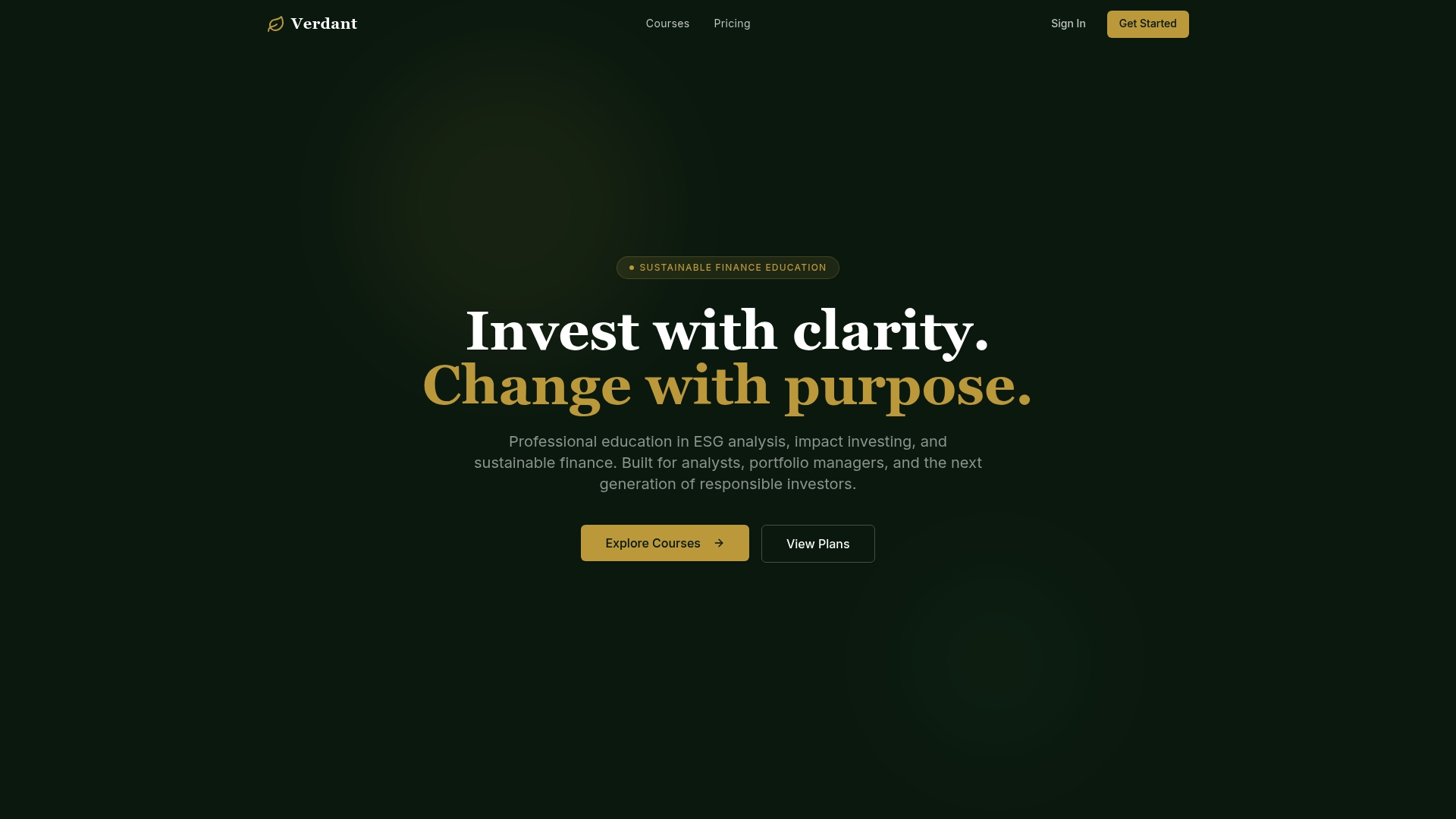
Verdantinstitute offers 16 structured courses and over 160 lessons covering everything from ESG foundations to advanced topics like transition finance and net-zero strategies. The platform includes CPD tracking, certifications, and real-world case studies built for practitioners, not students memorizing theory. Plans start at $18 per month for students and $58 per month for professionals. For a full breakdown of what each plan includes, the Verdantinstitute pricing page lists every feature by tier. If you are ready to build a skill set that holds up in interviews and on the job, Verdantinstitute is where that work starts.
FAQ
What is a sustainable finance skills checklist?
A sustainable finance skills checklist is a structured list of technical and interpersonal competencies finance professionals need for ESG integration. It typically covers framework knowledge, data tools, regulatory literacy, and cross-functional communication.
Which ESG frameworks should finance professionals know first?
TCFD and SFDR are the most widely required frameworks in institutional finance roles. CSRD and ISSB standards are increasingly tested in corporate and global investment contexts.
How long does it take to get a sustainable finance certification?
Programs like the HKGFA-CASI Certificate in Sustainable Finance require roughly 60 study hours completed within six months, with a 90-minute final assessment.
Are data skills like SQL required for ESG analyst roles?
SQL is not universally required but is a strong differentiator in competitive hiring. Excel and Power BI are the baseline expectations for most sustainability data analyst positions.
How do I demonstrate sustainable finance skills without years of experience?
Build a portfolio of ESG artifacts such as materiality assessments, climate risk reports, or sustainability dashboards. Verified work samples carry more weight in interviews than credentials alone.