

If you've been considering a role in sustainable finance, understanding what does an ESG analyst do is the right place to start. The reality is sharper than most career pages let on: this is a data-intensive, finance-facing role where your ability to translate non-financial risk into investment language matters far more than any passion for the environment. ESG analyst responsibilities sit at the intersection of regulatory compliance, financial modeling, and investor reporting. Get this distinction right early, and you'll position yourself far ahead of candidates who walk into interviews thinking it's mostly about corporate values.
Table of Contents
- Key Takeaways
- What does an ESG analyst do every day?
- Skills and qualifications for ESG analysts in 2026
- ESG analyst career paths and compensation
- How ESG analysts add value to investment decisions
- My take on what this role really demands
- Build the skills that ESG employers want
- FAQ
Key Takeaways
| Point | Details |
|---|---|
| ESG is finance, not PR | ESG analysts work within risk, reporting, and valuation frameworks, not communications or CSR teams. |
| Daily tasks are technical | Data collection, KPI monitoring, regulatory disclosure, and financial model integration define the workday. |
| Certifications signal credibility | The CFA ESG Certificate and CESGA are the most recognized credentials for landing and advancing in ESG roles. |
| AI is raising the bar | Routine data tasks are being automated, making interpretation, storytelling, and financial framing the new differentiators. |
| Career paths are broad | ESG analysts work across asset managers, banks, consultancies, and ratings agencies, each with distinct growth trajectories. |
What does an ESG analyst do every day?
The ESG analyst role explained simply: you gather, validate, and interpret environmental, social, and governance data to inform investment decisions and fulfill regulatory reporting obligations. That's the job. But breaking it into daily tasks reveals why finance training matters so much here.
Core daily tasks include ESG data collection, KPI monitoring against frameworks like TCFD and CSRD, supporting investor disclosures, and integrating ESG risks into financial models. On any given day, an analyst might be cleaning a dataset from a third-party data provider, cross-checking a company's Scope 1 and Scope 2 emissions disclosures, or preparing a section of a fund's sustainability report for regulators.
One concept that shapes how analysts prioritize their work is double materiality. Double materiality means assessing sustainability issues from two directions: the company's impact on the environment or society, and how those sustainability factors financially affect the company itself. In practice, this determines which ESG issues get escalated to portfolio managers and which ones sit in the appendix.
It's also worth clarifying where the ESG analyst job description sits relative to similar titles. ESG analysts differ from sustainability analysts and CSR officers in that the ESG analyst role is more technical, more finance-facing, and more tightly aligned with structured regulatory frameworks and investor expectations. A CSR officer manages community programs. A sustainability analyst might focus on operational footprint. An ESG analyst is building the risk case for an investment committee.
Pro Tip: When reviewing a job posting, look for mentions of TCFD, SFDR, CSRD, or SASB. These signal a genuine finance-side ESG role rather than a relabeled marketing or communications position.
One uncomfortable truth about entry-level ESG work: beginners face significant time on data cleaning and audit documentation before getting anywhere near strategic analysis. That's not a flaw in the career. It's the foundation.
Skills and qualifications for ESG analysts in 2026
The skills needed for an ESG analyst in 2026 span three categories: technical, conceptual, and commercial. Candidates who treat this role as solely requiring sustainability knowledge consistently underperform against those who bring financial rigor.
Here are the core competencies hiring managers actually test for:
- Financial analysis and data handling. Excel proficiency remains essential, but Python and SQL are now real differentiators, particularly for processing the large, often messy datasets that come from ESG data providers and corporate disclosures.
- Framework literacy. You need working knowledge of TCFD (climate-related financial disclosures), SASB (sector-specific accounting standards), and CSRD (the EU's corporate sustainability reporting directive). These aren't just buzzwords. They structure the entire reporting logic analysts operate within.
- Recognized certifications. CFA ESG Certificate and CESGA are the two credentials that consistently appear in ESG analyst job postings and signal to hiring managers that you understand the foundational language of the field. They also provide structured preparation for technical interview questions.
- Commercial instinct. This is the most overlooked skill in the field. Translating an emissions data point into an adjusted valuation, or mapping supply chain risk into a credit spread, requires you to think like an investment analyst, not an environmental scientist.
- Communication and interpretation. Junior ESG roles now demand storytelling and interpretation beyond data collection. Portfolio managers and clients want to understand what the data means for their returns, not just what the numbers say.
Pro Tip: Don't wait until you have a job to learn Python basics. Free resources and a few hours a week can get you to a level that genuinely differentiates your application, especially for roles at data-heavy firms like ratings agencies or quant-oriented asset managers.
Hiring managers prioritize candidates who combine ESG certification with strong financial analysis skills. Passion for sustainability alone does not close the gap. If you're a student, the certification pathways guide from Verdantinstitute is a practical starting point for sequencing your credentials.

ESG analyst career paths and compensation
Understanding the ESG analyst career path means knowing both where you can start and where the role leads, because the trajectory is less linear than in traditional finance.
Entry-level positions typically carry titles like ESG Research Associate, Sustainability Data Analyst, or Junior ESG Analyst. These roles exist across a wide range of employers:
- Asset managers and hedge funds (BlackRock, Vanguard, Schroders): Focus on portfolio-level ESG integration and investor reporting.
- Investment banks (Goldman Sachs, JPMorgan): ESG roles tied to sustainable finance products, green bonds, and regulatory compliance.
- ESG ratings agencies (MSCI, Sustainalytics): Heavy data work, benchmarking, and methodology development.
- Management consultancies (McKinsey, Deloitte): ESG strategy and reporting advisory for corporate clients.
- Corporates and pension funds: In-house ESG teams managing disclosure and risk.
For more on how these sectors stack up, the ESG career pathways breakdown from Verdantinstitute covers role distinctions across employer types.
On compensation, the numbers reflect where you sit in the market. The median ESG analyst salary in San Francisco reaches $124,000 in 2026, with a range of $95,000 to $165,000 depending on seniority and employer type. Finance firms pay a 15 to 25 percent premium over nonprofits and public sector roles.
| Employer type | Typical entry salary | Senior analyst range |
|---|---|---|
| Investment bank | $85,000–$105,000 | $130,000–$165,000 |
| Asset manager | $80,000–$100,000 | $120,000–$155,000 |
| Ratings agency | $70,000–$90,000 | $100,000–$130,000 |
| Consultancy | $75,000–$95,000 | $110,000–$145,000 |
| Corporate/in-house | $65,000–$85,000 | $95,000–$120,000 |
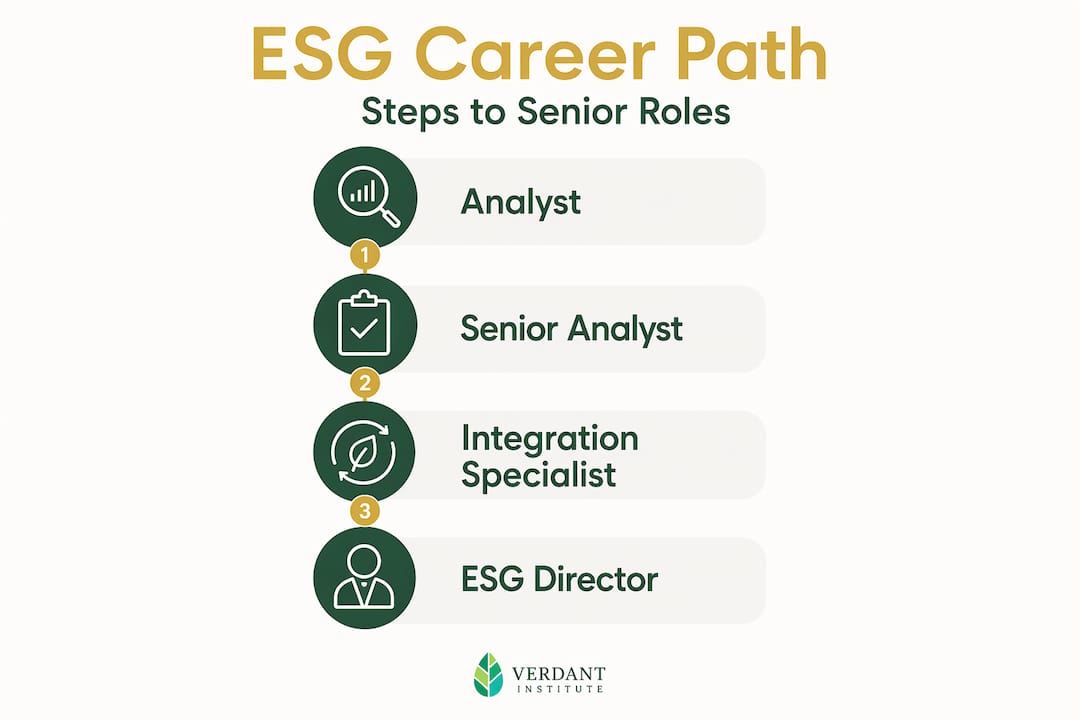
Progression from analyst to senior analyst to portfolio integration specialist or ESG director typically takes four to eight years, depending heavily on the credentials you hold and the quality of the deals or reports you can point to as outputs.
How ESG analysts add value to investment decisions
The role of ESG analyst within a finance organization is ultimately about making risk visible. ESG analysts provide insights on carbon emissions, diversity metrics, governance structures, and other factors that influence strategic investment decisions and portfolio construction.
What this looks like in practice is specific. An analyst covering the energy sector might model how a proposed EU carbon border adjustment affects the operating margins of a portfolio company. An analyst at a credit rating firm might assess whether water scarcity in a company's key manufacturing region constitutes a material credit risk within the next five years.
Successful ESG analysts connect ESG risks directly to financial impacts, such as adjusting a company's valuation based on carbon emission risk, rather than framing issues in terms of abstract regulatory compliance. That framing shift is what separates analysts who get promoted from those who stay in data entry.
The compliance dimension is also growing. With the CSRD now requiring tens of thousands of European companies to publish detailed sustainability disclosures, organizations need analysts who understand both the reporting logic and the data architecture behind those submissions. This is covered well in the Verdantinstitute piece on ESG disclosure research and its relevance to investment quality.
Pro Tip: When presenting ESG findings internally, always anchor your analysis to a financial metric first. Frame it as: "This emissions exposure represents an estimated X% downside to EBITDA under a carbon price scenario of $Y." That language gets investment committees to act.
The most important contribution ESG analysts make is translating complexity into decisions. The data exists. The frameworks exist. The analysts who add real value are the ones who tell a clear story about what it means for returns, risk, and capital allocation.
My take on what this role really demands
I've seen many candidates stumble into ESG analyst interviews expecting to discuss values and impact, only to face questions about TCFD scenario modeling and SFDR Article 8 classification. The gap between expectation and reality in this field is real, and it costs people opportunities.
What I've learned from observing how this field evolves is that the ESG analyst role has never been primarily about doing good. It's about making sure that non-financial risk doesn't become a financial surprise. The firms that treat it any other way tend to produce reports nobody reads and analysis nobody acts on.
The AI shift is also not overstated. AI now automates routine benchmarking and reporting tasks that used to fill a junior analyst's first two years. That's not a threat to the career. It's a signal that the entry point is moving. Newcomers who arrive with Python skills, CFA ESG knowledge, and the ability to write a crisp investment memo stand in a fundamentally different place than those who rely on spreadsheet work alone.
My advice to anyone pursuing ESG analyst skills for graduates: stop thinking about this as a sustainability career and start thinking about it as a finance career with a sustainability specialization. The rigor, the vocabulary, and the outputs are all rooted in capital markets. The faster you internalize that, the faster you'll move.
— Charles
Build the skills that ESG employers want

Understanding the ESG analyst role is the foundation. Building the skills that get you hired and promoted is the next step. Verdantinstitute offers a structured e-learning ecosystem built specifically for finance professionals and students who want to develop real, applicable ESG expertise. From foundational ESG frameworks to advanced topics like transition finance and net-zero strategy, the course library covers what the job actually demands.
With over 160 lessons across 16 courses, CPD tracking, and recognized certifications, Verdantinstitute equips you with the credentials and analytical depth that hiring managers are actively screening for. Student plans start at $18 per month and professional plans at $58 per month. Explore the full course catalog and pricing to find the track that fits your current level and career goals.
FAQ
What is an ESG analyst?
An ESG analyst is a finance professional who collects, validates, and interprets environmental, social, and governance data to assess investment risk and support regulatory reporting. The role sits firmly within finance and risk management, not communications or corporate responsibility.
What qualifications do ESG analysts need?
Most ESG analyst positions require a finance or related degree, working knowledge of frameworks like TCFD and SASB, and ideally a recognized certification such as the CFA ESG Certificate or CESGA. Technical skills including Excel, Python, and SQL are increasingly expected.
How much does an ESG analyst earn?
Salaries vary by employer type and geography. In San Francisco, the median ESG analyst salary is $124,000 in 2026, with finance firms paying a 15 to 25 percent premium over other sectors.
How does AI affect ESG analyst roles?
AI is automating routine data benchmarking and reporting tasks. This raises expectations for junior analysts to demonstrate stronger interpretation, financial framing, and storytelling skills rather than relying on manual data processing.
What's the difference between an ESG analyst and a sustainability analyst?
An ESG analyst is typically more finance-facing, working with structured reporting frameworks and investor-grade disclosures. A sustainability analyst often focuses more on operational footprint and corporate programs, with less direct connection to investment decision-making.