

ESG corporate culture is defined as the embedding of environmental, social, and governance principles into daily business decisions, operations, and leadership behavior. Companies that treat ESG as a cultural value rather than a compliance checkbox consistently outperform peers on risk-adjusted returns. High-ESG firms outperform low-ESG peers by 1.2 to 3.8 percentage points annually. That gap is not an accident. It reflects what happens when sustainability thinking shapes how people work every day, not just what gets reported at year-end.
Why ESG corporate culture matters for financial performance
The financial case for ESG culture is grounded in measurable outcomes, not theory. Companies with strong ESG integration see their cost of capital fall by 18 to 32 basis points for every standard deviation improvement in ESG performance. That reduction reflects lower perceived risk from lenders and investors who see ESG culture as a signal of operational discipline.
Operational benefits compound the financial gains. Supply chains managed under ESG principles face fewer disruptions. Regulatory compliance becomes proactive rather than reactive. Talent retention improves because employees want to work for organizations whose values align with their own. Each of these factors reduces cost and protects revenue in ways that show up directly in financial statements.

The most significant gains appear early. ESG operational gains are largest as companies move from low to mid-level ESG maturity. That means the first genuine cultural shift produces outsized returns compared to incremental improvements at higher maturity levels.
| Financial Benefit | What the Data Shows |
|---|---|
| Risk-adjusted returns | 1.2–3.8 percentage points above low-ESG peers annually |
| Cost of capital | 18–32 basis points lower per standard deviation ESG improvement |
| Financial reporting quality | Higher ethical culture reduces earnings restatements and fraud risk |
| Talent and productivity | Stronger ESG culture improves employee engagement and motivation |
| Regulatory exposure | Proactive ESG practices reduce compliance costs and legal risk |
Pro Tip: Prioritize foundational culture shifts before chasing marginal ESG score improvements. The data shows the biggest financial gains come from moving off a low baseline, not from optimizing an already mature program.
How do different culture types shape ESG outcomes?
Not every organizational culture drives ESG performance in the same way. A study of 468 Fortune 500 firms covering 2015 to 2023 found that distinct culture profiles produce distinct ESG results. The finding matters because it means culture is not just a backdrop for ESG. It is an active driver of which ESG pillars a company can realistically strengthen.
Hierarchical cultures, which emphasize structure, process, and clear accountability, tend to support environmental performance when backed by adequate resources. The discipline that makes hierarchies effective at following rules also makes them effective at reducing emissions, managing waste, and meeting environmental targets. Adhocracy and market cultures, which reward experimentation and competitive outcomes, drive stronger social and governance results. These cultures generate the agility and external focus needed to build stakeholder trust and improve board accountability.
The practical implication is that leaders should not try to force a single culture type across all ESG pillars. A balanced or mixed cultural profile, one that combines elements of hierarchy with market or adhocracy traits, produces the best overall ESG performance.
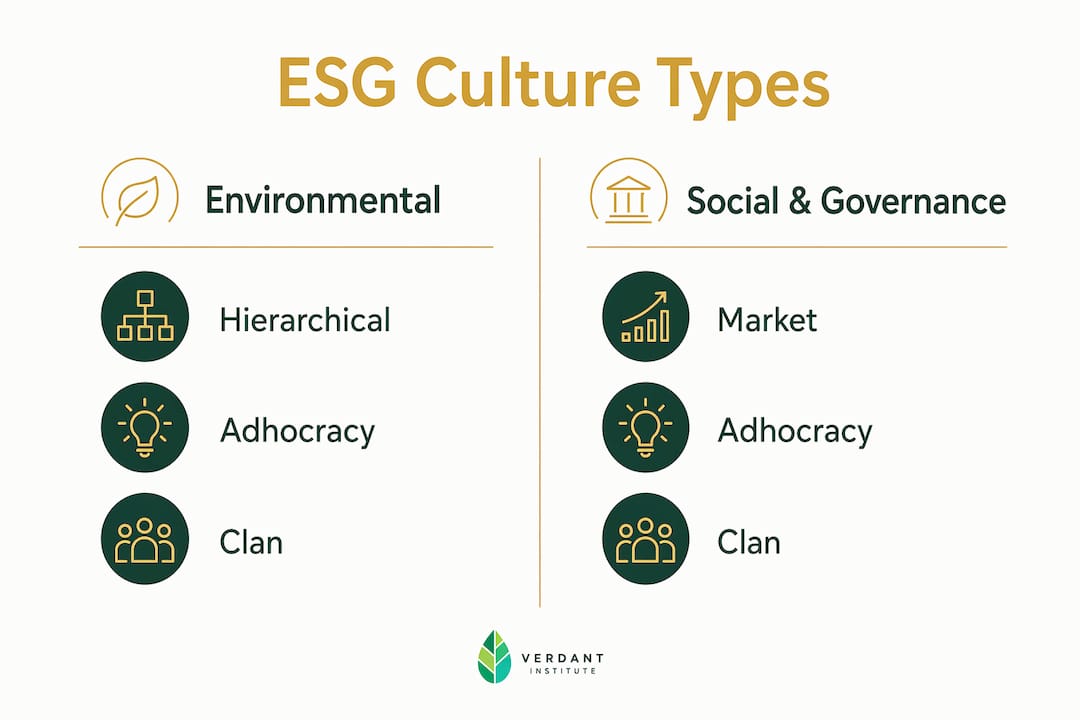
| Culture type | Environmental | Social | Governance |
|---|---|---|---|
| Hierarchical | Strong | Moderate | Moderate |
| Adhocracy | Moderate | Strong | Strong |
| Market | Moderate | Strong | Strong |
| Balanced or mixed | Strong | Strong | Strong |
Leadership and resource allocation determine whether a culture type actually activates its ESG potential. A hierarchical culture without budget for environmental programs produces no environmental gains. An adhocracy culture without leadership modeling ethical behavior will not improve governance. Culture creates the conditions. Leaders and resources determine the outcome.
What role does leadership play in credible ESG culture?
Credibility is the prerequisite for ESG value creation. ESG benefits depend on alignment between disclosed metrics and actual practices. When that alignment breaks down, the result is greenwashing, and greenwashing destroys the financial and reputational gains that genuine ESG culture produces.
Corporate culture acts as an informal governance mechanism. In competitive markets, a strong internal culture drives higher-quality ESG disclosure even without formal regulatory pressure. That means culture can substitute for regulation when it is authentic, and it can expose a company to regulatory and reputational risk when it is not.
Leaders build credible ESG culture through specific, visible actions:
- Tie executive compensation to ESG metrics so that incentives match stated values.
- Report ESG outcomes transparently, including failures and corrective actions, not just successes.
- Embed ESG criteria into capital budgeting so that investment decisions reflect environmental and social priorities.
- Engage employees directly in ESG goal-setting to build ownership rather than compliance.
- Conduct regular culture audits to identify gaps between stated ESG values and actual behavior.
- Hold suppliers to ESG standards through procurement criteria and ongoing monitoring.
The "Social" dimension of ESG covers human capital, leadership behavior, and incentive design. These factors directly influence financial reporting quality and risk management outcomes. A weak internal culture signals increased risk of financial instability regardless of what a company publishes in its ESG report.
Pro Tip: Avoid the trap of ESG branding without ESG behavior. Investors and employees now scrutinize the gap between public commitments and internal practices. Closing that gap is the single most effective thing a leader can do to protect ESG-related value.
How can leaders practically embed ESG values into their organizations?
Embedding ESG into corporate culture requires deliberate integration across strategy, operations, and daily decision-making. Policies and reports matter, but ESG outcomes happen during normal workdays, shaped by the choices employees make when no one is watching. That is the definition of a living culture.
A practical integration process follows a clear sequence:
- Assess materiality first. Identify which ESG issues are financially material to your business. ESG integration works best when focused on material issues with clear return on investment and internal metrics tied to financial outcomes. Not every ESG topic carries equal weight for every industry.
- Embed ESG into existing decision frameworks. Add ESG criteria to capital budgeting templates, supplier selection scorecards, and project approval processes. This makes ESG a factor in routine decisions rather than a separate exercise.
- Redesign incentive structures. Link manager and executive bonuses to ESG metrics alongside financial targets. Incentives shape behavior faster than any training program.
- Invest in education at every level. Leaders need technical ESG knowledge to make credible decisions. Verdantinstitute offers structured learning tracks covering ESG foundations through advanced topics like transition finance and net-zero strategies, giving finance professionals the depth they need to lead credibly.
- Track internal ESG metrics tied to financial performance. Revenue per unit of carbon, employee turnover costs, supplier risk incidents. These numbers connect ESG activity to business outcomes in language that finance teams understand.
- Run annual culture audits. Survey employees on whether ESG values show up in daily decisions. Compare results to external ESG disclosures. Gaps between internal culture and external reporting are early warning signs of credibility risk.
Pro Tip: Start with ESG integration best practices designed specifically for finance professionals. The frameworks used in financial services translate directly to capital allocation, risk assessment, and reporting, which are the three areas where ESG culture produces the fastest measurable results.
Key Takeaways
ESG corporate culture creates measurable financial and operational value when it is embedded in daily decisions, leadership behavior, and incentive structures rather than treated as a reporting exercise.
| Point | Details |
|---|---|
| Financial outperformance | High-ESG firms earn 1.2–3.8 percentage points more annually on a risk-adjusted basis. |
| Lower cost of capital | Each standard deviation ESG improvement cuts cost of capital by 18–32 basis points. |
| Culture type determines ESG pillar strength | Hierarchical cultures drive environmental results; adhocracy and market cultures drive social and governance outcomes. |
| Credibility is non-negotiable | ESG value disappears when disclosed metrics do not match actual practices. |
| Living culture beats written policy | Real ESG gains come from daily operational choices, not annual reports. |
The uncomfortable truth about ESG culture most leaders miss
Most ESG programs I have seen fail at the same point. They produce excellent documentation and mediocre behavior change. Leaders invest in reporting frameworks, hire sustainability officers, and publish ambitious targets. Then they leave the actual culture untouched.
The research is clear on this. Weak internal culture signals financial instability risk independent of what a company discloses publicly. That means you can have a polished ESG report and still carry the risk profile of a company with no ESG program at all. The report does not protect you. The culture does.
What actually works is slower and less visible. It is a CFO who asks about carbon exposure in a capital budgeting meeting. It is a procurement team that drops a supplier over labor practices without being told to. It is a board that reviews ESG metrics with the same rigor as quarterly earnings. These behaviors compound over time. They are also genuinely hard to fake, which is exactly why they create durable competitive advantage.
The leaders who get this right treat ESG culture as a behavior change program, not a communications program. They measure it internally before they report it externally. And they accept that the long-term performance gains from genuine ESG integration take years to fully materialize. Patience is part of the strategy.
— Charles
Verdantinstitute: build the ESG knowledge your culture needs
Embedding ESG into corporate culture requires leaders who understand the financial mechanics behind it. Verdantinstitute provides structured ESG and sustainable finance training built for finance professionals and corporate leaders who need more than surface-level awareness.

The platform covers ESG foundations, materiality frameworks, transition finance, and net-zero strategies across 16 courses and over 160 lessons. CPD tracking and certifications make the learning credible for professional development purposes. Plans start at $18 per month for students and $58 per month for professionals. Leaders ready to build a culture that holds up to scrutiny can review the full course and pricing options and find the track that fits their team's current knowledge level.
FAQ
What is ESG corporate culture?
ESG corporate culture is the integration of environmental, social, and governance principles into daily business decisions, leadership behavior, and employee practices. It goes beyond compliance to shape how a company operates at every level.
How does ESG culture affect financial performance?
High-ESG firms outperform low-ESG peers by 1.2 to 3.8 percentage points annually on a risk-adjusted basis, and each standard deviation improvement in ESG performance reduces cost of capital by 18 to 32 basis points.
What is the difference between ESG culture and ESG reporting?
ESG reporting documents outcomes. ESG culture determines those outcomes by shaping the daily choices employees and leaders make. Strong reporting without strong culture produces greenwashing risk, not financial value.
How does organizational culture type affect ESG outcomes?
A study of 468 Fortune 500 firms found that hierarchical cultures support environmental performance, while adhocracy and market cultures drive stronger social and governance results. Mixed cultural profiles produce the best overall ESG performance.
How can leaders avoid greenwashing in their ESG programs?
Leaders avoid greenwashing by aligning disclosed ESG metrics with actual internal practices, tying executive incentives to ESG outcomes, and conducting regular culture audits to close gaps between stated values and real behavior.