

ESG skills are defined as the professional competencies required to analyze, report on, and integrate environmental, social, and governance factors into business strategy, financial analysis, and operational decision-making. These skills are no longer optional for finance and sustainability professionals. Green hiring growth is running at 7.7% globally while the supply of workers with verified green skills grows at only 4.3%. That gap is widening every year, and employers are paying a premium to close it. Mandatory frameworks like the Corporate Sustainability Reporting Directive (CSRD) and the International Sustainability Standards Board (ISSB) have converted sustainability reporting from a voluntary exercise into a legal compliance function. The CFA Institute now treats ESG literacy as core financial knowledge, not a specialist add-on. For finance professionals and job seekers, understanding why ESG skills are in demand is the first step toward positioning yourself where the market is moving.
Why are ESG skills in demand across business and finance?
Three forces are driving the demand for sustainability expertise simultaneously: regulatory pressure, investor expectations, and business risk management. Each one alone would create hiring demand. Together, they are reshaping job descriptions across every major industry.
Regulatory compliance has become non-negotiable
Mandatory sustainability reporting under frameworks like CSRD and ISSB has shifted ESG from a goodwill effort to a legal audit function. Companies operating in the European Union must now produce audit-ready sustainability disclosures, and similar requirements are advancing in the United States, the United Kingdom, and across Asia-Pacific. Organizations that cannot produce accurate, verifiable ESG data face regulatory penalties and reputational damage. That creates direct demand for professionals who understand reporting standards, data verification, and disclosure methodology.

Investor and stakeholder pressure
Asset managers, pension funds, and institutional investors now screen portfolios for ESG risk as a standard part of due diligence. The CFA Institute has made clear that investment professionals must integrate ESG factors into core financial analysis, including cash flow modeling and capital allocation decisions. Sustainability is no longer a "nice-to-have" consideration. It directly affects valuations, cost of capital, and long-term financial performance.
The core drivers at a glance
- Regulatory compliance: CSRD, ISSB, and SEC climate disclosure rules require audit-ready ESG data from finance teams
- Investor scrutiny: Institutional investors embed ESG criteria into portfolio screening and manager selection
- Risk management: Climate-related financial risks, supply chain exposure, and social license to operate now appear on balance sheets
- Legal liability: Poor ESG performance generates shareholder litigation, regulatory fines, and market exclusion
- Stakeholder expectations: Employees, customers, and communities hold companies accountable for social and environmental commitments
Each of these drivers requires professionals who can translate ESG policy into measurable, defensible business practice. That is precisely the skill set employers cannot find in sufficient supply.
How does ESG demand vary across industries, especially in finance?
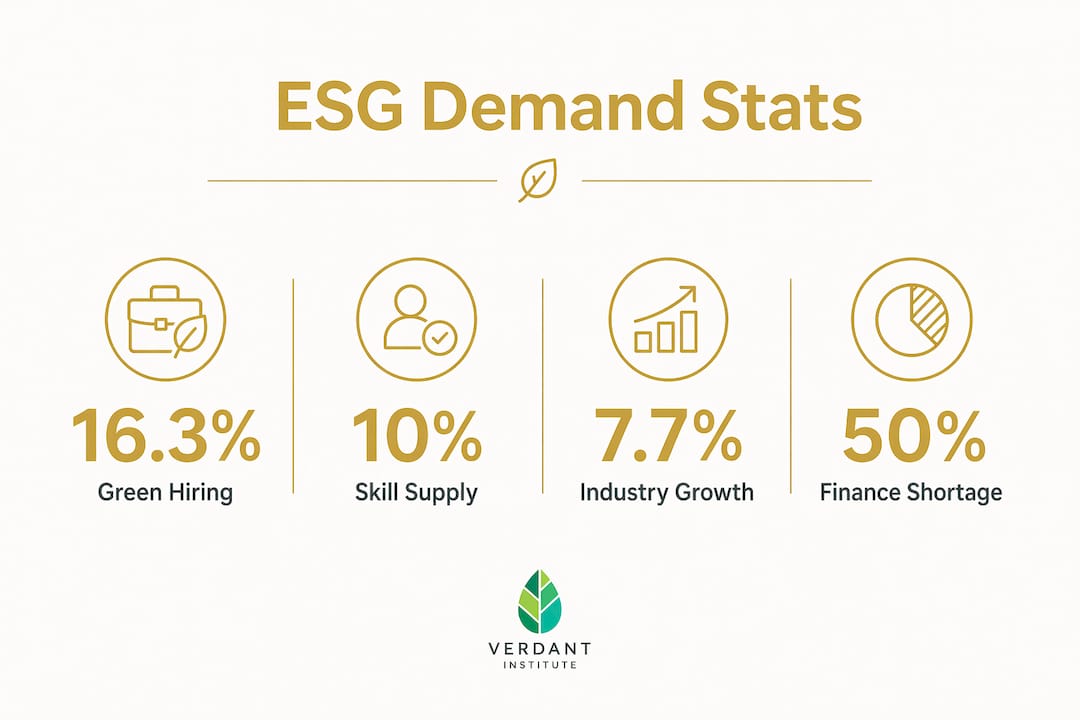
The financial services sector is experiencing the sharpest talent shortage of any industry. Financial services green hiring grew 16.3% year on year, yet only about 10% of workers in the sector currently hold verified green skills. That ratio is unsustainable for an industry now required to report on climate risk, sustainable investment mandates, and ESG-integrated portfolios.
| Industry | ESG skill demand driver | Key roles affected |
|---|---|---|
| Financial services | Regulatory reporting, ESG integration in portfolios | Analysts, portfolio managers, risk officers |
| Energy and utilities | Net-zero transition, carbon accounting | Engineers, project managers, compliance teams |
| Procurement and supply chain | Scope 3 emissions, supplier ESG audits | Procurement managers, operations leads |
| Accounting and audit | CSRD assurance, sustainability disclosures | Auditors, CFOs, financial controllers |
| Real estate | Green building standards, climate risk | Asset managers, valuers, developers |
The pattern across all sectors is the same. ESG skills are embedding across departments rather than sitting inside standalone sustainability teams. A procurement manager who understands Scope 3 emissions is more valuable than one who does not. An accountant who can prepare CSRD-compliant disclosures commands a premium over a peer who cannot. The bottleneck is not the number of sustainability professionals. It is the absence of ESG competency distributed across core business roles in finance, engineering, and operations.
Pro Tip: If you work in finance, you do not need to become a sustainability specialist to benefit from ESG skills. Adding one specific competency, such as ISSB reporting or carbon accounting, to your existing role makes you significantly more competitive in the current hiring market.
Which ESG skills do employers value most in 2026?
Employers are not looking for generalists who can describe ESG frameworks in broad terms. They want professionals who can execute. Successful ESG candidates combine technical knowledge with change management and collaboration skills to embed sustainability into operations. That dual competency is the defining characteristic of high-value ESG professionals in 2026.
Technical skills employers are hiring for
- Carbon accounting: Measuring, verifying, and reporting Scope 1, 2, and 3 greenhouse gas emissions under GHG Protocol standards
- Regulatory reporting: Preparing disclosures compliant with CSRD, ISSB S1 and S2, and Task Force on Climate-related Financial Disclosures (TCFD) frameworks
- ESG data analytics: Working with ESG data sources and AI-enhanced tools to assess company performance and portfolio exposure
- ESG disclosure analysis: Evaluating third-party sustainability reports for accuracy, completeness, and alignment with reporting standards
- Sustainable finance instruments: Understanding green bonds, sustainability-linked loans, and ESG-screened investment strategies
Soft skills that separate good candidates from great ones
Technical knowledge alone does not get ESG commitments implemented. Companies seek professionals who can translate ESG policy into operational programs, which requires stakeholder influence, cross-functional collaboration, and change management capability. An ESG analyst who can build a carbon model but cannot communicate its implications to a CFO or a board is only half as useful as one who can do both.
Sustainability literacy across departments is now a stated priority for HR leaders. Organizations are embedding sustainability knowledge throughout finance, procurement, and operations rather than concentrating it in a single team. Professionals who can apply ESG thinking to their core function, whether that is credit analysis, supply chain management, or financial reporting, are the ones getting hired and promoted.
Pro Tip: When building your ESG skill set, prioritize the intersection of your current expertise and ESG application. A credit analyst who learns ISSB S2 climate risk disclosure adds more immediate value than a generalist who studies ESG theory without a functional anchor.
What career opportunities do ESG skills open up?
The career case for building ESG competency is concrete and growing. Here are the most direct benefits professionals are seeing in the current market.
-
Salary premiums for ESG-competent professionals. Finance professionals with verified ESG skills command higher compensation than peers without them. The premium reflects genuine scarcity. When only 10% of financial services workers hold green skills and hiring demand grows at 16.3% annually, supply and demand math favors the skilled candidate.
-
Broader role access across the finance sector. ESG skills open pathways into ESG analyst roles, sustainable finance positions, impact investing teams, and ESG-integrated portfolio management. These roles exist at asset managers, banks, insurance companies, pension funds, and development finance institutions.
-
Career resilience through integration. Adding one climate-relevant skill to an existing profession builds more career resilience than pursuing a vague sustainability title. A finance professional who understands ESG in asset allocation or fixed income is positioned for long-term relevance as reporting requirements tighten.
-
Entry points for early-career professionals. ESG is one of the few areas in finance where entry-level candidates can differentiate themselves quickly. Employers hiring for ESG-integrated roles often value demonstrated knowledge and certification over years of experience, because the field itself is new enough that few senior professionals have deep expertise.
-
Senior leadership relevance. CFOs, chief risk officers, and heads of investor relations are now directly accountable for ESG disclosures. Senior professionals who understand the regulatory and analytical dimensions of ESG are better positioned for board-level conversations and executive roles. Explore ESG career pathways to see how these trajectories map across the finance sector.
Key Takeaways
ESG skills are in demand because regulatory mandates, investor requirements, and talent shortages have made them a core professional competency in finance and sustainability, not a specialist niche.
| Point | Details |
|---|---|
| Supply gap is widening | Green hiring grows at 7.7% while skill supply grows at only 4.3%, creating persistent demand. |
| Finance faces the sharpest shortage | Financial services green hiring grew 16.3% annually, yet only 10% of workers hold verified ESG skills. |
| Dual competency wins | Employers prioritize candidates who combine technical ESG knowledge with change management and collaboration skills. |
| Integration beats specialization | Adding one ESG skill to your existing role builds more career value than pursuing a standalone sustainability title. |
| Regulation is the floor, not the ceiling | CSRD and ISSB have made ESG reporting a legal requirement, and standards will only tighten from here. |
The uncomfortable truth about ESG career advice
I have watched a lot of finance professionals approach ESG skills the wrong way. They read about the demand, decide they need to "become an ESG professional," and then spend months studying broad sustainability concepts that do not connect to anything they actually do at work. That approach rarely leads to a better job or a better salary.
The professionals who are actually benefiting from the ESG skills surge are the ones who asked a different question. Not "how do I become an ESG person?" but "what does ESG mean for what I already do?" A fixed income analyst who learns how to assess ESG in bonds becomes more valuable to their current employer and more attractive to the next one. A financial controller who understands CSRD assurance requirements becomes indispensable when audit season arrives.
The other thing I would push back on is the idea that soft skills are secondary. Change management is genuinely hard. Getting a procurement team to track Scope 3 emissions, or convincing a CFO to adjust capital allocation based on climate risk, requires real influence and communication skill. The technical knowledge is learnable in months. The ability to move an organization is what separates ESG professionals who get things done from those who produce reports nobody reads.
My honest advice: start with the regulatory framework most relevant to your sector, build the technical skill to work within it, and then invest in your ability to communicate what it means to people who do not share your background. That combination is what employers are actually paying for.
— Charles
Build the ESG skills employers are hiring for with Verdantinstitute

Verdantinstitute is built specifically for finance and sustainability professionals who want to move from ESG awareness to ESG competency. The platform offers 16 structured courses and over 160 lessons covering carbon accounting, CSRD and ISSB reporting, ESG data analytics, and sustainable finance strategies. Learning tracks range from foundational knowledge for professionals new to ESG through to advanced practice areas including transition finance and net-zero strategies. CPD tracking and certifications are included, so your learning counts toward professional development requirements. Plans start at $18 per month for students and $58 per month for professionals. See the full course and pricing options to find the track that fits your role and career goals.
FAQ
Why are ESG skills in demand right now?
Mandatory reporting frameworks like CSRD and ISSB have made ESG compliance a legal requirement, while green hiring is growing at 7.7% against a skill supply growing at only 4.3%. The gap between demand and available talent is the direct cause of current market pressure.
Which industries need ESG skills the most?
Financial services faces the most acute shortage, with a 16.3% annual increase in green hiring but only 10% of workers holding verified ESG skills. Demand also runs high in energy, procurement, accounting, and real estate.
What technical ESG skills should finance professionals prioritize?
Carbon accounting, CSRD and ISSB regulatory reporting, and ESG data analytics are the three most in-demand technical skills for finance professionals in 2026.
Do I need to change careers to benefit from ESG skills?
No. Adding one ESG competency to your existing finance role, such as climate risk disclosure or ESG screening methodology, builds more career resilience than switching to a standalone sustainability position.
How do ESG skills affect salary and hiring prospects?
ESG-competent finance professionals command salary premiums because verified skills are scarce relative to demand. The 16.3% annual growth in financial services green hiring with only 10% of workers qualified creates strong negotiating leverage for skilled candidates.