

ESG in private equity refers to the systematic incorporation of environmental, social, and governance factors into investment decision-making, portfolio management, and value creation to reduce risk and generate sustainable returns. This is not a niche compliance exercise. General partners (GPs) at firms like KKR, Carlyle, and Blackstone now treat ESG due diligence as material to financial outcomes, running it in parallel with financial and legal diligence across the full investment lifecycle. Regulatory frameworks including the EU's Sustainable Finance Disclosure Regulation (SFDR) and industry initiatives like the ESG Data Convergence Initiative (EDCI) have formalized what limited partners (LPs) have demanded for years: credible, comparable, and continuous ESG data from their fund managers.
How ESG is integrated throughout the private equity investment lifecycle
ESG integration in private equity runs from deal sourcing through exit, not just at the point of initial screening. The process has three distinct phases, each with specific deliverables.
Phase 1: Pre-investment ESG due diligence. Before closing, GPs assess material ESG risks in the target company. This includes reviewing environmental liabilities, labor practices, governance structures, and supply chain exposure. The output is an ESG risk register that feeds directly into the investment thesis and purchase price negotiation. Firms that skip this step often inherit undisclosed liabilities, from contaminated sites to regulatory fines, that erode returns post-close.

Phase 2: Holding period monitoring and value creation. Once a company is in the portfolio, the GP works with management to execute an ESG value creation plan. This plan sets KPIs across energy use, employee safety, board composition, and data privacy, then tracks progress annually. ESG due diligence runs in parallel to financial and legal diligence throughout the PE lifecycle, with LPs increasingly requiring ESG questionnaires and portfolio ESG data. That LP pressure has made annual ESG reporting a standard fund obligation, not an optional add-on.
Phase 3: Exit preparation. ESG performance records are now part of the vendor due diligence package presented to strategic buyers and incoming PE sponsors. A company with three years of improving ESG metrics, documented governance upgrades, and a credible carbon footprint baseline commands a stronger exit narrative. Buyers pay a premium for reduced regulatory and reputational risk.
Pro Tip: Build the ESG value creation plan within 90 days of closing, not at the start of year two. Early KPI baselines give you three or more years of improvement data to present at exit, which is far more persuasive than a single-year snapshot.
The most sophisticated GPs treat ESG as a dynamic capability embedded in the investment thesis, not a reporting obligation bolted on afterward. That distinction separates firms that generate measurable ESG-linked value from those that produce polished reports with little operational substance.
What are the key regulatory frameworks shaping ESG in private equity?
The regulatory environment for ESG in private equity has shifted from voluntary to mandatory in most major markets. Understanding which rules apply to your fund structure is now a prerequisite for fundraising.
| Framework | Scope | Core Requirement |
|---|---|---|
| SFDR Article 8 | EU-marketed funds promoting E/S characteristics | Moderate disclosure; website and pre-contractual statements |
| SFDR Article 9 | EU-marketed funds with sustainable investment objective | Mandatory "do no significant harm" principle; detailed periodic reporting; strict asset alignment |
| TCFD | Global; increasingly mandatory for large asset managers | Climate-related financial risk disclosure across governance, strategy, risk, and metrics |
| IFRS S2 | Global; adopted by jurisdictions including UK and Canada | Climate-related disclosures aligned with TCFD; required for IFRS reporters |
| GHG Protocol | Global standard for emissions accounting | Scope 1, 2, and 3 emissions measurement and reporting |
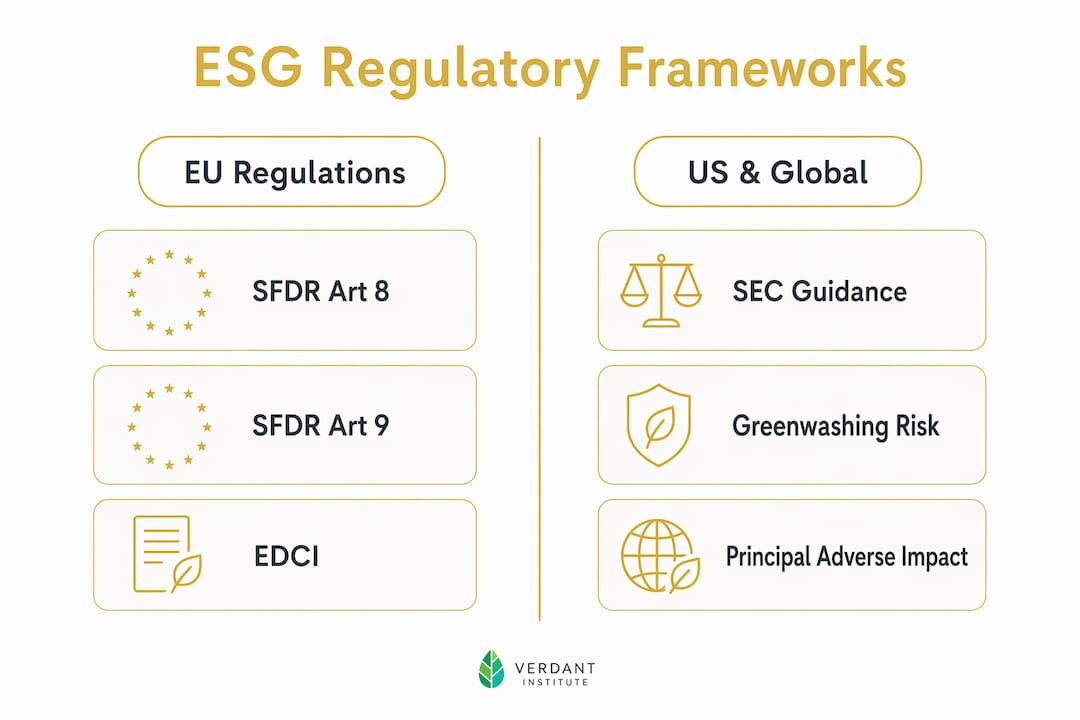
SFDR Article 9 requires mandatory application of the "do no significant harm" principle to all investments, detailed periodic reporting, and stricter asset alignment. That distinction matters operationally. An Article 9 fund must demonstrate that every portfolio company meets DNSH criteria across six environmental objectives, which requires granular data that most private companies do not collect by default.
The EDCI addresses the fragmentation problem at the industry level. The 2024 EDCI pilot approved 70% of 490 LP data requests, with 93% involving real portfolio company names. That level of direct LP-to-GP data sharing reduces duplicative reporting requests and creates a standardized benchmark set that improves cross-fund comparability over time.
Greenwashing risk is the regulatory exposure most GPs underestimate. Regulators in the EU and the SEC in the United States have both increased scrutiny of ESG claims that cannot be substantiated with underlying data. Funds that classify as Article 8 or Article 9 without the data infrastructure to support those claims face reclassification risk and reputational damage.
Pro Tip: If your fund is considering an Article 9 classification, map your PAI (Principal Adverse Impact) indicator data requirements before you finalize the fund prospectus. Retroactively collecting PAI data from portfolio companies is significantly harder than building it into your initial data collection framework.
What are the main challenges in ESG data collection for PE portfolios?
Private equity faces a data problem that public equity does not. Portfolio companies are private, have no mandatory sustainability reporting obligation in most jurisdictions, and often lack the internal resources to produce reliable ESG metrics. The result is a fragmented, inconsistent data environment that makes portfolio-level analysis genuinely difficult.
The core challenges break down as follows:
-
Coverage rate. Funds unable to report ESG metrics for roughly 40% of their portfolio represent a material blind spot, with 80% or more coverage targeted for key emissions and safety metrics. Coverage rate is the single most revealing data quality indicator. A fund reporting excellent ESG performance across 60% of its portfolio is not reporting excellent ESG performance. It is reporting a selected subset.
-
Scope 3 emissions complexity. Scope 1 and 2 emissions (direct and purchased energy) are relatively straightforward to measure. Scope 3 covers upstream and downstream value chain emissions and can represent 70% or more of a company's total carbon footprint. Most portfolio companies have no methodology in place to calculate this.
-
Methodological inconsistency. Without a standardized framework, portfolio companies use different boundaries, conversion factors, and reporting periods. The result is data that cannot be aggregated or benchmarked meaningfully at the fund level.
-
Resource constraints at the portfolio company level. A mid-market manufacturing company with 200 employees does not have a sustainability team. Asking that company to produce a full GRI-aligned sustainability report without support is unrealistic and produces low-quality outputs.
The practical solution to Scope 3 complexity is a top-down accounting approach. Top-down GHG Protocol-compliant methods can produce Scope 3 results in days rather than months. This approach uses spend-based or sector-average emission factors applied to financial data the company already has, rather than requiring granular supplier-level data collection. It is less precise than a full bottom-up analysis but is defensible, scalable, and sufficient for LP reporting and regulatory compliance.
A baseline carbon footprint for a PE-backed private company typically requires 6 to 10 weeks from kickoff to final report, covering Scope 1, 2, and relevant Scope 3 emissions. That timeline has direct implications for fund planning. If you close a deal in Q1 and want a baseline footprint before the first annual LP report, you need to initiate the process within weeks of closing, not months.
For ESG disclosure analysis techniques that help finance professionals navigate portfolio data gaps, the practical frameworks are worth reviewing before you design your data collection architecture.
How does ESG momentum affect private equity financial performance?
The most important insight in recent ESG research for private equity is the distinction between ESG status and ESG momentum. Static ESG ratings measure where a company is today. ESG momentum measures the direction and rate of improvement over time. The financial implications of that distinction are significant.
A CFA Institute analysis found that adding ESG momentum to portfolio construction increased the Sharpe ratio from 0.54 to 0.62, alongside lower volatility and reduced drawdowns. A Sharpe ratio improvement of that magnitude is not marginal. It represents a meaningful shift in risk-adjusted return that any institutional investor would notice in their performance attribution.
The mechanism is intuitive once you see it. Companies actively improving their ESG practices are typically also improving their operational efficiency, governance quality, and risk management. Those improvements show up in financial metrics before they show up in ESG ratings, which tend to lag operational reality by one to two years. PE managers who track ESG KPI trajectories are effectively getting an early signal on operational quality improvement.
For fund managers, this has direct implications for ESG portfolio construction. The goal is not to buy the highest-rated ESG companies at entry. The goal is to buy companies with credible improvement potential and then drive that improvement through the value creation plan. That is exactly what active ownership in private equity is designed to do.
Tracking ESG improvement trajectories rather than static ratings enables investors to capture economically meaningful portfolio effects. The practical implication for GPs is to set measurable ESG KPIs at entry, track them annually, and tie management incentives to ESG progress alongside financial targets.
Pro Tip: Tie at least two ESG KPIs to management compensation at the portfolio company level. Energy intensity reduction and lost-time injury rate are the most commonly used because the data is reliable, the improvement is operationally meaningful, and the link to financial performance is defensible to LPs.
Key takeaways
ESG integration in private equity drives measurable financial outcomes when embedded in the investment thesis, supported by credible data infrastructure, and tracked through improvement trajectories rather than static ratings.
| Point | Details |
|---|---|
| ESG runs the full lifecycle | Due diligence, holding period monitoring, and exit preparation all require distinct ESG deliverables. |
| Regulatory classification has real consequences | SFDR Article 9 funds face strict DNSH and PAI reporting obligations that require data infrastructure built before fund close. |
| Coverage rate is the key data quality signal | Funds reporting ESG metrics for less than 80% of their portfolio have material blind spots that undermine credibility. |
| ESG momentum outperforms ESG status | CFA Institute research shows ESG improvement trajectories improve Sharpe ratios and reduce portfolio volatility. |
| Start baseline carbon footprints early | The 6 to 10 week timeline for a credible Scope 1, 2, and 3 baseline means initiating the process at close, not at year-end. |
Why ESG in private equity rewards the operationally serious
I have reviewed ESG programs across dozens of PE-backed companies, and the pattern is consistent: the funds that treat ESG as an operational discipline produce better data, better outcomes, and better LP relationships than those that treat it as a reporting exercise. The difference is not resources. It is timing and intent.
The most common mistake I see is initiating ESG data collection in Q4 of the first holding year, when the annual LP report is already due. Treating ESG reporting as a one-off deliverable often leads to low-quality data. A rushed baseline is worse than no baseline because it creates a false anchor for future reporting. You spend the next three years defending a number you do not fully trust.
The funds that get this right start the baseline process within 60 days of close, agree on data collection responsibilities with portfolio company management before the first board meeting, and set KPIs that are genuinely tied to operational decisions. They also resist the temptation to classify funds at the highest SFDR level without the data infrastructure to support it. Greenwashing risk is not just reputational. It is increasingly a regulatory enforcement risk in the EU and a litigation risk in the United States.
The future of ESG in private equity belongs to firms that build it as a capability, not a function. That means embedding ESG thinking in deal teams, not outsourcing it entirely to a sustainability officer who joins the board call once a year.
— Charles
Build your ESG capability with Verdant Institute
Finance professionals who want to move beyond surface-level ESG knowledge and build genuine analytical depth in sustainable finance have a structured path available. Verdant Institute offers a library of 16 courses and over 160 lessons covering ESG integration, transition finance, net-zero strategies, and impact investing, all designed for working professionals in private equity and asset management.
Whether you are preparing for LP ESG questionnaires, designing a portfolio company data collection framework, or building the skills to evaluate SFDR fund classifications, Verdant Institute's learning tracks provide CPD-tracked, certification-backed training at $58 per month for professionals. The platform's Deep Dive and Advanced Practice tracks are built specifically for the complexity that PE fund managers and portfolio company finance teams face in 2026. Explore the full pricing and plan options to find the right fit for your team.
FAQ
What does ESG mean in private equity?
ESG in private equity refers to the integration of environmental, social, and governance factors into deal underwriting, portfolio monitoring, and exit strategy to manage risk and create sustainable value. GPs assess ESG risks during due diligence and track ESG KPIs throughout the holding period.
What is the difference between SFDR Article 8 and Article 9 for PE funds?
Article 8 funds promote environmental or social characteristics with moderate disclosure requirements, while Article 9 funds have sustainable investment as their explicit objective and must apply the "do no significant harm" principle to all investments with stricter periodic reporting obligations.
How do PE firms collect ESG data from portfolio companies?
GPs typically use annual ESG questionnaires, standardized frameworks like the EDCI metrics set, and third-party consultants to collect Scope 1, 2, and 3 emissions data alongside social and governance indicators. Coverage rates above 80% are the target for credible portfolio-level reporting.
Does ESG integration improve private equity returns?
CFA Institute research shows that tracking ESG momentum, meaning year-over-year improvement rather than static ratings, increased portfolio Sharpe ratios from 0.54 to 0.62 with lower volatility. The financial benefit comes from operational improvements that ESG KPI progress signals ahead of traditional financial metrics.
What is the ESG Data Convergence Initiative?
The EDCI is an industry initiative that standardizes ESG metrics and enables direct LP-to-GP data sharing to reduce fragmented reporting requests and improve cross-fund benchmarking. The 2024 pilot approved 70% of 490 LP data requests, demonstrating growing adoption across the private equity industry.