
ESG index construction methodology follows a four-stage process: universe definition, exclusionary and norms-based screening, ESG scoring for selection or weighting, and portfolio construction with constraints. Every decision in that chain, from which data provider supplies the scores to whether the index holds sector weights constant, shapes the portfolio's ESG quality, tracking error, and real-world impact. Providers like MSCI and S&P Global publish detailed methodology documents that make these choices explicit, but the gap between indices that look similar on the surface can be enormous once you examine the underlying framework.
The core stages at a glance:
- Universe definition: Start with a parent index such as the MSCI World or S&P 500, which sets the liquidity and capacity floor.
- Exclusionary screening: Remove companies based on business activity (controversial weapons, thermal coal, tobacco) and norms-based violations such as UN Global Compact breaches.
- ESG scoring layer: Apply best-in-class selection, score tilting, or full optimization to rank and weight remaining constituents.
- Portfolio construction: Set final weights with sector, country, and individual stock constraints, then define a rebalancing schedule.
The sector-neutral versus unconstrained design choice cuts across all four stages. Sector-neutral indices tilt toward ESG leaders within each sector while preserving parent-index sector weights, keeping tracking error low but limiting how much absolute ESG quality can improve. Unconstrained indices let the optimization run across the full eligible universe, producing higher ESG scores at the cost of meaningful sector deviations.

How each stage of ESG index construction works
1. Define the starting universe
Every ESG index construction begins with a parent conventional index. Common choices are the MSCI World, S&P 500, and FTSE All-World. The parent index sets the investability baseline: liquidity, market-cap thresholds, and geographic scope are all inherited. Choosing a narrower parent, say a single-country index, concentrates both the opportunity set and the ESG constraints that follow.
2. Apply business activity exclusions
Exclusion screens are binary. A company either clears the revenue threshold or it does not. Screens typically target controversial weapons, thermal coal, oil sands, tobacco, and adult entertainment. The depth of exclusions varies widely: a minimal list covering only cluster munitions removes fewer than 0.1% of companies by count, while a comprehensive exclusion list covering thermal coal, oil sands, tobacco, gambling, and weapons can remove 5–10% of market cap.
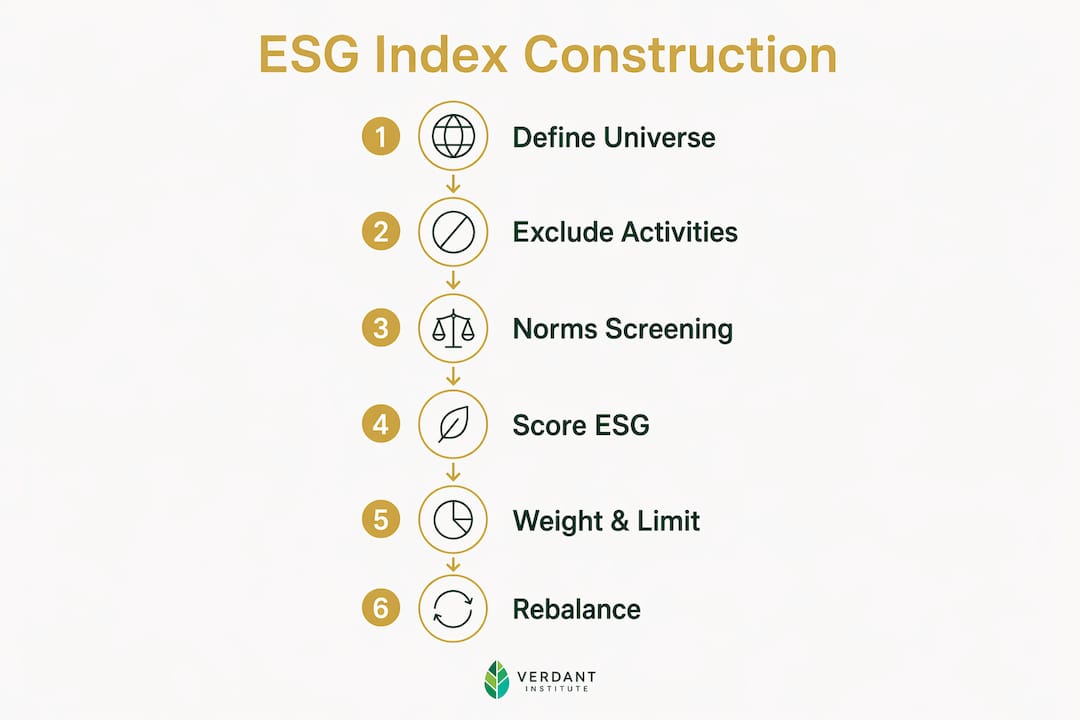
3. Apply norms-based screens
Many indices add a UN Global Compact screen after business activity exclusions. Companies with documented, unresolved UNGC violations assessed by providers such as RepRisk or Sustainalytics are removed from the eligible universe. The J.P. Morgan JESG suite, for instance, applies UNGC norms-based screening across both corporate and quasi-sovereign issuers as a distinct step after its exclusionary layer.
4. Score and optimize the eligible universe
After exclusions, the remaining companies go through the ESG optimization layer. Three approaches dominate:
- Best-in-class selection: Within each sector, retain the top percentage by ESG score and exclude the bottom. This is sector-neutral and the most common approach for broad ESG indices.
- Score tilting: Adjust weights proportionally to ESG scores rather than applying a binary cut. Higher-scoring companies receive larger weights relative to their market-cap baseline; lower-scoring ones receive smaller weights.
- Full optimization: Run a mathematical objective function, typically minimizing ESG risk or tracking error, subject to multiple simultaneous constraints. The Morningstar ESG Enhanced Indexes use this approach, minimizing ESG risk while constraining tracking error, turnover, and sector active weights within a 5% band of the parent benchmark.
5. Set weights and apply concentration limits
Once the eligible universe and ESG tilts are determined, final weights are set. The MSCI ESG Universal Indexes multiply each security's market-cap weight in the parent index by a Combined ESG Score, then normalize to 100%. Issuers in broad parent indexes such as the MSCI World are capped at 5% to limit concentration risk. Morningstar's framework caps individual security weights relative to the screened parent weight to limit concentration risk, following established portfolio weighting constraints.
6. Rebalance to keep ESG data current
Quarterly rebalancing is the standard for most equity ESG indices. Annual reconstitution creates a real problem: ESG deterioration events can persist in the index for months before the next review removes the offending company. Quarterly cycles reduce that lag, though they introduce higher turnover costs. Paris-Aligned Benchmark indices must rebalance at least annually to meet the 7% annual decarbonization requirement under EU climate benchmark rules.
What drives ESG scores and which factors matter most
ESG scoring is where methodology diverges most sharply across index providers, and where the least transparency often exists.
Absolute versus relative benchmarking is the first fork. Absolute benchmarking measures a company against fixed external standards such as GRI or the SDGs, regardless of what peers are doing. Relative benchmarking compares performance within an industry peer group, which reduces sector-specific volatility and makes scores more actionable for portfolio construction. Most ESG index methodologies favor relative benchmarking because it produces more stable, comparable scores across sectors.
Data source reliability is the deeper problem. ESG scores combine self-reported company disclosures, third-party databases, expert assessments, and publicly available information. Score correlations between major providers sit at 0.4 to 0.6, meaning two indices built on identical construction rules but different data providers will produce materially different portfolios. The JESG suite addresses this by blending scores from four providers: RepRisk, Sustainalytics, Verisk Maplecroft, and the Climate Bonds Initiative, then applying a three-month rolling average to smooth daily noise.
Key insight: The ESG data provider embedded in an index is often the single most consequential methodology choice, yet it is rarely disclosed prominently in fund marketing materials. Differing provider methodologies cause score correlations as low as 0.4 to 0.6 among major providers, affecting index consistency in ways that are invisible to most investors.
Controversy scores add a real-time layer on top of static ESG ratings. The MSCI ESG Universal Indexes exclude any company with a Red Flag controversy score of 0, indicating an ongoing Very Severe ESG controversy. Controversy integration matters because static annual ratings can lag breaking events by months. For a deeper look at how controversy scoring works in practice, Verdantinstitute's ESG controversy scoring guide covers the assessment mechanics in detail.
Forward-looking metrics are increasingly embedded in scoring frameworks. Carbon intensity targets, net-zero commitments, and Transition Pathway Initiative (TPI) alignment scores feed into optimization constraints rather than just screening filters. The Morningstar ESG Enhanced Indexes require the optimized portfolio to achieve carbon intensity substantially lower than the parent index at each reconstitution, which is a hard constraint, not a soft preference.
Tilting versus optimization: which weighting approach fits your objectives?
Two main weighting philosophies produce substantially different index compositions and behaviors. Research shows up to a 60% difference in index composition between tilting and optimized approaches, affecting tracking error and turnover.
| Characteristic | Target exposure (tilting) | Optimization |
|---|---|---|
| Mechanism | Adjusts market-cap weights by ESG score multiplier | Solves objective function subject to multiple constraints |
| Tracking error | Moderate | Lowest (tracking error minimization variant) |
| Turnover | Higher, but in larger, more liquid stocks | Can be very high without explicit turnover constraints |
| Robustness to data noise | More resilient | Sensitive; 20% noise on Scope 3 data causes large weight shifts |
| Explainability | Transparent: weight follows score and tilt | Less transparent: weights emerge from solver |
| Liquidity | Higher (lower leverage ratios) | Can breach capacity constraints in smaller stocks |
Target exposure starts with market-cap weights and tilts them toward companies with favorable ESG characteristics. The mechanics are transparent: you can trace exactly why a given stock received its weight. Optimization defines a utility function, say minimizing tracking error or ESG risk, and solves for the weight vector that satisfies all constraints simultaneously. The tracking error optimized approach delivers the lowest tracking error, roughly half that of target exposure in comparable analyses, but it is also the most sensitive to input data quality and risk model assumptions.
Pro Tip: Before selecting a weighting methodology, stress-test it against noisy input data. Introducing 20% random noise to Scope 3 emissions intensity figures and comparing the resulting weights to those of the original index is a practical robustness check. Target exposure indices tend to hold up significantly better under this test than tracking error optimized indices, which can show substantial portfolio weight differences when covariance inputs change.
The trade-off between ESG quality and tracking error is unavoidable. Higher ESG quality requires accepting more deviation from the parent benchmark. Methodology defines the acceptable tracking error ceiling, and that ceiling is a policy choice as much as a technical one. Avoiding common financial forecasting mistakes in that calibration, such as anchoring too tightly to historical tracking error without accounting for forward-looking carbon constraints, is where methodology design often breaks down in practice.
Transparency, governance, and where ESG index design is heading in 2026
Governance of ESG index methodology is not just a disclosure checkbox. It determines whether investors can actually understand what bet an index is making on their behalf.
IOSCO's Sustainable Finance Taskforce published its ESG Indices as Benchmarks report as a framework for applying its Principles for Financial Benchmarks to ESG-specific contexts. The core requirement: administrators must disclose data sources, weighting of metrics within selection criteria, scoring mechanisms, and the application of ESG ratings. That sounds basic, but voluntary disclosure regimes mean many administrators still fall short.
IOSCO Principle 11 on Content of Methodology recommends that ESG benchmark administrators clearly disclose how they reflect ESG factors in their methodologies, including data sources, weightings of metrics within selection criteria, scoring mechanisms, and the application of ESG ratings, so that investors can make informed decisions.
Key governance requirements for a credible ESG index methodology in 2026:
- Expert judgment disclosure: Administrators must document when and how expert judgment overrides quantitative inputs, particularly for forward-looking metrics where data is inherently less reliable.
- Data input hierarchy: A clear waterfall specifying which data source takes precedence when multiple providers disagree or coverage is missing. The JESG methodology applies exactly this logic, using region-sector averages when individual issuer coverage is absent.
- Methodology update governance: Changes to scoring models, exclusion lists, or weighting schemes should follow a defined review process with advance notice to index users.
- Greenwashing safeguards: IOSCO explicitly flags greenwashing as a vulnerability in ESG benchmarks, particularly where methodology complexity obscures the actual ESG tilt the index is making.
The forward-looking direction in ESG index design is toward decarbonization constraints embedded directly in the optimization. S&P Global's ESG intelligence infrastructure increasingly powers indices that incorporate commitment-based metrics, such as science-based targets and net-zero pledges, alongside backward-looking emissions data. This requires complex optimization beyond static ESG filters, since commitment-based data is qualitative, forward-looking, and subject to revision.
Regulatory pressure in the US market remains less prescriptive than in the EU, where Paris-Aligned Benchmark and Climate Transition Benchmark regulations set hard decarbonization floors. US index administrators currently operate under voluntary disclosure norms, though SEC climate disclosure rules and growing institutional demand for methodology transparency are pushing the market toward more explicit documentation standards.
Key Takeaways
Sound ESG index construction requires explicit, documented choices at every stage, from parent index selection through weighting methodology, because each decision compounds into the portfolio's final ESG quality and risk profile.
| Point | Details |
|---|---|
| Four-stage process | Universe definition, exclusionary screening, ESG scoring, and portfolio weighting are the four core stages every methodology must address. |
| Data provider impact | Score correlations between major ESG data providers sit at 0.4 to 0.6, meaning provider choice alone can produce materially different portfolios from identical construction rules. |
| Tilting vs. optimization | Tilting and optimization approaches can produce substantially different index compositions, with optimization delivering lower tracking error but higher sensitivity to input noise. |
| Carbon intensity constraint | Morningstar ESG Enhanced Indexes require carbon intensity substantially lower than the parent index at each reconstitution, illustrating how forward-looking constraints are now embedded as hard optimization limits. |
| Transparency as governance | IOSCO requires disclosure of data sources, scoring mechanisms, and expert judgment use so investors can assess the specific ESG tilt an index is making. |
Verdantinstitute's professional ESG training programs cover index construction methodology, scoring frameworks, and sustainable finance strategy in depth, with structured tracks for both early-career analysts and senior practitioners. CPD-tracked certifications are available for professionals who need documented competency in ESG index development and impact investing analysis.