

An ESG case study is a structured analysis that evaluates a company's environmental, social, and governance performance against measurable standards to inform investment and risk decisions. Developing one well requires more than good intentions. It demands a repeatable process built around frameworks like the European Sustainability Reporting Standards (ESRS), the Corporate Sustainability Reporting Directive (CSRD), and the Global Reporting Initiative (GRI). This ESG case study development guide walks finance professionals and students through every stage, from materiality assessment to third-party assurance, so you can produce credible, audit-ready work that holds up to institutional scrutiny.
What prerequisites are essential for ESG case study development?
Effective ESG case study development starts before you collect a single data point. The first requirement is a cross-functional team that includes finance, sustainability, legal, and risk functions. Each group owns different data streams, and gaps appear fast when any one function works in isolation.
Framework selection is the second prerequisite. The major ESG disclosure frameworks serve different purposes and are often used together. Using multiple frameworks in parallel helps satisfy diverse stakeholder requirements and regulatory obligations at the same time. The table below maps the most common frameworks to their primary use cases.

| Framework | Primary focus | Typical use case |
|---|---|---|
| ESRS / CSRD | EU regulatory compliance | Mandatory reporting for EU-listed companies |
| GRI | Broad sustainability disclosure | Stakeholder and public reporting |
| SASB | Industry-specific metrics | Investor-grade financial materiality |
| TCFD | Climate risk and opportunity | Climate scenario analysis |
Technology infrastructure is the third prerequisite. You need a system that collects, validates, and stores ESG data with an audit trail. Spreadsheet-based workflows fail at scale and create serious problems during external assurance reviews.
Pro Tip: Build your data collection templates around your chosen framework's disclosure requirements before the reporting period begins. Retrofitting templates after data collection wastes time and introduces errors.
How does the eight-stage ESG reporting process guide case study development?
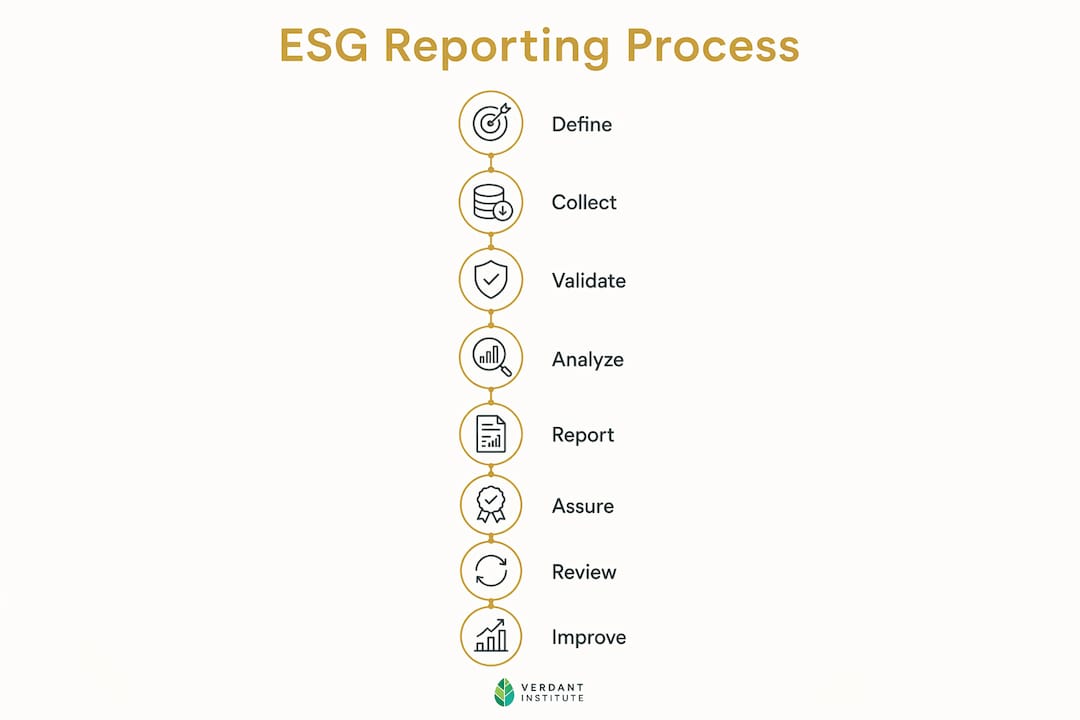
The eight-stage ESG reporting process is the backbone of any credible ESG case study. Each stage feeds directly into the next, and skipping one creates compounding problems downstream. The stages align with the financial reporting calendar so that ESG disclosures carry the same governance rigor as financial statements.
The eight stages are:
- Materiality assessment — Identify which ESG topics are significant enough to disclose based on their impact on the business and on society.
- Framework selection and scoping — Choose the reporting standards that match your regulatory obligations and stakeholder expectations.
- KPI definition and data mapping — Define the specific metrics you will track and identify which business units own each data point.
- Data collection and validation — Gather raw data from internal systems and validate it against defined quality criteria.
- Internal review — Subject the draft disclosures to review by finance, legal, and senior leadership before external submission.
- External assurance — Engage a third-party auditor to verify the accuracy and completeness of your disclosures.
- Publication — Release the final report through the appropriate regulatory and public channels.
- Stakeholder engagement — Gather feedback from investors, regulators, and civil society to inform the next reporting cycle.
Synchronizing this process with financial control cycles strengthens governance integration across business units. The most common failure point is stage four. Teams that start data collection only after the reporting period ends consistently produce incomplete records that fail audit review.
Pro Tip: Assign a named data owner for every KPI at stage three. When assurance questions arise months later, you need a specific person accountable for each number, not a shared inbox.
What are the double materiality assessment steps in ESG case studies?
Double materiality is the requirement to assess both how ESG issues affect the company financially and how the company's activities affect people and the environment. The ESRS framework, specifically the ESRS 2 IRO-1 and IRO-2 disclosures, mandates this dual perspective for EU-regulated entities. Understanding double materiality methodology is now a core competency for finance professionals working on sustainable development case studies.
The Double Materiality Assessment (DMA) follows four steps:
- Context mapping — Document the company's value chain, operating sectors, and geographic footprint to establish the scope of potential impacts.
- Impact, risk, and opportunity (IRO) identification — List every material ESG topic that could generate a significant impact, financial risk, or business opportunity.
- Scoring severity and likelihood — Rate each IRO on two axes: how severe the impact is and how likely it is to occur. This produces a ranked materiality matrix.
- Narrative and table reporting — Document the methodology, scoring rationale, and final topic list in a structured disclosure.
Narrative descriptions for a DMA typically run 800–2,500 words to explain the assessment process adequately. That word range reflects the depth of documentation required to withstand audit and stakeholder scrutiny. Thin narratives that simply list topics without explaining scoring methodology fail regulatory review.
Pro Tip: Run your IRO identification workshop with external stakeholders present, not just internal teams. Regulators and investors view external input as evidence of genuine engagement rather than a box-checking exercise.
How do you ensure data quality and audit readiness in ESG reporting?
ESG reporting is a continuous cycle, not a sprint that begins when the reporting period closes. Teams that treat it as an annual event consistently miss data quality thresholds and face costly remediation during assurance. The fix is integrating data validation into monthly or quarterly business review cycles so that errors surface early.
The COSO framework for Internal Controls over Sustainability Reporting (ICSR) gives finance teams a recognized structure for designing these controls. Companies adopt COSO ICSR to meet audit readiness standards that third-party assurance providers expect. The parallel to financial internal controls is intentional: ESG data must meet the same documentation and traceability standards as revenue figures.
On assurance requirements, the direction is clear. ESG disclosure standards increasingly require third-party limited assurance, with reasonable assurance phasing in within three years under CSRD. Limited assurance is the current baseline; reasonable assurance is the near-term destination. The gap between the two is significant in terms of documentation depth and control design.
Retrofitting third-party assurance onto data collection processes designed only for publication leads to costly, failed audits. Audit readiness must be integrated from materiality assessment onwards.
Linking ESG risks into your enterprise risk register is the final piece. ESG risks belong in enterprise registers alongside financial and operational risks, with a defined risk appetite that enables board-level decision-making. Finance professionals who treat ESG risk as a separate reporting exercise miss the governance integration that sophisticated investors now expect. For a deeper look at how ESG risks connect to portfolio decisions, the principles behind ESG in fixed income illustrate how material risks translate directly into credit and valuation analysis.
Key Takeaways
A credible ESG case study requires a continuous, eight-stage process built on double materiality assessment, framework alignment, and audit-ready data controls from the first day of the reporting period.
| Point | Details |
|---|---|
| Start with a cross-functional team | Finance, sustainability, legal, and risk must all contribute data and review disclosures. |
| Use frameworks in parallel | GRI, SASB, TCFD, and ESRS serve different audiences; using them together satisfies more stakeholders. |
| Run DMA with external input | External stakeholder participation in IRO identification strengthens regulatory credibility. |
| Treat reporting as a continuous cycle | Monthly data validation prevents the audit failures that last-minute collection causes. |
| Integrate ESG into enterprise risk | ESG risks belong in the same register as financial risks, with board-approved risk appetite. |
What I've learned from building ESG case studies that actually hold up
The most common mistake I see finance professionals make is treating an ESG case study as a communications exercise rather than an analytical one. The instinct to present a clean, positive narrative is understandable. Investors and boards want good news. But leading ESG strategies acknowledge trade-offs transparently rather than making perfect-score promises, and that transparency is precisely what builds stakeholder trust over time.
The second pattern I've noticed is the vague metric problem. Phrases like "we reduced our environmental footprint" appear in reports constantly and say nothing useful. Specific, verifiable metrics like "30% reduction in water consumption per unit produced" are what sophisticated investors actually use. Vague claims signal weak data infrastructure, and experienced analysts notice immediately.
The third lesson is about embedding ESG into business strategy rather than running it as a parallel track. Embedding ESG metrics into executive compensation ties sustainability directly to business priorities and drives real accountability. When ESG performance affects pay, data quality improves, cross-functional cooperation increases, and the case study reflects genuine operational reality rather than a curated snapshot.
ESG case studies are most useful when you treat them as dynamic tools for continuous improvement rather than annual compliance documents. The companies that use their own case studies to identify gaps and set the next year's targets get compounding value from the process. The ones that file and forget get compliance costs with no strategic return.
— Charles
Build stronger ESG case studies with Verdantinstitute
Finance professionals who want to move from theory to practice need more than a framework checklist. Verdantinstitute offers structured learning tracks covering ESG analysis, impact measurement, and sustainable finance, built specifically for professionals and students working in financial services.

With over 160 lessons across 16 courses, Verdantinstitute covers materiality assessment, ESG investment strategies, CSRD compliance, and assurance-ready reporting workflows. CPD tracking and certifications make it practical for professionals managing continuing education requirements. Student plans start at $18/month and professional plans at $58/month. Review the full course library and choose your plan to see which track fits your current role and development goals.
FAQ
What is an ESG case study in finance?
An ESG case study is a structured analysis of a company's environmental, social, and governance performance using defined frameworks and measurable metrics to support investment and risk decisions.
Which frameworks are most important for ESG case study development?
ESRS and CSRD are mandatory for EU-regulated entities. GRI, SASB, and TCFD complement these by addressing stakeholder reporting, industry-specific metrics, and climate risk disclosure respectively.
What is double materiality and why does it matter?
Double materiality requires assessing both how ESG issues affect the company financially and how the company affects people and the environment. ESRS 2 mandates this dual assessment for EU-regulated disclosures.
How do you prepare ESG data for third-party assurance?
Integrate data validation into monthly business reviews, apply the COSO ICSR framework for internal controls, and assign named data owners for every KPI from the start of the reporting period.
How long should a double materiality assessment narrative be?
DMA narratives typically run between 800 and 2,500 words to document the methodology, scoring rationale, and final topic list at the depth regulators and auditors require.