

ESG sovereign bond analysis is the systematic evaluation of environmental, social, and governance factors to assess sovereign credit risk and explain variability in bond yields and market pricing. This framework goes well beyond traditional credit metrics. Analysts using tools like the ND-GAIN index, ASCOR, and LSEG Refinitiv data can now quantify how a government's climate governance quality, institutional credibility, and social policy translate directly into borrowing costs. The empirical case is no longer theoretical. Research across OECD economies confirms that ESG scores explain not just yield levels but yield volatility, making this analysis a core input for any serious fixed income practitioner.
What does the empirical evidence say about ESG and sovereign bond yields?
The relationship between ESG performance and sovereign borrowing costs is now measurable with precision. A 10-point decline in climate resilience causes approximately 2 basis points rise in sovereign bond yields across OECD economies over the 2001–2020 period. That may sound modest, but at scale across a multi-billion dollar portfolio, it represents a material and systematic pricing signal.
Euro Area research reinforces this finding. Climate risk is priced beyond standard macroeconomic fundamentals, with better environmental and climate performance linked to lower 10-year sovereign bond spreads. This means analysts who rely solely on GDP growth, debt-to-GDP ratios, and current account balances are working with an incomplete model.
The governance dimension carries the most weight. Countries with stronger institutional quality and regulatory effectiveness consistently show lower borrowing costs. Social readiness, by contrast, shows a mixed or even negative effect on yields, a finding from ND-GAIN component analysis across 31 OECD countries. The implication is direct: not all ESG pillars price equally in sovereign debt markets, and treating them as interchangeable is an analytical error.
| ESG Pillar | Effect on Sovereign Yields | Key Metric |
|---|---|---|
| Environmental | Lower spreads with better climate performance | Climate resilience index, carbon intensity |
| Governance | Significant yield reduction with stronger institutions | ND-GAIN governance score, regulatory effectiveness |
| Social | Mixed or negative effect; context-dependent | Social readiness index, HDI components |
Sovereign bonds also function as the fiscal foundation for all corporate assets within a country. Weaknesses in sovereign ESG factors affect corporate ESG risk regardless of individual company efforts. This systemic relationship makes sovereign ESG analysis a prerequisite, not an add-on, for any ESG investment analysis framework.
Which ESG metrics and tools are essential for sovereign bond analysis?
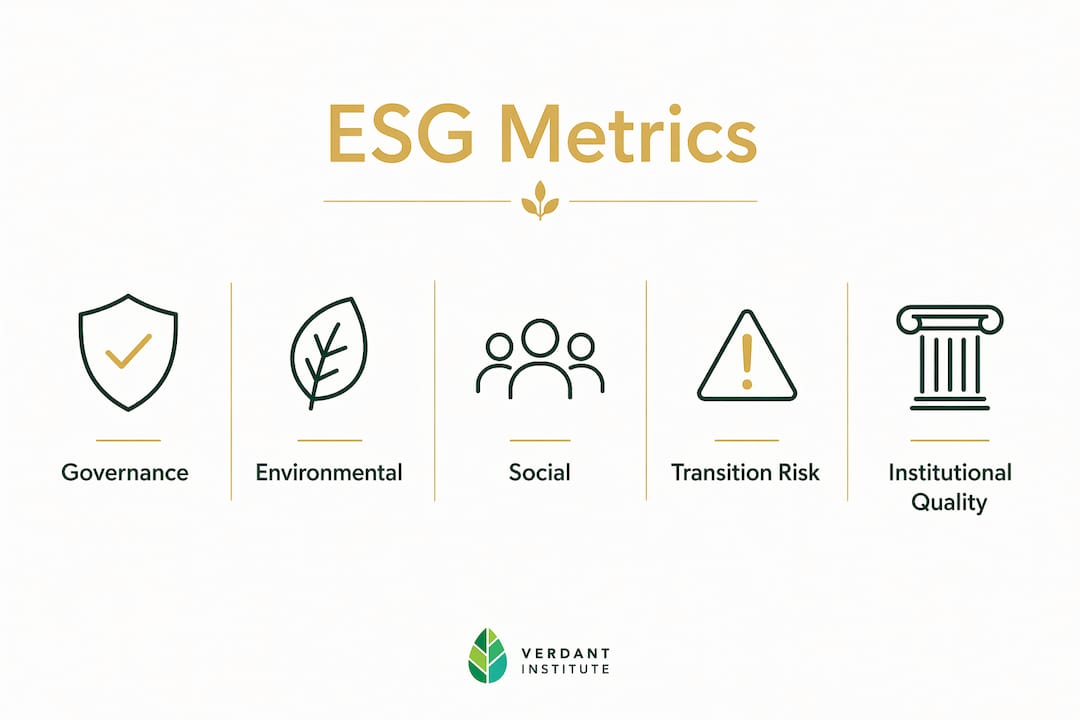
Sovereign ESG metrics fall into three categories: environmental, governance, and social. Each requires a distinct set of data sources and analytical approaches.

Environmental metrics center on carbon intensity and climate policy credibility. Institutional investors now standardize sovereign net-zero alignment using policy-adjusted carbon budgets and GDP percentages tied to high transition risk industries. This framework covers 85 countries accounting for 90% of global greenhouse gas emissions. The Weighted Average Carbon Intensity (WACI) of a sovereign's economy is another standard input, measuring the carbon exposure embedded in a country's industrial structure.
Governance metrics include institutional quality scores, rule of law indices, and regulatory effectiveness ratings. These draw from sources like the World Bank Governance Indicators and the ND-GAIN Country Index, which scores countries on climate readiness and adaptive capacity. ASCOR (Assessing Sovereign Climate-related Opportunities and Risks) provides a dedicated framework for evaluating sovereign transition risk, covering policy commitments, net-zero targets, and interim milestones.
Social metrics are the most contested. Human Development Index components, inequality measures, and social safety net coverage all appear in various frameworks. The challenge is that higher social spending can signal both resilience and fiscal stress, which is why social readiness shows ambiguous yield effects in empirical studies.
For sovereign ESG data sources, analysts typically combine ND-GAIN and ASCOR with commercial providers like LSEG Refinitiv, MSCI, and Sustainalytics. No single source covers all three pillars with equal depth, so triangulation across providers is standard practice.
- ND-GAIN Country Index: Scores 192 countries on climate vulnerability and readiness; strong on environmental and governance dimensions
- ASCOR: Dedicated sovereign transition risk tool; tracks policy commitments, interim targets, and decarbonization pathways
- LSEG Refinitiv: Broad ESG scoring with historical time series; useful for quantitative backtesting
- WACI: Measures economy-wide carbon intensity; directly links sovereign industrial structure to transition risk exposure
How does ESG analysis shape sovereign bond investment strategies?
ESG analysis changes how portfolio managers allocate across sovereign issuers, not just how they screen them. The most direct application is a portfolio tilt toward countries with credible decarbonization pathways. Investors can achieve comparable yields while improving their portfolio's transition profile by rotating into sovereigns with stronger climate governance. This is not a sacrifice of return. It is a reallocation of risk.
Transition risk is the central mechanism. Unplanned or disorderly climate policy transitions stress fiscal space, increase deficit financing needs, and raise borrowing costs. Analysts who integrate ASCOR data into credit overlays can identify sovereigns where the gap between stated climate ambition and actual policy implementation creates latent credit risk not yet reflected in spreads.
For ESG investment strategies in fixed income, momentum approaches are gaining traction. Rather than screening on absolute ESG scores, momentum strategies favor sovereigns showing measurable improvement in governance quality or carbon policy credibility over a defined period. This reduces the opportunity cost of excluding large issuers with low absolute scores but improving trajectories.
Pro Tip: When evaluating sovereign green bonds, always verify the issuance currency before comparing yields. Local currency issuances in emerging markets carry currency depreciation risk that can negate the yield premium entirely.
Key considerations for portfolio integration include:
- Credit overlay integration: Map ASCOR transition risk scores against existing credit ratings to identify mispriced sovereigns
- ESG momentum screening: Track year-over-year changes in ND-GAIN governance scores to identify improving issuers
- Impact reporting requirements: Sovereign green bond allocations require use-of-proceeds verification; build this into due diligence workflows
- Framework maturity assessment: Evaluate whether a sovereign's ESG reporting aligns with ICMA Green Bond Principles or equivalent standards
For a deeper look at how ESG shapes asset allocation decisions across fixed income portfolios, the mechanics extend well beyond sovereign selection into duration management and risk factor decomposition.
What are the main challenges in interpreting sovereign ESG data?
Sovereign ESG data carries structural limitations that analysts must understand before drawing investment conclusions. The most significant is the gap between credit ratings and market pricing of transition risk. Credit ratings are only beginning to incorporate climate transition risks explicitly, meaning market spreads may already reflect risks that formal ratings have not yet captured. This creates both mispricing opportunities and analytical traps.
Social readiness metrics present a specific interpretive challenge. Higher social spending and stronger safety nets can signal fiscal resilience or fiscal overextension depending on the sovereign's debt structure and revenue base. Analysts should treat social scores as context variables rather than direct yield predictors.
Pro Tip: Do not rely solely on long-term net-zero targets when assessing transition risk. Use interim policy verification metrics like 2030 Interim Policy Verification scores from ASCOR to gauge near-term policy credibility.
Currency denomination is another source of distortion. Comparing green bond yields without accounting for currency denomination produces misleading assessments, particularly when comparing emerging market local currency bonds against developed market hard currency issuances. A 200 basis point yield premium in a local currency bond can disappear entirely after accounting for currency depreciation over a three-year holding period.
Unplanned transition risk compounds these challenges. Disorderly policy shifts, such as sudden carbon pricing changes or stranded asset write-downs, can stress sovereign fiscal space faster than credit models anticipate. Analysts should build scenario analysis around transition pathways rather than treating current policy as a stable baseline.
How do sovereign green bonds fit into ESG sovereign bond analysis?
Sovereign green bonds are government-issued debt instruments where proceeds are earmarked for environmentally beneficial projects, typically aligned with the ICMA Green Bond Principles. Common use cases include renewable energy infrastructure, sustainable transportation, biodiversity protection, and climate adaptation programs. They represent the most direct expression of a government's environmental commitment in capital markets.
The analytical treatment of sovereign green bonds differs from standard sovereign debt in two important ways. First, use-of-proceeds verification requires ongoing monitoring, not just initial due diligence. Second, the yield relationship with conventional bonds varies significantly by market.
| Feature | Sovereign Green Bond | Traditional Sovereign Bond |
|---|---|---|
| Use of proceeds | Earmarked for environmental projects | General government expenditure |
| Yield vs. conventional | Greenium (slight premium) in developed markets | Benchmark yield |
| Emerging market yield | Higher yield reflecting currency and political risk | Lower risk-adjusted yield in hard currency |
| Reporting requirements | Annual impact reports required | Standard financial disclosure |
| ICMA alignment | Required for credible issuance | Not applicable |
Emerging market sovereign green bonds carry higher yields that reflect currency and political risks, which can erode returns if not carefully analyzed. Foreign investors in local currency green bonds face currency depreciation exposure that standard yield comparisons do not capture. Due diligence for these instruments must include sovereign fiscal health assessment, currency risk hedging costs, and the credibility of the government's impact reporting framework.
For analysts integrating ESG in fixed income portfolios, sovereign green bonds offer a way to express both credit views and sustainability preferences simultaneously, but only when the underlying sovereign ESG fundamentals support the allocation.
Key takeaways
Sovereign ESG analysis is a quantitative discipline where governance quality, climate policy credibility, and transition risk exposure each carry measurable effects on bond yields and portfolio risk.
| Point | Details |
|---|---|
| Governance drives yields most | Stronger institutional quality consistently lowers sovereign borrowing costs more than social metrics. |
| Climate risk is already priced | Euro Area and OECD data confirm ESG factors affect spreads beyond standard macro fundamentals. |
| Social metrics require caution | Social readiness shows mixed yield effects; treat it as context, not a direct pricing signal. |
| Currency risk distorts comparisons | Always verify issuance currency before comparing sovereign green bond yields across markets. |
| Interim targets matter more | Use 2030 policy verification metrics from ASCOR rather than long-term net-zero pledges alone. |
Where sovereign ESG analysis is heading
I have spent years watching fixed income practitioners treat ESG as a compliance checkbox rather than a risk factor. That is changing, and the pace of change is faster than most credit desks realize.
The empirical evidence is now strong enough that ignoring governance quality in sovereign credit analysis is the same as ignoring debt-to-GDP ratios. The 2 basis point yield movement per 10-point climate resilience decline is not a rounding error at institutional scale. It is a systematic pricing signal that belongs in every sovereign credit model.
What concerns me is the social readiness piece. Too many analysts either ignore it or weight it equally with governance, and both approaches produce bad outputs. Social metrics in sovereign ESG are genuinely complicated. A country with high social spending and strong safety nets might show fiscal stress signals that push yields up, not down. You have to understand the mechanism, not just the score.
The standardization work happening through ASCOR and the institutional investor coalitions pushing for policy-adjusted carbon budgets is the most important structural development in this space right now. When 85 countries representing 90% of global emissions are covered by a common quantitative framework, the analytical playing field changes. Credit ratings will follow market pricing, not lead it.
My advice: build your sovereign ESG analysis on governance and environmental metrics first, use social scores as qualitative context, and always verify interim policy milestones over long-term targets. The analysts who get this right in the next three years will have a genuine edge.
— Charles
Build your sovereign ESG analysis skills with Verdantinstitute

Verdantinstitute offers structured learning tracks built specifically for finance practitioners who need to move beyond surface-level ESG familiarity. The platform's Deep Dive courses cover sovereign ESG metrics, transition risk frameworks, and fixed income integration in detail, using the same data sources and analytical tools discussed in this article. Whether you are building your first sovereign ESG overlay or refining an existing credit process, Verdantinstitute's curriculum maps directly to what practitioners need. CPD tracking and certifications are included. Plans start at $18 per month for students and $58 per month for professionals. Explore the full course and pricing options to find the track that fits your current level.
FAQ
What is ESG sovereign bond analysis?
ESG sovereign bond analysis is the evaluation of environmental, social, and governance factors to assess sovereign credit risk and explain differences in bond yields. It uses tools like ND-GAIN, ASCOR, and LSEG Refinitiv to quantify how government policy quality and climate readiness affect borrowing costs.
How much do ESG factors affect sovereign bond yields?
A 10-point decline in a country's climate resilience index raises sovereign bond yields by approximately 2 basis points, based on OECD data from 2001–2020. Governance quality shows the strongest and most consistent effect on yield levels.
Which ESG metrics matter most for sovereign debt analysis?
Governance metrics, including institutional quality and regulatory effectiveness, carry the most weight in sovereign bond pricing. Environmental metrics like policy-adjusted carbon budgets and WACI are also material, while social readiness metrics show ambiguous effects and require careful interpretation.
What are the risks of investing in sovereign green bonds?
Sovereign green bonds in emerging markets carry currency and political risks that can erode yield premiums for foreign investors. Analysts must verify issuance currency, assess hedging costs, and confirm the credibility of the issuer's impact reporting before allocating.
How do I embed ESG analysis into a sovereign bond investment process?
Start by overlaying ASCOR transition risk scores against existing credit ratings to identify gaps between market pricing and ESG fundamentals. Use interim policy verification metrics like 2030 targets rather than long-term net-zero pledges, and apply ESG momentum screens to track improving sovereigns over time. For a structured approach, review how to embed ESG in investment decisions across fixed income portfolios.