

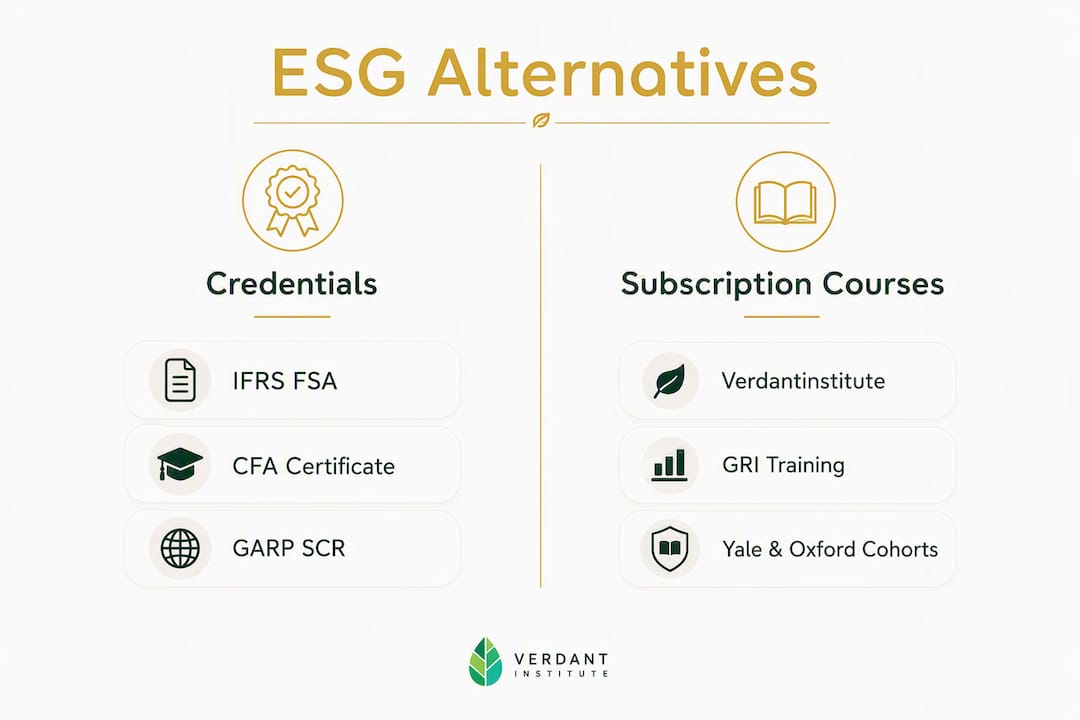
The strongest alternatives to esgcentral.in for US-based finance professionals and students are: Verdantinstitute, the IFRS Foundation FSA Credential (via approved education providers), the CFA Institute Certificate in ESG Investing, GARP's Sustainability and Climate Risk (SCR) Certificate, GRI professional training, and university-backed cohort programs from Yale and Oxford delivered through partners like GetSmarter.
Here is who each suits best at a glance:
- Finance pro / investment analyst: CFA Institute ESG Certificate, GARP SCR, Verdantinstitute
- Reporting specialist / disclosure role: IFRS FSA Credential, GRI training, Oxford Saïd programme
- Risk manager: GARP SCR
- Academic / cohort learner: Yale SOM, Oxford Saïd, Verdantinstitute structured tracks
On cost and time: credential exams (IFRS FSA, GARP SCR, CFA) typically cost several hundred dollars and require weeks of structured study. Cohort programs from Yale or Oxford run higher and span several weeks with fixed schedules. Subscription platforms like Verdantinstitute offer monthly subscription pricing for students and professionals, letting you learn at your own pace across a full curriculum.
Table of Contents
- What are the best esgcentral.in alternatives?
- Detailed profiles: who each alternative is really for
- How to choose the right alternative for your goals
- What to expect when switching from esgcentral.in
- Why Verdantinstitute stands out as a practical alternative
- Which platforms offer the best community and networking?
- What post-course support does each platform provide?
- Mobile and offline learning: what each platform supports
- Key Takeaways
- A practical perspective on credentials vs. courses
- Verdantinstitute: a subscription alternative worth considering
- Further reading and authoritative sources
What are the best esgcentral.in alternatives?
| Alternative | Best for | Credential/Certificate | Format | Approx. cost | Time to complete | CPD/Employer recognition |
|---|---|---|---|---|---|---|
| Verdantinstitute | Finance pros and students | Completion certificate + CPD tracking | Self-paced subscription | $18–$58/month | Flexible | CPD-tracked; finance-sector focused |
| IFRS FSA Credential | Reporting specialists | Recognized two-level credential | Exam-based (Level I + II) | ~$450–$650 per level | Weeks of prep per level | High; ISSB/TCFD-aligned |
| CFA Institute ESG Certificate | Investment professionals | Recognized certificate | Self-paced + online community | ~$890 | Self-directed | High; CFA Institute brand |
| GARP SCR Certificate | Risk managers | Recognized certificate | Exam-based | ~$750 | Weeks of prep | High; risk sector |
| GRI Professional Training | Reporting/disclosure roles | GRI certificate | Self-paced / workshop | ~€1,250 | Days to weeks | Recognized in reporting roles |
| Yale SOM (GetSmarter) | Senior practitioners / cohort learners | Certificate of completion | Cohort-based | Higher (executive pricing) | Several weeks | Strong academic brand |
| Oxford Saïd Programme | Reporting leaders / finance executives | Certificate (AICPA & CIMA partnership) | Cohort-based online | Higher (executive pricing) | Several weeks | AICPA & CIMA recognized |
Cost figures sourced from Climefy's ESG certification guide. GRI pricing is denominated in euros as listed by GRI.
Detailed profiles: who each alternative is really for
Verdantinstitute
Built specifically for finance professionals and students who want structured, curriculum-first ESG training without committing to a single exam cycle. The course library spans 16 courses and 160+ lessons across tracks from Foundations through Advanced Practice topics like transition finance and net-zero strategies. CPD hours are tracked automatically. The subscription model means you can work through deep-dive modules on portfolio decarbonization or industry-specific ESG integration on your own schedule, then revisit them as frameworks evolve. Students pay an affordable monthly rate; professionals pay a higher monthly rate.
IFRS Foundation FSA Credential
The FSA Credential is a two-level exam-based credential that requires passing both Level I and Level II to earn the designation. It is the most directly aligned credential for professionals working in sustainability reporting and disclosure under ISSB standards. If your role involves preparing or auditing sustainability disclosures, this is the credential employers in that space recognize most.
CFA Institute Certificate in ESG Investing
A self-paced program with an online learner community and annual curriculum updates. It targets investment professionals who need to demonstrate ESG integration in valuation and portfolio construction. The CFA Institute brand carries weight with asset managers and institutional investors across the US. At roughly $890, it sits in the mid-range for credential costs.
GARP Sustainability and Climate Risk (SCR) Certificate
Developed by senior risk practitioners and climate experts, the SCR Certificate covers sustainability, climate risk, nature risk, and transition planning. It is the clearest credential signal for risk management roles. Study materials are structured for exam preparation, and the GARP name is well-recognized among risk teams at banks and asset managers.
GRI Professional Training
GRI training is the go-to for professionals responsible for sustainability reports and stakeholder disclosures. Courses cover the GRI Standards directly, which remain the most widely used reporting framework globally. Pricing is listed in euros (~€1,250 for the professional program), and the credential is recognized in reporting and corporate sustainability roles rather than investment roles.
Yale SOM and Oxford Saïd cohort programs
Yale's Sustainable Finance and Investment program runs through GetSmarter in a cohort model that combines academic faculty with industry practitioners. Oxford Saïd's sustainability reporting programme covers ISSB, TCFD, ESG data management, and assurance readiness, with AICPA & CIMA partnership adding professional recognition. Both programs carry strong academic brand signals and are priced at executive education levels. The cohort format is the point: you are not just completing modules, you are exchanging practice with peers at similar career stages.
Pro Tip: For ESG research skills that translate directly into investment analysis, pair a credential exam with a subscription platform so you can build applied knowledge while you prep.
How to choose the right alternative for your goals
Start with your career goal, not the credential name. Certification choice aligns tightly with role: investment and portfolio roles favor CFA-style credentials; reporting and disclosure roles lean toward IFRS FSA or GRI training; risk roles point to GARP SCR.
Ask each provider these questions before committing:
- Is the credential recognized by employers in my specific sector (asset management, banking, corporate reporting)?
- Does the program offer CPD hours I can log toward a professional body requirement?
- What is the exam format, pass rate, and retake policy?
- Is there a cohort or live-session component, or is it entirely self-directed?
- What is the refund or transfer policy if my timeline changes?
On budget and timeline: exam-based credentials (IFRS FSA at ~$450–$650 per level, GARP SCR at ~$750, CFA certificate at ~$890) require a defined study cycle, typically several weeks of focused preparation. Cohort programs from Yale or Oxford run on fixed schedules spanning multiple weeks and carry higher tuition. A subscription platform like Verdantinstitute gives you access to the full curriculum from day one, with no exam deadline pressure.
Pro Tip: Choose a cohort program when your primary goal is building a professional network in sustainable finance. Choose a credential exam when you need a recognized designation on your resume for a specific role. A subscription platform works best when you need ongoing, curriculum-depth learning alongside either route.
What to expect when switching from esgcentral.in
Moving to any of these alternatives means a different content model. Key differences to anticipate:
- Credential-focused platforms (IFRS FSA, GARP SCR, CFA) are exam-prep ecosystems, not course libraries. Content is structured around passing an assessment, not browsing topics.
- Subscription platforms like Verdantinstitute give you a full curriculum you can navigate by topic, track, or depth level. There is no single exam endpoint.
- Cohort programs (Yale, Oxford) have fixed start dates and peer cohorts. You cannot start immediately, and the schedule is non-negotiable.
- GRI training is highly specific to reporting standards. If your role does not involve preparing sustainability disclosures, the content may be narrower than you need.
On US availability: all options listed are available to US-based learners. Credential exams (IFRS FSA, GARP SCR, CFA) are administered globally. Cohort programs from Yale and Oxford accept US participants and are priced in USD or GBP respectively. GRI training is available online internationally, though pricing is listed in euros.
For readers also evaluating ESG data sources alongside training platforms, the distinction between a data provider and an education provider matters: these alternatives are all education and credentialing options, not raw data feeds.
Why Verdantinstitute stands out as a practical alternative
Verdantinstitute is built around a single premise: finance professionals and students need ESG training that goes deep on the finance side, not just general awareness content.

Pricing is transparent: $18/month for students and $58/month for professionals. There is no exam fee on top of the subscription, and no fixed schedule to work around. For teams, institutional licensing replaces per-seat subscriptions. You can review the full pricing and plan details before committing.
The subscription model also means the curriculum stays current as frameworks like ISSB and TCFD evolve. You are not studying for a snapshot-in-time exam; you are building working knowledge you can apply and update.
Which platforms offer the best community and networking?
Cohort programs win here. Yale SOM and Oxford Saïd are explicitly designed around peer interaction: faculty-led sessions, cohort discussion boards, and industry practitioner contributions are built into the program structure. The cohort model is the mechanism for network-building, not a side feature.
The CFA Institute ESG Certificate includes an online learner community, which is more limited than a live cohort but still provides peer connection for a self-paced program. GARP and GRI training are primarily individual study experiences with less structured community interaction.
Verdantinstitute's structured learning tracks are designed to be cohort-compatible for institutional clients, though individual subscribers learn at their own pace. For finance professionals and students who want to explore ESG integration best practices alongside their coursework, the blog and resource library extend the learning beyond the platform.
What post-course support does each platform provide?
Credential programs (IFRS FSA, GARP SCR, CFA) provide the credential itself as the primary career signal. Post-exam, the value is in the designation you can list and the professional body membership that sometimes accompanies it. GARP, for example, maintains a community of risk professionals that SCR holders can access.
Yale and Oxford programs typically include alumni networks and, in some cases, access to ongoing executive education events. The AICPA & CIMA partnership on the Oxford programme adds a professional body connection that can support CPD requirements.
Verdantinstitute's subscription model means post-course support is built in: you retain access to updated course content, CPD tracking, and new lessons as they are added. There is no "post-course" cliff where access ends.
Mobile and offline learning: what each platform supports
Self-paced subscription platforms and credential prep tools generally offer the strongest mobile experience. Verdantinstitute's e-learning platform is accessible via browser on mobile devices. Credential prep platforms for GARP SCR and CFA ESG Certificate are similarly browser-based and mobile-accessible.
Cohort programs from Yale and Oxford are delivered through partner platforms (GetSmarter, for example) that are optimized for desktop but accessible on mobile. Live or synchronous sessions in cohort programs require a stable connection and are not designed for offline use.
Offline access varies by platform and is not universally available. If offline learning is a hard requirement, check each provider's specific app or download capabilities before enrolling. Finance professionals who travel frequently should confirm mobile and offline options directly with the provider.
Key Takeaways
Recognized ESG credentials (IFRS FSA, CFA, GARP SCR, GRI) carry distinct employer signals and require different time and cost commitments than subscription or cohort-based learning platforms.
| Point | Details |
|---|---|
| Match credential to role | Investment roles favor CFA-style credentials; reporting roles favor IFRS FSA or GRI; risk roles point to GARP SCR. |
| Credential exam costs | Exam fees range from ~$450–$650 per level (IFRS FSA) to ~$890 (CFA certificate) and ~$750 (GARP SCR). |
| Cohort vs. self-paced | Cohort programs (Yale, Oxford) build networks but run on fixed schedules; subscription platforms offer flexibility with no exam deadline. |
| Check CPD and employer uptake | Confirm CPD recognition, employer uptake in your sector, and cohort availability before committing to any program. |
| Verdantinstitute subscription | Verdantinstitute offers 16 courses and 160+ lessons with CPD tracking at $18–$58/month, no exam fee required. |
A practical perspective on credentials vs. courses
The credential vs. course debate gets framed as an either/or, and that framing misleads most people who ask it.
A recognized credential (IFRS FSA, GARP SCR, CFA ESG Certificate) is a resume signal. It tells a hiring manager or promotion committee that you passed a standardized assessment. For roles in audit, reporting, or institutional investment where that signal is explicitly required, there is no substitute. Go get the credential.
But credentials are snapshots. The ISSB standards are evolving. TCFD is being absorbed into IFRS S2. Net-zero frameworks are being rewritten. A credential you earned two years ago does not automatically reflect what the frameworks say today.
That is where a subscription curriculum earns its keep. Verdantinstitute is not trying to replace the IFRS FSA or GARP SCR. It covers what those credentials cannot: ongoing, finance-specific depth that updates as the field moves. For professionals who already hold a credential and want to stay current, or for students building foundational knowledge before sitting an exam, the subscription model is the more practical tool.
One transparency note: Verdantinstitute issues completion certificates and CPD-tracked credentials, not the formal designations issued by IFRS, CFA Institute, or GARP. If a job posting requires one of those specific designations, pursue it directly. If you need working knowledge and CPD hours, the subscription is the faster and more cost-effective route.
Verdantinstitute: a subscription alternative worth considering
Finance professionals and students looking for a practical, finance-first ESG curriculum do not have to choose between a rigid exam cycle and a general awareness course.
Verdantinstitute gives you access to 16 structured courses and 160+ lessons covering sustainable finance, ESG analysis, climate science, regulatory frameworks, and portfolio decarbonization, with subscription rates of $18/month for students and $58/month for professionals. CPD hours are tracked automatically, and completion certificates are issued per course. For universities and finance teams, institutional licensing covers multiple learners under a single agreement. View the full plan options or browse the course library to see what fits your current role and goals.
Further reading and authoritative sources
- IFRS FSA Credential — official exam and registration details
- CFA Institute Sustainable Investing Certificate — program page
- GARP SCR Certificate — exam registration and candidate guide
- Yale SOM Sustainable Finance and Investment Program (GetSmarter)
- Oxford Saïd Sustainability Reporting and ESG Data Management Programme
- Climefy ESG Certification Guide — cost ranges and study-hour comparisons
- ACCA Certificate in Sustainability for Finance — US page
- Verdantinstitute course library and pricing