

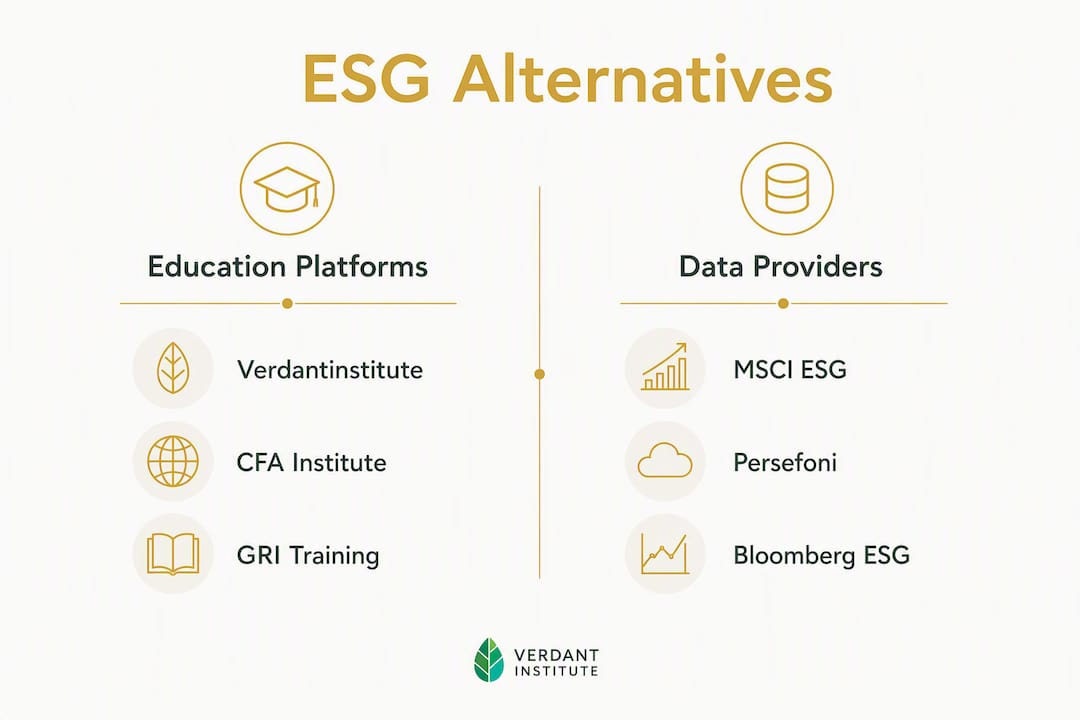
For U.S. finance professionals, Verdantinstitute is the strongest starting point among esgforinvestors.com alternatives — it's the only subscription platform that pairs structured CPD-tracked training with coverage of regulatory frameworks, portfolio decarbonization, and transition finance in one place. Beyond education, the shortlist breaks into three practical categories:
- Education-first platforms (Verdantinstitute, CFA Institute ESG Certificate, PRI Academy): best for CPD hours, career credentials, and building in-house analytical capacity
- Enterprise ESG data vendors (MSCI ESG Research, Sustainalytics): best for portfolio screening, issuer-level risk ratings, and integration with existing research workflows
- Carbon-accounting and reporting tools (Persefoni, Bloomberg ESG / LSEG): best for regulatory-grade emissions reporting and audit-ready disclosures
Table of Contents
- How do these alternatives compare at a glance?
- What does each alternative actually offer?
- How do ESG providers actually differ in methodology?
- How should you choose the right ESG alternative?
- Why Verdantinstitute is the recommended pick — and when to choose something else
- How to pilot and adopt an alternative in 30–90 days
- Key Takeaways
- The case for training before data
- Verdantinstitute: structured ESG training built for finance professionals
- Sources and further reading
How do these alternatives compare at a glance?
| Alternative | Type | Best For | Methodology Transparency | Pricing / Access | U.S. Availability | Recommended User |
|---|---|---|---|---|---|---|
| Verdantinstitute | Education | CPD, ESG skills, sustainable finance credentials | Published course syllabi; ISSB/GRI-aligned content | $18/mo (student) / $58/mo (professional); institutional licensing | Full U.S. access | Finance professionals, analysts, students |
| CFA Institute (ESG Certificate) | Certification / CPD | Professional credential, exam-based learning | CFA curriculum standards | Pay-per-course / exam fee | Full U.S. access | CFA charterholders, portfolio managers |
| PRI Academy | Education / CPD | Responsible investment principles, signatory training | PRI framework aligned | Pay-per-course | Full U.S. access | Asset managers, institutional investors |
| GRI Training | Standards training | Sustainability reporting, disclosure frameworks | GRI Standards (published) | Pay-per-course | Full U.S. access | Sustainability officers, IR teams |
| MSCI ESG Research | Data / Ratings | Portfolio screening, issuer ESG risk ratings | Published methodology papers | Enterprise subscription | Full U.S. access | Asset managers, analysts |
| Sustainalytics | Data / Ratings | ESG risk ratings, controversy monitoring | Published methodology | Enterprise subscription | Full U.S. access | Investment teams, ESG analysts |
| Persefoni | Carbon accounting | PCAF-aligned emissions reporting, audit-ready data | PCAF / ISSB framework | Enterprise SaaS | Full U.S. access | CFOs, sustainability officers |
| Bloomberg ESG / LSEG | Data / Reporting | Integrated ESG data, terminal workflows | Proprietary + disclosed | Enterprise / terminal | Full U.S. access | Institutional investors, data teams |
Pro Tip: If you're evaluating this table for a procurement decision, prioritize the "Methodology Transparency" column first. A vendor that publishes its scoring logic is far easier to defend to compliance and audit teams than one that doesn't. For training buyers, check whether the provider offers CPD recognition from CFA Institute or PRI and explore their financial reporting services that support ESG reporting standards and audit readiness.
What does each alternative actually offer?
Verdantinstitute
Verdantinstitute offers 16 courses and over 160 lessons organized into four tracks: Academic Foundations, Foundations, Deep Dives, and Advanced Practice (covering transition finance and net-zero strategies). Every plan includes CPD tracking and a completion certificate. At $58/month for professionals and $18/month for students, Verdantinstitute is the most accessible structured ESG training available in the U.S. market. Institutional licensing makes it practical for finance teams that need consistent training across departments.
CFA Institute and PRI Academy
The CFA Institute's Certificate in ESG Investing is the closest thing to an industry-standard credential for portfolio managers. It's exam-based, globally recognized, and maps directly to the analytical skills institutional employers look for. PRI Academy covers responsible investment principles and is particularly useful for asset managers who are PRI signatories or working toward signatory status. Both are pay-per-course rather than subscription, which suits professionals who need a single credential rather than ongoing learning.
GRI training
GRI (Global Reporting Initiative) training focuses on sustainability disclosure rather than investment analysis. If your role sits closer to corporate reporting, investor relations, or sustainability officer work, GRI's standards-based courses are the right fit. They're not designed for portfolio managers, but they're indispensable for teams building audit-ready disclosure frameworks.
MSCI ESG Research and Sustainalytics
These are the two dominant enterprise ESG data vendors for U.S. institutional investors. MSCI ESG Ratings cover thousands of issuers and integrate directly with portfolio management systems. Sustainalytics provides company-level ESG risk ratings and controversy monitoring, which investment teams use to screen issuers and track exposures. Both publish methodology papers, which matters for audit and compliance teams. Neither is a training platform; they're data infrastructure.

Persefoni
Persefoni is built specifically for carbon accounting aligned to PCAF and ISSB frameworks. It's the tool of choice when a firm needs audit-ready Scope 1, 2, and 3 emissions data rather than ESG scores. Enterprise ESG software can reduce reporting cycles from months to days through automated compliance and data verification workflows, and Persefoni is one of the platforms that delivers that kind of efficiency at scale.
Bloomberg ESG / LSEG (Refinitiv)
For teams already inside Bloomberg Terminal or LSEG Workspace, these integrated ESG data layers are the path of least resistance. Coverage is broad, update frequency is high, and the data feeds directly into existing research and reporting workflows. The trade-off is cost: both are enterprise-tier, and the ESG data modules sit on top of existing terminal fees.
How do ESG providers actually differ in methodology?
The single biggest source of confusion in ESG investing is that "ESG" means something different depending on who's selling it. J.P. Morgan Asset Management notes that sustainable investing spans positive tilt, best-in-class, thematic, and impact approaches, each with distinct selection rules. A best-in-class screen and a thematic clean-energy fund will produce completely different portfolios even if both carry an "ESG" label.
The materiality question cuts even deeper. Single materiality focuses on ESG risks that affect a firm's financial performance. Double materiality adds the reverse: how a firm's operations affect society and the environment. MSCI and Sustainalytics are primarily single-materiality tools. Impact-focused frameworks, including PCAF-aligned carbon accounting, operate under double materiality. Choosing the wrong framework for your mandate isn't just an analytical error — it's a compliance risk.
Pro Tip: Before signing any data vendor contract, request the vendor's published methodology document and ask specifically whether their scoring is quantitative and audit-ready. If they can't produce a methodology paper, that's a red flag regardless of brand recognition.
Greenwashing is the other structural risk. Some funds repackage existing strategies as "ESG" without changing underlying security selection. A values-first framework — defining non-negotiable exclusions before selecting tools — reduces exposure to marketing-driven labels. That framework starts with training, not data subscriptions.
How should you choose the right ESG alternative?
Work through this sequence before committing to any platform:
- Define your use case first. Are you building analyst skills (education), screening a portfolio (data), or filing regulatory emissions reports (carbon accounting)? The answer eliminates most of the shortlist immediately.
- Assess data needs and scale. A solo analyst needs something different from a 50-person investment team with regulatory reporting obligations.
- Check integration requirements. Does the tool connect to your portfolio management system, LMS, or reporting workflow? Ask for a sample data export before signing.
- Verify audit-readiness. For any regulatory reporting use case, confirm the platform supports PCAF, ISSB, or GRI standards and can produce audit-ready outputs.
- Evaluate cost against actual usage. Subscription platforms like Verdantinstitute offer predictable monthly costs; enterprise data vendors typically require annual contracts with significant minimums.
Red flags to watch for:
- Opaque scoring with no published methodology
- Frequent score changes with no change documentation
- No enterprise integrations or API access
- Limited alignment with U.S. regulatory frameworks (SEC climate disclosure rules, TCFD)
- No client case studies or reference accounts available
Specific questions to ask vendors: What are your primary data sources? How often is data updated? Can you provide a sample audit-ready report? Do you support direct indexing workflows, and what are the account minimums? Who are your current institutional clients in the U.S.?
Why Verdantinstitute is the recommended pick — and when to choose something else
For finance professionals who need to build or deepen ESG analytical skills, Verdantinstitute is the clearest choice. The structured learning tracks map directly to the competencies that portfolio managers, analysts, and sustainability officers need: ESG integration, climate risk, regulatory frameworks, and impact measurement. CPD tracking and completion certificates make it defensible for professional development budgets.
Choose Verdantinstitute when: you need CPD hours, are building in-house ESG capacity, or want structured credentials that align with CFA and PRI frameworks.
Choose MSCI or Sustainalytics when: your primary need is issuer-level screening data integrated into existing portfolio tools at scale.
Choose Persefoni or Bloomberg ESG when: you have regulatory reporting obligations that require audit-ready emissions data or broad data coverage across asset classes.
Choose CDFIs or community-centered investment vehicles when: you need measurable local impact as an explicit mandate, rather than just ESG risk management.
How to pilot and adopt an alternative in 30–90 days
- Days 1–7: Define the use case and get stakeholder sign-off from procurement, compliance, and the sustainability officer or portfolio analytics lead.
- Days 8–21: Run a sample data import or complete one full course module. Test methodology validation against your existing framework.
- Days 22–45: Export a sample report or CPD record. Check it against your audit or compliance requirements.
- Days 46–60: Evaluate integration with your portfolio management system or LMS. Identify any technical gaps.
- Days 61–90: Assess adoption across the team. For training platforms, track completion rates. For data platforms, measure time saved on reporting cycles.
ESG integration is a lifecycle process — proxy voting, annual reassessments, and holdings reviews are ongoing requirements, not one-time setup tasks. Build that governance cadence into your pilot evaluation criteria from day one.
Key Takeaways
For U.S. finance professionals, the right ESG alternative depends entirely on use case: education-first platforms like Verdantinstitute for CPD and skills, enterprise data vendors for portfolio screening, and carbon-accounting tools for regulatory reporting.
| Point | Details |
|---|---|
| Match tool to use case | Education, data screening, and carbon accounting serve different mandates — pick the category before the vendor. |
| Methodology transparency matters | Always request a published methodology document; opaque scoring is a compliance liability. |
| Greenwashing is a real risk | A values-first framework defined before tool selection reduces exposure to marketing-driven ESG labels. |
| Carbon accounting needs PCAF/ISSB alignment | Audit-ready emissions reporting requires platforms that explicitly support PCAF or ISSB frameworks. |
| Verdantinstitute leads for training | At $18–$58/month with CPD tracking and 16 structured courses, Verdantinstitute is the most accessible professional ESG training in the U.S. |
The case for training before data
Most finance teams approach ESG backwards. They buy the data subscription first, then discover their analysts lack the framework to interpret the outputs correctly. A Sustainalytics score without an understanding of single versus double materiality is just a number. A Persefoni carbon report without PCAF literacy is a compliance risk waiting to happen.
The professionals who get the most out of enterprise ESG data tools are the ones who built the conceptual foundation first. That's not a philosophical preference — it's a practical observation about how ESG integration actually works in institutional settings. The governance discipline that separates effective ESG programs from marketing claims requires ongoing skills development, not just a data feed.
Verdantinstitute: structured ESG training built for finance professionals
If you've been relying on free resources or fragmented content for ESG education, Verdantinstitute offers a more direct path. The platform's 16 courses span everything from ESG foundations to transition finance and net-zero strategy, organized into tracks that fit whether you're a student ($18/month) or a working professional ($58/month). Every subscription includes CPD tracking and a completion certificate you can use for professional development records.
For finance teams and universities, institutional licensing provides consistent training across departments without per-seat complexity. The course library covers the regulatory frameworks, ESG data sources, and analytical skills that make enterprise data tools actually useful. If your team is evaluating ESG platforms and realizes the skills gap is the real bottleneck, start with Verdantinstitute's course catalog or contact the team about institutional pricing.
Sources and further reading
| Source | URL | Annotation |
|---|---|---|
| J.P. Morgan Asset Management — Sustainable Investing Approaches | Link | Covers positive tilt, best-in-class, thematic, and impact strategies with methodology distinctions |
| Chicory Wealth — Impact Investing Services | Link | Explains single vs. double materiality and community-centered investment structures |
| Pomegra Learn Library — DIY Values-Based Investing | Link | Covers greenwashing risk, values-first frameworks, direct indexing minimums, and lifecycle governance |
| ESGVerify — Compare ESG Investing Tools | Link | Enterprise ESG software comparison including reporting cycle automation |
| Verdantinstitute | Link | Course catalog, CPD tracking, and institutional licensing details |
| Verdantinstitute — ESG Data Sources Guide | Link | Identifies leading ESG data firms and integration considerations for institutional investors |
| Verdantinstitute — ESG Screening Methodology Guide | Link | Step-by-step evaluation of vendor screening methodologies and transparency standards |