

If you think impact investing career pathways are reserved for finance veterans with decades of Wall Street experience, you are wrong. This is one of the most persistent and costly misconceptions in sustainable finance today. The field is actively hiring from economics, policy, nonprofit work, and even tech. Understanding exactly where you fit, what credentials matter, and how to build relevant skills is the difference between circling the opportunity and walking through the door. This guide covers the roles, credentials, networks, and regulatory knowledge you need to move forward.
Table of Contents
- Key Takeaways
- Impact investing career pathways: what the field actually looks like
- Education and credentials that actually move the needle
- Networking, mentorship, and real experience: breaking in
- Regulatory knowledge and the skills that separate senior candidates
- My take on what actually builds a career here
- Build your foundation with Verdant Institute
- FAQ
Key Takeaways
| Point | Details |
|---|---|
| Diverse entry points exist | Only about 31% of impact investing professionals come from traditional finance backgrounds. |
| Deal skills beat credentials alone | Financial modeling and impact measurement matter more than job titles for breaking in. |
| Fellowships accelerate hiring | Structured programs like Mosaic Fellowship place roughly 45% of participants in full-time roles. |
| Regulatory knowledge is a differentiator | Understanding EU SFDR Articles 8 and 9 increases your competitiveness for senior positions. |
| Networking is ongoing work | Treating relationship-building as a continuous practice is the defining habit of successful career builders. |
Impact investing career pathways: what the field actually looks like
The term "impact investing" gets used loosely, so it helps to start with the recognized industry vocabulary. Impact investing refers to investments made with the intention to generate positive, measurable social or environmental outcomes alongside a financial return. Career paths within this space span fund management, due diligence, portfolio monitoring, impact measurement, and investor relations.
Roles you will actually encounter include:
- Investment Analyst: Screens deals, builds financial models, and supports due diligence at early-stage or growth-stage funds.
- Due Diligence Associate: Evaluates financial, operational, and impact performance of potential investees.
- Portfolio Manager: Oversees a portfolio of investments, monitors performance, and manages relationships with portfolio companies.
- Impact Measurement Specialist: Designs and tracks frameworks for measuring social or environmental outcomes.
- Associate Director, Impact Investments: Combines cross-functional research, due diligence support, and impact reporting in a hybrid mid-career role.
What separates these roles is not just seniority. Investment officer positions at a fund demand hard financial skills. Roles within impact-focused operating organizations often weight program design, stakeholder management, and measurement expertise more heavily.
Here is a quick comparison to help you identify your natural entry point:
| Role type | Key skills required | Typical background |
|---|---|---|
| Investment Analyst (Fund) | Financial modeling, sector research | Finance, economics |
| Impact Measurement Analyst | Data collection, frameworks (IRIS+, SROI) | Social science, policy, finance |
| Due Diligence Associate | Credit analysis, ESG screening | Finance, consulting |
| Portfolio Monitor | Reporting, stakeholder engagement | Nonprofit, finance, consulting |
| Impact Org Investment Officer | Program design, capital deployment | Development, policy, finance |
Only about 31% of practitioners had prior finance careers before entering this space. That means nonprofit managers, government analysts, and technologists have made successful transitions. Identifying your target route early shapes every other decision you make, including which certifications to pursue and which networks to join.
Education and credentials that actually move the needle
A finance or economics degree remains the most direct academic on-ramp for fund-side roles. Sustainability, environmental policy, and development economics degrees open doors on the impact management and portfolio operations side. Neither path is a guarantee, and neither closes the other off entirely.
Beyond degrees, targeted certifications and online learning fill the gaps that formal education leaves. Programs worth prioritizing include:
- CFA (Chartered Financial Analyst): Signals rigorous investment analysis capability, especially useful for fund-side roles.
- ESG certifications: Structured programs covering SFDR, impact measurement, and ESG integration build specialized knowledge that generalist degrees rarely provide.
- Impact measurement courses: Proficiency in frameworks like IRIS+ or the Impact Management Project's five dimensions distinguishes candidates at analyst and associate levels.
- Financial modeling courses: Practical competency in building three-statement models and discounted cash flow analyses is non-negotiable for deal-facing positions.
Structured development programs take credentials further. The IIX Summer Apprenticeship offers 8 to 12 week in-person placements with structured mentorship across specialized units, providing hands-on exposure that no online course can replicate. Seats are limited, which keeps the mentorship intensive and genuinely useful.
Pro Tip: When evaluating any certification program, check whether it covers CPD (Continuing Professional Development) tracking. Employers increasingly expect documented professional development, and CPD-recognized credentials carry more weight in formal hiring processes.
The skill gap that catches most candidates off guard is impact measurement. Financial modeling you can learn independently. Knowing how to design an impact thesis, select indicators, and report against outcomes is rarer and more valued. Prioritize it. Platforms like Verdant Institute's ESG certification guide lay out a clear, structured path from foundational knowledge to recognized credentials.

Networking, mentorship, and real experience: breaking in
Here is the uncomfortable reality about careers in social finance. Getting hired is not primarily a credentials problem. It is a relationships and demonstrated capability problem. You can have the right degree and the right certifications and still be invisible to the funds and organizations doing the most interesting work.
Successful Mosaic Fellowship participants consistently describe treating networking as the job itself, not as a task attached to job searching. About 45% of Mosaic fellows secured full-time impact investment jobs after the program, with expanded sector networks and concrete investment skills cited as the most career-relevant outcomes.
Here is a practical process to build genuine industry relationships and experience:
- Attend investment committee meetings wherever possible. Many fellowships and apprenticeships give access to live deal discussions. Show up, take notes, ask precise questions afterward. This is where deal-adjacent skills compound quickly.
- Use the GIIN jobs board actively. The GIIN jobs board lists impact investment roles by location and recency, covering everything from remote analyst positions to senior roles at major institutional funds. Check it weekly, not when you feel like job searching.
- Identify two or three practitioners whose work you genuinely respect and request informational conversations. Not generic coffee chats. Come with specific questions about their fund's impact thesis or a portfolio company you researched. Specificity signals seriousness.
- Join peer cohorts and alumni networks tied to structured programs. The network you build through a fellowship matters as much as the skills you develop. Many impact investing internships and entry-level roles get filled before they are ever posted publicly.
- Document your deal exposure. If you supported a credit memo, built a financial model, or contributed to an impact report, write it up cleanly. Concrete examples from real work beat a resume full of course completions.
Pro Tip: Do not wait until you have the "perfect" background to reach out. Finance professionals and career changers who engage early, even before completing certifications, position themselves as genuinely curious and motivated. Most practitioners in this space remember when they were breaking in and respond well to people who do their homework first.
Regulatory knowledge and the skills that separate senior candidates
Understanding where regulatory requirements shape sustainable finance career paths is no longer optional. The EU Sustainable Finance Disclosure Regulation (SFDR) has become a baseline competency expectation in European markets and is gaining relevance globally as institutional investors align with similar frameworks.
SFDR Article 9 funds require that all investments qualify as sustainable and apply do-no-significant-harm (DNSH) criteria across the portfolio. Article 8 funds promote environmental or social characteristics but allow more flexibility in asset composition. These distinctions are not just classification details. They shape what data you collect, how you structure due diligence, and what you report to investors.
Here is how regulatory competencies map to career progression:
| Competency level | What it covers | Career stage |
|---|---|---|
| Foundational SFDR awareness | Article 8 vs. 9 distinctions, PAI disclosures | Analyst, associate |
| Data governance and reporting | Managing sustainability data workflows for compliance | Mid-level specialist |
| Disclosure framework design | Building internal policies for DNSH and impact alignment | Senior associate, director |
| Investment product structuring | Classifying and reclassifying funds under SFDR | Portfolio manager, partner |
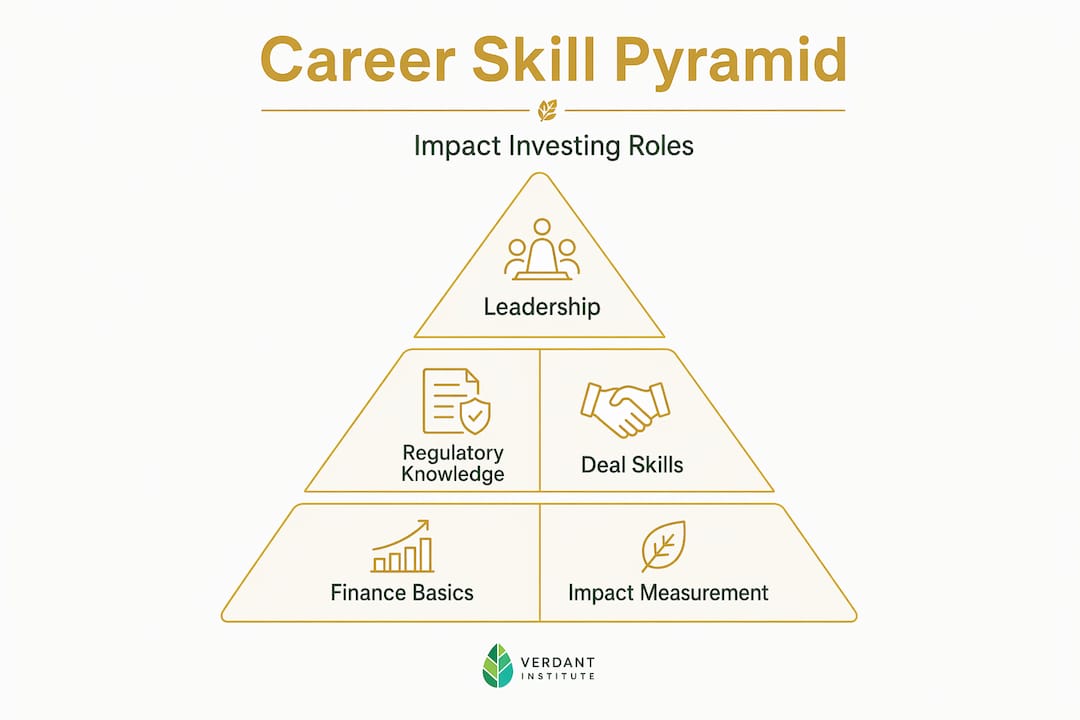
Senior ESG investment roles often require 10 or more years of experience spanning the full investment lifecycle, from pre-investment screening through post-investment engagement and ESG action plan development. That progression is built one competency layer at a time.
Expertise in documenting and managing sustainability data workflows is especially valuable right now, given the complexity of principal adverse impact (PAI) reporting. Candidates who understand the operational mechanics of SFDR, not just the theory, are genuinely scarce. That scarcity is your opportunity. For a deeper look at how these regulatory frameworks play out in fixed income portfolios specifically, Verdant Institute's breakdown of ESG in fixed income is worth your time.
My take on what actually builds a career here
I have watched professionals with stellar credentials from top MBA programs get passed over for roles that went to people with more specific, demonstrable experience. And I have seen career changers from policy and nonprofit work land associate roles at respected impact funds within 18 months of deliberately building their skills. The pattern is consistent.
The first thing I tell anyone serious about this field is to stop treating your first job title as the goal. Relationship-building compounds over time in ways that no individual role replicates. The fund manager who remembers you from an intelligent question at a conference two years ago may be the person who thinks of you when a position opens that was never listed publicly.
The second thing is about deal skills. Concrete capabilities like financial modeling, impact measurement, and due diligence analysis are what hiring managers actually evaluate. Signaling your passion for impact through titles, club memberships, or broad volunteering does almost nothing for your candidacy if you cannot walk through a deal process.
Where I see finance professionals stumble is in underestimating how much sector specialization matters. A generalist finance background gets you to the interview. Knowing the nuances of gender-lens investing, climate infrastructure, or affordable housing finance gets you the offer. Pick a lane and go deep.
Finally, values alignment is real but it is also a two-way street. The organizations doing the most disciplined work in this space take mission seriously. They also expect financial rigor. Treating those as competing priorities is the wrong frame. The best careers in impact investing are built by people who refuse to separate them.
— Charles
Build your foundation with Verdant Institute
Verdant Institute is built specifically for finance professionals and students who want to develop real expertise in ESG and sustainable finance, not just a certificate to list on a resume. With 16 courses and over 160 lessons organized across structured learning tracks, from foundational ESG concepts to advanced transition finance, the platform covers exactly the skill areas that hiring managers in impact investing actually test for. CPD tracking and recognized certifications make your development visible to employers. Whether you are a student starting at $18 per month or a working professional at $58 per month, you can explore the full course catalog and pricing and find the plan that fits your timeline and goals.
FAQ
What backgrounds break into impact investing most successfully?
Only about 31% of professionals in the field came from traditional finance careers. Successful entrants also come from nonprofit management, government, policy, and tech sectors, particularly when they build targeted financial and impact measurement skills.
What skills are most important for impact investment jobs?
Financial modeling, impact measurement, and due diligence are the most valued technical skills. Regulatory knowledge, particularly around SFDR, is increasingly required for roles at institutional funds operating in European markets.
Are impact investing internships worth pursuing?
Yes. Structured programs like the IIX Summer Apprenticeship provide hands-on deal exposure and mentorship that accelerates hiring significantly. About 45% of Mosaic fellows secured full-time impact investing roles after completing the program.
How does SFDR knowledge help sustainable finance career paths?
Understanding SFDR Article 8 and 9 fund classifications, PAI disclosures, and DNSH criteria positions you for compliance, product structuring, and senior ESG roles where these competencies are directly applied.
How long does it take to break into impact investing?
Timelines vary widely. Career changers who deliberately build deal skills, complete structured programs, and maintain active networks can transition within 12 to 24 months. Finance professionals pivoting from traditional roles often move faster when they add targeted ESG and impact measurement credentials to existing analytical skills.