

The most effective way to build green finance connections as a U.S. professional is to join two or three institutional networks, attend targeted events each quarter, and follow up with new contacts within two weeks. Start this week with these four steps:
- Subscribe to the US SIF mailing list and scan their upcoming event calendar.
- Visit the SBFN website and identify which thematic working group aligns with your work.
- Send one LinkedIn message to a peer you met at a recent event, asking a specific question about their current project.
- Follow the Principles for Responsible Investment (PRI) on LinkedIn and register for their next free webinar.
Sector experts recommend attending 2–3 events or webinars per quarter and following up promptly. That cadence, combined with membership in one or two institutional networks, gives you the reach of a broad network without the noise of high-volume outreach.
Three outreach templates to copy now:
- Connect: "Hi [Name], I work on [topic] at [org] and noticed your work on [specific project]. I'd value connecting."
- Ask for insight: "I'm exploring [topic]. Would you be open to a 20-minute call to share your perspective?"
- Request intro: "You mentioned knowing [Name]. Would you be comfortable making a brief introduction?"
Table of Contents
- What are the key networks for sustainable finance professionals?
- Which events and conferences are worth your time?
- How do you join these networks and move from attendee to contributor?
- How to network effectively in sustainable finance over the long term
- Where can you upskill and meet peers at the same time?
- Key Takeaways
- Why getting into the room is the real competitive advantage
- Verdantinstitute: structured learning that builds your network from day one
- Useful sources and where to subscribe
What are the key networks for sustainable finance professionals?
The seven networks below cover the full spectrum of the impact investing community, from central-bank regulators to civil-society advocates. Each has a distinct membership model and a different value proposition for U.S. participants.
| Network | Primary focus | Who can join | How to engage | Best for | U.S. presence |
|---|---|---|---|---|---|
| NGFS | Central-bank climate risk | Central banks, supervisors | Working groups, publications | Regulatory capacity-building | Fed, OCC, FDIC observe |
| SBFN | Emerging-market sustainable finance | Regulators, industry associations | Thematic working groups, peer exchanges | Regulatory framework design | World Bank secretariat |
| IFC Sustainable Finance | Private-sector green investment | Banks, investors, corporates | Guidance notes, events, toolkits | Practitioner training, deal structuring | IFC Washington, D.C. |
| PRI | Responsible investment | Asset owners, managers, service providers | Signatory network, working groups | Asset-owner and manager guidance | Large U.S. signatory base |
| US SIF | U.S. sustainable investing | Asset managers, advisors, NGOs | Membership, conferences, research | U.S.-focused advocacy and research | Headquartered in U.S. |
| Ceres | Corporate sustainability advocacy | Investors, companies, NGOs | Investor networks, policy engagement | Climate policy and shareholder advocacy | Boston-based, U.S.-focused |
| Climate Bonds Initiative | Green bond standards | Issuers, investors, regulators | Certification, events, toolkits | Green bond market development | Global, active U.S. outreach |
Network for Greening the Financial System (NGFS): The NGFS is the central-bank and supervisor network for climate risk. Its scenario models and supervisory guidance have become the de facto standard for stress-testing climate exposure. U.S. regulators at the Federal Reserve, OCC, and FDIC participate as observers. If you work in prudential regulation or risk management, the NGFS scenario publications are the first toolkit to read.
Sustainable Banking and Finance Network (SBFN): Facilitated by the World Bank Group, SBFN runs four member-led thematic working groups covering measurement, data and disclosure, incentive-based sustainable finance frameworks, and sustainable finance instruments. Membership is open to financial regulatory bodies and industry associations from emerging markets, so U.S. professionals typically engage as knowledge partners or through World Bank-convened events rather than as direct members.
IFC Sustainable Finance Resources: The International Finance Corporation publishes guidance notes, toolkits, and case studies on green lending, blended finance, and ESG integration for private-sector institutions. Their open-access materials are among the most practically useful for U.S. banks and asset managers looking to structure green products.
Principles for Responsible Investment (PRI): With a large U.S. signatory base spanning pension funds, endowments, and asset managers, PRI is the go-to network for asset owners and investment managers. Signatories gain access to working groups, peer benchmarking, and an annual conference. The PRI Academy also offers training that counts toward CPD hours.
US SIF: The Forum for Sustainable and Responsible Investment is the primary U.S.-focused membership organization for sustainable investing practitioners. It publishes the biennial Trends Report on U.S. sustainable investing, runs an annual conference, and maintains a policy advocacy function. For any U.S.-based professional, this is the first membership to consider.
Ceres: Boston-based Ceres convenes investors and companies through its Investor Network and the BICEP coalition for climate policy. Their shareholder engagement work and policy advocacy make them the right hub for professionals focused on corporate accountability and climate legislation.
Climate Bonds Initiative: The Climate Bonds Initiative sets the standards for green bond certification and publishes market data on labeled bond issuance. Their events and working groups are the primary meeting point for green bond issuers, underwriters, and investors globally.
Who should prioritize what: A U.S. regulator should start with NGFS publications and SBFN peer exchanges. An asset manager should join PRI as a signatory and attend US SIF's annual conference. A civil-society stakeholder or NGO professional will find the most traction through Ceres and Climate Bonds Initiative events.
Which events and conferences are worth your time?
Finding the right events is less about searching broadly and more about following the right calendars. Each of the networks above maintains an event page; subscribing to their mailing lists is the fastest way to catch registration windows before they fill.
- US SIF Annual Conference: The flagship U.S. gathering for sustainable investing professionals, typically held in the fall. Workshops and roundtables are structured for peer interaction, not just keynote listening.
- PRI in Person: The PRI's annual global conference rotates cities and draws asset owners, managers, and service providers. Virtual attendance options have expanded since 2020.
- NGFS Roundtables and Plenary Meetings: Primarily for central-bank and supervisory staff. Outputs are published publicly, so even non-members can follow the technical work.
- SBFN Workshops: World Bank-convened workshops on specific sustainable finance themes, often tied to working-group outputs. Emerging-market focus, but U.S. knowledge partners are welcomed.
- Climate Bonds Initiative Summit: An annual event focused on green bond market development, with strong issuer and investor participation.
- Ceres Investor Summit: Held periodically in New York, this event convenes institutional investors and corporate leaders on climate risk and policy.
Before registering for any event, check three things: whether the agenda includes workshop or roundtable formats (not just panels), whether the attendee list or past-participant profiles are published, and whether the event offers working-group or committee meetings alongside the main program. Those side meetings are where the real relationship development happens.
Pro Tip: Set a calendar alert for September each year. Most major sustainable finance conferences publish their call-for-speakers and early-bird registration in September–October for the following spring cycle.
For regional and virtual options, follow the LinkedIn pages of each network and search LinkedIn Events using terms like "ESG," "green bonds," or "transition finance." The Financial Centres for Sustainability (FC4S), a global network of 44 financial centres, also publishes regional event listings that occasionally include North American programming.
How do you join these networks and move from attendee to contributor?
Most networks offer at least one free entry point. Here is how the paths typically work:
Free and open access: IFC guidance notes, NGFS scenario publications, and Climate Bonds Initiative market reports are all publicly available. Downloading and citing these in your own work is a legitimate first step toward visibility in the community.

Event-based engagement: Registering for a public conference or webinar requires no institutional membership. This is the lowest-friction way to meet peers and understand a network's culture before committing to membership fees or institutional approval processes.
Individual and institutional membership: US SIF and Ceres offer tiered membership with annual fees that vary by organization type and size. PRI membership is institutional and requires a commitment to the six Principles. Budget 4–8 weeks for institutional approval processes at larger organizations.
Invitation-only working groups: SBFN thematic working groups and NGFS expert groups are largely invitation-based. The path in is to demonstrate expertise first: publish a comment on a consultation paper, present at a public workshop, or partner with a member institution on a joint submission.
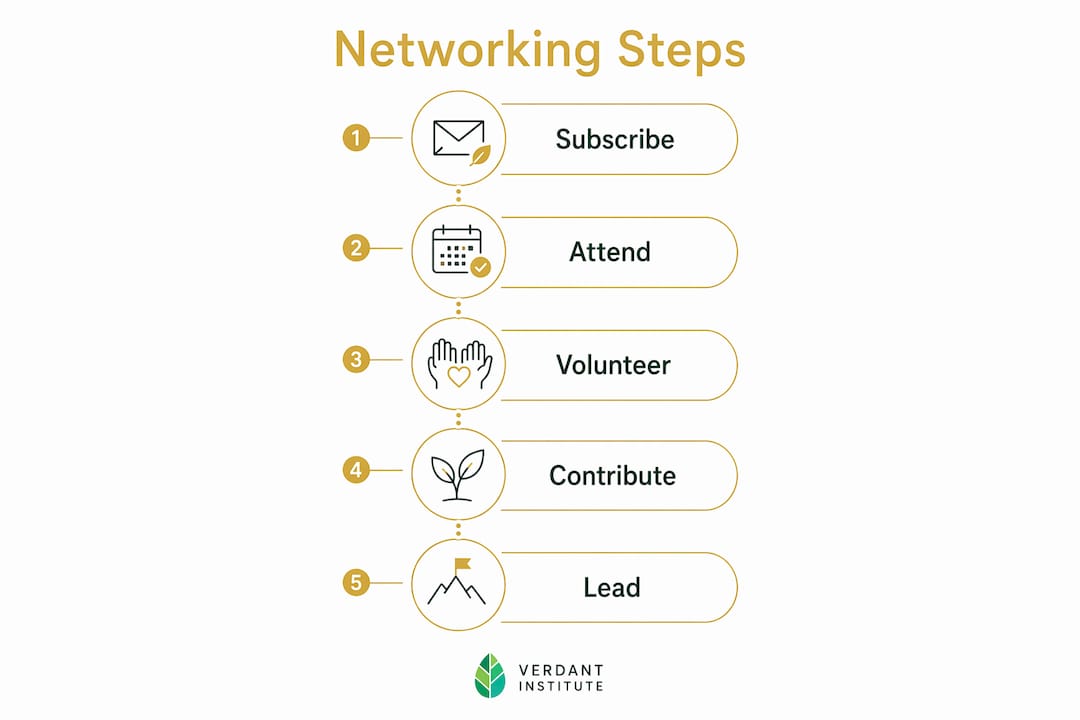
The stepwise path looks like this: subscribe to mailing lists and download key toolkits → attend one public event → volunteer for a small task (note-taking, session facilitation) → propose a session topic or co-author a comment letter → apply for a working-group seat.
Pro Tip: Volunteering to help organize a side event or workshop at a conference is one of the fastest ways to get introduced to working-group chairs. Offer a specific skill, such as data analysis or facilitation, rather than a general willingness to help.
Recruiter guidance consistently points to strategic volunteering as a reliable path to hidden opportunities in this sector. The same logic applies to network participation: doing a small task well is more persuasive than a cold application.
How to network effectively in sustainable finance over the long term
Sustainable finance operates on a referral-first culture where a significant share of roles and collaborations are filled through relationships rather than public postings. High-volume outreach does not work here. What does work is depth.
Before an event:
- Read the agenda and identify two or three specific speakers or attendees you want to meet.
- Prepare one concrete question per person, tied to their published work or recent project.
- Update your LinkedIn headline to reflect your current focus area, not just your job title.
During and after:
- Exchange contact details with a specific follow-up commitment ("I'll send you that IFC paper we discussed").
- Connect on LinkedIn within 24 hours with a message referencing the specific conversation.
- Follow up two weeks later with a brief, low-pressure note. A two-week follow-up is the accepted norm in this sector; it reopens conversations without pressure.
On LinkedIn, use it as a dialogue tool, not a broadcast channel. Sharing that you completed an ESG certificate or contributed to a working-group paper signals authenticity and specific expertise. Reposting generic industry news does not. Practitioners who share specific learning milestones consistently report more meaningful inbound connections than those who post commentary on trending topics.
Pro Tip: Publish 1–2 short LinkedIn reflections per quarter tied to something you learned or contributed to. Tag the network or event by name. This creates a searchable record of your engagement that working-group chairs and recruiters actually look at.
Three copy-ready templates:
- Post-event connect: "Hi [Name], we spoke briefly at [Event] about [topic]. I'd like to stay connected and follow your work on [specific area]."
- Two-week follow-up: "Hi [Name], following up on our conversation at [Event]. I came across [resource] that relates to what you mentioned. Happy to share if useful."
- Ask for insight: "I'm working on [specific challenge] and your experience with [topic] seems directly relevant. Would you have 20 minutes for a call in the next few weeks?"
Sustainable networking means long-term, mutual success rather than transactional exchanges. Asking for insight and introductions builds rapport far more effectively than asking directly for jobs or referrals.

Where can you upskill and meet peers at the same time?
Training programs that include cohort interaction are the most efficient way to combine credentialing with network-building. A certificate completed in isolation adds a line to your resume. A cohort-based program adds a cohort to your contact list.
When evaluating a training program for its networking value, look for four things: cohort size small enough for real interaction (under 30 participants is ideal), peer discussion forums or live sessions, alumni community access after completion, and CPD recognition from a credible body. Programs aligned with your specialization matter too. A transition finance practitioner gains more from a course that covers SFDR and EU Taxonomy mechanics than from a general ESG survey course, because the peer group will be more relevant.
Formats that create the most networking value: cohort-based e-learning with live Q&A sessions, practitioner clinics tied to real deal or policy case studies, and workshop series run by the networks themselves (SBFN workshops, PRI Academy modules). Check whether the program offers a capstone presentation or group project. Presenting your work to peers is one of the fastest ways to establish credibility and get remembered.
For U.S. professionals building a sustainable finance career, combining external network membership with a structured learning track creates a compounding effect: the credential signals seriousness, and the cohort gives you peers to engage with immediately. The skills checklist for finance professionals is a practical starting point for identifying which training gaps to close first.
Key Takeaways
Effective networking in the sustainable finance industry requires depth over volume, institutional anchors, and a consistent follow-up discipline.
| Point | Details |
|---|---|
| Start with two networks | U.S. professionals should join US SIF and PRI first. Regulators should add NGFS publications to their reading list. |
| Attend multiple events regularly; consistent event attendance, combined with prompt follow-up, builds the relationships that drive referrals and collaboration. | |
| Follow up within two weeks | A two-week follow-up is the accepted sector norm; it reopens conversations without pressure. |
| Use LinkedIn as a dialogue tool | Share specific learning milestones rather than generic news to signal authentic expertise to peers and working-group chairs. |
| Verdantinstitute for structured upskilling | Verdantinstitute's CPD-tracked courses and cohort learning tracks build the credentials and peer connections that complement external network membership. |
Why getting into the room is the real competitive advantage
The conventional wisdom about sustainable finance networking focuses on the mechanics: which events to attend, which LinkedIn posts to write. What gets underplayed is the structural reason why presence matters so much in this particular field.
Sustainable finance is still being built. Regulatory frameworks like the EU Taxonomy and SFDR are evolving, U.S. disclosure rules are contested, and the technical standards for green bonds and transition finance are actively debated in working groups. That means the people in those working groups are not just networking. They are shaping the rules that everyone else will have to follow. When the NGFS publishes a new scenario framework, the practitioners who participated in the drafting process understand its limitations and assumptions in ways that no published document fully captures. That knowledge advantage is real, and it flows through relationships.
The same dynamic plays out at the practitioner level. Ceres investor coalitions have moved corporate climate disclosure from a voluntary nicety to a boardroom priority, largely because the right investors were in the same room, coordinating. Showing up consistently to these forums, contributing a specific skill, and building a reputation for follow-through is how individual professionals gain influence that extends well beyond their own organization.
Verdantinstitute: structured learning that builds your network from day one
Joining the right networks is step one. Showing up with credible knowledge is what makes those connections stick. Verdantinstitute's subscription learning platform gives you CPD-tracked courses across transition finance, ESG integration, green bonds, and net-zero strategy, with cohort pathways designed for working professionals. At $58/month for professionals, you get access to 16 courses, over 160 lessons, and a peer cohort that extends your network beyond the events calendar.
The credential matters because working-group chairs and conference organizers notice it. The cohort matters because your classmates are the same practitioners you will meet at US SIF and PRI events. Verdantinstitute's structured tracks are built to complement external network membership, not replace it. If you are mapping your ESG career pathway and want a learning plan that also builds your professional community, start your subscription at Verdantinstitute today.
Useful sources and where to subscribe
These are the primary publications, toolkits, and mailing lists worth following. Each one maintains an event calendar or working-group output feed that is worth checking quarterly.
- NGFS Publications: Scenario frameworks and supervisory guidance for central banks and regulators. Subscribe via the NGFS website for new report alerts. Essential reading for anyone in prudential regulation or climate risk.
- SBFN Toolkits and Peer Exchanges: Practical guidance on sustainable finance framework design, published by the World Bank-facilitated network. Follow the SBFN website for working-group outputs and workshop announcements.
- IFC Sustainable Finance Guidance: Open-access notes on green lending, blended finance, and ESG integration for private-sector institutions. Available via the World Bank Group publications portal.
- PRI Guidance and Signatory Resources: Annual reporting framework, working-group outputs, and the PRI Academy training catalog. Signatories receive direct email updates; non-signatories can follow PRI on LinkedIn.
- US SIF Resources: The biennial Trends Report and policy briefs on U.S. sustainable investing. Subscribe to the US SIF mailing list for conference announcements and research releases.
- Ceres Publications: Investor network reports, corporate engagement guides, and climate policy briefs. Subscribe via the Ceres website; follow their investor network announcements for event invitations.
- Climate Bonds Initiative Market Data: Annual green bond market reports and certification standards. Subscribe to their newsletter for issuance data updates and summit registration alerts.
Set a recurring calendar reminder every quarter to check each network's event page for new workshop announcements, call-for-input deadlines, and working-group recruitment notices. Most registration windows for high-value workshops close within three to four weeks of announcement.