

A responsible investing policy statement is a formal, organization-wide framework that integrates environmental, social, and governance (ESG) factors into investment decision-making to align portfolios with sustainability goals and fiduciary duties. The industry standard term is a "responsible investment policy," as defined by the Principles for Responsible Investment (PRI). PRI signatories must develop this policy as a documented framework treating ESG factors as financial risk and return considerations, not as a marketing statement. This guide walks finance professionals through every stage: defining core components, drafting with precision, embedding the policy in operations, and maintaining it as markets and regulations evolve.
What are the essential components of a responsible investing policy statement?

A responsible investment policy works only when it contains specific, operational elements. High-level commitments without concrete definitions leave portfolio managers without guidance. Major institutional investors consistently structure their policies around three pillars: ESG integration, active stewardship, and transparency. Each pillar requires its own section with defined processes and accountabilities.
The core components every policy must address:
- ESG integration approach. Define exactly how ESG factors enter security selection and asset allocation. Specify whether the approach is best-in-class screening, negative exclusion, or full ESG integration across all asset classes.
- Active ownership and stewardship. Set out proxy voting guidelines, engagement priorities, and escalation procedures. A policy that omits stewardship leaves a significant lever for influence unused.
- Materiality definition. Specify which ESG factors are material to your portfolio's risk and return profile. Policies that lack operational definitions of materiality leave portfolio managers uncertain about which factors to prioritize in practice.
- Exclusion and gating frameworks. Effective policies include gating or exclusion frameworks with clear, numeric thresholds for controversial sectors such as weaponry or tobacco. This removes ambiguity and enables immediate investability decisions.
- Fiduciary alignment. Explicitly link sustainability goals to fiduciary obligations. Failure to do so can cause legal challenges and mission drift.
- Transparency and reporting. Commit to specific reporting cadences and disclosure standards, such as TCFD or GRI, so stakeholders can hold the organization accountable.
Pro Tip: Draft the materiality definition before writing any other section. It anchors every subsequent decision about what to include, exclude, and measure.
How to draft a responsible investing policy statement step by step
Drafting a policy without a structured process produces vague documents that fail in practice. An effective responsible investment policy requires at least seven distinct steps, from risk assessment through annual review. Skipping any step typically results in a policy that cannot guide daily decisions.
- Assess portfolio risks and opportunities. Map your current holdings against ESG risk categories: climate transition risk, physical climate risk, social license to operate, and governance quality. This baseline tells you where the policy needs to be most specific.
- Benchmark against industry standards and peer policies. Review PRI guidance, TCFD recommendations, and publicly available policies from comparable institutions. Benchmarking prevents you from drafting in isolation and reveals gaps.
- Define scope and focus areas. Decide which ESG themes the policy will address: climate change, human rights, board diversity, or all three. Narrow scope produces more actionable language than broad commitments.
- Draft core sections with concrete language. Write each section using precise, operational terms. Legal experts recommend clear, actionable language and explicit definitions of materiality rather than aspirational statements.
- Engage stakeholders for validation. Circulate the draft to investment teams, risk officers, legal counsel, and, where relevant, beneficiaries. Their input surfaces operational conflicts before the policy is finalized.
- Align with regulatory requirements and PRI standards. Check the draft against applicable regulations, such as the EU Sustainable Finance Disclosure Regulation (SFDR) if relevant to your jurisdiction, and confirm PRI alignment if your organization is a signatory.
- Establish a review cycle. Industry standards recommend updating the policy at least annually to keep pace with evolving market and regulatory requirements. Build the review date into the policy document itself.
The table below maps each drafting step to its primary output and the team responsible.
| Step | Primary output | Owner |
|---|---|---|
| Risk and opportunity assessment | ESG risk register | Investment team |
| Benchmarking | Gap analysis report | ESG or strategy team |
| Scope definition | Focus area list | Senior leadership |
| Drafting | Policy document draft | ESG officer or legal counsel |
| Stakeholder validation | Annotated feedback log | Project lead |
| Regulatory and PRI alignment | Compliance checklist | Legal and compliance |
| Review cycle setup | Annual review calendar | Board or investment committee |
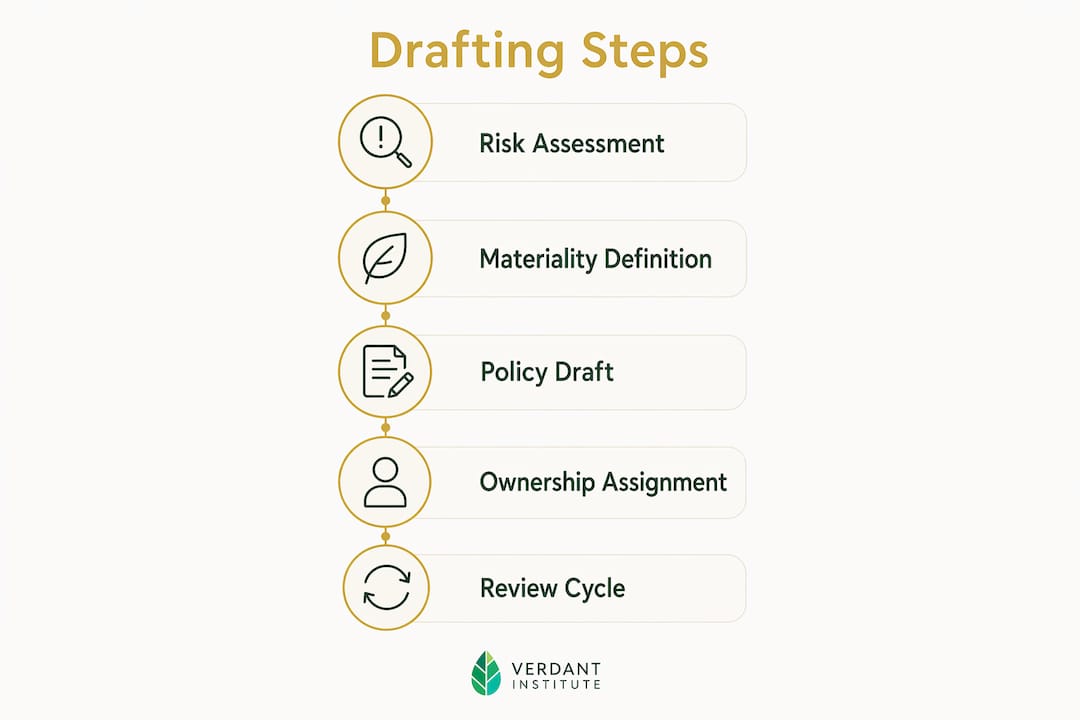
Pro Tip: Assign a named owner to each section of the policy, not just to the document as a whole. Ownership at the section level prevents the "everyone's responsible, no one's responsible" failure mode.
How to integrate the policy into investment management processes
A policy document that sits in a shared drive is not an investment policy. It is a filing artifact. Responsible investment must be fully integrated and central to investment research and stewardship, not an afterthought or compliance checkbox. Integration means the policy shapes decisions at every stage of the investment process.
Practical integration requires action across four areas:
- Security selection. Embed ESG screening criteria directly into the investment research template. Every analyst report should include a materiality assessment against the policy's defined ESG factors. For guidance on applying this in practice, the Verdantinstitute resource on embedding ESG in decisions covers the mechanics in detail.
- Asset allocation. Apply the policy's exclusion thresholds at the portfolio construction stage, not as a post-construction filter. A gating framework with numeric thresholds creates immediate guidance and efficient decision-making at this stage.
- Active stewardship and progress tracking. Log all engagement activities and proxy votes against the policy's stewardship commitments. Track progress quarterly and report deviations to the investment committee.
- Mandate and reporting alignment. Ensure client investment mandates reference the policy directly. Reporting to clients and regulators should map outcomes back to specific policy commitments, not generic ESG language.
Integrating material ESG data enhances risk management and can identify growth opportunities, countering the misconception that responsible investing reduces financial returns. ESG integration improves long-term risk-adjusted returns when it is well-aligned with investment horizons. That alignment starts with a policy that defines what "material" means for your specific portfolio.
Finance professionals working across ESG investment strategies will find that the policy acts as a decision filter, not a constraint. It reduces the time spent debating edge cases because the framework has already answered the question.
Common challenges and best practices for maintaining the policy
Most policy failures are not drafting failures. They are maintenance failures. A policy written in 2023 that has not been updated since is almost certainly misaligned with current regulatory requirements and market practice. Organizations that maintain structured policy governance are better positioned for regulatory and market shifts than those that treat the policy as a one-time deliverable.
The most common pitfalls and how to avoid them:
- Vague language. Phrases like "we consider ESG factors where relevant" provide no operational guidance. Replace them with specific criteria: which factors, in which asset classes, weighted how.
- Mission drift. Confusion between financial goals and values-based goals produces inconsistent decisions. Clearly define the relationship between sustainability goals and fiduciary obligations in the policy text itself.
- Static exclusion lists. Exclusion criteria tied to specific company names go stale quickly. Threshold-based exclusions, such as revenue percentages from a given activity, remain valid as companies evolve.
- Regulatory lag. ESG disclosure requirements are changing rapidly across jurisdictions. Assign a compliance officer to monitor regulatory developments and flag required policy updates before deadlines arrive.
- Stakeholder disengagement. Annual reviews that happen without stakeholder input produce policies that investment teams ignore. Build a formal consultation step into every review cycle.
"The policy is the cornerstone of an organization's broader ESG strategy and should connect strategy to investment operations clearly." — LexisNexis Legal Guidance
Investor frameworks that align mission, risk, and return and use evidence-based, transparent approaches perform best for long-term outcomes. That alignment is not accidental. It is the product of a policy that was drafted with operational precision and maintained with discipline.
Key takeaways
A responsible investment policy is only as effective as the operational definitions, review cycles, and integration processes that support it.
| Point | Details |
|---|---|
| Define materiality first | Specify which ESG factors are material to your portfolio before drafting any other section. |
| Use numeric exclusion thresholds | Threshold-based gating frameworks remove ambiguity and speed up investability decisions. |
| Integrate at every process stage | Embed the policy in security selection, asset allocation, stewardship, and client reporting. |
| Review at least annually | Industry standards require annual updates to keep pace with regulatory and market changes. |
| Link sustainability to fiduciary duty | Explicit alignment between ESG goals and fiduciary obligations prevents legal risk and mission drift. |
Why most responsible investment policies fail before they start
The uncomfortable truth I have observed across finance teams is this: most organizations treat the responsible investment policy as a communications exercise. They write it for an external audience, publish it on their website, and move on. The investment team never reads it. The portfolio managers never reference it. It has no operational weight.
The policies that actually work share one characteristic: they were written for the people making daily investment decisions, not for the people reading the annual report. That means the language is specific enough to answer a real question at the point of decision. Can we hold this company given our exclusion criteria? Does this bond issuer meet our stewardship engagement threshold? A good policy answers both questions in under two minutes.
I also think the fiduciary alignment question is underweighted in most drafting processes. Finance professionals sometimes treat sustainability goals and financial goals as separate tracks that run in parallel. They are not. ESG integration improves long-term risk-adjusted returns when the policy is built around material factors, not around values statements. The policy is the mechanism that keeps both tracks on the same rail.
Finally, the annual review is not a formality. It is the moment when the policy either earns its place or becomes irrelevant. I have seen teams spend months drafting a policy and then skip the first review because "nothing has changed." Something always changes. Regulatory requirements shift. New ESG data becomes available. Portfolio composition evolves. The review cycle is what separates a living policy from a document.
— Charles
Build your ESG policy expertise with Verdantinstitute
Finance professionals who want to move from policy theory to operational practice need more than a template. Verdantinstitute offers structured learning tracks covering ESG integration, responsible investment frameworks, and sustainable finance strategy, built specifically for practitioners.

The platform's Deep Dive courses cover the full spectrum from foundational ESG concepts to advanced topics like transition finance and net-zero strategies. CPD tracking and certifications mean your learning counts toward professional development requirements. Plans start at $18 per month for students and $58 per month for professionals. Visit the Verdantinstitute pricing page to find the plan that fits your role and review the full course library.
FAQ
What is a responsible investment policy statement?
A responsible investment policy statement is a formal document that defines how an organization integrates ESG factors into its investment process. PRI signatories are required to maintain one as a documented, organization-wide framework.
What should a responsible investment policy include?
A complete policy includes an ESG integration approach, active stewardship guidelines, a materiality definition, exclusion or gating criteria, fiduciary alignment language, and a transparency and reporting commitment.
How often should a responsible investment policy be reviewed?
Industry standards recommend reviewing and updating the policy at least annually to reflect regulatory changes, market developments, and shifts in portfolio composition.
What is the difference between a responsible investment policy and an ESG strategy?
The policy is the governing framework that defines principles, criteria, and accountabilities. The ESG strategy is the operational plan that executes against those principles across specific asset classes and investment processes.
How does a responsible investment policy relate to fiduciary duty?
A well-drafted policy explicitly links sustainability goals to fiduciary obligations, showing that ESG integration serves the financial interests of beneficiaries rather than conflicting with them. Failure to make this link creates legal and governance risk.