

The UN Sustainable Development Goals function as the primary organizing framework for impact investing globally, giving investors a shared vocabulary, measurable targets, and a defensible rationale for deploying capital toward social and environmental outcomes alongside financial returns. The role of UN SDGs in impact investing is not decorative. They define what "impact" means, which sectors attract intentional capital, and how outcomes get measured and reported.
The SDGs serve several concrete functions for impact investors:
- Common language: All 17 goals and their 169 targets give fund managers, LPs, and portfolio companies a shared reference point that crosses borders and asset classes.
- Investment guidance: The UN's six investment pathways (food systems, energy access, digital connectivity, education, jobs and social protection, and climate action) identify where capital can generate multiplier effects across multiple goals simultaneously.
- Measurement basis: SDG targets translate into quantifiable indicators that anchor impact measurement systems like IRIS+ and the GIIN's reporting standards.
- Urgency signal: The 2030 deadline creates a time-bound mandate that institutional investors increasingly treat as a portfolio planning constraint, not a background aspiration.
- Standard-setter alignment: Bodies like the United Nations Development Programme (UNDP), the Global Impact Investing Network (GIIN), and the Operating Principles for Impact Management use the SDGs as the reference architecture for their frameworks and disclosure requirements.
The UNDP has facilitated alignment39/en/pdf) of over $400 billion in private sector investments with the SDGs through impact standards, disclosure frameworks, and taxonomies. That figure alone signals how far the framework has moved from aspirational policy document to active capital allocation tool.
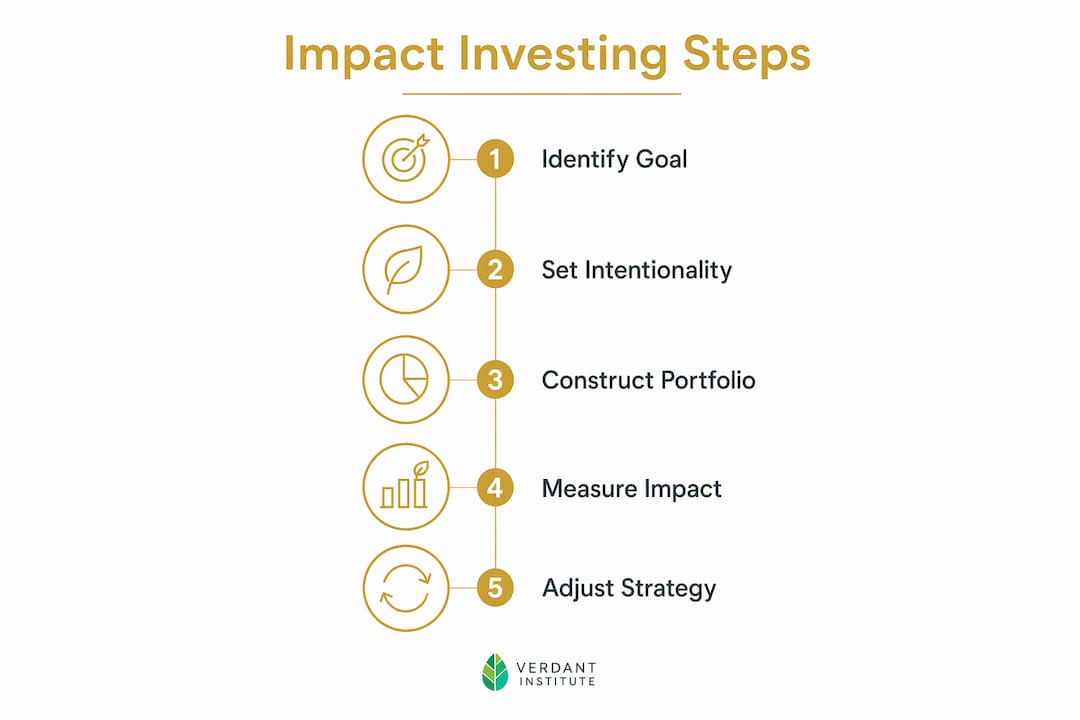
How impact investing connects to the UN SDGs
Impact investing's defining feature is intentionality: the impact objective gets set before the investment, not retrofitted afterward. That distinction separates it from general ESG integration, where sustainability factors inform risk analysis but don't necessarily define the investment thesis. According to the GIIN and the Operating Principles for Impact Management25/en/pdf), SDG alignment is the mechanism that makes this intentionality credible and verifiable.

The flow works like this. An investor identifies a target SDG, say SDG 3 (Good Health and Well-Being) or SDG 7 (Affordable and Clean Energy). They then map specific SDG targets within that goal to investable sectors, screen for companies or projects whose business models directly address those targets, and build impact measurement systems tied to the same indicators the UN uses to track global progress. The SDG framework doesn't just inspire the investment; it structures the entire decision chain.

The SDG Investor Platform39/en/pdf), developed by the UNDP, takes this further by providing country- and sector-level market intelligence that identifies over 700 investment opportunities across more than 50 countries. For a fund manager building a portfolio around SDG 2 (Zero Hunger) or SDG 9 (Industry, Innovation, and Infrastructure), that platform offers granular data on where the gaps are and which sub-sectors carry the most investable characteristics.
ESG integration and impact investing strategies diverge most sharply on this point. ESG screens can exclude harmful companies without ever directing capital toward a specific development outcome. SDG-aligned impact investing requires the investor to demonstrate that their capital contributes to a named goal, which is a much higher bar.
Practical SDG alignment in the US market
US-based impact investors have built portfolios around several SDG-aligned sectors, and the domestic policy environment has increasingly reinforced those choices. Renewable energy investments tied to SDG 7 accelerated after the Inflation Reduction Act created tax credits and incentives that improved risk-adjusted returns for clean energy projects. Community development financial institutions (CDFIs) channel capital toward SDG 1 (No Poverty) and SDG 10 (Reduced Inequalities) through affordable lending in underserved markets. Healthcare impact funds, particularly those focused on rural access and underserved populations, align with SDG 3.
Sustainable finance products globally surpassed $7 trillion in 2023, reflecting sustained investor appetite even as greenwashing concerns intensified scrutiny of impact claims.
Measurement frameworks are what separate credible SDG-aligned portfolios from marketing exercises. IRIS+ (managed by the GIIN) provides a catalog of standardized metrics that map directly to SDG targets, allowing investors to report outcomes in terms the UN framework recognizes. The IFRS Foundation's Sustainability Disclosure Standards, launched in 2023, added another layer of international harmonization that US investors with global LPs increasingly need to comply with.
Challenges in applying SDGs to US portfolios are real and worth naming directly:
- SDG-washing risk: Attaching SDG icons to a fund deck without underlying impact logic is widespread. Investors who can't articulate which specific SDG targets their portfolio addresses, and how, are doing marketing, not impact investing.
- Additionality complexity: Proving that an investment caused an outcome, rather than simply coinciding with one, requires counterfactual analysis that most fund managers don't conduct rigorously.
- Goal overload: With 17 goals and 169 targets, investors face pressure to claim alignment across too many SDGs, which dilutes focus and makes measurement unwieldy.
- Data gaps: US domestic impact data at the sub-sector level often lags what the UNDP SDG Investor Platform provides for emerging markets, making apples-to-apples benchmarking difficult.
The US regulatory environment has moved toward SDG-consistent policy without explicitly adopting the SDG framework. The Securities and Exchange Commission's climate disclosure rules, the Treasury's green bond guidelines, and CDFI Fund programs all create incentive structures that reward the same behaviors SDG-aligned investing demands, even if the language differs.
How to use SDGs strategically, not just symbolically
The most common mistake experienced practitioners see is treating SDG alignment as a checklist. A fund claims exposure to SDG 4 (Quality Education) because it holds an edtech company. That's alignment in name only. What separates credible impact investors from the rest is the Theory of Change: a logical, documented map from the investment's specific activities to the SDG outcomes those activities are supposed to produce.
A Theory of Change in SDG-aligned impact investing ensures measurable cause-and-effect logic between investments and outcomes, preventing superficial compliance and building the kind of credibility that institutional LPs now demand. Without it, impact claims can't survive due diligence.
The UNDP SDG Investor Platform's granular intelligence is one of the most underused tools in this space. The table below illustrates how it structures investment intelligence across sectors relevant to US-based fund managers with global mandates.
| SDG | Sector example | Indicative IRR range | Investment type |
|---|---|---|---|
| SDG 7 (Clean Energy) | Distributed solar, mini-grids | Market-rate to above-market | Equity, infrastructure debt |
| SDG 3 (Good Health) | Rural health clinics, diagnostics | Below-market to market-rate | Equity, blended finance |
| SDG 2 (Zero Hunger) | Sustainable agriculture, cold chain | Market-rate | Equity, trade finance |
| SDG 9 (Infrastructure) | Digital connectivity, logistics | Market-rate to above-market | Equity, project finance |
| SDG 1 (No Poverty) | Microfinance, CDFIs | Below-market to market-rate | Debt, blended finance |
Indicative IRR ranges reflect UNDP SDG Investor Platform intelligence; actual returns vary by market and structure.
The distinction between impact-aligned and impact-generating investments is where portfolio construction gets serious. Impact-aligned investments hold assets that happen to support SDG outcomes. Impact-generating investments39/en/pdf) require evidence of additionality: the positive outcome occurred because of the investment, not despite it or independently of it. A solar project that would have been financed by a development bank regardless of your fund's participation is aligned, not generating. That difference matters for impact reporting, LP communications, and increasingly for regulatory compliance.
Pro Tip: Map each portfolio company to a specific SDG target (not just the goal), document the Theory of Change before closing the investment, and build impact KPIs into the term sheet. Retrofitting impact measurement after deployment is where SDG-washing starts.
UNDP's Private Finance for the SDGs initiative supports investment-ready opportunities and policy dialogues across 40 markets, focusing on renewable energy, climate action, healthcare, and agriculture. For US fund managers with emerging market exposure, this program is a direct source of de-risked deal flow.
What the 17 SDGs mean for impact investors
The 17 SDGs, adopted by all UN member states in 2015 as part of the 2030 Agenda, cover every dimension of sustainable development from poverty and hunger to climate, inequality, and governance. For impact investors, they function as a sector map and a reporting taxonomy simultaneously.
| SDG | Description | Typical impact investing themes |
|---|---|---|
| SDG 1: No Poverty | End poverty in all forms | Microfinance, CDFIs, affordable housing |
| SDG 2: Zero Hunger | End hunger, achieve food security | Sustainable agriculture, food supply chains |
| SDG 3: Good Health | Ensure healthy lives | Healthcare access, diagnostics, vaccines |
| SDG 4: Quality Education | Inclusive, equitable education | Edtech, vocational training, early childhood |
| Gender Equality | Achieve gender equality | Women-led SME finance, gender-lens funds |
| Clean Water | Water and sanitation for all | Water infrastructure, WASH projects |
| SDG 7: Affordable and Clean Energy | Access to clean energy | Solar, wind, energy storage, mini-grids |
| SDG 8: Decent Work and Economic Growth | Sustained economic growth | SME lending, workforce development |
| SDG 9: Industry, Innovation and Infrastructure | Resilient infrastructure | Digital connectivity, logistics, manufacturing |
| SDG 10: Reduced Inequalities | Reduce inequality within and among countries | Inclusive finance, underserved community investment |
| Sustainable Cities | Inclusive, safe cities | Affordable housing, urban transit, green buildings |
| Responsible Consumption | Sustainable consumption and production | Circular economy, sustainable supply chains |
| SDG 13: Climate Action | Combat climate change | Carbon markets, climate adaptation, green bonds |
| Life Below Water | Conserve oceans | Blue bonds, sustainable fisheries |
| Life on Land | Protect terrestrial ecosystems | Conservation finance, sustainable forestry |
| Peace and Justice | Peaceful, inclusive institutions | Rule-of-law programs, anti-corruption initiatives |
| SDG 17: Partnerships for the Goals | Strengthen means of implementation | Blended finance, public-private partnerships |
The SDGs are not independent silos. An investment in SDG 7 (clean energy) typically advances SDG 13 (climate action) and SDG 8 (decent work) through job creation in the energy sector. This interdependence is precisely why the six investment pathways identified by the UN matter: they show investors where a single capital allocation can move multiple goals at once, which is the closest thing to an efficiency frontier in impact portfolio construction.
The 2030 Agenda demands mobilizing $4 trillion in developing countries alone, a figure that underscores why private capital, guided by the SDG framework, is not optional. Public finance cannot close that gap. The SDGs exist precisely to give private investors the roadmap they need to deploy capital where it counts, with enough standardization to make outcomes comparable and credible across markets.
Finance professionals building impact investing asset classes around the SDG framework will find that the goals provide both the destination and the measurement system. The challenge is moving from icon-level alignment to investment-grade impact logic, which is where the real work happens.
Key Takeaways
The UN SDGs function as both the strategic map and the measurement standard for credible impact investing, with the UNDP having facilitated over $400 billion in private sector SDG-aligned investments through its standards and frameworks.
| Point | Details |
|---|---|
| SDGs define intentionality | Impact investing requires SDG alignment set before investment, not applied after the fact. |
| UNDP and GIIN set the standards | The SDG Investor Platform and Operating Principles for Impact Management operationalize SDG alignment for fund managers. |
| Theory of Change prevents SDG-washing | Mapping investments to specific SDG targets with causal logic separates credible impact from marketing claims. |
| Impact-generating beats impact-aligned | Additionality, proving the investment caused the outcome, is the standard institutional LPs increasingly require. |
| Sustainable finance reached $7 trillion | Global sustainable finance products surpassed $7 trillion in 2023, reflecting the scale of SDG-aligned capital markets. |
Finance professionals who want to build real competency in SDG-aligned impact investing need more than a framework overview. Verdantinstitute offers structured learning tracks covering impact investing, ESG analysis, and sustainable finance, with CPD-tracked certifications designed for practitioners at every level. Plans start at $18/month for students and $58/month for professionals. Start building expertise in the skills that institutional investors and fund managers now expect.