

Impact investing asset classes are distinct investment categories chosen to generate measurable social and environmental outcomes alongside financial returns. The Global Impact Investing Network (GIIN) defines impact investing as investments made with the intention to produce positive, measurable impact. Understanding the full impact investing asset classes list is the foundation of any credible portfolio strategy in this space. Private equity, private debt, public equity, real assets, green bonds, social impact bonds, and blended finance each carry distinct risk profiles, liquidity characteristics, and impact potential that every serious investor must know.
1. the core impact investing asset classes list
The impact investing asset classes list recognized by the GIIN and leading practitioners covers seven primary categories. Each category differs in how capital is deployed, how impact is measured, and what financial return profile investors should expect. Knowing these distinctions is not optional for professionals building or advising on impact portfolios.
2. private equity
Private equity is the dominant impact investing asset class, with a 74% allocation among impact investors per 2025 GIIN data. That figure reflects private equity's unique ability to deliver high additionality: capital goes directly into companies that would not otherwise access commercial financing. Investment horizons typically run 7–12 years, which suits the time required to build enterprises in underserved markets or early-stage climate technology.

Private equity in impact investing spans venture capital, growth equity, and buyout strategies. Venture impact funds like those targeting clean energy startups or health technology in emerging markets represent the highest-risk, highest-return end of the spectrum. Growth equity in affordable housing developers or agricultural supply chains sits at the moderate end. The long lock-up period is the primary trade-off for the strong additionality this asset class delivers.
Pro Tip: When evaluating private equity impact funds, ask managers to specify their theory of change at the portfolio company level, not just the fund level. Vague fund-level narratives are a red flag for weak impact discipline.
3. private debt
Private debt is the second most common impact investment option, with a 49% allocation among impact investors. It offers more stable income and lower volatility than equity, making it attractive for institutional investors with liability-matching requirements. Instruments include direct loans, mezzanine debt, and microfinance facilities.
Microfinance is the most established private debt subcategory in impact investing. Institutions like Grameen Bank and BlueOrchard Finance have demonstrated that lending to low-income borrowers in developing markets can generate consistent returns while expanding financial inclusion. Mezzanine debt in affordable housing projects is another common structure, where the debt provider earns a fixed coupon while the developer delivers below-market rental units.
Private debt's impact additionality is strong when capital fills a genuine financing gap. The key due diligence question is whether the borrower could access equivalent capital from commercial lenders. If the answer is yes, the additionality argument weakens significantly.
4. public equity and thematic etfs
Public equity represents approximately 16% of impact investing assets, a relatively small share given the size of global equity markets. The reason is additionality. Buying shares on a secondary market does not provide new capital to the company. The impact case for public equity rests on shareholder engagement, voting rights, and signaling effects rather than direct capital provision.
Thematic ETFs from providers like iShares, Nuveen, and Calvert track indices focused on clean energy, water infrastructure, or gender equity. These products offer liquidity and low cost, but true impact investing requires intentionality and additionality beyond ESG screening. Most thematic ETFs provide alignment with impact themes rather than measurable additionality. Investors should classify them as impact-aligned rather than impact-generating instruments.
5. real assets: infrastructure and renewable energy
Real assets cover physical investments in infrastructure, renewable energy, sustainable agriculture, and affordable housing. This category delivers some of the most tangible and measurable impact outcomes available in any asset class. A solar farm in sub-Saharan Africa produces a countable number of megawatt-hours of clean energy and a countable number of households served.
Climate and environmental projects account for 58% of global impact assets, which reflects the dominance of renewable energy and clean infrastructure in real asset impact portfolios. Infrastructure investments typically offer long-duration, inflation-linked cash flows, which align well with pension fund and endowment liability structures. Affordable housing real estate investment trusts (REITs) and community development financial institutions (CDFIs) are the primary vehicles for housing-focused real asset impact investing.
6. green bonds
Green bonds are fixed-income instruments where proceeds are earmarked for environmental projects. The green bond market surpassed $500 billion in annual issuance by 2024, making it the largest and most liquid segment of the labeled bond market. Investors receive standard bond returns: a fixed coupon and principal repayment at maturity. The impact comes from use-of-proceeds restrictions, not from the bond's financial structure.
The Climate Bonds Initiative and the International Capital Market Association (ICMA) Green Bond Principles provide the primary frameworks for green bond verification. Investors should review the second-party opinion and post-issuance reporting to confirm proceeds are deployed as stated. Greenwashing risk is real in this market. Bonds labeled "green" without credible verification and transparent reporting deserve skepticism.
Pro Tip: Require annual allocation and impact reports from green bond issuers before including them in a portfolio. Issuers who cannot provide project-level data are not meeting basic accountability standards.
7. social impact bonds
Social impact bonds (SIBs) are outcome-based contracts where repayment depends on achieving measurable social outcomes. If the program fails to meet its targets, investors bear the loss. This structure shifts financial risk from governments to private capital, which incentivizes rigorous outcome management by service providers.
A classic SIB structure involves three parties: a government commissioner, a service provider (often a nonprofit), and private investors. The government pays only if outcomes are achieved. Investors fund the program upfront and earn a return if targets are met. The Peterborough Prison SIB in the UK and the Rikers Island project in New York are the most cited early examples. Both produced important lessons about contract design and outcome measurement complexity.
SIBs are not suitable for all investors. They require comfort with illiquidity, outcome uncertainty, and complex legal structures. For investors who prioritize direct social outcomes and can tolerate these constraints, SIBs offer a genuinely differentiated impact investment option.
8. blended finance
Blended finance uses concessional capital to absorb first-loss risk and unlock private commercial investment in otherwise inaccessible markets. Development finance institutions (DFIs) like the International Finance Corporation (IFC) and the U.S. International Development Finance Corporation (DFC) typically provide the concessional tranche. Commercial investors enter at a senior position, protected by the first-loss buffer.
This structure opens frontier markets in sectors like off-grid energy, smallholder agriculture, and healthcare in low-income countries. Without the concessional layer, commercial investors would price the risk as prohibitive. Blended finance arrangements strategically use concessional capital to access high-impact opportunities that pure commercial capital cannot reach. The Convergence network tracks blended finance deals globally and reports that the structure has mobilized hundreds of billions in private capital for development.
9. how return expectations vary across asset classes
Return expectations differ materially across the impact investing categories listed above. 72% of impact investors reported satisfaction with financial performance in a 2025 survey, with many noting that impact investments met or exceeded non-impact benchmarks. That aggregate figure masks significant variation by asset class.
Private equity venture strategies targeting early-stage climate technology carry the widest return dispersion: some funds deliver 20%+ IRR, others return below cost. Microfinance debt funds typically target 4%–8% net returns, consistent with their lower-risk profile. Green bonds track investment-grade corporate bond returns. Social impact bonds offer government-linked returns contingent on outcome achievement, typically in the 5%–10% range when targets are met.
"Successful impact investments require thresholds of materiality, additionality, and measurability to move beyond mere alignment tools." — Wellington Management
Rigorous impact measurement focuses on outcome metrics and requires substantial due diligence and administrative costs. Investors who underestimate these costs will find their net returns eroded. Budget for impact reporting as a real line item, not an afterthought.
10. building a portfolio across impact asset classes
Portfolio construction across impact investing categories requires deliberate decisions about liquidity, time horizon, and thematic focus. The table below summarizes the key characteristics of each major asset class to support allocation decisions.
| Asset Class | Liquidity | Typical Time Horizon | Additionality | Primary Impact Theme |
|---|---|---|---|---|
| Private Equity | Low | 7–12 years | High | Climate, financial inclusion |
| Private Debt | Low to medium | 3–7 years | High | Financial inclusion, housing |
| Public Equity / ETFs | High | Flexible | Low | Climate alignment, gender |
| Real Assets | Low | 10–20 years | High | Renewable energy, housing |
| Green Bonds | Medium to high | 5–10 years | Medium | Environmental projects |
| Social Impact Bonds | Very low | 3–7 years | Very high | Social services, recidivism |
| Blended Finance | Very low | 5–15 years | Very high | Frontier markets, development |
Diversification across these asset classes reduces concentration risk while maintaining impact breadth. A portfolio anchored in private equity and real assets for high additionality, supplemented by green bonds for liquidity, and with a small allocation to SIBs for outcome-linked exposure, reflects a credible institutional approach. Catalytic capital with below-market return expectations can anchor the highest-risk positions, freeing the rest of the portfolio to target market-rate returns.
Pro Tip: Apply a three-part screen to every potential impact asset: Is the impact material? Is it additional? Is it measurable? Assets that fail any one of these tests belong in an ESG-aligned portfolio, not a true impact portfolio.
Key takeaways
A credible impact investing portfolio requires deliberate allocation across private equity, private debt, real assets, green bonds, social impact bonds, and blended finance, each selected for its specific additionality, return profile, and measurability.
| Point | Details |
|---|---|
| Private equity leads allocations | 74% of impact investors allocate to private equity, reflecting its high additionality and direct capital provision. |
| Additionality separates impact from alignment | Public equity ETFs provide theme alignment but not additionality; true impact requires capital that fills a genuine gap. |
| Green bonds offer scale and liquidity | The $500 billion+ annual market gives investors a liquid, verifiable entry point into environmental project finance. |
| Blended finance unlocks frontier markets | Concessional first-loss capital from DFIs enables commercial investors to access high-impact, high-risk markets. |
| Measure outcomes, not just outputs | Rigorous impact measurement requires outcome metrics and dedicated reporting budgets to maintain portfolio integrity. |
Why most impact portfolios are quietly underperforming on impact
I have reviewed dozens of portfolios that carry the "impact investing" label, and the most common problem is not financial underperformance. The problem is impact dilution. Managers load up on thematic ETFs and labeled green bonds because they are easy to buy and easy to report. They call it an impact portfolio. It is not.
The distinction between impact investing and ESG integration is not semantic. ESG integration screens out harm. Impact investing funds solutions. A portfolio that is 80% public equity thematic funds and 20% green bonds is an ESG-aligned portfolio with a marketing problem.
The asset classes that deliver genuine additionality are private equity, private debt in underserved markets, real assets in frontier regions, and blended finance structures. These are harder to access, harder to report on, and harder to explain to investment committees. That difficulty is exactly why they generate real impact. If it were easy, commercial capital would already be there.
My advice to professionals building impact mandates: set your additionality threshold before you select your instruments. Decide what percentage of the portfolio must demonstrate direct capital provision to underserved markets or sectors. Then build backward from that threshold. You will end up with a smaller, less liquid, more complex portfolio. You will also end up with one that actually does what it claims.
— Charles
Deepen your impact investing expertise with Verdantinstitute
Knowing the asset classes is the starting point. Applying them in real portfolio construction, impact measurement, and client reporting requires structured professional development.
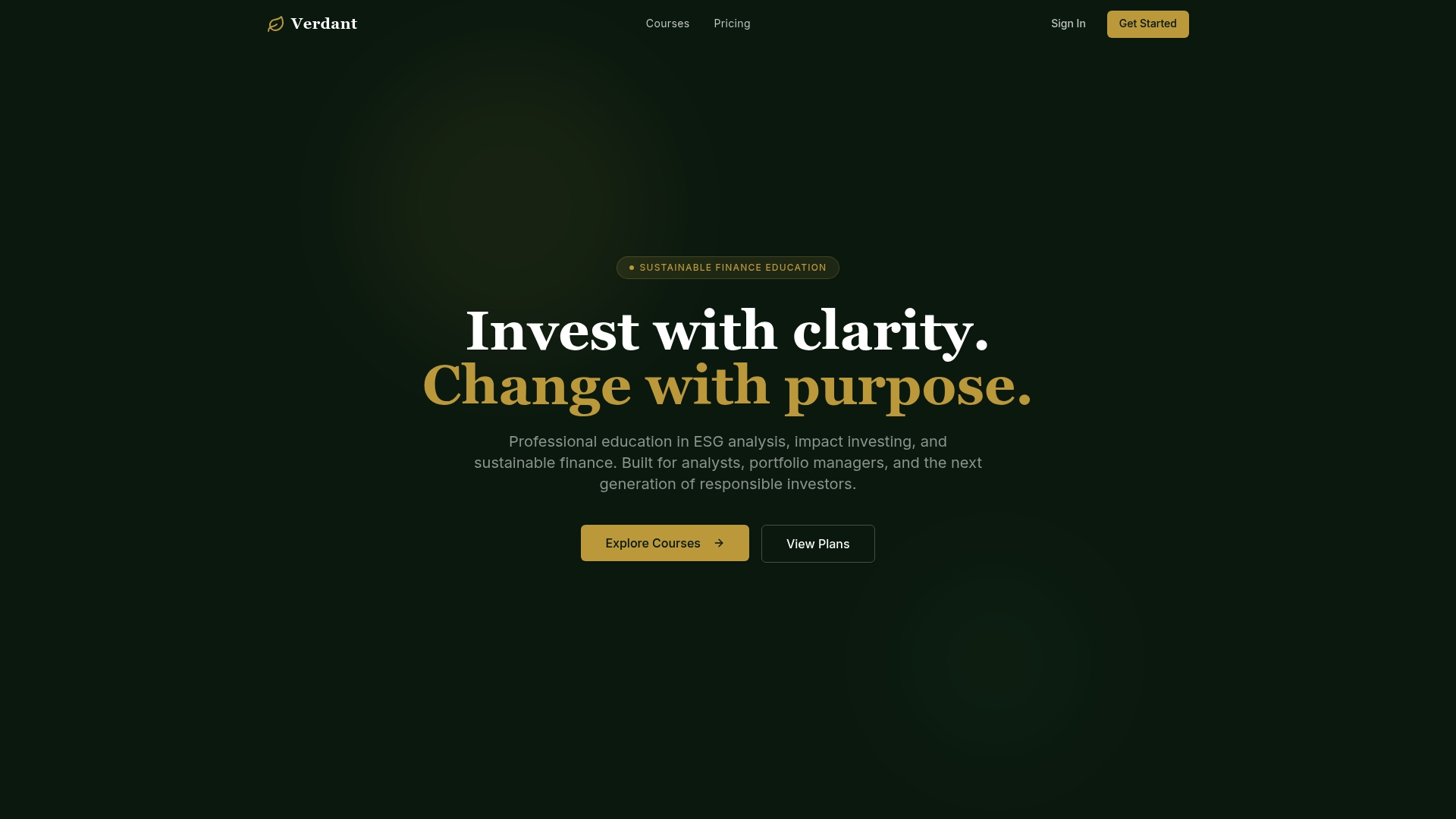
Verdantinstitute offers 16 courses and over 160 lessons covering impact investing, ESG analysis, transition finance, and net-zero strategies. The platform's Deep Dive and Advanced Practice tracks are built specifically for finance professionals who need more than a surface-level overview. CPD tracking and certifications are included. Whether you are building your first impact mandate or advising institutional clients on portfolio-level impact strategy, explore Verdantinstitute's course plans to find the right level of depth for your practice.
FAQ
What is the most common impact investing asset class?
Private equity is the most common impact investing asset class, with a 74% allocation rate among impact investors per 2025 GIIN data. Its high additionality and direct capital provision make it the preferred vehicle for serious impact mandates.
Do impact investments deliver competitive financial returns?
72% of impact investors reported satisfaction with financial performance in a 2025 survey, with many noting returns that met or exceeded non-impact benchmarks. Returns vary significantly by asset class, from microfinance debt at 4%–8% to venture impact equity targeting 15%+.
How are green bonds different from social impact bonds?
Green bonds are standard fixed-income instruments with proceeds earmarked for environmental projects, offering predictable coupon payments. Social impact bonds are outcome-based contracts where repayment depends entirely on achieving measurable social results, so investors bear loss risk if targets are not met.
What is blended finance and why does it matter?
Blended finance uses concessional capital, typically from development finance institutions, to absorb first-loss risk and attract private commercial investment into frontier markets. Without this structure, most high-impact opportunities in low-income countries would remain inaccessible to commercial investors.
How do i know if a fund is truly impact investing vs. ESG?
True impact investing requires intentionality, additionality, and measurable outcomes. ESG funds screen for risk or alignment but do not require direct capital provision to underserved markets. Apply the materiality, additionality, and measurability test to every fund before classifying it as impact.