

U.S. employers hiring for ESG roles want one specific combination: technical data skills, fluency in at least one reporting framework, enough governance and business literacy to connect sustainability metrics to financial decisions, and demonstrable evidence of all three. Passion for sustainability no longer differentiates candidates. The skills that actually move a resume from the pile to the interview are concrete, learnable, and largely tool-based.
Here are the ten skills and tools employers name most often in ESG job descriptions:
- Advanced Excel (pivot tables, VLOOKUP, data modeling)
- Power BI or Tableau (dashboard building and data visualization)
- Python or SQL (data cleaning, merging datasets, basic analysis)
- GHG Protocol (Scope 1, 2, and 3 emissions accounting)
- GRI Standards (stakeholder and sustainability reporting)
- TCFD and ISSB frameworks (investor-facing climate disclosure)
- SEC climate disclosure awareness (U.S. regulatory context)
- Carbon accounting and KPI calculation
- Stakeholder engagement and cross-functional communication
- Critical thinking and systems-level problem solving
The fastest path to an entry-level ESG role: Build data fundamentals first (Excel + one visualization tool), complete one GHG Protocol exercise, then package both into a public portfolio project. That three-step sequence signals more to a hiring manager than any certification alone.
Table of Contents
- The five skill clusters U.S. employers prioritize for ESG hires
- Technical skills employers expect: tools, methods, and practical examples you can show
- Reporting and disclosure frameworks you should know (what to learn first and why)
- Business, governance, and risk skills: how ESG links to corporate strategy
- Soft skills and cross-functional capabilities employers require
- How employer expectations change by sector
- Degrees, certifications, and evidence employers value
- Translate skills into hireable evidence: resume bullets, LinkedIn, and interview lines
- How long it takes to build hireable ESG skills and what it typically costs
- Why U.S. regulation and investor pressure are increasing demand for these skills
- One compact, evidence-backed learning pathway
- Key Takeaways
- The hiring bar has moved, and most graduates haven't caught up yet
- What to look for in an ESG course (and where Verdantinstitute fits)
- Useful sources and further reading
The five skill clusters U.S. employers prioritize for ESG hires
Hiring managers rarely evaluate candidates skill by skill. They screen for clusters, and knowing which cluster matters most for a given function tells you where to invest your time.
-
Technical and data skills. The ability to collect, clean, and analyze sustainability data using tools like Excel, Power BI, Tableau, Python, and SQL. This cluster is the baseline for almost every ESG role posted in the U.S. today, because ESG data work has moved from qualitative narrative to quantitative reporting.
-
Reporting and disclosure frameworks. Knowledge of GRI, TCFD, ISSB, GHG Protocol, and SEC climate disclosure rules. Employers need people who can translate raw data into audit-ready disclosures. Without this, technical skills have no output.
-
Governance, risk, and strategy. Understanding how ESG connects to board-level decisions, risk registers, and corporate strategy. This cluster is what separates candidates who can execute tasks from those who can advise leadership.
-
Stakeholder engagement and communication. The ability to explain sustainability data to non-technical audiences, write board-ready summaries, and manage relationships across functions. Employers consistently flag this as a differentiator, especially for roles that sit between sustainability teams and finance or legal.
-
Systems thinking, ethics, and problem solving. Seeing how environmental, social, and governance factors interact across a supply chain or business model. Employers value this because ESG problems rarely have clean, isolated solutions.
How employers weight these clusters depends on function. Finance and investment teams lean heavily on clusters 1, 2, and 3. Operations and procurement roles weight cluster 1 and 5 more. Communications and reporting roles prioritize clusters 2 and 4. Knowing your target function before you build your skill set saves months of misdirected effort.
Technical skills employers expect: tools, methods, and practical examples you can show
The shift is clear: modern ESG roles in the U.S. prioritize technical and data-led competencies over purely communication-focused sustainability work. Employers expect tool proficiency you can demonstrate, not just list.
Tools and languages employers specify:
- Excel: Advanced functions (INDEX/MATCH, nested IFs, array formulas), pivot tables, and data modeling for emissions tracking and KPI dashboards.
- Power BI / Tableau: Building interactive dashboards that visualize emissions trends, supply chain risk, or social metrics for leadership review.
- Python: Merging large datasets from multiple sources, automating repetitive data cleaning tasks, running basic statistical analysis on ESG metrics.
- SQL: Querying sustainability databases, pulling supplier data, filtering large environmental datasets by facility or region.
Methods employers expect you to understand:
- GHG accounting across Scope 1, 2, and 3 using the GHG Protocol methodology
- Data cleaning and validation (handling missing values, outliers, inconsistent units)
- KPI calculation and trend analysis for sustainability targets
- Basic statistical analysis to identify patterns in environmental or social data
- Dashboard design that communicates insight, not just data
Mini use-cases you can build right now:
- Download EPA facility-level emissions data and build a Power BI dashboard showing Scope 1 trends by industry sector.
- Create a supplier-screening spreadsheet in Excel that scores vendors on environmental and labor criteria using weighted averages.
- Write a short Python script that merges two public datasets (e.g., CDP disclosures and company revenue data) and outputs a ranked list by emissions intensity.
Pro Tip: Frame every portfolio project around a business question, not a technical exercise. "I built a dashboard" is forgettable. "I built a dashboard that identified three facilities responsible for 60% of a company's Scope 1 emissions, enabling targeted reduction planning" is what gets you an interview.
Industry-recognized platforms like Envizi (IBM), Sphera, and S&P Global Trucost are increasingly mentioned in mid-level job descriptions. You don't need hands-on experience with these at the entry level, but knowing what they do and how they fit into a corporate ESG data workflow signals genuine industry awareness.

Reporting and disclosure frameworks you should know (what to learn first and why)
Knowing which framework to learn first matters because they serve different audiences and purposes. Spending three months studying GRI when you're targeting investment-facing roles is a real opportunity cost.
Framework overview:
- GHG Protocol: The technical standard for calculating and categorizing greenhouse gas emissions. It underpins almost every other framework's emissions data. Learn this first, before any reporting standard.
- TCFD (Task Force on Climate-related Financial Disclosures): Investor-facing framework covering governance, strategy, risk management, and metrics. Widely referenced in U.S. corporate disclosures and increasingly embedded in SEC expectations.
- ISSB (International Sustainability Standards Board / IFRS S1 and S2): The emerging global baseline for sustainability disclosure, building on TCFD. U.S. employers in multinational firms and finance increasingly expect familiarity with IFRS S1 and S2.
- GRI Standards: Broader stakeholder-facing reporting covering environmental, social, and governance topics. More commonly used in corporate sustainability reports than investor filings.
- SEC Climate Disclosure: The SEC's climate-related disclosure rules create specific U.S. obligations around Scope 1 and 2 emissions, climate risk, and governance. For U.S.-based roles, this is non-negotiable context. A full breakdown of how these frameworks relate to each other is covered in this ESG disclosure frameworks guide.
Recommended learning order for entry-level candidates:
- GHG Protocol basics (Scope 1–3 definitions, calculation methods, boundary-setting)
- TCFD or ISSB (pick one; TCFD is more established in U.S. job descriptions right now)
- GRI Standards (adds breadth for stakeholder reporting roles)
- SEC climate disclosure rules (critical for any U.S.-facing corporate or finance role)
A job description example: "Familiarity with TCFD-aligned reporting and ability to support Scope 3 data collection across the value chain" is a direct signal that GHG Protocol plus TCFD is the minimum expectation for that role. An interview answer that names specific TCFD pillars and explains how they connect to a company's risk register will outperform a generic answer about "understanding sustainability reporting."
Business, governance, and risk skills: how ESG links to corporate strategy
Technical skills get you to the interview. Governance literacy gets you the offer. Employers want candidates who understand that ESG is not a reporting exercise sitting beside the business; it is embedded in how companies manage risk, allocate capital, and report to investors.
Typical governance responsibilities in early-career ESG roles:
- Supporting board-level ESG reporting and preparing materials for leadership review
- Drafting or updating sustainability policies and internal ESG targets
- Maintaining risk registers that include climate, social, and governance risks
- Tracking KPIs against science-based targets or regulatory thresholds
- Supporting decarbonization project planning and progress reporting
Business fluency means being able to explain why a 15% reduction in Scope 2 emissions matters to a CFO. It means connecting a supplier labor audit to procurement cost risk. Candidates who can make that translation are substantially more useful to a hiring manager than those who can only produce the underlying data.
U.S. regulatory pressure is accelerating this expectation. The SEC's climate disclosure framework requires companies to report on climate-related risks, governance structures, and in many cases Scope 1 and 2 emissions. That creates direct demand for people who understand both the technical measurement side and the governance and disclosure obligations that sit above it. Investor pressure compounds this: sustainability hiring has shifted from broad early-stage growth to a period where employers expect subject-matter expertise and the ability to connect ESG to financial and operational outcomes.

For candidates targeting finance or investment roles, linking ESG metrics to strategic finance decisions is the specific capability that separates a strong application from a generic one.
Soft skills and cross-functional capabilities employers require
Hiring managers use soft skills to differentiate candidates who look similar on paper. These are not vague personality traits; they are specific, demonstrable capabilities that employers probe in behavioral interviews.
In-demand soft skills for ESG roles:
- Critical thinking: Evaluating the quality of ESG data, identifying gaps in a supplier's disclosure, questioning assumptions in a carbon model.
- Stakeholder engagement: Building relationships across finance, legal, operations, and external partners; translating technical findings into language each audience understands.
- Data storytelling: Turning a spreadsheet of emissions data into a clear narrative for a board presentation or investor report.
- Cross-functional collaboration: Working on projects that span multiple departments, often without direct authority over the people involved.
- Ethical judgment: Recognizing greenwashing risk, flagging data quality issues, and maintaining integrity in disclosure processes.
- Adaptability: Adjusting workflows as AI-enabled tools change how ESG data is collected and analyzed. Employers value candidates who engage with new tools rather than resist them.
Employers consistently identify critical thinking, stakeholder engagement, and systems thinking as the human capabilities that allow staff to translate sustainability metrics into business insights for leadership.
Three behavioral interview prompts you should prepare for:
- "Tell me about a time you had to explain a complex data finding to a non-technical audience." Use STAR format: describe the data, the audience, how you simplified the message, and the outcome.
- "Describe a situation where you identified a problem in a process and proposed a solution." Frame a project where you spotted a gap in data collection or reporting and fixed it.
- "Give an example of working with people from different functions toward a shared goal." Use a cross-disciplinary project, capstone, or internship experience.
How employer expectations change by sector
The skills that get you hired in asset management look different from those that get you hired in manufacturing or tech. Targeting the right sector before you build your skill set is one of the highest-leverage decisions you can make.
Finance and investment: Financial modeling, valuation, and risk analytics are non-negotiable alongside ESG knowledge. Entry-level titles include ESG Analyst, Sustainable Investment Associate, and ESG Research Associate. These roles expect Excel-based financial modeling, TCFD/ISSB familiarity, and the ability to integrate ESG factors into investment analysis. Candidates from finance backgrounds who add ESG framework knowledge are highly competitive here.
Manufacturing and industrials: Life-cycle assessment (LCA), energy management, and operational decarbonization are the priority skills. Entry-level titles include Sustainability Coordinator and Environmental Compliance Analyst. Scope 1 and 2 emissions accounting is central; Scope 3 supply chain data is increasingly required. Hands-on project experience with energy audits or waste reduction initiatives carries real weight.
Technology: Product sustainability, supply chain data management, and carbon footprint calculation for digital infrastructure are the focus areas. Entry-level titles include Sustainability Data Analyst and ESG Program Coordinator. Python and SQL skills are particularly valued here because tech companies generate large volumes of operational data that need analysis.
Professional services and consulting: Reporting, stakeholder engagement, and framework fluency dominate. Entry-level titles include ESG Consultant (Junior), Sustainability Reporting Analyst, and CSR Associate. GRI and TCFD knowledge plus strong written communication are the baseline. The ability to manage client relationships and present findings clearly is weighted heavily.
ESG responsibilities are increasingly embedded across finance, legal, and risk teams, which means candidates from non-ESG functions gain a real advantage by adding ESG capability to their primary skill set rather than starting from scratch.
Degrees, certifications, and evidence employers value
Credentials signal intent; projects signal capability. Employers use both, but they weight them differently depending on the role level and sector.
Certifications worth listing:
- CFA ESG Certificate: Strong signal for finance-facing roles; recognized by investment teams and asset managers.
- GARP Sustainability and Climate Risk (SCR): Valued in risk management and financial services contexts.
- GHG Protocol Training: Practical, tool-specific credential that directly maps to job description requirements.
- PRI Academy: Relevant for investment and responsible finance roles.
- University master's or specialist diplomas in sustainability, environmental management, or sustainable finance carry weight, especially when paired with a quantitative undergraduate background.
- Micro-credentials from recognized platforms in data analytics, Power BI, or Python signal tool proficiency quickly and cheaply.
The distinction between signal credentials and functional training matters. A CFA ESG Certificate tells a hiring manager you understand the investment-relevance of ESG. A completed Power BI course with a published dashboard tells them you can do the work on day one. You need both types on your resume, not one or the other.
Resume bullet examples:
- "Completed GHG Protocol Corporate Standard training; applied Scope 1–3 methodology to calculate emissions baseline for a 12-facility manufacturing portfolio (capstone project)."
- "Built interactive Power BI dashboard using EPA public emissions data; visualized Scope 1 trends across 200+ facilities by sector."
- "Earned CFA ESG Certificate; applied TCFD framework to analyze climate risk disclosures for five S&P 500 companies as part of independent research project."
Continuous professional development matters beyond the first credential. Employers view sustained learning as evidence that a candidate will keep pace with a field where regulatory requirements and reporting standards change frequently. CPD tracking, which platforms like Verdantinstitute support directly, is a concrete way to demonstrate that commitment on your resume and LinkedIn profile.
A national survey found a notable ESG skills gap across competencies for recent graduates, with ambiguous job descriptions contributing to the mismatch. The practical fix: use specific, capability-based language on your resume rather than vague phrases like "ESG awareness." Write "calculate organizational carbon footprint using GHG Protocol" instead.
Translate skills into hireable evidence: resume bullets, LinkedIn, and interview lines
The gap between having a skill and proving it to an employer is almost always a communication problem. These templates give you a starting point.
Resume bullet templates:
- "Built a Power BI dashboard using EPA public emissions data covering 150+ facilities; identified the top 10% of emitters responsible for 58% of total Scope 1 output."
- "Applied GHG Protocol Scope 1–3 methodology to calculate a carbon baseline for a university operations capstone; recommended three reduction measures with projected 12% emissions cut."
- "Developed a supplier ESG screening tool in Excel using weighted criteria across environmental, labor, and governance indicators; used to evaluate 40 hypothetical vendors."
Interview response templates (problem, action, outcome):
- "In my capstone project, the company's Scope 3 data was incomplete across 60% of suppliers [problem]. I built a data collection template in Excel and contacted five key suppliers to fill gaps [action]. The final analysis covered 85% of spend and identified the highest-risk supplier category [outcome]."
- "During my internship, leadership needed a summary of our climate risk exposure for a board meeting [problem]. I mapped our operations against TCFD risk categories and built a one-page summary with three priority risks [action]. The board approved a follow-up risk assessment based on that summary [outcome]."
LinkedIn dos and don'ts:
- Do: List specific tools (Power BI, GHG Protocol, TCFD) in your Skills section. Add a featured project with a link to a public dashboard or GitHub repository.
- Don't: Write "passionate about sustainability" as your headline or summary opener. It signals nothing a hiring manager can evaluate.
- Do: Use your About section to describe one specific project and its outcome in two sentences.
Practical portfolio advice from ESG career specialists confirms that dashboards and simplified carbon analyses are among the most effective ways for entry-level applicants to prove technical fluency.
How long it takes to build hireable ESG skills and what it typically costs
| Timeframe | Focus | Key outputs | Approximate cost |
|---|---|---|---|
| Months 1–3 | Excel proficiency, GHG Protocol basics, data fundamentals | Scope 1–3 calculation exercise, one cleaned public dataset | low to moderate cost depending on course selection |
| Months 3–6 | Power BI or Tableau, one reporting framework (TCFD or ISSB), portfolio project | Published dashboard, one-page TCFD analysis | moderate cost depending on tool access and courses |
| Months 6–12 | Sector specialization, financial modeling (if targeting finance), certification prep | recognized certification and portfolio pieces | cost varies by certification and course choices |
The total investment to become hireable at the entry level varies based on chosen certifications and whether free resources are used for foundational learning. Most of the data fundamentals work can be done at zero cost using EPA, CDP, and World Bank public datasets.
Free and low-cost ways to build demonstrable projects include university capstone projects, volunteer work with nonprofits that need sustainability reporting help, open-source datasets from the EPA or SEC EDGAR, and community challenges on platforms like Kaggle that occasionally feature ESG-adjacent datasets.
LinkedIn data shows that the hiring rate for green skills is significantly higher than the overall hiring rate, with green talent demand rising noticeably in recent years. That gap between supply and demand means a well-prepared candidate with a portfolio and one solid credential is competing in a less crowded field than most graduates assume.
Why U.S. regulation and investor pressure are increasing demand for these skills
The demand for ESG-skilled graduates is not driven by corporate values statements. It is driven by regulatory requirements and investor expectations that create concrete compliance obligations.
Key demand drivers:
- The SEC's climate disclosure framework requires large public companies to report on climate-related risks, governance structures, and Scope 1 and 2 emissions, creating direct demand for people who can collect, verify, and disclose that data.
- Institutional investors, including major asset managers, now routinely request ESG data as part of due diligence and portfolio monitoring, which pushes ESG work deeper into finance and legal teams.
- The ISSB's IFRS S1 and S2 standards are being adopted by multinational companies operating across jurisdictions, expanding the need for people fluent in global disclosure frameworks.
- Corporate supply chain transparency requirements (Scope 3 reporting, supplier audits) are expanding the ESG function into procurement and operations.
These regulatory and investor pressures change what early-career ESG roles actually involve. Instead of writing sustainability narratives, entry-level analysts are increasingly expected to produce audit-ready data, run scenario analyses, and support governance reporting cycles. The shift in sustainability hiring reflects exactly this: employers now expect subject-matter expertise and the ability to connect ESG to financial and operational outcomes, not just general awareness.
For U.S.-based job seekers, the practical implication is straightforward: SEC disclosure awareness and GHG Protocol proficiency are not optional extras. They are the baseline that separates candidates who can contribute immediately from those who need six months of on-the-job training before they are useful.
One compact, evidence-backed learning pathway
Entry-level employers rarely expect full expertise. They want structured foundational knowledge and the ability to translate sustainability outputs into business strategy. That means you can become hireable faster than you think, if you sequence the learning correctly.
- Months 1–3: Data fundamentals and GHG basics
- Master Excel: pivot tables, VLOOKUP, INDEX/MATCH, basic data modeling.
- Complete the GHG Protocol Corporate Standard free training materials (available at ghgprotocol.org).
- Download one public dataset (EPA Greenhouse Gas Reporting Program) and build a simple analysis.
- Signal of readiness: You can calculate a Scope 1–3 emissions baseline and explain the methodology.
- Months 3–6: Visualization, frameworks, and portfolio
- Learn Power BI or Tableau using free tutorials (Microsoft Learn for Power BI; Tableau Public for Tableau).
- Study one reporting framework in depth: TCFD is the best starting point for U.S. finance roles; ISSB for multinational contexts.
- Build and publish one portfolio project that combines a tool and a framework (e.g., a TCFD-aligned dashboard using public company data).
- Signal of readiness: You have a public project you can walk through in an interview.
- Months 6–12: Specialization, financial fluency, and credentials
- If targeting finance: add financial modeling basics (DCF, scenario analysis) and study how ESG integrates into investment analysis. The demand for ESG skills in finance is particularly strong for candidates who pair both.
- If targeting operations or manufacturing: deepen Scope 3 and life-cycle assessment knowledge.
- Pursue one recognized certification (CFA ESG Certificate or GARP SCR for finance; GHG Protocol training for operations).
- Begin applying once you have two portfolio pieces and one credential in progress.
Free resources to use throughout:
- EPA Greenhouse Gas Reporting Program data (public, downloadable)
- CDP open data portal (company-level climate disclosures)
- SEC EDGAR (public company climate-related filings)
- GHG Protocol website (free training materials and calculation tools)
- Microsoft Learn (free Power BI training)
- Tableau Public (free Tableau desktop and community resources)
Key Takeaways
U.S. employers hiring ESG graduates want technical data skills, at least one reporting framework, governance literacy, and a portfolio project that proves all three, not just a credential or a passion statement.
| Point | Details |
|---|---|
| Technical tools are the baseline | Excel, Power BI or Tableau, and GHG Protocol proficiency appear in nearly every entry-level ESG job description. |
| Frameworks signal readiness | TCFD and ISSB are the priority for finance roles; GRI adds breadth; SEC disclosure awareness is non-negotiable for U.S. positions. |
| Portfolio projects close the gap | A published dashboard or carbon analysis demonstrates capability faster than a certification alone. |
| Sequence your learning | Build data fundamentals first (months 1–3), then add a framework and portfolio project (months 3–6), then specialize and certify (months 6–12). |
| Verdantinstitute accelerates the path | Verdantinstitute's structured ESG and sustainable finance courses include CPD tracking and certification prep, covering the frameworks and tools employers ask for. |
The hiring bar has moved, and most graduates haven't caught up yet
The era of "generalist passion" in ESG hiring is genuinely over. That's not a harsh judgment; it's just where the market is. Employers have had enough time to hire enthusiastic generalists, watch them struggle with audit-ready data requests, and recalibrate what they actually need. What they need now is people who can sit down on day one and do something specific: run a Scope 3 calculation, build a disclosure-ready dataset, or explain a TCFD risk category to a CFO.
What I find underappreciated in most career advice for ESG graduates is how much the governance and business fluency piece matters relative to the technical piece. Everyone tells you to learn Python. Fewer people tell you that the candidate who wins the offer is usually the one who can explain why the Python output matters to a risk committee. The translation layer between data and decision is where most early-career candidates are weakest, and it's also where the most experienced hiring managers look first.
The AI angle is real but often overstated. Yes, AI tools are changing how ESG data is collected and processed. But that makes human judgment about data quality, ethical disclosure, and stakeholder communication more valuable, not less. A candidate who understands when to trust a model and when to question it is more useful than one who can only run it.
The practical message: build the technical skills because they are the entry ticket. But spend equal time learning to communicate what those skills produce. That combination is what the market is actually paying for right now.
What to look for in an ESG course (and where Verdantinstitute fits)
Most ESG courses teach frameworks. Fewer teach you to apply them to real data, build a portfolio piece, and track your professional development in a way employers can verify. That gap is worth thinking about before you commit to a program.
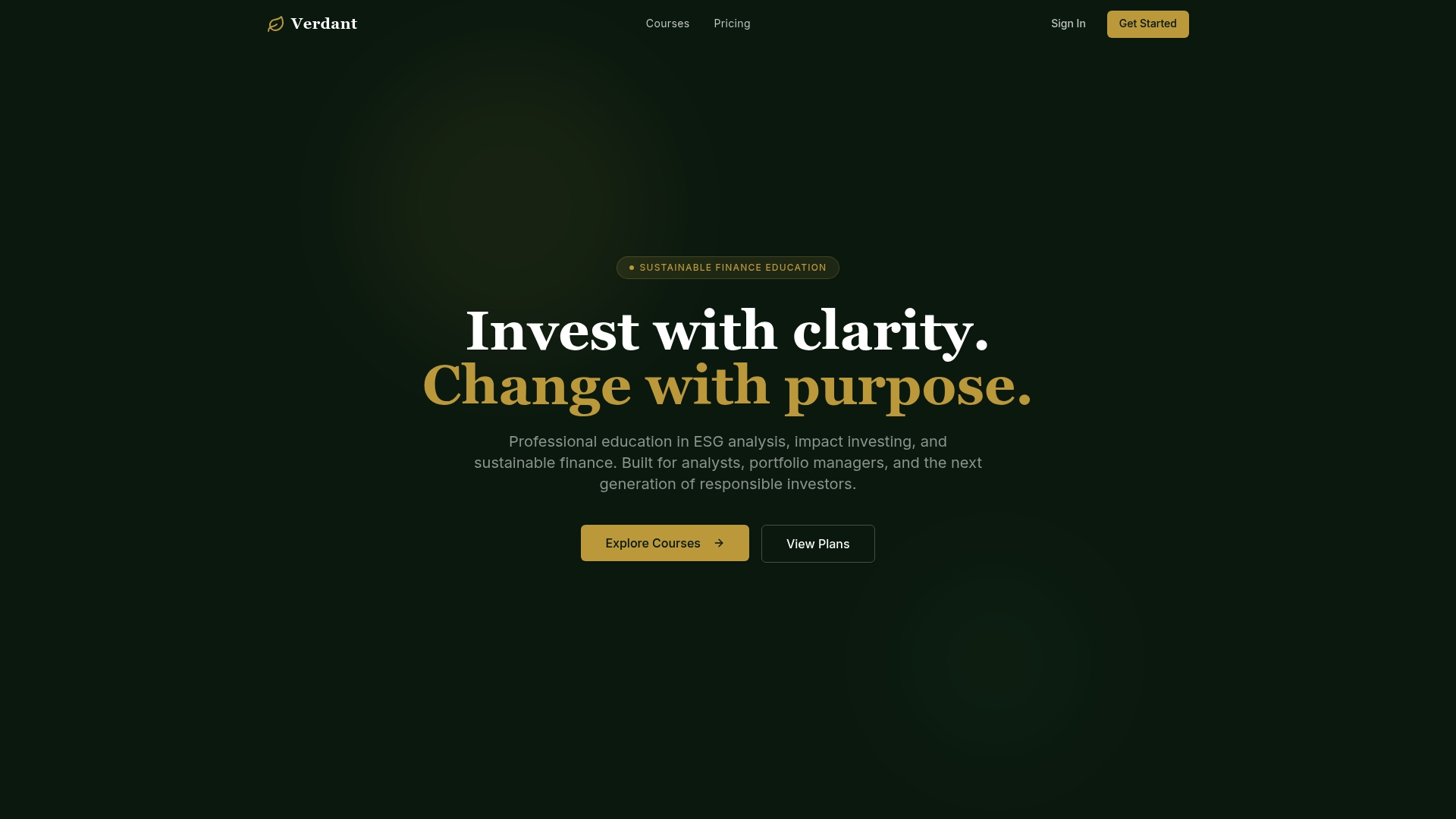
Verdantinstitute is built specifically for this gap. The platform covers ESG and sustainable finance through structured learning tracks, from foundational concepts to advanced practice areas like transition finance and net-zero strategies, with over 160 lessons across 16 courses. Every plan includes CPD tracking and certification preparation, so the learning you do is documented in a format employers recognize. Student plans start at $18/month, making it one of the more accessible structured options for graduates building toward their first ESG role.
When you evaluate any course against the learning pathway above, check for three things: hands-on projects using real or public data, explicit coverage of at least one major reporting framework (TCFD, ISSB, or GRI), and tool-based training in Excel, Power BI, or Python. If a course covers frameworks only in theory with no applied output, it will not close the portfolio gap that most entry-level applicants face. Visit verdantinstitute.com to review the current course syllabi and match them against the skills and timeline in this guide.
Useful sources and further reading
- GHG Protocol: The primary standard for corporate greenhouse gas accounting. Use it to study Scope 1–3 methodology and download free calculation tools and training materials.
- GRI Standards: The full GRI Standards library, including sector-specific standards. Use it to understand stakeholder-facing sustainability reporting requirements.
- ISSB / IFRS Sustainability Standards: The source for IFRS S1 and S2 standards. Use it to study the investor-facing disclosure baseline that multinational employers increasingly reference.
- TCFD Recommendations: The original TCFD framework and supplemental guidance. Use it to understand the four-pillar structure (governance, strategy, risk management, metrics and targets) that appears in U.S. corporate disclosures.
- SEC Climate Disclosure Rules: The SEC's official guidance on climate-related disclosure obligations for public companies. Use it to understand U.S.-specific regulatory requirements and what companies must report.
- EPA Greenhouse Gas Reporting Program: Facility-level emissions data for U.S. companies. Use it as a free public dataset for portfolio projects and emissions analysis exercises.
- CDP Open Data Portal: Company-level climate, water, and forest disclosures. Use it for portfolio projects that require real corporate ESG data.
- Kogod Sustainability Skills Gap Research: Research on the gap between green talent supply and employer demand in the U.S. Use it to understand the demand context and prioritize which skills to build first.